
After an uncomfortable run, it is understandable to want to know what caused the problem. Yet the conclusion can become too large a leap: one meal did not agree with you, so a whole food group goes on a prohibited list, followed later by another. Within a few weeks, familiar choices may shrink considerably while the actual question remains unresolved. The useful next step is precise observation and any necessary professional assessment while maintaining an adequate overall diet.
This article is for adult recreational runners. It does not dispute the need for an established allergy, coeliac or other prescribed diet, and does not recommend self-directed food challenges. Keep following the medical and dietetic guidance you have received. The aim is to review new restrictions of uncertain origin that you are considering because of one experience, an online rule or an unverified test. Persistent or recurring symptoms require appropriate healthcare support.
Do not treat three different statements as one
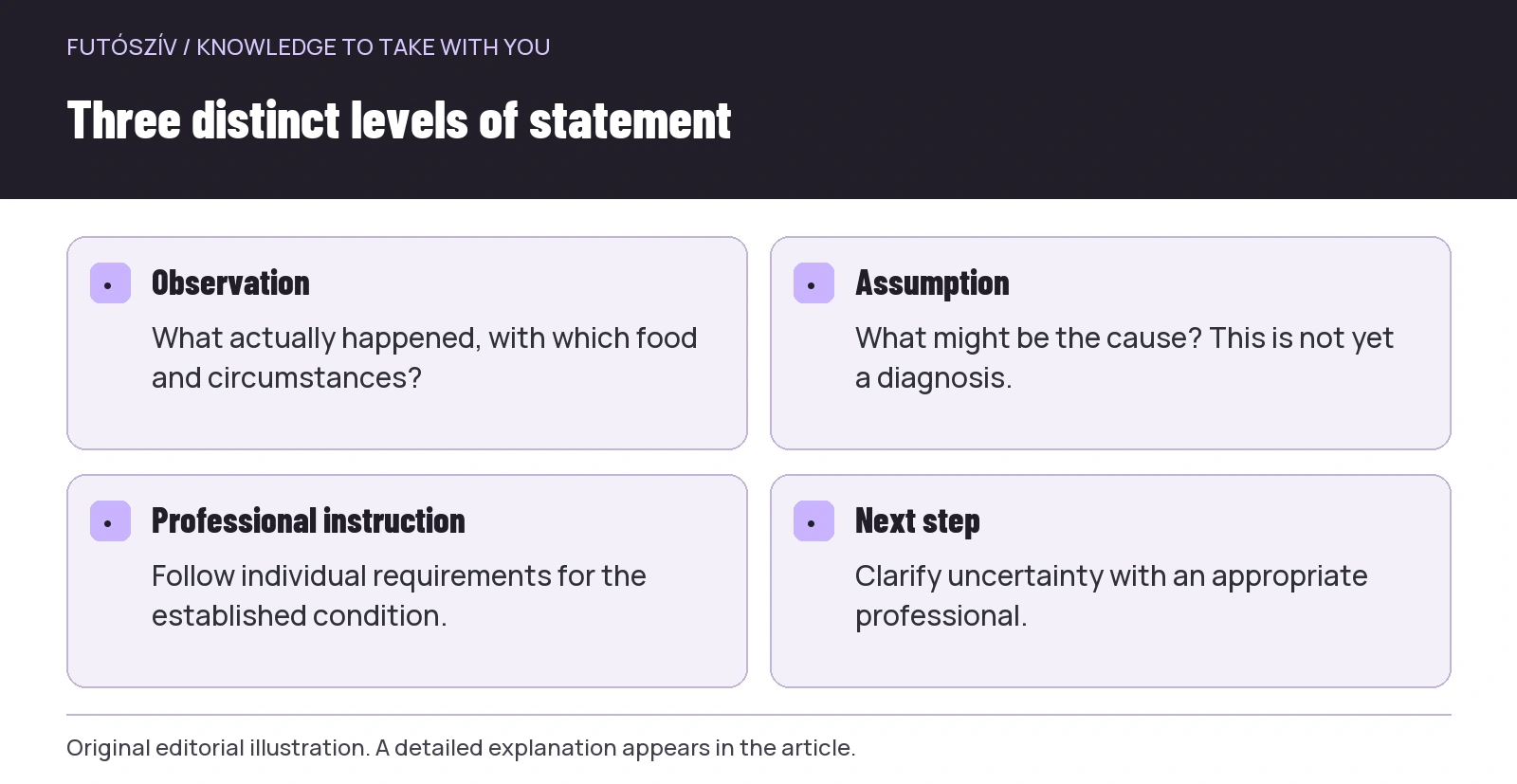
The first statement is: this happened to me. For example, you experienced discomfort during a particular run after a particular meal. The second is: I think this might have caused it. This is an interpretation requiring more information. The third is: I avoid this food according to my healthcare provider’s guidance. This is a condition linked to an individual professional decision. The statements have different degrees of certainty and different next steps, so record them separately.
If every observation immediately becomes a certain cause, it becomes difficult to trace where each restriction came from. The whole meal’s composition, amount, timing and running conditions may have changed too. This does not mean your experience is insignificant. It means a good question starts with a precise description and claims no more than you actually know. Your notes can help with that.
| Type of claim | Example | Next step |
|---|---|---|
| Observation. | Discomfort occurred after a specific dish. | A factual description of food and circumstances. |
| Assumption. | It may relate to an ingredient. | Appropriate professional discussion without self-diagnosis. |
| Prescribed requirement. | Individual dietary guidance for an established condition. | Follow your plan and necessary monitoring. |
| General online rule. | An unfamiliar post prohibits a food for every runner. | Check evidence, intended audience and individual applicability. |
Recurring symptoms need assessment
The NHS information on food intolerance recommends seeking medical help for recurring symptoms and cautions against excluding foods independently without professional support. Dietary restrictions without appropriate planning can remove important nutrients. A symptom’s cause cannot be established simply by placing a poor run alongside an ingredient eaten earlier. Your healthcare provider can plan the necessary assessment.
A specific account can help at a medical appointment: which food, when, which symptom and how it developed. If symptoms are urgent or severe, do not wait to finish a diary. Difficulty breathing, sudden swelling of the throat or tongue, fainting or collapse may require immediate help. Notes are a tool for a later professional conversation, rather than a condition for acute care or a standalone treatment.
Look for evidence rather than a test’s name
The British Dietetic Association’s 2026 testing guidance distinguishes appropriate diagnostic investigations from unproven alternative tests. For example, it does not regard food-specific IgG levels as a reliable diagnosis of food intolerance. A long, colourful results list is therefore not a sufficient basis for removing many foods. Interpreting test findings requires clinical history and an appropriate professional method.
If a service promises to explain every digestive and running-performance problem with one package, ask precise questions. Which condition does it investigate? Whom is it recommended for? Which validated method does it use, and with what limitations? Who interprets the result alongside your history? A large food list does not necessarily provide more useful information. Do not base the next dietary decision on the number of prohibited entries.
Heart rate from a sports watch, an app score or a simple home measurement after eating cannot replace an allergy diagnosis either. Such data may have other purposes and be affected by many circumstances. You can take your symptoms seriously without treating every available number as proof of a cause. Choosing the appropriate investigation helps keep individual decisions from following chance associations.
 Enlarge diagram
Text version of the illustration
- Observation
- What actually happened, with which food and circumstances?
- Assumption
- What might be the cause? This is not yet a diagnosis.
- Professional instruction
- Follow individual requirements for the established condition.
- Next step
- Clarify uncertainty with an appropriate professional.
A temporary investigative diet needs a plan too
If a professional recommends a targeted dietary change, clarify its purpose, exact scope and follow-up. What needs changing, what must remain adequately provided, and when will the result be evaluated? A temporary procedure with a defined purpose is different from an indefinitely expanding personal prohibited list. Necessary reintroduction or further testing is a professional question too, particularly with suspected allergy or an established condition.
Do not create a home food-challenge protocol from steps collected online. A diagnostic investigation and getting to know a new food in everyday life are different things. Do not suspend prescribed avoidance because a general article recommends variety either. A targeted plan clarified with your provider keeps necessary restrictions in place and prevents unnecessary ones from quietly accumulating.
Look at what remains on the plate
If several ingredients have disappeared from your diet, make a brief map of the dishes you actually eat. The question is not how many prohibitions you have followed, but whether the remaining meals meet your needs. A removed component may not have an adequate replacement. The next step is then an individual professional review of the whole diet, rather than necessarily another product or exclusion.
Consider home and on-the-move options separately. A diet may look varied on paper while only one suitable food is available at work or during race travel. Access barriers can affect daily eating too. A practical solution may involve advance discussion, your own suitably stored food or a simpler accessible dish. You do not have to abandon an individual dietary requirement to plan implementation more precisely.
Consider running demands and sufficient food together
The Australian Institute of Sport information on energy availability explains that low energy availability can arise not only from deliberate restriction but also from difficulties with time, access or planning. Persistent inadequate provision can affect health and sport. This is not a label for self-diagnosis, but a reason to examine dietary changes together with workload and individual needs.
A new prohibition can reduce actual food intake even if this was not the intention. Without adequate replacement, fewer and fewer meal options may remain. Body weight alone or one training result cannot fully assess the situation. If coordinating food and running is uncertain, seek individual sports dietetic and, where needed, medical support. The full daily picture says more than one number in an app.
Keep notes brief and linked to a question
Record the specific food, approximate amount consumed, meal time and relevant circumstances. Separate what actually happened from what you assume. There is no need to analyse every ingredient in endless detail every day. If logging itself increases anxiety or a sense of compulsion, tell the professional too. Its purpose is to support seeking help, rather than turn eating into constant monitoring.
Preserve uncertainty when comparing occasions. Did several variables change at once? Was the run’s intensity or the whole day’s eating different? A diary can record this but cannot control every factor. Do not turn personal observations into a definite food rule for everyone. Your provider can use the specific question and relevant information to decide which further step is justified.
 Enlarge diagram
Text version of the illustration
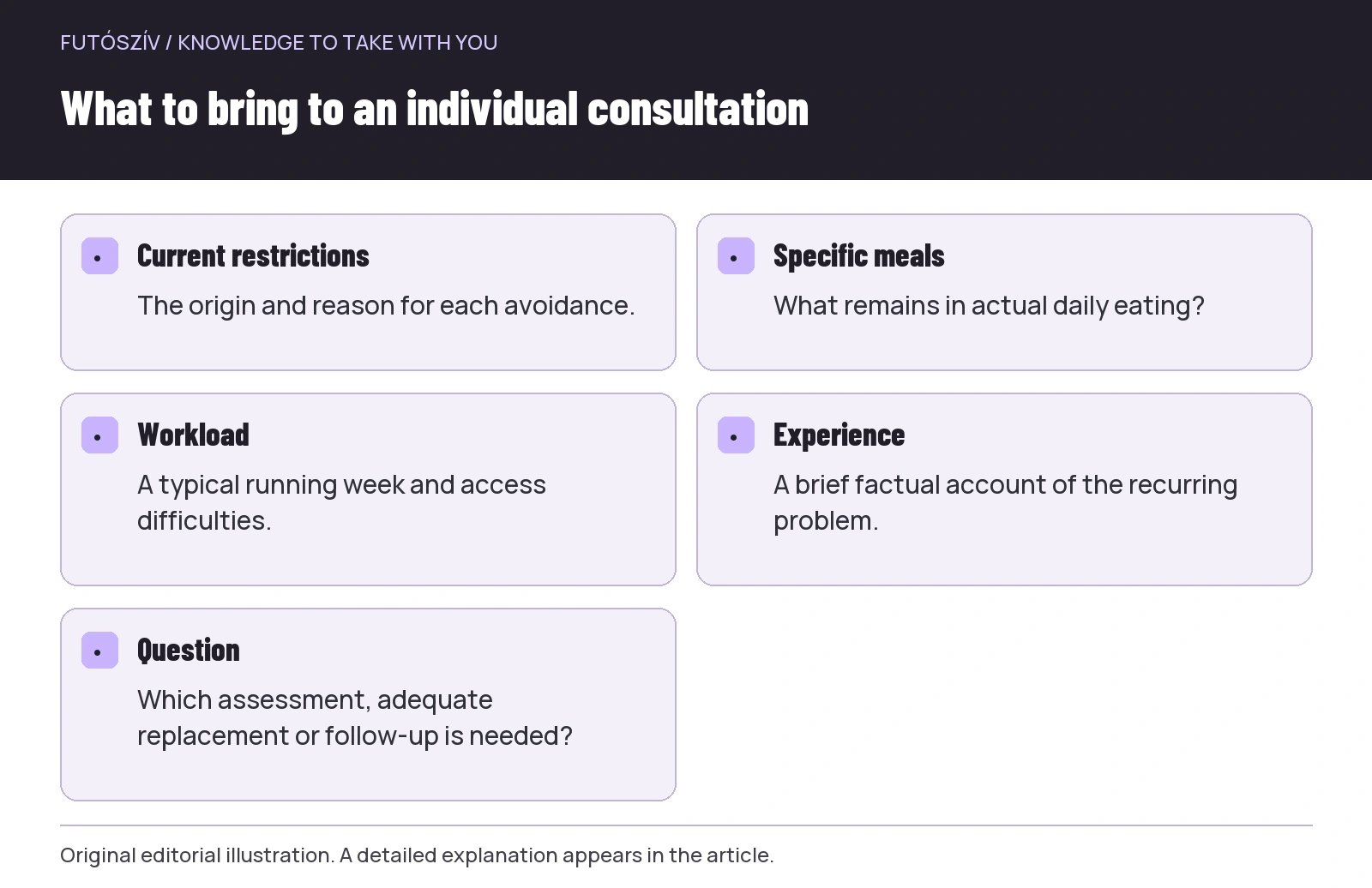
- Current restrictions
- The origin and reason for each avoidance.
- Specific meals
- What remains in actual daily eating?
- Workload
- A typical running week and access difficulties.
- Experience
- A brief factual account of the recurring problem.
- Question
- Which assessment, adequate replacement or follow-up is needed?
Read community rules in terms of their intended audience
Advice written for a clinical condition, a special race situation or an elite athlete’s individual plan is not automatically a general running rule. Ask whom it concerns, for what purpose and over what period. A short video often omits the full context. You can find a personal example interesting without introducing a compulsory restriction into your own eating because of it.
Likewise, natural, clean and forbidden are not reliable health categories. A food’s personal suitability depends on its composition, your condition, the amount and the overall diet together. Moralising labels can make calm discussion of actual needs harder. Sharing specific food options and appropriate information can be more useful in a running community than judging each other’s plates.
How to prepare for professional discussion
List the foods you currently avoid and write the reason beside each. It may be guidance for an established condition, an investigative plan underway with a professional, a personal choice or an uncertain assumption. The list is not for independently reintroducing anything. It helps the professional see where each requirement originates and which overall diet needs reviewing. Bring relevant results and earlier guidance too.
In Hungary, the National Association of Hungarian Dietitians’ dietitian directory can help you contact a suitable professional. When enquiring, mention your running workload, required special diet and specific question; clarify relevant specialist experience separately. If fear or rigidity around food affects daily life, explain this openly. Appropriate care may require cooperation between several professionals.
The aim is necessary requirements alongside workable choices
A good personal plan retains restrictions that are genuinely needed without adding unverified prohibitions. Specific symptoms receive appropriate assessment, while the overall diet also fits running demands. This is not always one quick change. Separating facts, assumptions and professional instructions can nevertheless make the first conversation more precise and help restore manageable, suitable food choices.
Sources and further reading
- NHS: Food intolerance
- British Dietetic Association: Food allergy and food intolerance testing
- Australian Institute of Sport: Energy Availability
- National Association of Hungarian Dietitians: Dietitian directory
How Futószív articles are prepared: our editorial guidelines.