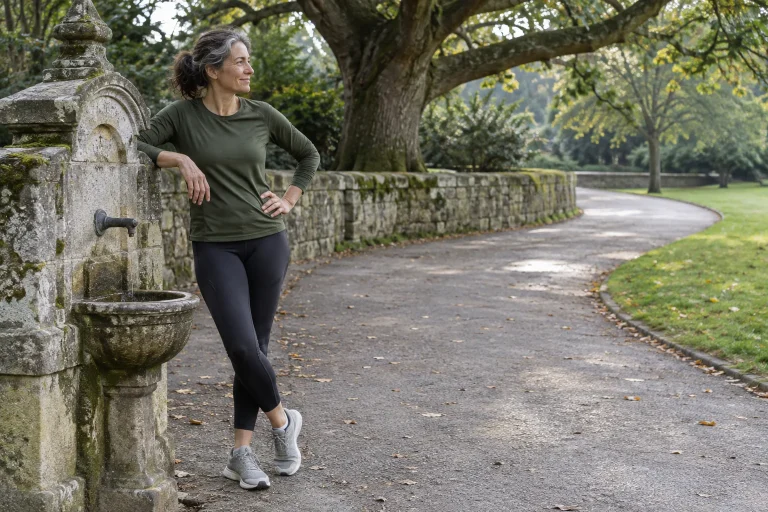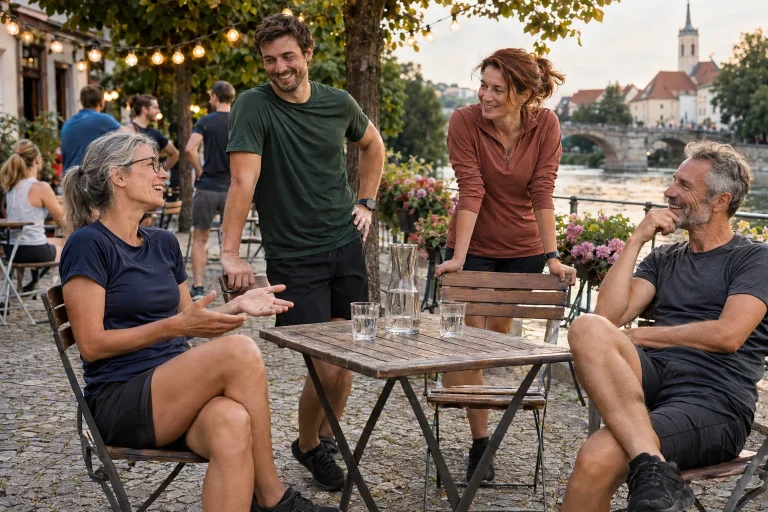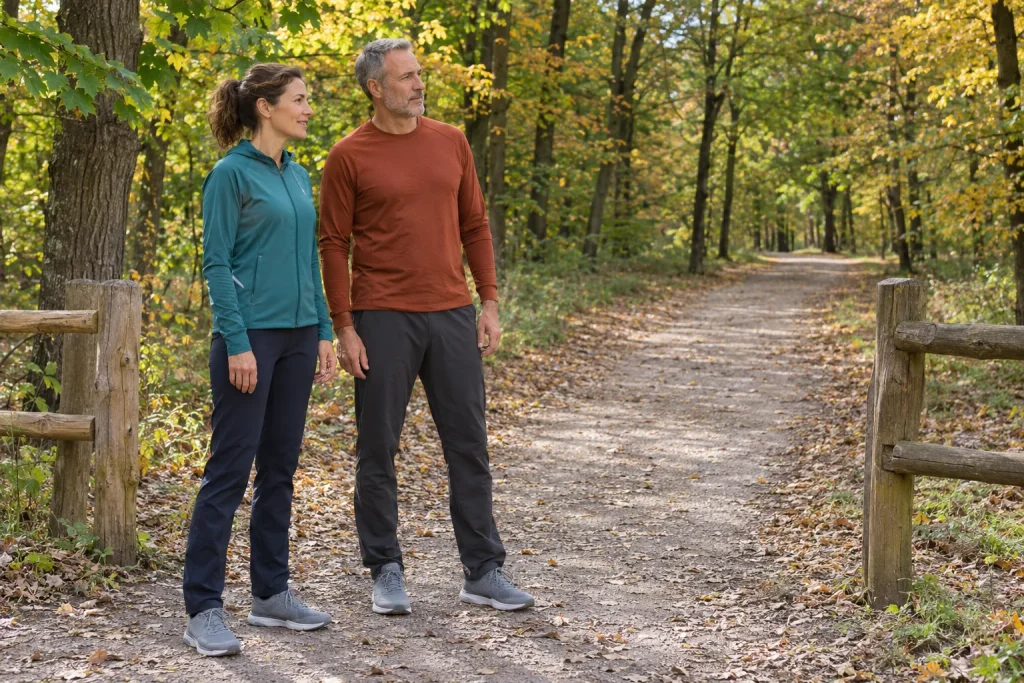
You set off to move, yet a conversation that went badly keeps returning. At other times, changing routes makes it easier to attend to other things, and the unpleasant story dominates the afternoon less. Such experiences help explain why researchers began examining the relationship between natural environments and rumination. The question is more precise than whether woodland clears your head: what did they call rumination, how did they measure it, and what change could a single walk reveal?
The often-cited 2015 study combined two kinds of data: participants’ own reports and blood flow in a brain region. This offers an interesting glimpse into research on environmental experience, but is neither a running-based treatment trial nor a direct photograph of thoughts. The story remains useful when we understand the experience and method together. Spending time in nature can then be personally valuable without a research headline having to promise a certain mental state.
Thinking through a problem and going round in circles are different
The research concept of rumination captures recurring patterns of self-related thought, often with negative content. Not all self-reflection belongs here. Trapnell and Campbell’s original human personality research distinguished ruminative and reflective forms of self-attention. The 1999 study and the questionnaire approach derived from it provide important background, because different processes can underlie the sentence ‘I am thinking about myself’. Reflection is not in itself a mistake or an activity to avoid.
In an example of our own, one thought might be: next time I will ask more precisely what the other person needs. Another repeatedly returns to the same event with the question: why do I ruin everything? This illustrates a difference; it is neither a diagnostic test nor a system for judging the correctness of your thoughts. Alongside content, the way thoughts repeat and their role in the situation can be of interest. A single sentence cannot establish a clinical condition.
Thinking while running can also take many forms. You may plan, recall an encounter or simply let the subjects of your attention alternate. Research does not require you to empty your head during movement. The question about rumination instead examines how recurring negative self-focus might relate to a particular environmental experience. You do not need to categorise every thought to describe your own experience.
What happened in the nature-walk experiment?
In 2015, Bratman and colleagues randomly assigned thirty-eight healthy adults living in urban settings to natural or busy urban routes. They studied ninety-minute walks of equal distance, using questionnaires and MRI-based blood-flow measurements before and afterwards. In the nature group, reported rumination and blood flow in the subgenual prefrontal region decreased. However, the overall time-by-environment interaction for self-report did not reach the conventional significance threshold; the reported p-value was 0.07. The blood-flow analysis found a clearer group difference. The original paper therefore presents more nuanced detailed results than its title.
Not all participants contributed equally to the measurements: data were also excluded from the imaging analysis because of motion artefacts. The study used walking, rather than running, and the natural route’s elevation gain differed from the urban route’s. These are important details for understanding the study. They do not invalidate the observation, but define the comparison the researchers made. A ready-made psychological prescription for every person and route would be a much larger claim.
A before-and-after design shows a change. The control condition helps ask how differently that change developed in the other situation. Describing only one group’s own improvement is therefore insufficient when the question concerns the difference between conditions. Such details also belong in an accessible scientific account. A precise explanation can preserve an interesting finding without presenting its certainty as stronger than the actual data support.
 Enlarge image
The questionnaire and brain signal offer two separate perspectives
Questionnaire data capture how a participant answered predefined questions. MRI-based blood-flow data come from a different measurement procedure. Neither records the entire stream of thought. If two indicators change in the same study, they may tell an interesting shared story, but that does not make one a perfect translation of the other. The words describing personal experience do not need replacing with a brain-related number to count as meaningful data.
Inferring a psychological state from a difference related to blood flow is a separate methodological task. Poldrack’s original 2006 analysis of a neuroimaging database showed how much it matters whether a region’s signal is characteristic of a given process compared with other processes. The paper on reverse inference therefore also provides important background for reading images from environmental research. A brain region’s name is not the exclusive label for a single thought or feeling.
As an illustrative analogy, an open running bag may tell you someone is preparing for something, but it does not reveal all their plans. They may use the same bag for several activities. The analogy does not model brain function; it only illustrates the difference in inference. A signal from a measurement gains further meaning from the experiment’s task, timing and other data. Together, these make its interpretation more substantiated or more uncertain.
| Data or claim | What should you retain? | How large is the further step? |
|---|---|---|
| Self-reported rumination | A specified questionnaire, time point and comparison | Knowing the entire stream of thought |
| Regional blood flow | A circulation indicator examined using a particular procedure | Confidently reading a single specific feeling |
| Change after a single walk | The result within a short follow-up window | Declaring a therapeutic effect lasting for months |
A different design examines the longer-term everyday relationship
In Bratman and colleagues’ 2021 research, more than six hundred adults reported their time in nature, general positive and negative emotions, and rumination characteristics. The cross-sectional analysis found relationships between these variables and also examined a mediation model. The original study asked about the everyday relationship in a larger sample, but did not randomly assign people to different experiences of nature. An association alone therefore cannot establish a causal sequence.
A larger sample does not automatically provide a stronger answer to the same question. A short experiment examines a controlled change, while a questionnaire survey may follow differences already present between people. Both can provide important information. One does not replace the other simply because of participant numbers. Always look for whether researchers changed the conditions or asked how people lived otherwise.
The word mediation can also sound too strong in everyday language. A statistical model may show that data fit a proposed pathway. Timing and causation nevertheless remain separate questions. Several factors may be associated simultaneously with time in nature and mood. The study is useful when we avoid turning the model’s result into a proven personal mechanism.
What happens when walking is examined in a clinical group?
In 2022, Watkins-Martin and colleagues conducted a randomised study among outpatients diagnosed with depression. Thirty-seven adults completed a single sixty-minute nature or urban walk; their emotional reports were followed at several time points for two days. The nature group had lower negative-affect values overall, while positive emotions showed no difference by location. The original human study did not measure the same rumination endpoint as the 2015 experiment and did not establish lasting recovery.
This distinction matters in both directions. An experiment with healthy participants is not automatically a treatment result for a clinical condition. Nor can a short mood change measured in a clinical group be reversed into a claim that all everyday rumination represents a diagnosis. Research participants and endpoints should remain visible. This makes the possible role of nature experience an interesting research area, while the conditions for individual care are not determined by this article.
The NIMH’s official information describes depression as a condition involving persistent symptoms that also affect everyday functioning; treatment involves professional assessment and personalised options. According to the official health information, walking or running does not replace necessary help. If recurring thoughts, low mood or loss of interest persistently disrupt your life, consider speaking with a GP or mental-health professional. Enjoying movement and asking for help are entirely compatible.
What might changing routes mean for a runner?
The experiments presented used walking, so they do not provide a running pace or duration for reducing rumination. Faster movement, the route’s demands and your own state would create a different situation. The question you can retain as a runner is instead what entering that particular environment means to you. After a familiar street section, do different details come to the foreground, and what makes the encounter personally memorable? Your own description of the experience can answer this without a research promise.
One fictional reader does not choose a woodland-edge route to quiet a particular brain region. They go because they like the place and company. If a thought becomes less dominant along the way, they can say so; if the same thought returns, they need not turn it into a failed workout. Choosing a route is not a moral or psychological achievement. A pleasant activity can have a place in the day even if it does not solve the problem that occupied you beforehand.
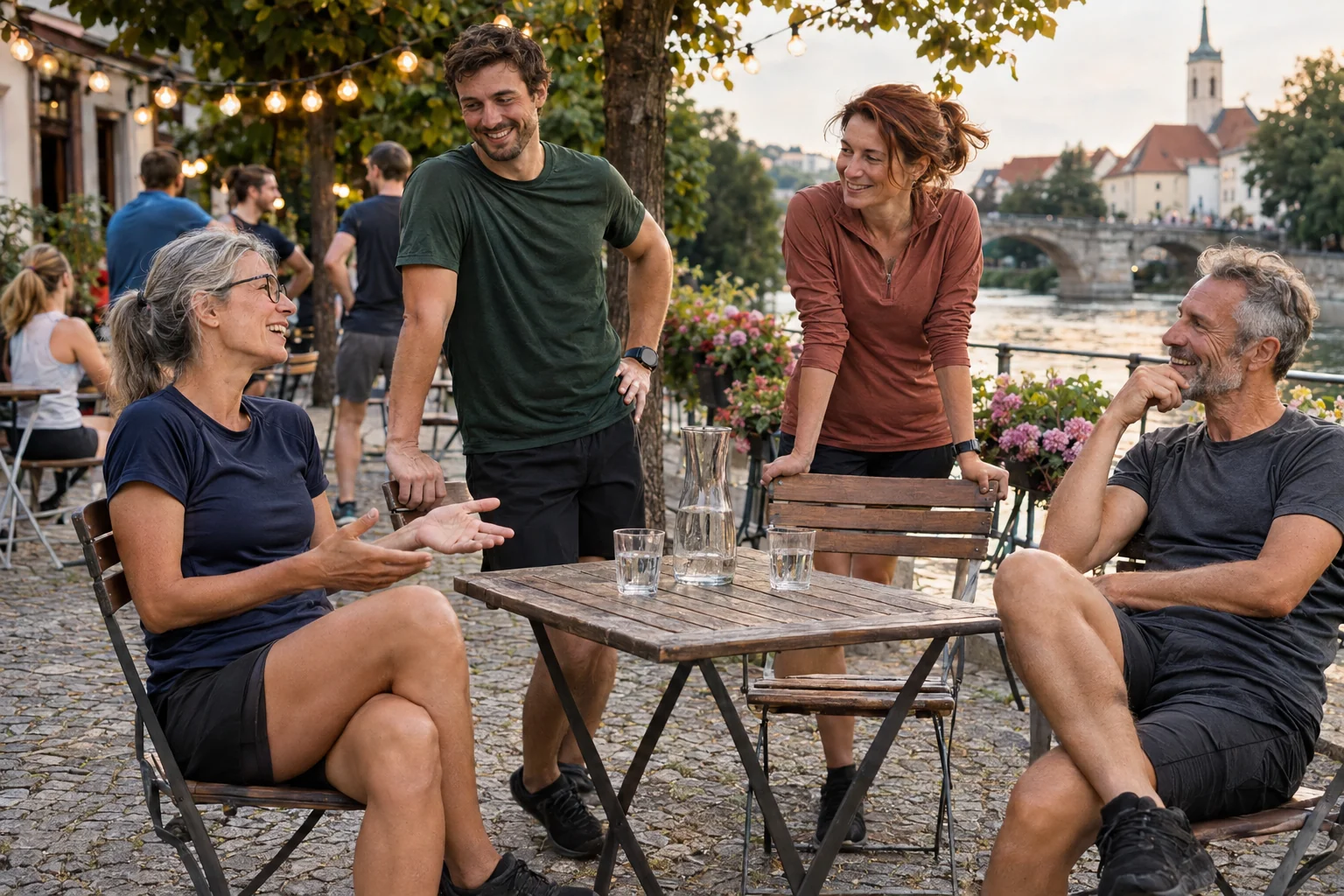
A new location also has practical conditions: access, finding your way, time and safe movement. The label ‘natural’ does not override them, and the research presented does not require setting off alone somewhere unfamiliar. An encounter suited to your day can be simpler or shared with others. You need not reproduce an experimental route with laboratory precision for nature experience to have personal meaning.
 Enlarge image
An interesting result without a certain psychological promise
A strength of the 2015 experiment is that it tried to understand environmental experience through several methods. Results of differing strength and the short timescale belong to the complete story. The later survey and clinical study added new questions, rather than repeating the same sentence with different participant numbers. This shows how a research area develops: through the meeting of different perspectives and precisely bounded observations.
In your own run, you do not need to eliminate every recurring thought for the occasion to be valuable. You can describe what the setting was like, what engaged you and how it fitted into your day. Research may provide explanatory background, but does not read your mental state for you. The story of the nature walk remains most informative when we preserve both the possibility of the experience and the evidence’s actual scope.
Sources
- Trapnell and Campbell, 1999: rumination and reflective self-attention
- Bratman and colleagues, 2015: nature walking, rumination and blood flow
- Poldrack, 2006: reverse inference from brain-imaging data
- Bratman and colleagues, 2021: a cross-sectional study of nature experience and rumination
- Watkins-Martin and colleagues, 2022: emotional effects of a single walk in a clinical group
- NIMH: depression, professional help and treatment
How Futószív articles are prepared: our editorial guidelines.