Returning to running after pacemaker implantation involves several separate questions. First come recovery from the procedure and your current medical instructions. Later, you need to clarify how sport relates to the underlying condition, the device’s operation and its individual settings. The comfort of a running vest or chest strap is another consideration: equipment can be poorly positioned even when a device is working well.
There is no return-to-running calendar or heart-rate zone that applies to every runner with a pacemaker. The aim is to know which questions the surgical team, the device clinic and a cardiologist familiar with sport can answer. Showing your specific running goal and the equipment you actually use makes this much easier than the general question, “Is everything allowed now?”
First identify which device you have
A pacemaker uses electrical impulses to support the heart’s function. Approaches differ: the NHS describes a conventional device placed beneath the skin of the chest and connected by leads, as well as a leadless version delivered directly into the heart that may be suitable in some situations. The NHS information on pacemakers therefore does not describe just one type of procedure. Start with your own discharge report and device identification.
Your device card is a practical starting point for the discussion. Do not recite the model from memory or infer the exact system from the location of a scar. Ask which details to carry, where to find the review service’s contact information and whom to tell when receiving other healthcare. Your exercise companion may only need to know where the accessible identification is; you decide how much detailed medical information to share.
A pacemaker and an implantable cardioverter defibrillator, or ICD, are not the same thing, although systems combining several functions also exist. Another athlete’s story about their device is therefore not a personal instruction manual either. If someone online writes about a collision, a delivered shock or a particular heart rate, you would first need to know which device and condition they mean. Your question can be assessed based on your own device and the reason it was implanted.
Early wound healing differs from later fitness for sport
During the initial period after the procedure, follow instructions on wound care, arm movement, lifting and physical activity. The NHLBI information on recovery after implantation also discusses recovery and initial activity restrictions separately. The reasons for instructions may extend beyond skin sensitivity; a scar that looks good from the outside is therefore not enough to establish that every movement and item of equipment is appropriate.
Find the instructions on your discharge sheet for using your arm, exertion and follow-up during the relevant period. If running is not addressed, ask. Do not automatically assume that “light activity” or “gradual activity” includes jogging with impact, arm movement and longer uninterrupted exertion. Describe precisely the activity you would like to begin.
Do not count backwards from your next race date to decide when recovery ends. If your plan still requires avoiding certain movement, a version of running that you think moves the chest less is not a workaround. Clarify treadmill running, trails and easy outdoor jogging with the team too. The useful question is which activity might be considered now, under what conditions, and when the answer may change.
Why does function during exercise matter later?
Device follow-up and monitoring the heart condition are related but not identical tasks. Device checks, for example, assess battery and lead function, as described in the American Heart Association patient information. Alongside knowing that the device is functioning properly, you also need to know what exertion your overall cardiovascular condition currently allows.
The Heart Rhythm Society’s 2024 athlete consensus says that other conditions limiting exercise must also be considered when returning to sport. In some situations involving a pacemaker, a supervised exercise test appropriate to the sport may help assess rate response and other activity-related settings. The HRS official description of the document emphasises individualised sports decisions. This is a medical assessment, not an instruction to perform a test run at home.
If unusual fatigue, breathlessness or another symptom appears during previously comfortable activity, do not immediately label it an incorrect setting. Symptoms can have several explanations. It is more useful to describe the circumstances and contact your care providers. Your account is important information, but does not replace determining whether the device, underlying condition or another circumstance is involved.
 Enlarge image
What does rate response mean in everyday terms?
Rate response refers to how a pacemaker adjusts heart rate to exercise. Its implementation and significance depend on the device, its settings and the person’s own heart function. As a runner, you do not need to learn the programming menu. What is worth understanding is how your heart rate is expected to change during activity and which observations your care team requests. The HRS discusses the individual importance of device programming appropriate to the athlete.
At a review, you might ask: “With the settings used in my case, what role should heart rate play in planning exercise?” This is more useful than copying another runner’s lower or upper device rate. A programmed technical value and a recommendation for your exercise load are not automatically the same. Ask the professional to explain the difference in your own case.
Do not try to reach your old watch zone at any cost. If a number falls short of a previous target, it does not follow that running faster is the solution. If an exercise-related assessment has not yet been completed, a plan set on your watch cannot replace it. Individual guidance should address which data can provide useful feedback and which displayed values you should not use as independent decision thresholds.
Three separate considerations for a vest or strap
With equipment, first clarify mechanical contact. The AHA warns against pressure around the implant and clothing that rubs the wound in the early period. To assess a running vest or bag you might wear later, show where the strap runs, where the seams sit and how it would fit on your body. After a recent procedure, do not perform your own pressure test or trial with loaded equipment without permission.
| Question | What should you show? | Why is it separate? |
|---|---|---|
| Pressure and rubbing | The strap, seam and intended position. | This is physical contact, not wireless compatibility. |
| A magnetic component | The fastening, holder and device instructions. | Specific requirements may apply to proximity to a magnet. |
| An electronic sensor | The exact model and where you wear it. | The requirements for the particular product and implant must be checked together. |
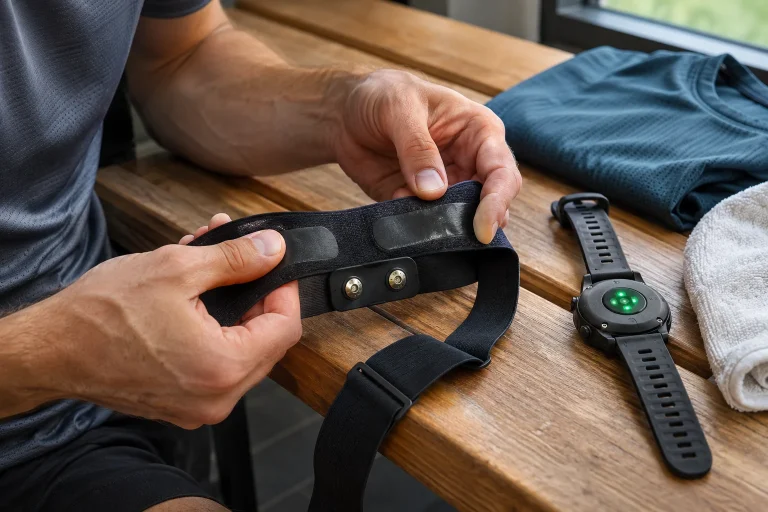
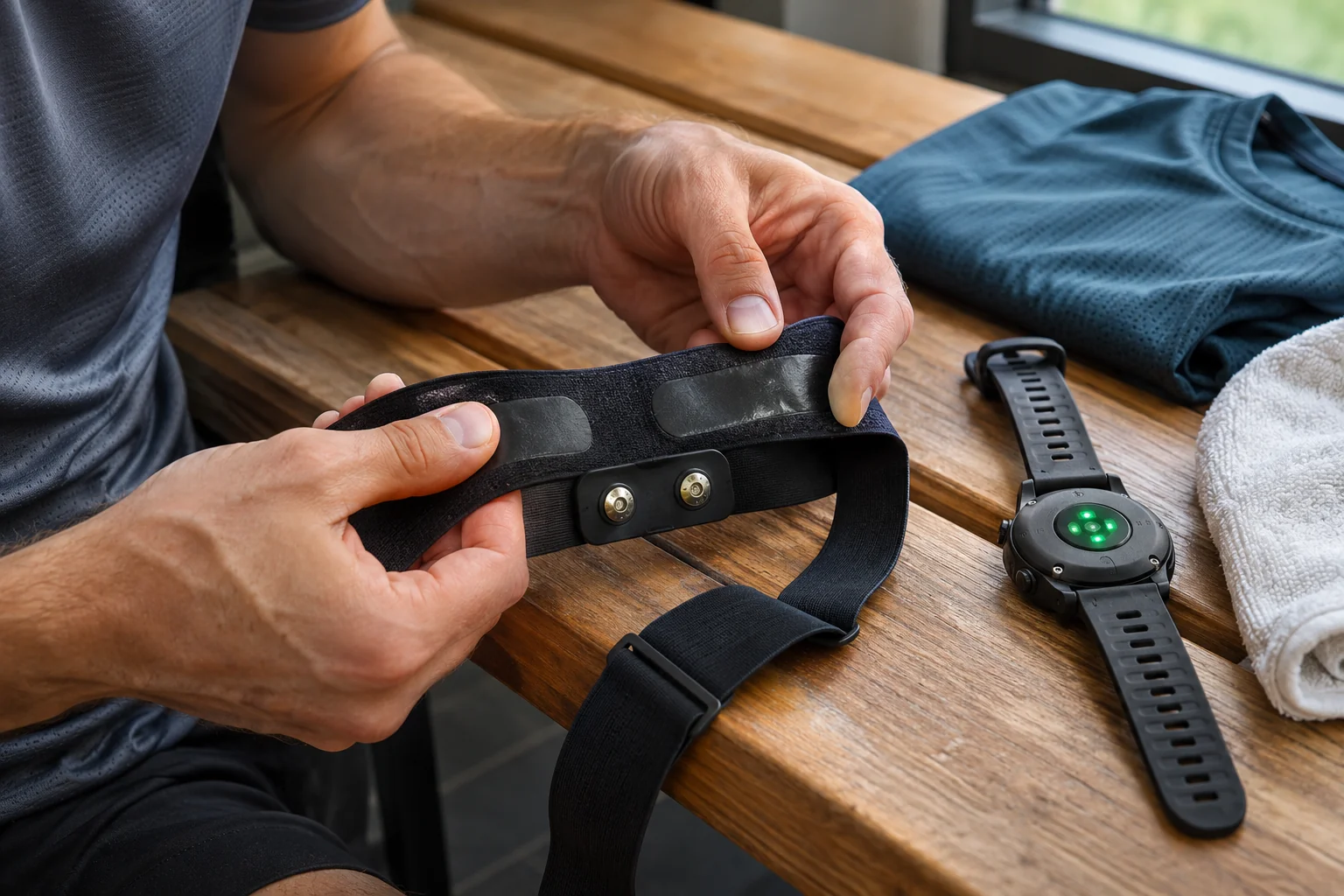
The term chest strap provides little technical information on its own. It may mean a simple harness, an elastic strap holding a sensor or equipment with a magnetic clasp. Do not decide based on a generic webshop statement that something is “recommended for athletes”. Bring the exact product name, instructions and, if possible, the item itself to the discussion. Soft padding alone does not prove electronic compatibility, just as electronic compatibility does not guarantee a comfortable fit.
Phone, earphones and magnetic holder: placement matters too
The AHA information on interference warns about nearby magnets and storing phones and earphones containing magnetic materials close to an implanted device. As general guidance, it describes keeping several such items at least 6 inches, approximately 15 centimetres, away. This is not individual approval for every product and situation: the manufacturer’s requirements for your own device and accessory must also be checked.
The chest phone pocket on a running vest is therefore a placement to discuss separately. Likewise, mention a magnetic bottle or phone holder, or if you would hang removed earphones around your neck. Alongside naming the item, show its position: a photograph of the equipment may help but cannot replace a decision specific to the device. Do not deliberately bring a magnet close to see whether you feel anything.
The NHLBI information on living with a pacemaker explains that electromagnetic interference is not necessarily detectable by sensation. “It caused me no symptoms” is therefore not a compatibility test. Make the question to your care team and manufacturer specific: what requirements apply to this implanted device, this product and this carrying position? The word Bluetooth or the general category of sports watch does not provide a complete answer on its own.
How should you describe your running situation at a review?
Organise your account into three parts. First, the activity already agreed and undertaken: what it was, when and in which circumstances. Second, the experience: whether a new symptom occurred and, if so, what happened. Third, your next goal: which movement or equipment you would like to add. This keeps a future plan separate from what you have already tried and lets the professional see which answer you need.
For example, continuing a familiar, short, flat jog is a different question from a longer trail day with a backpack. In the latter, the load, straps, ability to stay in contact and distance from help may all change. Name these separately. You do not need to create your own risk score; what helps is ensuring that no important detail of the real situation is omitted simply because the sports app records both as “running”.
For sports-watch material brought to an appointment, mark the time of the symptom and the relevant section. Rather than supplying months of disorganised data, ask which format and level of detail are wanted. If remote monitoring is used, clarify when data is assessed, how you receive feedback and which symptoms require contact independently of it. Regular data transmission does not mean someone is watching every symptom in real time.
 Enlarge image
Which changes must not be dismissed as equipment discomfort?
New redness, swelling, increasing tenderness, discharge or changes accompanied by fever around the implant require urgent contact with your care providers. The NHS highlights this because of the possibility of infection too. Do not automatically treat it as strap chafing just because it appeared after wearing equipment. Removing the vest does not replace clarifying what caused the change.
Severe difficulty breathing, tight or radiating chest pain, sudden confusion or another severe episode of illness requires immediate help: in Hungary, call 112 and do not drive. Do not wait for the watch to flag an error or attempt to check device function at home. Discuss less intense but recurring previous symptoms or new dizziness with your care team promptly too. Having a device does not automatically explain every new symptom.
Your running companion should also understand stopping and seeking help. An agreed plan can include contact information and the location of identification, but should not leave your companion responsible for home diagnosis or device programming. Their role is to recognise the situation, obtain help and follow the instructions given. Once symptoms settle, the conditions for continuing must also be clarified with your care providers, not with the group’s pace.
A good return plan makes sense outside the clinic too
A fictional example: someone who used to run regularly brings their vest and its magnetic clasp to a review, together with a description of a planned flat jog. They are not asking for general permission for every sport. They ask what is appropriate now, what needs further assessment, where they can carry their devices and which symptoms to report. Specific questions help the decision at this appointment; its outcome cannot be copied to a runner with a different device.
Before leaving, explain the next step back in your own words. Which activity did you discuss, what remains unresolved, when is the review and what should you do about a new symptom? If the equipment still needs a manufacturer’s answer, keep that as a separate outstanding question. Running life with a pacemaker can be planned well when wound healing, heart condition, device function and equipment each receive the appropriate answer.
Sources
- NHS: Pacemakers
- NHLBI: After Getting a Pacemaker
- AHA: Living With Your Pacemaker
- HRS: 2024 expert consensus on arrhythmias in the athlete
- AHA: Devices That May Interfere With ICDs and Pacemakers
- NHLBI: Living With a Pacemaker
How Futószív articles are prepared: our editorial guidelines.