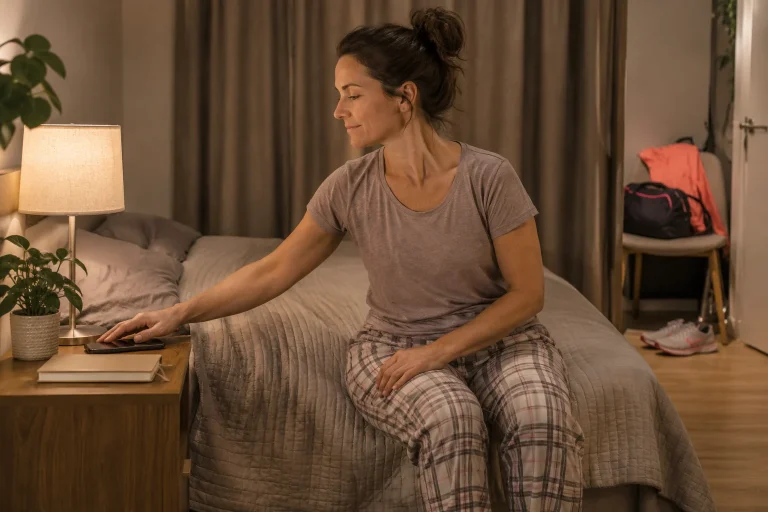
A bad dream can change the start of a running morning. Beyond feeling short of sleep, the memory may return during the day or make you fear the next night. Occasional unpleasant dreams differ from regularly disturbing nightmares in frequency, burden and everyday consequences. If sleep and daily life are affected, you need not solve it alone through a new evening routine.
The NHS recommends medical discussion for recurring nightmares affecting sleep and everyday function. Running may be a valued part of life, but completing training cannot determine the difficulty’s significance. More exhaustion is not personalised nightmare treatment. Understand the event, its effects and what targeted support can offer. NHS: nightmares and seeking help.
Night-time fright can involve different phenomena
The NHS distinguishes nightmares from night terrors. After waking from a nightmare, people usually remember the bad dream; during a night terror, they may move or vocalise without truly waking and generally lack a clear memory later. These descriptions are not certain home diagnostic rules. Adult symptoms should not automatically be considered identical to childhood experiences. Distinguishing night-time events.
AASM’s 2018 position paper on adult nightmare disorder considers recurrent, strongly unpleasant, well-remembered dreams alongside orientation after waking and significant distress. Daytime consequences matter. A nightmare is therefore more than an interesting or unusual dream when it persistently disrupts rest and daily life. AASM: professional understanding of nightmare disorder.
At the appointment, describe dream recall, awareness on waking and any movement or sounds a partner noticed. Do not fill missing memory with supposedly certain details. Label another person’s account separately. More precise description does not require selecting a disease name first.
Daytime effects belong in the account
After recurring nightmares, difficulty may extend beyond the night. Dream memories, fear of bedtime or trouble focusing may characterise the next day. You need not experience all of them to ask for help. Specific personal consequences help more than deciding whether an imagined threshold has been met.
Next-morning running arrangements can be affected too. Perhaps you cancelled an early meeting because you could not return to sleep, or struggled to focus at work after training. Do not describe these as sporting weakness. Professional discussion concerns understanding sleep and daytime difficulty rather than judging missed workouts.
The NHS insomnia information emphasises not driving when sleepy. If travelling to running requires driving after a distressing night, take actual sleepiness seriously. You need not first run to prove you can function. Immediate safety does not depend on already having a precise explanation for nightmares. NHS: sleep difficulties and daytime safety.
 Enlarge image
Brief notes need not involve reliving the dream
Preparing for a primary-care or sleep-medicine discussion may need only neutral details: onset, approximate frequency, ability to return to sleep and the following day. Say if discussing dream content is distressing. General educational writing cannot expect detailed home trauma processing or a self-administered therapeutic exercise.
| Observation area | A short example | What you need not decide |
|---|---|---|
| Onset and recurrence | A new event or longstanding recurring pattern. | Which diagnosis certainly fits. |
| State after waking | I remember the dream and struggle to settle afterwards. | The dream’s one correct symbolic meaning. |
| Partner observation | They heard speech or saw forceful movement overnight. | Which sleep stage the observation proves. |
| Daytime impact | I struggle to focus or fear the next evening. | Which sporting performance would prove the difficulty. |
| Changed history | Timing of new treatment, illness or a distressing event. | That it is definitely the sole cause. |
NHLBI includes timing, falling asleep and waking, daytime function, health history and medicines in sleep assessment. A short diary may help, but the provider chooses investigations. Here the diary presents context rather than independently diagnosing or treating. NHLBI: assessing sleep difficulties.
If making notes itself is very distressing, it should not become a compulsory obstacle before help. Begin with one sentence: I have recurring nightmares that make my days harder. Agree a fuller discussion with the professional. A complete notebook is not required to be heard.
A stressful event may matter without establishing diagnosis
The NHS lists distressing or anxiety-provoking experiences, illness, certain medicines and other sleep-related conditions among possible backgrounds. Explain them as parts of the whole history. Timing does not prove causation, and do not independently stop medicine because symptoms appeared around treatment. NHS: possible history and associated factors.
NIMH explains that many reactions may follow trauma; not everyone develops post-traumatic stress disorder. Recurrent event-related dreams belong to one possible PTSD symptom group, but one dream cannot diagnose it. Persistent symptoms interfering with everyday function need appropriate mental-health assessment. You need not classify yourself from an online checklist before seeking help. NIMH: post-trauma symptoms and assessment.
For a running friend, practical information may suffice: a more predictable start or flexible cancellation is needed. You have no obligation to tell the group dream details or a distressing history. A request for support and the account for professional assessment can differ in length and detail.
Targeted treatments exist, but this is not a home worksheet
AASM’s 2018 position paper recommends imagery rehearsal therapy as one psychological approach for nightmare disorder and PTSD-associated nightmares. It relates individual care selection to clinical circumstances and available options. Naming the method does not mean independently starting detailed dream-reworking or exposure exercises from this article. AASM: adult nightmare treatment options.
Krakow and colleagues’ 2001 randomised study assigned 168 women who had experienced sexual assault, most with PTSD, to targeted therapy or a waiting-list control. The treated group showed more favourable changes in nightmares, sleep and PTSD symptoms; not everyone completed follow-up. This concerns a particular clinical population and intervention, rather than running or a general evening routine. Krakow and colleagues: human trial of targeted nightmare therapy.
The comparison treatment matters too. In an original 2010 trial involving 124 male Vietnam veterans with severe chronic PTSD, imagery rehearsal did not significantly outperform a credible active-control programme on primary outcomes. This does not prove it helps nobody; effects need interpretation within population and comparison. Personal treatment choice cannot simply copy one study’s promise. Active-controlled trial, 2010.
Report forceful dream-related movement separately
Tell a doctor specifically about punching, kicking, falling from bed or injury to a partner during an event. AASM’s 2023 REM sleep behaviour disorder guideline highlights injury risk and a safe sleeping environment. This may be a different clinical question from a remembered bad dream alone. Do not name the event through daytime dream interpretation. AASM: REM sleep behaviour disorder and safety.
Ask for individual advice on preventing injury and temporary environmental measures, especially for repeated or dangerous movement. Do not collect data through deliberate awakening experiments or recreate events. If someone is injured or immediate danger exists, address that before a diary. Call 112 in a life-threatening situation.
A partner can separately describe observations but need not supervise the whole night or diagnose. Observation cannot reliably identify the brain’s sleep stage. A professional clarifies the investigation question. Everyday “nightmare” can cover several phenomena, making movement and injury separate details worth reporting.
 Enlarge image
Keep running flexible rather than a treatment test
If bad nights make mornings unpredictable, simplify group arrangements. An agreed cancellation method or different meeting place can remove pressure to explain. This is practical support rather than nightmare therapy. You need not promise a better night after completing a particular distance.
NIMH also mentions supportive relationships and personally appropriate coping options alongside or within professional care for trauma-related difficulties. Choosing treatment may require an experienced mental-health professional. Enjoyed movement and company do not remove the need for targeted help with persistent symptoms. NIMH: support and individual care.
A training log needs no nightmare performance code either. A brief note about changing plans may suffice for memory. Detailed health data need not automatically reach a coach or app followers. Share what group work or departure arrangements require, discussing the rest with your chosen professional.
Make help-seeking lead to a tangible next step
Bring a brief summary: onset, event description, ability to return to sleep and daytime effects. Also bring current treatments. Ask which specialist care may suit, whether investigations are needed and which changes should prompt earlier contact. Clarifying details can be a shared task.
You need not perfect every evening habit before asking for help. Routine is one circumstance, while recurring nightmares and daily distress are concerns in their own right. The aim is not more duties alongside running, but an understandable account and appropriate assessment, with treatment where needed for your situation.
Sources
- NHS: nightmares and night terrors
- AASM: treatment of adult nightmare disorder, 2018 position paper
- NIMH: post-traumatic stress disorder
- Krakow and colleagues: targeted nightmare-therapy trial, 2001
- Cook and colleagues: imagery rehearsal active-controlled trial, 2010
- AASM: REM sleep behaviour disorder treatment guideline, 2023
- NHLBI: diagnosing insomnia
- NHS: insomnia
How Futószív articles are prepared: our editorial guidelines.