A recumbent exercise bike may initially feel more reassuring than a high saddle: a broader seat, back support and easier access on some models. This can be a real comfort advantage in your choice. You need not like an upright bike to seek worthwhile movement. A more comfortable form still does not establish correct adjustment or how much effort pedalling will require.
The first trial should therefore not aim at a long workout or displayed calorie target. First establish whether the particular machine works for you: suitable capacity, enough seat space, reachable pedals and controls, and how to stop and get out. Technical suitability, comfortable position and health-related exercise capacity are connected but distinct questions.
If chest pain, severe breathlessness, faintness or another sudden illness occurs during the trial, stop and seek help; severe symptoms need urgent care. A backrest does not protect against becoming medically unwell. The NIDDK information on physical activity highlights these warning signs as well as suitable equipment and consultation when pain occurs.
Do not infer personal suitability from the machine’s shape
“Recumbent” does not specify one standard posture. Seat height, backrest angle, central frame and adjustment relative to pedals can differ. Handholds and their location matter too. A pleasant or unpleasant experience on one machine does not necessarily describe the next.
At a larger body size, seat width and clearance between side handles are separate questions. Seat softness is not the same as suitable support. If an edge presses or a handhold squeezes, say so. You need not use an uncomfortable machine because a brochure calls it comfortable, or blame your body for every design limitation.
Known knee, hip, back or other health problems may require individual assessment of activity choices. “Joint-friendly” cannot replace that. A recumbent bike is no universal cure for every pain, and one unsuccessful trial does not establish that no activity is possible. Name the specific problem first.
Getting in and out are equally part of the trial
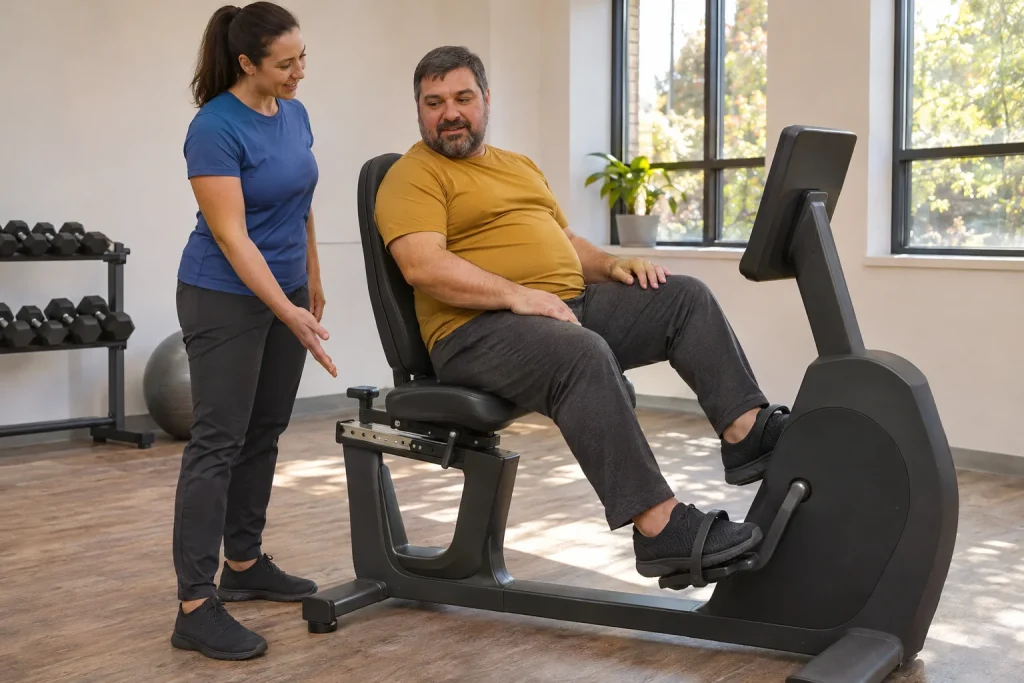
Examine the approach to the seat. Some designs provide a wider step-through; others have obstructing frame or seat-side parts. Your leg merely fitting through is insufficient: the whole movement needs usable room. Before pedalling, ask gym staff to demonstrate entry and exit under the machine’s instructions.
Consider surroundings too. Is the entry side clear, without stepping over another guest’s bag? A floor bottle or towel is small but can obstruct movement in the wrong place. Put belongings where they cannot block access or reach moving parts during use.
Discuss exit while planning the first session, rather than only after finishing. Know how the machine stops, when foot retention can be released and which fixed handle is suitable on that model. If rising already feels unstable or causes dizziness, a more decisive movement cannot resolve it. Arrange personal safety conditions and necessary help beforehand.
 Enlarge image
Do not choose seat-to-pedal distance at random
Your pedal-reaching position must remain usable throughout movement. If you reach only by sliding the pelvis back and forth or forcing the leg straight, report the adjustment problem. Sitting too close may create uncomfortable restriction. Find suitable distance with assistance using the product instructions and your own movement, rather than a general internet centimetre value.
The official manual for the earlier Life Fitness 95Ri model separately covers seat distance and locking and prohibits adjustment while pedalling. This is a technical example for that model. Do not automatically operate other machines’ levers and locks the same way; follow the actual unit’s instructions.
Do not discover alone during the trial which lever releases what. Stop as prescribed first, then inspect adjustment and relocking with staff. Later, note the chosen position number or mark, but only for that machine. The same number on the neighbouring bicycle need not mean the same position.
Include feet and control access
Your shoe position and any pedal strap should be suitable. Ask staff to show permitted footwear and retention on that machine. Hanging laces, loose clothes or a towel reaching moving parts concern more than comfort. Match equipment to machine instructions rather than adjusting it while moving.
Learn more than programme starting. Know how to change resistance, what pause means and how to finish. If a button requires leaning far forward from the seat, say so. An impressive screen cannot compensate for difficult access to basic functions. A simpler usable console may be a better choice.
You need not choose a hard-sounding or weight-loss-promising programme. Clarify with staff which settings fit your previously agreed aim. If resistance changes automatically, learn how to manage or interrupt it. A machine menu is not personalised healthcare advice.
Effort can be high even in a comfortable seat
A backrest affects posture, but does not remove pedalling work. Load varies with resistance, cadence, duration and your condition. Two people can experience different effort at the same displayed level. Identical level numbers on different machines need not even represent identical resistance technically.
The CDC information on intensity distinguishes an activity’s general intensity from intensity relative to a person. It also names comfortable speech as a simple guide: at moderate intensity, talking is generally possible; at vigorous intensity, pauses for breath may be needed after a few words. This is not a diagnostic examination or proof that unusual breathlessness comes only from excessive resistance.
You need not sing aloud, force complete sentences or match another person’s breathing to observe yourself. If a planned easy trial becomes very difficult quickly, report it and modify the situation under your plan. Do not suppress new or unusual symptoms because you are seated. “It is only cycling” cannot judge symptom severity.
What should you note instead of displayed distance?
Keep the exact machine type, seat setting, programme and what felt comfortable or problematic from the first session. Describe duration and effort in your own words too. A full database is unnecessary. The aim is to base the next setup and any discussion on more than remembered kilometres.
Exercise-bike kilometres are not running kilometres. Ground contact, movement pattern and environment differ from running. This does not make cycling less valuable; it means an arbitrary conversion should not mark a running plan complete. If cycling complements another sport, interpret its role through your aim and total weekly load.
Displayed calories or heart rate alone cannot make health decisions either. Meaning depends on equipment and settings. First-trial success is not a round number on screen. Discovering that a seat edge no longer presses but a control button still needs easier reach can be much more useful.
 Enlarge image
Buying remains a separate decision after a good trial
For home equipment, plan space, delivery and assembly. Beyond machine dimensions, allow clearance for entry and intended use. A seat rail moving backwards must not meet a wall or furniture. Obtain precise requirements from the selected model’s guide rather than estimating from a similar bike’s picture.
The Life Fitness Club Series+ manufacturer product page separately lists seat adjustment, pedals and maximum user weight, for example. This helps read specifications rather than recommending a purchase. Its particular features do not establish that another model in your local gym adjusts identically or offers the same functions.
Ask whether you would receive exactly the version tried. Different seats, consoles or accessories can affect everyday use. If a home trial, return or service matters, confirm current conditions in writing with the distributor. You need not commit immediately after a pleasant demonstration, especially with basic usage questions unresolved.
Keep trial results genuinely useful
Imagine two outcomes. First, seating and entry are comfortable but the chosen automatic programme quickly becomes too hard, raising a load-setting question. Second, resistance is easy but reaching the pedals requires sliding forwards, leaving machine size or adjustment unresolved. Do not close both with one “not for me”.
Next time, one situation might call for a simpler familiar programme; the other might require another device or a professionally agreed solution. Include how you felt afterwards. Pain or unusual illness is not overridden by remembering a comfortable seat. Describing experience and obtaining necessary healthcare assessment help together.
A usable recumbent bike is not good because effort looks minimal or because it brings you closer to mandatory running kilometres. It can suit you when you perform activity matching your aim in an appropriate environment, know the machine and consider your condition. A calm first trial spent asking questions is a meaningful part of this, rather than wasted training time.
Sources
- NIDDK: Staying Active at Any Size
- CDC: Physical Activity Intensity
- Life Fitness: Club Series+ product information
- Life Fitness: 95Ri owner’s manual
How Futószív articles are prepared: our editorial guidelines.