The particular challenge of a first solo run is that you now make the decisions previously made together. You choose when to set off, turn, stop and return home. You do not need to organise a special test of courage. A familiar area, a few details clarified beforehand and a simple finishing plan may be enough to make the outing manageable.
The freedom of running alone is primarily freedom to decide. You do not have to match anyone’s speed, or stick to a commitment made in front of others when you would prefer to change it. This guide shows how to prepare for a short first outing close to home. A remote mountain route or race requires its own preparation; treat those as separate plans.
Which decision would you like to settle beforehand?
Consider what makes you uncertain. Recognising the route? Not knowing when to turn back? Where to put your phone? Or having always relied on someone else to set the pace? These are different questions, and each can have its own solution. A general feeling of “I do not dare go alone” can then become a few specific preparations.
If the route is the issue, choose a section you already know from walking or running with others. If finishing feels uncertain, choose a turning point or time limit in advance. If you miss a shared rhythm, start with a programme you know, in which walking is already an accepted option. A first outing does not need to be new in every moment to be successful.
Write a one-sentence plan: “On Tuesday afternoon I will exercise on the familiar walkway near home, decide about returning at the small bridge, and get home by the agreed time.” You do not need to post this publicly. For your own use, the sentence makes today’s task and its boundaries clear.
Even a familiar place is not the same at every time
Choose a time of day when you genuinely know the route. A park you have visited several times during the day raises separate questions about evening gates, lighting and traffic. For a first solo outing, it may be simpler to choose a period for which you already have on-site points of reference. You can expand the variety later.
The NHS information for beginners also emphasises planning your route beforehand and staying aware of your surroundings. It specifically highlights noticing pedestrians, cyclists and vehicles. For your own outing, the implication is to leave enough attention free to recognise situations; instructions from an app or music do not override the actual surroundings.
Before setting out, check for anything that changes the familiar route. An event, building work, a closed passage or extreme weather may require you to review the earlier plan. Making a change is easiest while you are still at home. If there is no suitable alternative, moving the outing to another time is a valid decision too.
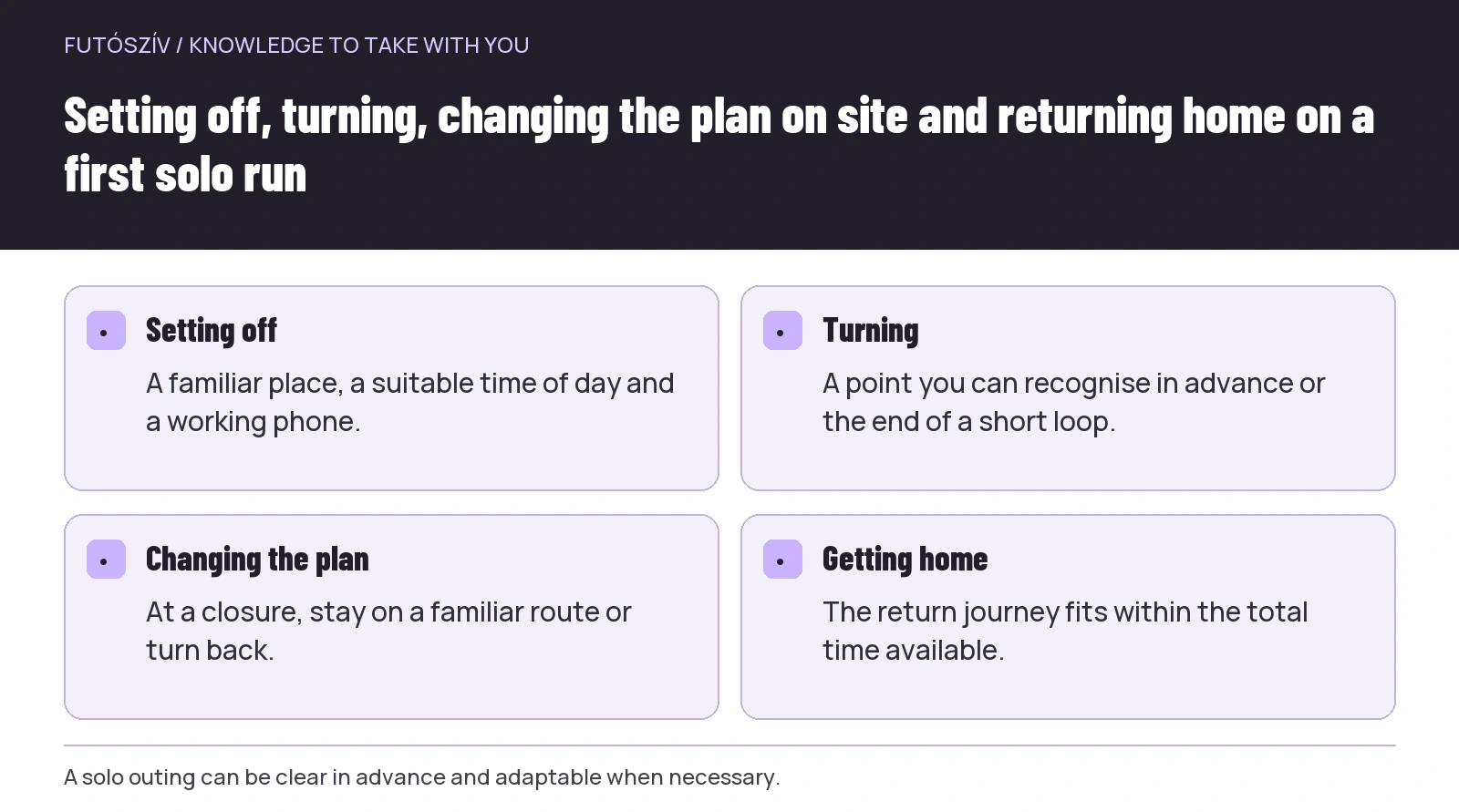 Enlarge diagram
Text version of the diagram
- Setting off
- A familiar place, a suitable time of day and a working phone.
- Turning
- A point you can recognise in advance or the end of a short loop.
- Changing the plan
- At a closure, stay on a familiar route or turn back.
- Getting home
- The return journey fits within the total time available.
A simple departure sheet
| Question | Make your own answer specific |
|---|---|
| Where will you start? | A familiar, unambiguous starting point |
| Which way will you go? | A known section with few uncertain junctions |
| Where can you turn back? | An easily recognised point or the end of a short loop |
| When would you like to get home? | A time that covers the whole absence |
| How can you make contact? | A working phone and a known contact |
| What might change the plan? | A closure, weather, feeling unwell or another obstacle |
You do not need to print the table every time. Initially, it helps ensure that preparation includes getting home and making contact. Later, these details may become routine. Habit does not, however, replace checking current conditions: even a familiar route can have a temporarily closed section.
What is worth sharing, and with whom?
If you wish, tell a trusted person the area and your expected return time. Be clear whether this is simply information or whether you have also agreed to check in. “I have gone running” and “I will check in around seven” are different arrangements. The person concerned needs to know what to expect.
If you agree on a time, allow a realistic window for your absence. The difference between leaving your front door and stopping the running app can easily cause misunderstanding. The end of the programme may still be followed by a few minutes of walking or travel home. Counting that beforehand makes communication more accurate.
You do not need to share your route live with strangers. You choose the recipient and method of sharing. If you use a location-sharing feature, test it with the person concerned before leaving: what can they see, when do they receive an alert, and what happens if the data connection is lost or the battery runs out? A feature’s name alone does not prove it fulfils the role you agreed.
Do not let your phone become a new task at the first junction
At home, try out where you will put your phone and key. A few steps of gentle movement can show whether the contents of your pocket slide around, your keys press into you and you can access the device. You can make adjustments before leaving the door. You do not need to buy a complete equipment package for a first solo outing if your existing solution works adequately.
Check the battery and whether you can make a call if needed. If you follow audio guidance on your phone, get to know the settings beforehand. Interrupted audio or an accidentally muted app should not make the whole programme incomprehensible. It helps to know for yourself what the next simple step would have been: walking, turning or finishing.
Saving the route can help, but for a first outing choose somewhere you do not need to check the screen at every corner. If you do need to check directions, stop somewhere suitable, leaving others room to pass. Using a phone and monitoring your surroundings require separate attention; it is safer to do them one after the other.
Do not try to prove yourself in the first few minutes
Alone, you may easily try to reproduce a previous group pace from memory, or feel inspired by the first pleasant section to expand the plan quickly. Yet a first independent outing has another task too: you are trying out setting off, finding your way and making your own decisions. It can remain simple and clear in advance.
The NHS Couch to 5K programme also builds on alternating running and walking. This is a reminder that switching to walking does not cancel out the outing. If you follow a beginner programme, a familiar element is easier to carry out independently than a completely new series of tasks. Questions about individual training load may require advice from a coach or healthcare professional.
Frame today’s plan so that it includes a choice. “I can turn back at the bridge” is an easy rule to follow. “It only counts if I run every street” unnecessarily narrows the decision. Independence includes being able to make changes on site when circumstances justify them.
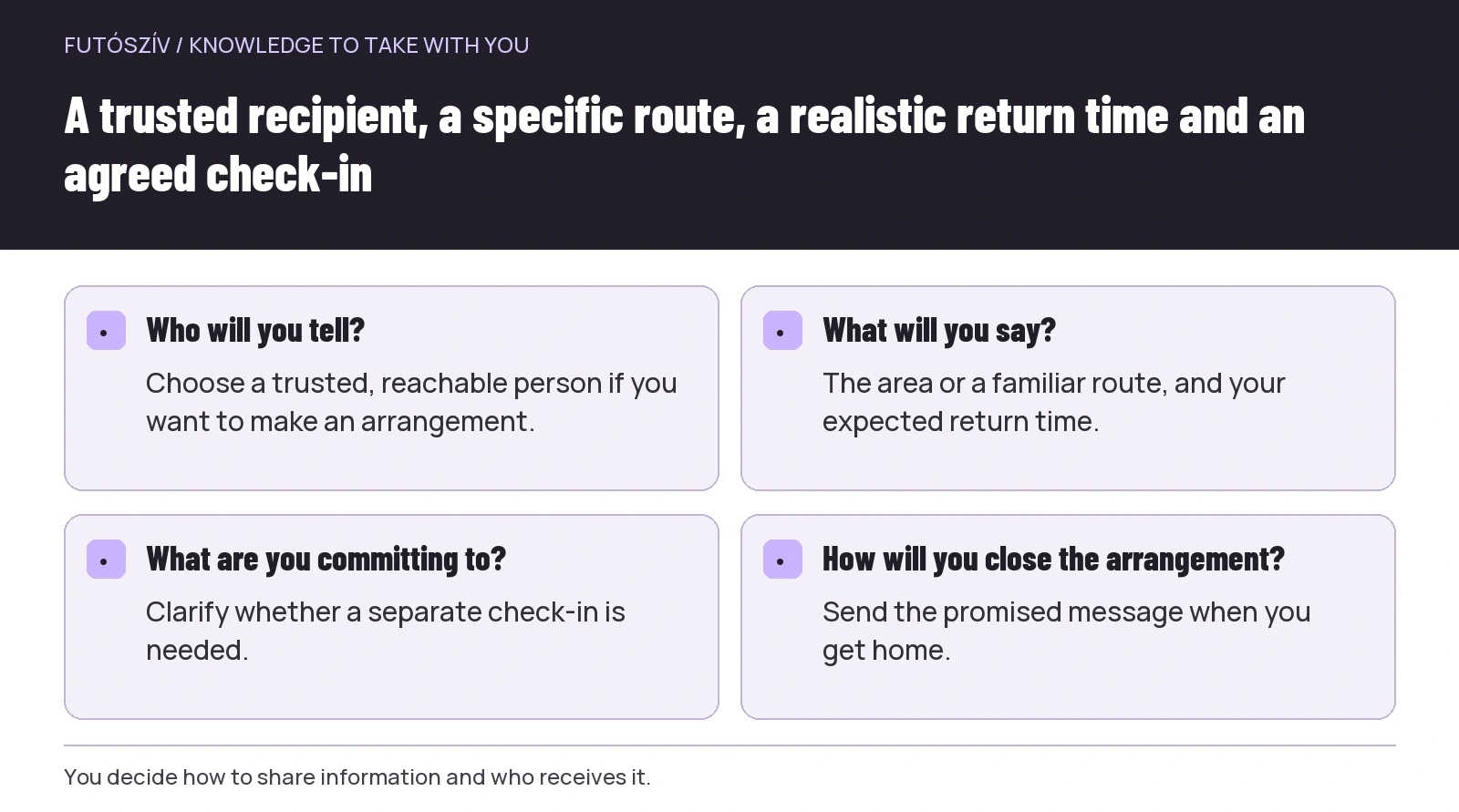 Enlarge diagram
Text version of the diagram
- Who will you tell?
- Choose a trusted, reachable person if you want to make an arrangement.
- What will you say?
- The area or a familiar route, and your expected return time.
- What are you committing to?
- Clarify whether a separate check-in is needed.
- How will you close the arrangement?
- Send the promised message when you get home.
Three changes you can decide on beforehand
If a section is closed: stay on the familiar part or turn back. You do not need to take an unfamiliar detour to complete the line originally imagined on the map. Exploring a new route can be a separate outing for which you prepare. During a first solo run, shortening is often simpler and clearer.
If you have less time: use the shortcut you already know. The end of the programme does not have to be a destination set by an app. If you need to get home for a commitment, arriving on time is part of the plan too. Make the decision earlier rather than rushing home in a scramble.
If something unusual happens: stop, assess the situation and ask for help if necessary. You do not have to continue in a situation where you cannot calmly find your way or respond appropriately. Depending on the actual circumstances, getting home may involve walking, a familiar transport option or agreed help.
Be able to explain where you are
We often use nicknames for familiar parks: “the big tree”, “the back gate”, “the old playground”. These may be clear among friends but not to someone else. Even at the planning stage, it is useful to note one or two official street names, entrances or nearby addresses. This enables more accurate communication both for arranging an everyday meeting and for asking for help.
In a genuine emergency in Hungary, you can call 112. According to the police information , the call handler asks, among other things, about the location, what happened and the people involved. Your task then is to answer factually and clearly and follow instructions. The emergency number is not for general route enquiries or reporting a simple delay.
Knowing the area does not mean having to memorise every street name. Identifying a few important points on the loop beforehand and checking your position if needed may be enough. Do not think of a device’s automatic functions as replacing an accurate explanation in every circumstance. Naming the specific place remains a useful skill.
Decide about headphones while still at home
Some people find audio guidance makes the first outing easier to follow; others would rather focus on the area. Neither choice needs a debate on principle. What matters is that your chosen setup still lets you notice your surroundings and change the setting when the situation changes. Your usual home volume may create a different task on the street.
Practise stopping playback beforehand. When you reach a junction, crowded area or navigation point, make it simple to free your attention. Do not search through a complicated screen menu while moving. Controls you can use comfortably are part of preparation.
If uncertain, you can try the first outing without audio. This lets you find out how you monitor time and surroundings independently. It gives you concrete experience for later habits. You do not need to decide immediately that every future run must take the same form.
Getting home completes the outing
If you promised to check in, do so in the agreed way. A short message may be enough to let the other person know the outing has ended. This is particularly important if anything changed from the time you shared earlier. The clearer the first arrangement was, the easier the next one will be.
Then note three things: which preparation helped, where you had to make your own decision, and what you would prepare differently. For example, you might choose a more accessible pocket, give a more accurate return time or use another gate. These small observations make setting off independently increasingly simple.
After your first solo run, you do not need to take on a longer or more distant route immediately. Repeating the familiar outing deepens what you have just learned: you know how to set off, find your way, decide when to change and get home. Many kinds of running can later build on that practical knowledge.
How Futószív articles are prepared: our editorial guidelines.