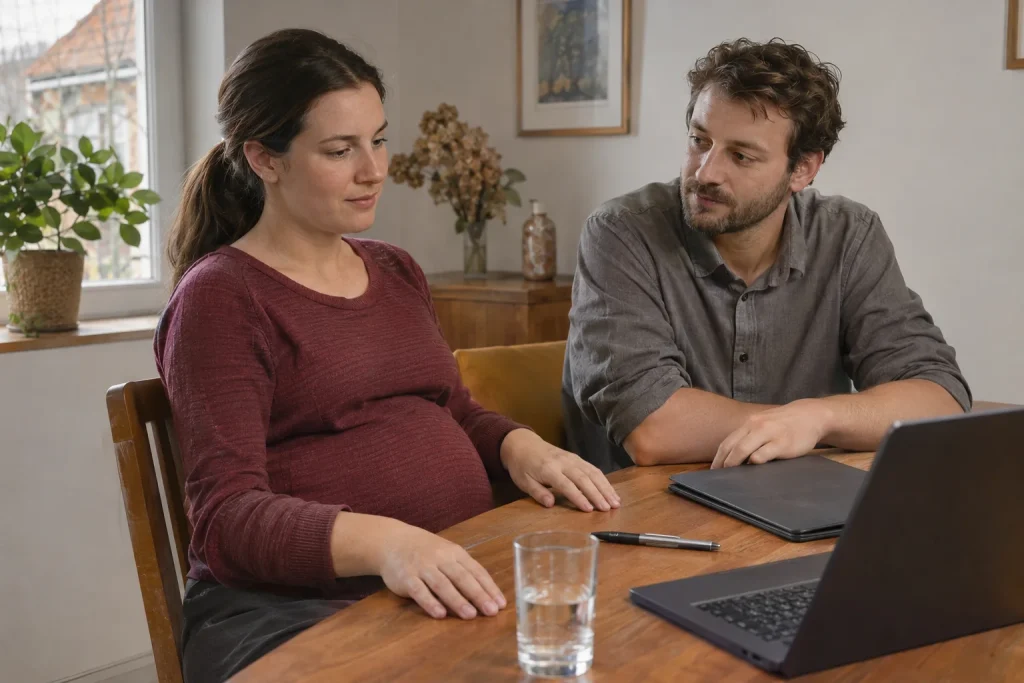
Entering seemed a good idea several months ago. You had a goal, perhaps accommodation and shared travel plans too, but pregnancy has changed the situation. The money already paid can easily start to feel as though it decides whether you participate: after preparing so much, surely you should complete something at least. Yet payment is an administrative fact, not a finding of medical fitness. It makes sense to deal separately with what happens to your entry and the conditions for your own participation.
This does not mean money, planning or disappointment do not matter. It means they belong to different questions. You have one discussion with your maternity care professional about your current condition and the particular programme, and another with the organiser about the terms of your entry. With companions, you discuss what changes in the shared plan. Keeping these strands separate prevents payment becoming an unspoken obligation to start.
An entry confirmation is not personal clearance for sport
The NHS page on exercise in pregnancy emphasises considering previous activity, your known condition and necessary adjustments. An event’s general participation terms do not know your current findings or symptoms. Accepting your entry therefore does not answer whether that particular race programme is appropriate for you in your present pregnancy circumstances.
The question involves more than the advertised distance. It may include travel, an early departure, waiting, a crowded start area and how you will get home. Describe the real programme when speaking with your care professional. An apparently short event can involve a long day of organisation, while a local outing may be arranged differently. These are not circumstances that grant or deny permission on their own, but details needed for individual consideration.
‘I will not run fast anyway’ does not resolve every question. Reducing your pace may be part of a plan if considered appropriate for you individually, but it does not automatically turn any race into a suitable activity. Today’s health decision should start from your current condition, not from the fact that the entry fee has already left your bank account.
What is a sunk cost, and how might it appear here?
The original decision research published by Arkes and Blumer examined how money, time or effort already invested can increase the tendency to continue. The work included a field study involving theatre season tickets and questionnaire scenarios. It did not concern pregnant runners’ healthcare decisions, so it does not establish what is happening for you; it provides a concept for recognising a familiar pressure in decision-making.
In a running situation, this might sound like: ‘I have already put so much into it; I cannot stay away.’ The earlier investment is real, but it does not tell you the appropriate next step. Taking part does not make money already spent unspent again. The current question is instead what further commitment would follow, and how it fits your individual circumstances.
Time and anticipation can matter just as much as money. Perhaps you linked many training sessions to the goal, or your friends were looking forward to this weekend too. You can express disappointment about these things. You do not need to participate to prove the preparation had value. Earlier experiences of movement, learning and community connection do not become real only by crossing a start line.
Make two separate lists of questions
Put your current condition, new symptoms, your care professional’s guidance and the actual day’s programme on the healthcare list. On the organisational list, put entry terms, deadlines, the contact person and whether travel can be changed. If everything is squeezed into a single ‘Can I go?’ question, practical feasibility and suitability can easily become confused. An unchangeable accommodation booking does not answer the health question.
The CDC guidance on activity during pregnancy recommends discussing individual modifications to activity with a doctor. Do not expect the organiser’s customer service to provide this discussion. The organiser can clarify the terms of its event; your care professional can start from your current health situation. Knowing these different roles makes administration clearer too.
| Question | Who should you clarify it with? | What answer cannot replace this? |
|---|---|---|
| Is this particular programme appropriate in my current condition? | Your maternity care professional and, where necessary, the relevant healthcare professional. | Acceptance of the entry or another runner’s experience. |
| What can happen to my entry? | The organiser’s official terms and customer service. | A previous year’s rule shared in a social group. |
| What changes in the shared travel plan? | Your fellow travellers and the particular service provider. | The fact that everyone originally planned the same thing. |
| How am I coping with a changed goal? | With help from a trusted companion, family member or your care professional if needed. | Immediately setting a new distance or return date. |
Alongside the two lists, a separate emotional question can remain: what is hardest to let go of? It may be the weekend together, a long-awaited destination or confidence associated with the goal. Administrative arrangements will not necessarily resolve this feeling, but neither do you have to turn disappointment into a health argument because of it.
 Enlarge image
Look for the official terms of your own entry, not a general rule
Open the event’s current official information and your own confirmation. Check specifically what your purchase covered, whether there is a deadline for changes and which channel you should use to report a change. This article does not establish a right to a refund, deferral or transfer. You need to find these out from the particular terms of your entry.
If the description is unclear, send a brief, factual question. Provide the identifier requested by the organiser through the appropriate channel, and ask which option, deadline and action apply to you. You do not need to attach an entire set of medical documents to the first message. Clarify exactly what the administration requires first.
Do not start from another race’s practice or a previous year’s arrangements. A friend’s experience may suggest what to ask, but it is not a decision on your case. Keep a written response if you receive one and check what remains to be done. Sending a question and completing a change are different things; be clear about when the entry matter is considered closed.
Make further costs visible separately too
Alongside the paid entry, travel, accommodation or organisational commitments may still lie ahead. You do not need to treat these as one large loss. Look separately at what has already happened, what can change and what would only arise later. Today’s decision affects future steps; an earlier payment does not automatically justify another expense or a demanding programme.
Shared accommodation and transport may affect others too, so it is worth starting discussions in good time. Every medical detail does not need to be public for this to happen. You can say that your participation may change and you would like to review shared bookings. The precise division of costs and possibilities for changes need to be arranged separately with those involved.
This is not a task in financial optimisation at any cost. ‘Getting the most’ from every amount spent is not more important than your individual healthcare framework. Some payments may not be recoverable; that can be hard to accept. Even so, your next decision does not have to remain tied to the same old plan. Sometimes closure simply means knowing what happened and not automatically adding another commitment.
Being a spectator is not a compulsory compromise either
If you do not run, going along at least to cheer may seem an obvious idea. It can be enjoyable if appropriate for your individual condition and the day’s circumstances, but it is not compulsory proof that you are a supportive companion. A spectator’s day can also involve long travel, waiting, standing and uncertain opportunities to rest. Consider the whole programme, not only the fact that you will not be running.
If you would go as a spectator, discuss a plan adapted to your own needs with your companions: how long you will stay, how you will leave, where you will meet and whose bag minder or driver you will not automatically be that day. A helping role taken on instead of running can also be too much. You do not need to repay the community for a missed sporting performance with organisational work.
Not attending at all can also be an understandable decision. You do not have to use every available part of an event to bring an earlier entry to a satisfactory close. If being there would be difficult now, you can say so too. A change in participation reflects a changed personal situation, not how interested you are in your companions.
Give companions a brief message they can act on
Separate the decision from the organisational request when communicating. For example: ‘I am not starting this time. I am dealing with the entry through the organiser. We need to change this part of our shared travel plan.’ You do not have to convince the group with every medical reason for them to accept the change of programme. You can have a more detailed personal discussion separately with whomever you choose.
If the response is more encouragement to do ‘at least a shorter distance’, you can repeat that you are discussing activity requirements with your care professional and currently want to settle the organisational change. Another person’s well-meant suggestion does not oblige you to reconsider the health decision in front of the group. A clear boundary helps prevent the conversation becoming endless replanning.
A different kind of discussion about disappointment may also have a place with your partner. Not every sentence has to become a to-do list. You can say that you have made the decision but still feel sad about the change. This is not inconsistency, and it does not mean you must return to the original plan. Understanding and practical help may both be needed.
 Enlarge image
Do not let an entry become a deadline for returning
If the organiser offers a later option, do not treat that as an automatic sporting commitment either. Understand its conditions first, then consider separately when and how future participation can be assessed. Today’s change does not have to immediately create another fixed date that generates the same pressure later.
A postpartum or later running plan cannot be derived from the present entry matter. Individual recovery and healthcare assessment remain separate processes even when another event already appears in the calendar. A voucher, transfer option or new entry remains an administrative possibility, not a promise of future fitness to participate.
You do not need to quickly assign the preparation already completed to a new race either. The value of memories, routines learned and time together can live on outside another goal. If you want a new plan later, you can discuss it with knowledge of your circumstances then. The present task may simply be to close the original programme in an orderly way.
You can ask for support with disappointment too
The NHS page on mental health during pregnancy supports sharing feelings and speaking to your care professional if you have concerns. A significant goal changing can be emotionally difficult, but you do not need to turn that automatically into a diagnosis. You can explain what the event meant to you and what help you need now.
If emotional difficulty remains burdensome or interferes with everyday life, seek professional support. Running is not a compulsory coping tool, and a new race entry is not a universal solution to feeling bad. Even while dealing with practical arrangements, there can be room for someone to listen without immediately seeking a new goal for you.
An orderly decision can end with three separate outcomes: clarifying the healthcare aspect, settling entry and travel arrangements, and having a personal discussion about the change. All three do not need to feel easy at the same moment. What matters is that the money already paid is never given the role of deciding your current participation for you.
Sources
- NHS: exercise during pregnancy and individual circumstances
- NHS: mental health and help during pregnancy
- CDC: discussing individual modifications to activity
- Arkes and Blumer: The psychology of sunk cost, original decision research, 1985
How Futószív articles are prepared: our editorial guidelines.