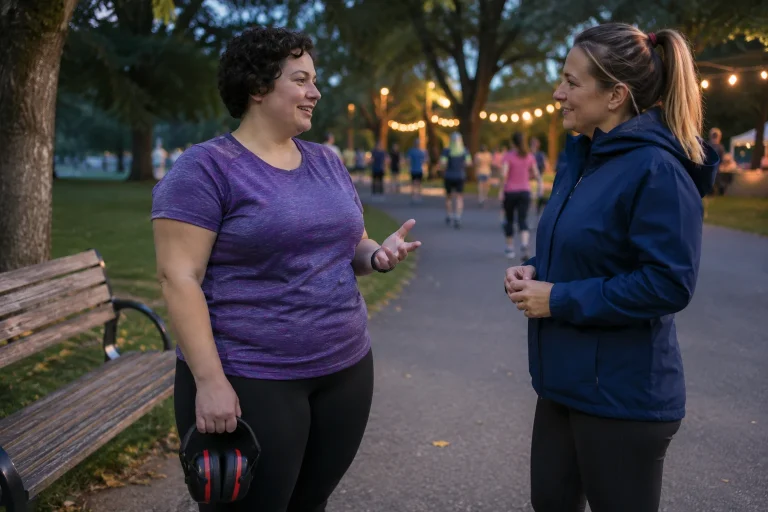
Your running companion suddenly stops, breathes rapidly, trembles and says something is very wrong. Someone in the group already names it: definitely panic. That label is not an examination. A helper’s first task is safety, monitoring the person’s condition and reaching appropriate help, rather than winning an argument about which illness the scene most resembles. Calm presence and arranging care can happen together.
If the person is unresponsive, has severe breathing difficulty, chest pain or another serious new symptom, do not wait out the supposed duration of a panic attack. Seek urgent help; in Hungary, call 112. Someone with known panic disorder can still become unwell for another reason. This article clarifies your role as a running-group member: what to describe, what not to claim with certainty and how help can remain humane in an uncertain situation.
Similar symptoms do not mean the same cause
The NHS information on panic disorder lists a fast heartbeat, shortness of breath, chest pain, dizziness, trembling and tingling among possible panic-attack symptoms. These can occur in other conditions too. A symptom list therefore cannot safely establish that the person faces no health danger. Your companion can be very frightened and still need medical assessment of physical symptoms.
The ANZCOR first-aid guideline on rapid breathing also emphasises possible alternative causes and uncertainty in a presumed panic diagnosis. Many causes cannot be determined in first aid. If someone does not recover completely, becomes unwell again or deteriorates, medical help is needed; immediately if worsening. Its follow-up considerations do not instruct you to wait a set period before acting on severe symptoms.
“I’ve had this before” is important information. It is not identical to “this is definitely the same”. Listen to whether the person describes this as familiar, whether anything differs and whether a plan was previously agreed with a professional. Uncertainty can be passed on too. You need not persuade them towards either explanation. Factual description of the condition helps care more than certainty constructed among friends.
Watch heart rate or a favourable app signal does not settle the question either. The group need not compare devices or vote on a “normal” value from shared experience. Tell emergency services or healthcare staff what you see, what your companion reports and what changed. Data can supplement this, but obtaining it must not delay help.
Stop safely and make help readily accessible
First look around: are you on a road, cycle lane or another hazardous spot, and can further danger to the group be prevented? Do not force the person to run on or walk far to reach somewhere prettier or quieter. The Resuscitation Council UK first-aid guideline also starts from a framework of safe assistance suited to the person’s condition. Arranging the environment should not delay necessary care.
For severe chest symptoms, major breathing difficulty, fainting or collapse, seek urgent help. An exact running-route location is not always a street address: describe the park entrance, a nearby landmark and access, then answer the dispatcher’s questions. Identify uncertain details as uncertain. Do not try to supply a ready diagnosis because a group member has seen a similar experience before.
If someone is unresponsive, call for help immediately; in Hungary, 112. The 2025 adult basic life support guideline says an unresponsive person not breathing normally should be treated as a suspected cardiac arrest. Start CPR with the emergency dispatcher’s help and use an AED as soon as available, following its instructions. Gasping or unusual breathing does not guarantee normal breathing, including when an athlete collapses.
An alert person who can talk and seems less severely unwell still needs monitoring. Initial improvement must not automatically send them back into running. Seek healthcare assessment for new, unusual, recurring or unresolved symptoms. This does not declare that something serious definitely happened. It recognises that the group’s information is insufficient to determine the cause and suitability for further exertion.
 Enlarge image
Simple language and enough space can help more than competing advice
The St John Ambulance guide reviewed in October 2026 recommends calm, supportive presence and stresses that panic symptoms overlap with emergencies. What helped previously can differ between people. Ask an alert person what would help now instead of automatically imposing your favourite method. Conversation must not obstruct assessment or an emergency call.
A useful phrase could be: “I’m here with you. Can you tell me what changed, and would you like to call someone?” Or: “We’re getting help, and I’ll stay beside you.” These do not promise a definite diagnosis. You cannot substantiate “there’s nothing wrong”, while “just calm down” does not explain how you are helping. You can remain calm while acknowledging that the cause is not yet known.
With several people present, avoid everyone asking questions at once. One can talk to the person, another arrange help or guide responders to the location, while others give space. This is our organisational example for making help clearer, rather than a rigid assignment for every case. Adapt roles to the situation, and if there are only two of you, do not delay calling because nobody can take each role separately.
A quieter setting does not necessarily mean retreating to a distant location. It may mean bystanders stepping back, fewer questions and no video recording. Before touching, ask whether they want this if their condition and the situation allow. A helper need not prove concern through a hug, physical direction or loud encouragement. Calm presence can be real help even with few visible actions.
Paper bags and improvised breathing tests are not a group solution
ANZCOR strongly opposes rebreathing exhaled air, for example through a paper bag, to manage rapid breathing. St John Ambulance also notes that this is not a generally safe method. Do not look for a bag, cover the person’s mouth or turn the scene into a breathing experiment. The running group may not be able to identify the cause of fast breathing; a familiar film technique does not remove that uncertainty.
Likewise, do not ask them to hold their breath, breathe forcefully or run a few steps to prove nothing is wrong. This article gives no general breathing rate or inhalation-to-exhalation ratio. An alert person may describe a coping approach previously agreed individually, but the group need not devise a new protocol for them. Their current condition and appropriate professional contact remain the basis of help.
Do not offer someone else’s medicine to calm them either. “This is what I take when it happens” is not an administration instruction for an unwell companion. If they have their own prescribed medicine and plan, they can provide information, and the dispatcher or care provider can advise. Rewriting medication is not the helper’s task, and a familiar box does not remove the need to assess new symptoms.
A known plan provides information, rather than explaining every later episode
If a companion previously chose to share the support they want for a known difficulty, respect this. Distinguish a support request from a healthcare instruction, however. Whom to call or how to speak with them can be practical details agreed in advance. Determining the cause of new symptoms or excluding emergency help is a different task. An older agreement cannot require ignoring a severe condition.
| What you may know | How this helps | What it does not determine |
|---|---|---|
| They have had a panic attack before. | Listen to whether this feels similar and what helped before. | It does not prove the current episode’s cause. |
| They have a chosen contact person. | You can reach them according to consent and the circumstances. | It does not replace a necessary emergency call. |
| They have individual support preferences. | Unwanted questioning or improvisation can be avoided. | It does not automatically permit further running. |
Do not store every detail of an individual plan in a group chat without consent. Even a designated companion needs only the information relevant to their role. Facts necessary for care should, of course, be passed to healthcare helpers during the episode. That does not entitle every club member to know diagnoses, medicines or earlier personal histories.
Improvement should not make continuing a performance test
Once your companion feels better, they need not run a section in front of you to make improvement credible. Following a difficult situation, the next questions may concern care advice, getting home and whom they want to stay with. “There’s only this much left” is not a health consideration. Nor is the time the group has lost a useful measure. Someone receiving help should not also be responsible for preserving everyone else’s training statistics.
The overview of the WHO psychological first aid guide highlights humane, practical help and respect for dignity after seriously distressing events. We use this as a general support principle here, rather than claiming every episode causes trauma. In your running situation, it may mean someone retrieves the bag, you discuss the journey back and nobody expects a public explanation of what happened.
Later, ask whether they would like to talk about the experience or help arranging a professional discussion. The NHS recommends medical assessment for suspected panic disorder, considering other possible causes. Recurring difficulties may benefit from targeted professional support; a running group cannot replace it. Seeking help does not require first admitting that symptoms were “only psychological”. Physical and emotional distress can both be taken seriously.
 Enlarge image
A community can prepare to help without becoming a diagnosis club
A group can clarify meeting points, route access, location details for emergency calls and organiser contacts beforehand. Appropriate first-aid training provides a more useful basis than a diagnostic list built from accumulated group stories. Practising roles is especially helpful when someone is unresponsive or not breathing normally. Preparation does not guarantee uncertainty will never occur.
The key community sentence can be simple: we do not need to identify the cause before helping. We stop, observe the condition, seek appropriate help and speak respectfully. Panic can be one possible explanation, but not a shortcut for withholding assistance. A friend’s presence matters precisely because the person and their care remain central in an uncertain moment.
Sources
- NHS: Panic disorder
- ANZCOR 9.2.8: First Aid Management of Rapid Breathing
- St John Ambulance: Panic attack, 2026
- Resuscitation Council UK: Adult basic life support, 2025
- Resuscitation Council UK: First aid, 2025
- WHO: Psychological first aid
How Futószív articles are prepared: our editorial guidelines.