A weekend running-trip bag starts organised: a clean top, dry socks and carefully chosen shoes fit inside. On the way home, the muddy, wet footwear must return to the same bag, preferably while everything else stays usable. Good packing therefore works in both directions. It asks not only how shoes fit, but where you remove them, how you separate them from clothes, when you clean them and where they can dry. This guide helps you think through short domestic journeys and multi-day running weekends without ranking shoe brands or bags.
One pair or two: start with the tasks
List what the shoes need to do on the trip. A road session, muddy trails, long walking sightseeing and a race start can be different uses. Suitcase size alone should not determine appropriate running footwear. Equally, one short run does not automatically require three pairs. Choose from the route and shoes you already know first, then find the packing method. An “all-purpose travel shoe” label does not replace whether the particular item is comfortable and suitable for your run.
Think about after running too. If your only pair becomes soaked, must you spend hours on a train, go to a restaurant or run again the next day in it? Separate spare footwear suited to travel and the expected environment can solve a specific problem, but helps only if genuinely wearable in that situation. Make a simple packing table: what you wear while travelling, while running and afterwards. You then do not discover while closing the bag that dry socks have no dry footwear to go with them.
Inspect the sole before departure
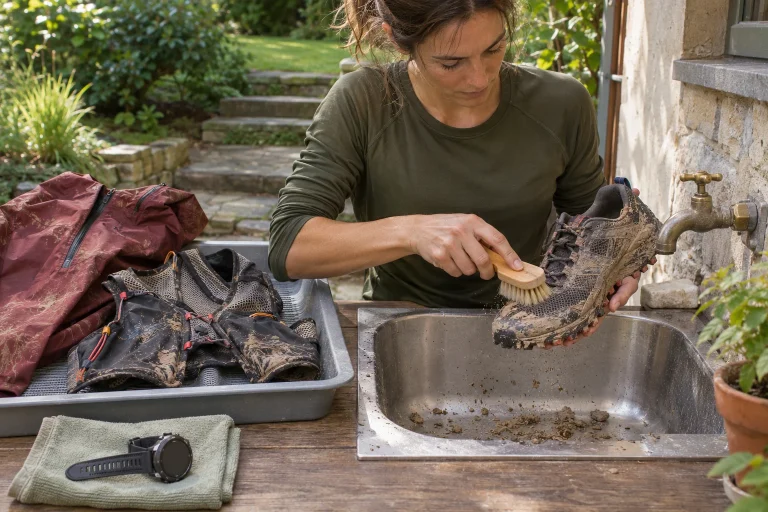
A clean upper does not guarantee a clean sole. Turn the shoe over and inspect grooves, heel and tread recesses. Trapped stones, dry soil and plant matter easily enter the bag. Remove them gently with a suitable tool under the shoe’s care instructions. Do not start picking the sole clean on a station bench or accommodation corridor. A clean tray or easy-to-clean surface at home is better for inspection and collecting scattered debris.
Conservation gives this another purpose. The US National Park Service prevention guide links removing soil and plant material from shoes and equipment to reducing invasive-species spread. This is not Hungarian legislation and does not prescribe the same procedure for every trail. The practical lesson is useful, however: do not deliberately transport mud and seeds trapped in soles between running locations. Check special rules for the area visited too, without improvising a disinfectant recipe.
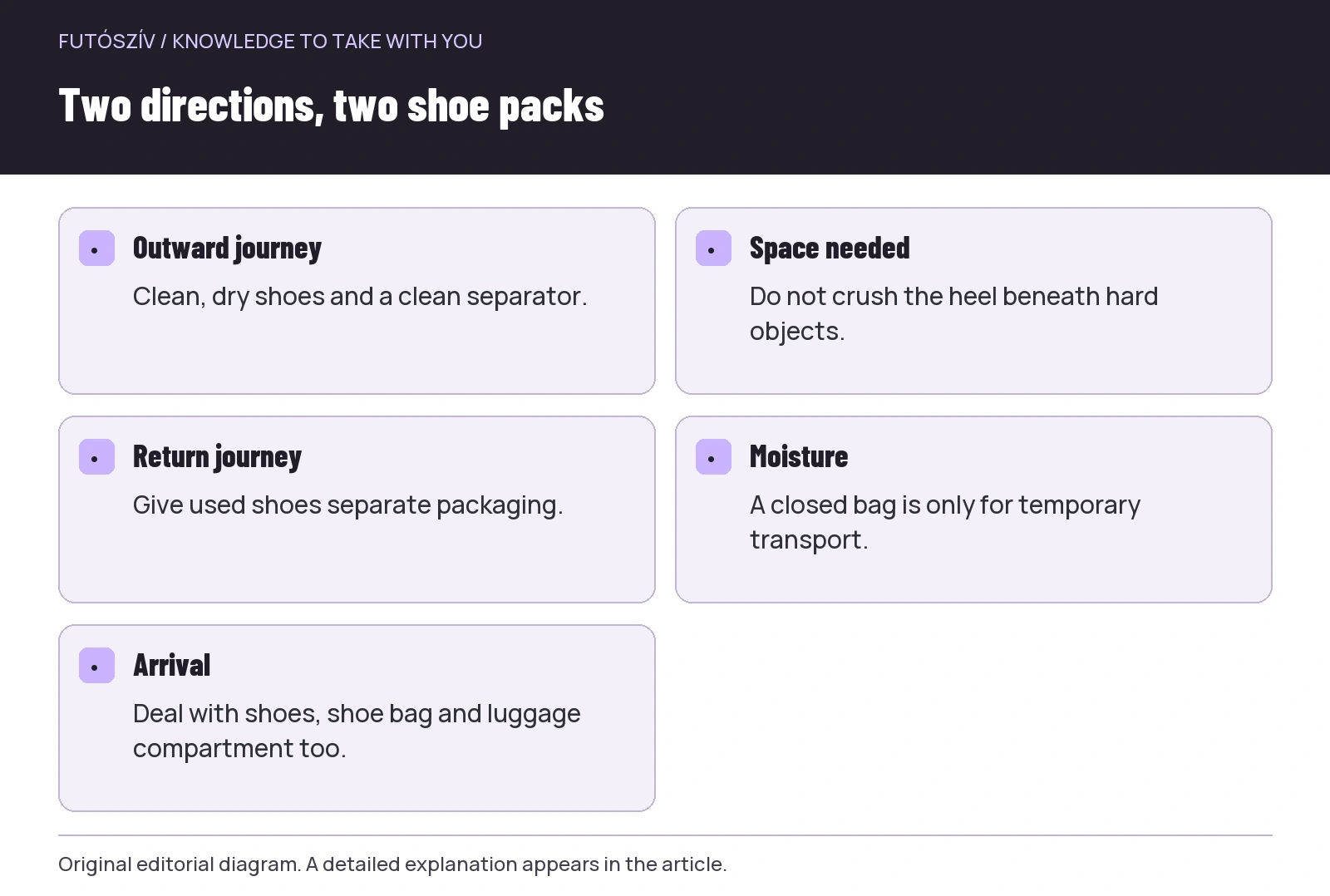 Enlarge diagram
Text version of the diagram
- Outward journey
- Clean, dry shoes and a clean separator.
- Space needed
- Do not crush the heel beneath hard objects.
- Return journey
- Give used shoes separate packaging.
- Moisture
- A closed bag is only for temporary transport.
- Arrival
- Deal with shoes, shoe bag and luggage compartment too.
Put dry shoes in the outgoing bag
If cleaning before leaving, allow suitable time for manufacturer-directed drying. The Brooks cleaning information describes gentle hand cleaning and air drying for its own shoes. Check the precise method for your model. A shoe bag is not a dryer: sealing a damp upper and insole inside is not resolved by a suitcase looking neat outside. If pre-departure washing would leave shoes wet, plan appropriate cleaning and timing together.
Remove insoles only if the shoe design supports it. Check moisture beneath them too, then dry and replace as instructed. The ASICS care guide also warns against accelerating drying with radiators and tumble dryers. Do not recover a pre-travel delay through direct high heat. Drying time can depend on shoes and circumstances; check actual condition rather than a general number of hours. A damp interior and apparently dry exterior are different.
Choose the shoe bag for the homeward journey too
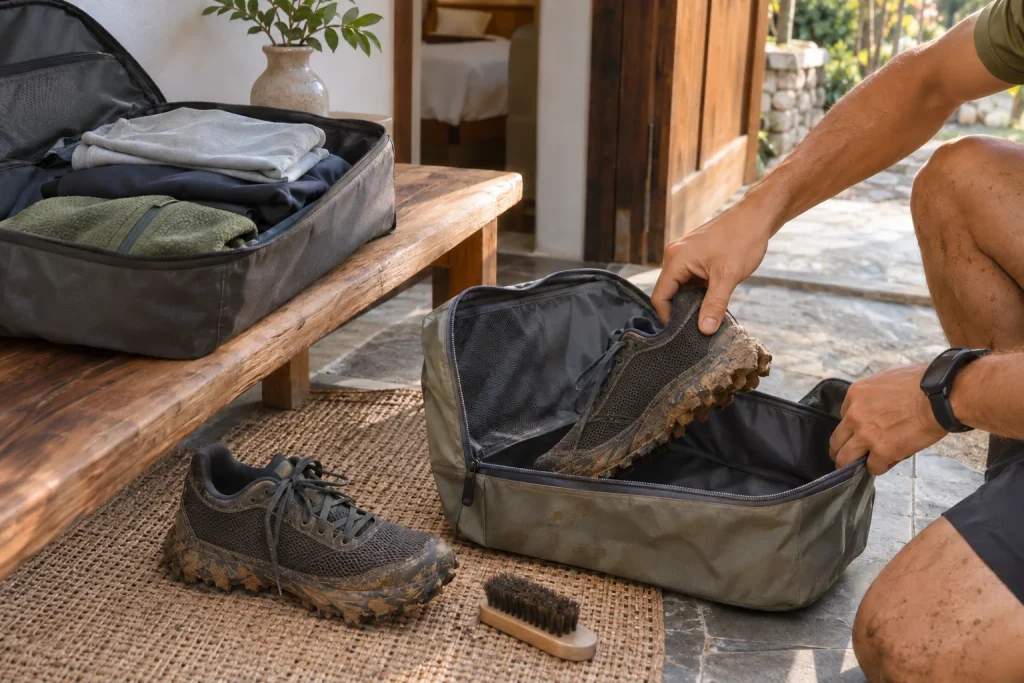
A simple separator can protect clothing from direct sole contact, but not every bag contains moisture or fine dust. Check closure, seams, cleanability and whether your shoes fit comfortably. Forcing a heel into a too-tight bag is not a good aim. In a larger, opaque bag, however, wet shoes can be easy to forget. Do not choose solely by litres or a product being called a shoe bag.
A short, dry urban run differs from a rainy trail race. The first may need only a cleanable separator; the second may require temporary moisture protection for the journey home too. Sealed packaging serves temporary transport, not prolonged wet storage. Open it promptly on arrival and begin care. If using a reusable bag, clean its inside according to instructions too. Do not return the next clean shoes into the previous run’s mud.
| Travel situation | Shoe-packing task | Detail to resolve beforehand |
|---|---|---|
| A one-day running outing by train | Separate used and clean equipment | Where and into what will removed shoes go? |
| Muddy trail running reached by car | Manage soil residue and moisture | Cleaning place, spare footwear and boot placement |
| Two runs in one weekend | Drying opportunities between outings | Accommodation facilities and a backup plan |
| Small cabin bag | Coordinate space and access | Avoid damaging shoes through compression |
| Travelling home straight from the finish | Quick repacking in an organised order | Keep an empty used-kit bag accessible |
Where should shoes go inside luggage?
Soles should not touch clean clothes, food or fragile objects. Avoid heavy items pressing persistently on uppers or heels. A separate shoe compartment may be convenient, but check its size with luggage fully loaded. Some compartments take space from the main area; external shape does not reveal actual packability. Try the arrangement at home with the complete necessary load and close the bag without force.
Putting clean socks inside shoes may save room, but consider it only in clean, dry footwear with appropriate separation. Small items should not stretch the upper, and do not forget a hard charger or key bunch inside. After running, the shoe interior is in another state, so the same space is not automatically clean-clothing storage. If using it outwards, leave room on the return for separately packed socks and used equipment. A two-way trial is worth more than a perfectly full outgoing suitcase.
Access is valuable in a small backpack too
If running begins immediately after arrival, do not place shoes at the bottom beneath clothes needed only in the evening. Running kit can be a unit lifted out together: shoes, socks and required session clothing kept separately clean. This avoids unpacking all luggage at the station before setting off. Do not create another problem: avoid pressing a watch, glasses and other sensitive objects between soles simply to keep everything in one bag.
If attaching shoes outside, check the bag is designed for it, the fastening is stable and footwear will not catch others in narrow spaces. Loosely hanging shoes can interfere on public transport and crowded routes. External placement does not automatically keep them clean or dry; they may encounter rain and dust while travelling. Shoelaces alone are not fasteners for every situation. If the bag only closes with objects tied outside, review the whole equipment quantity and layout.
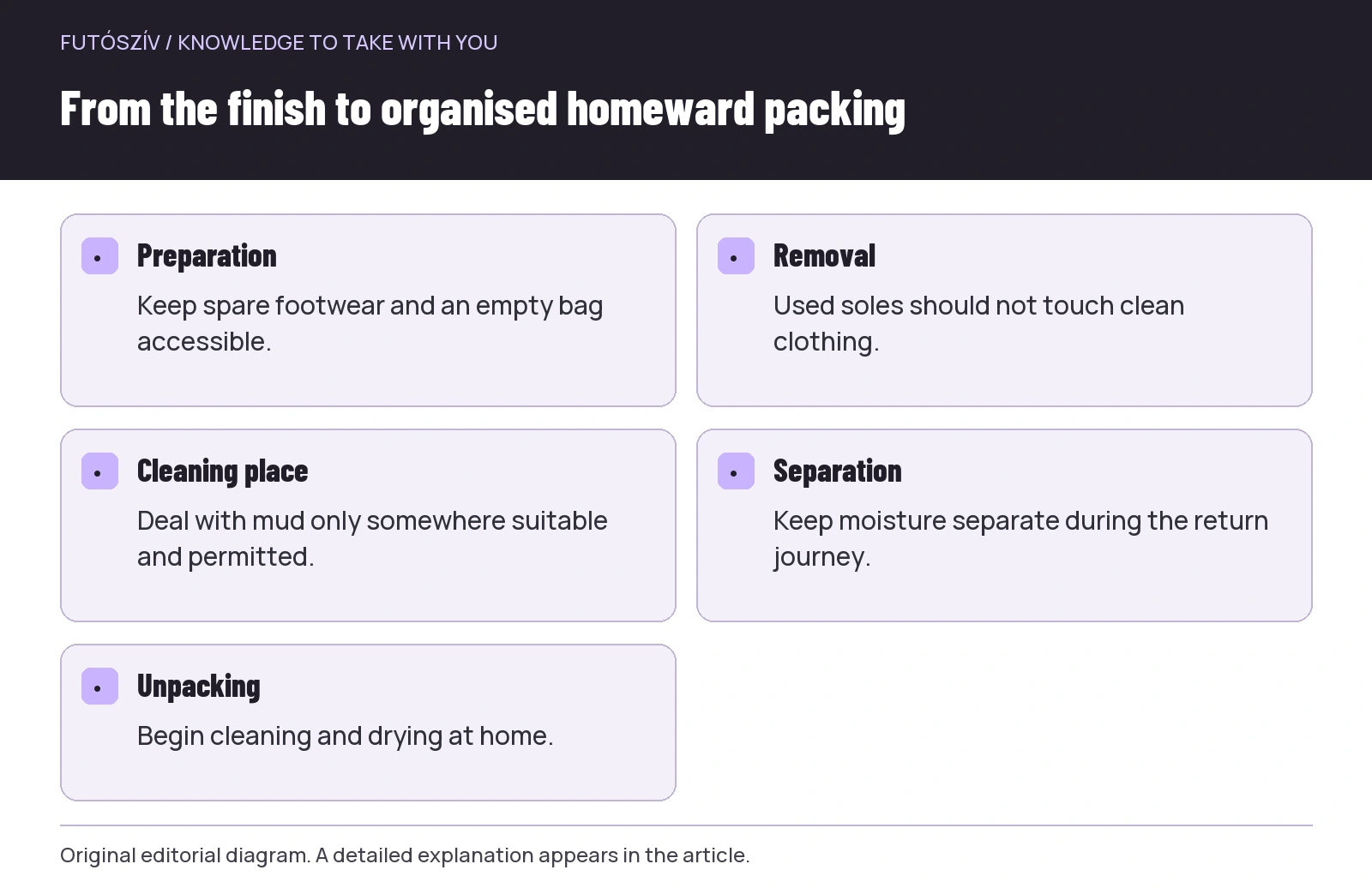 Enlarge diagram
Text version of the diagram
- Preparation
- Keep spare footwear and an empty bag accessible.
- Removal
- Used soles should not touch clean clothing.
- Cleaning place
- Deal with mud only somewhere suitable and permitted.
- Separation
- Keep moisture separate during the return journey.
- Unpacking
- Begin cleaning and drying at home.
The order of repacking after running
Before leaving, put the empty used-kit bag and spare footwear somewhere accessible. At the finish, first find an appropriate changing place, then remove shoes without placing them on top of clean luggage. Use an available, permitted cleaning area; a public hand basin or accommodation towel is not automatically a shoe-cleaning tool. Do not wash mud into a stream or scatter dirt where others must clean it. Decide according to local rules and surroundings.
Without a suitable cleaning place, arrange separation for transport and do thorough care at the first appropriate location. You do not need to pretend very wet shoes are perfectly clean to pack properly: what matters is knowing you carry used items requiring further attention. Close the bag appropriately for transport, then open on arrival. If alongside a bottle or soaked clothing, separate those too so liquid does not travel through the whole bag.
At accommodation, do not rely on one night’s drying
Ask about usable facilities and put shoes in a ventilated location permitted by the manufacturer. Do not improvise with a hot heater or position them where water or mud marks furniture. If insole removal is permitted, drying parts separately may be easier to check. Arranging tongue and laces can improve access, but do not force the construction apart. Choose a drying spot that does not obstruct movement or mark its surroundings.
For consecutive runs, decide beforehand what to do if shoes remain wet in the morning. The answer depends on the run, weather and existing equipment; every situation does not require buying another pair. You may modify the programme, take another suitable shoe or arrange the route to leave time for care. Do not assume a drying time valid for every material and room. Check the real state, rather than discovering discomfort in the first kilometre of the next run.
At home, the shoe bag is part of the task too
Open the used-shoe package, retrieve footwear and arrange its care. Then attend to the bag, luggage compartment and surface where you packed. If mud entered the lining, clean shoes will not enter a clean environment next time. Follow luggage cleaning rules: a waterproof-coated or reinforced compartment may not wash like a simple fabric sack. Full drying matters here too before putting everything away.
Finally, review what worked. Did shoes fit comfortably, was the second pair needed, could you reach spare footwear easily, and did moisture stay separate? These observations support precise changes next time. The best solution is not the one compressing kit into the smallest space, but one where shoes arrive usable, remain manageable after running and keep clothing clean. Packing finishes when equipment brought home is organised and dry again for the next outing.
Sources and further reading
- Brooks – cleaning running shoes
- ASICS – Running Shoe Cleaning and Maintenance
- National Park Service – Invasive Species Prevention
How Futószív articles are prepared: our editorial guidelines.