Food packed at home may pass through several stages before eating: travel, work, waiting before training and the journey home. Choosing a container therefore involves more than fitting lunch inside. Chilling, the lid, liquid ingredients and where food will actually be accessible matter too. A working system considers the whole journey, so midday does not bring a new decision over a box that has spent an uncertain time in a bag.
This guide offers household and transport ideas for adult recreational runners. It does not establish one safe travel duration for every food or a personal serving size. The actual food, product label and necessary storage conditions take precedence. With allergies or prescribed diets, composition, utensil use and appropriate separation must also be provided. Packing routines do not replace proper earlier preparation and cooling.
Map the food’s journey before choosing the container
List the daily stages: when food leaves the home fridge, how it travels, where it is stored and when it is eaten. If carrying two meals, each journey may matter separately. Suitable workplace storage for lunch does not automatically resolve later transport of late-afternoon food. Leftovers carried home begin another stage whose history includes the whole day.
In a simple example day, you leave in the morning, reach the office later, eat lunch at midday and attend training in the afternoon. Rather than exact hours, focus on cooling opportunities: are the food’s conditions met during travel, on arrival and before training? This example establishes no generally safe waiting period. A necessary plan combines actual food, real surroundings and verifiable storage.
The existence of a workplace fridge is not a complete answer
Check whether you can actually use it, whether space exists and which conditions it provides. If the container only goes in after a meeting lasting hours, the earlier stage still needs addressing. Do not leave uncertain temperature or cleanliness as an assumption in your plan. Clarify access and placement beforehand, especially at a new workplace or temporary venue.
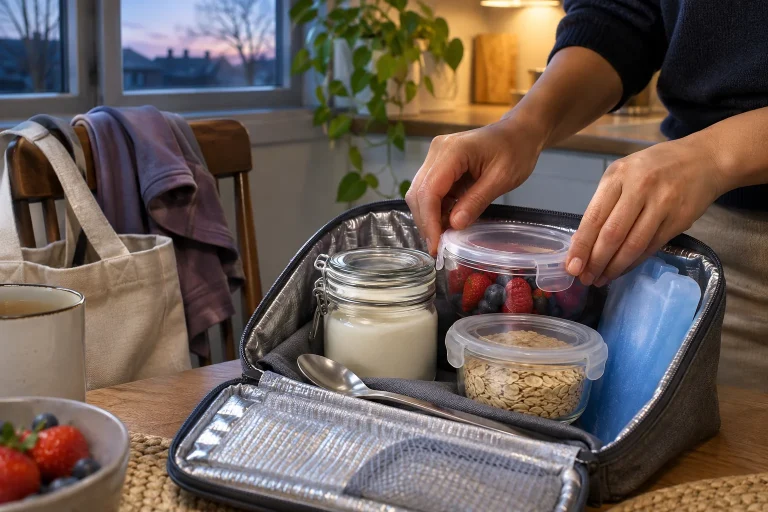
The German Federal Institute for Risk Assessment, BfR, guidance on preparing meals ahead mentions checking refrigeration at the eating location in advance and transporting food in a cool bag. This directs attention to the whole day. Choose a clean, suitable closable container and chilling appropriate to the food. An attractive box alone does not provide these conditions.
Look for four separate container properties
The first is suitability for food contact, the second compatibility with the particular food and temperature. The third is the closure needed during transport, the fourth cleanability. These are different. A storage container does not necessarily suit every cooking or reheating method. Check microwave, oven, dishwasher and freezer conditions in the specific manufacturer’s guidance.
The European Commission information on food contact materials also includes transport containers and kitchen utensils in this category. Choose a purpose-made food-suitable container. A previously used plastic box of unknown purpose does not automatically become suitable food storage. The material’s name alone does not establish every condition of use either.
 Enlarge diagram
Text version of the illustration
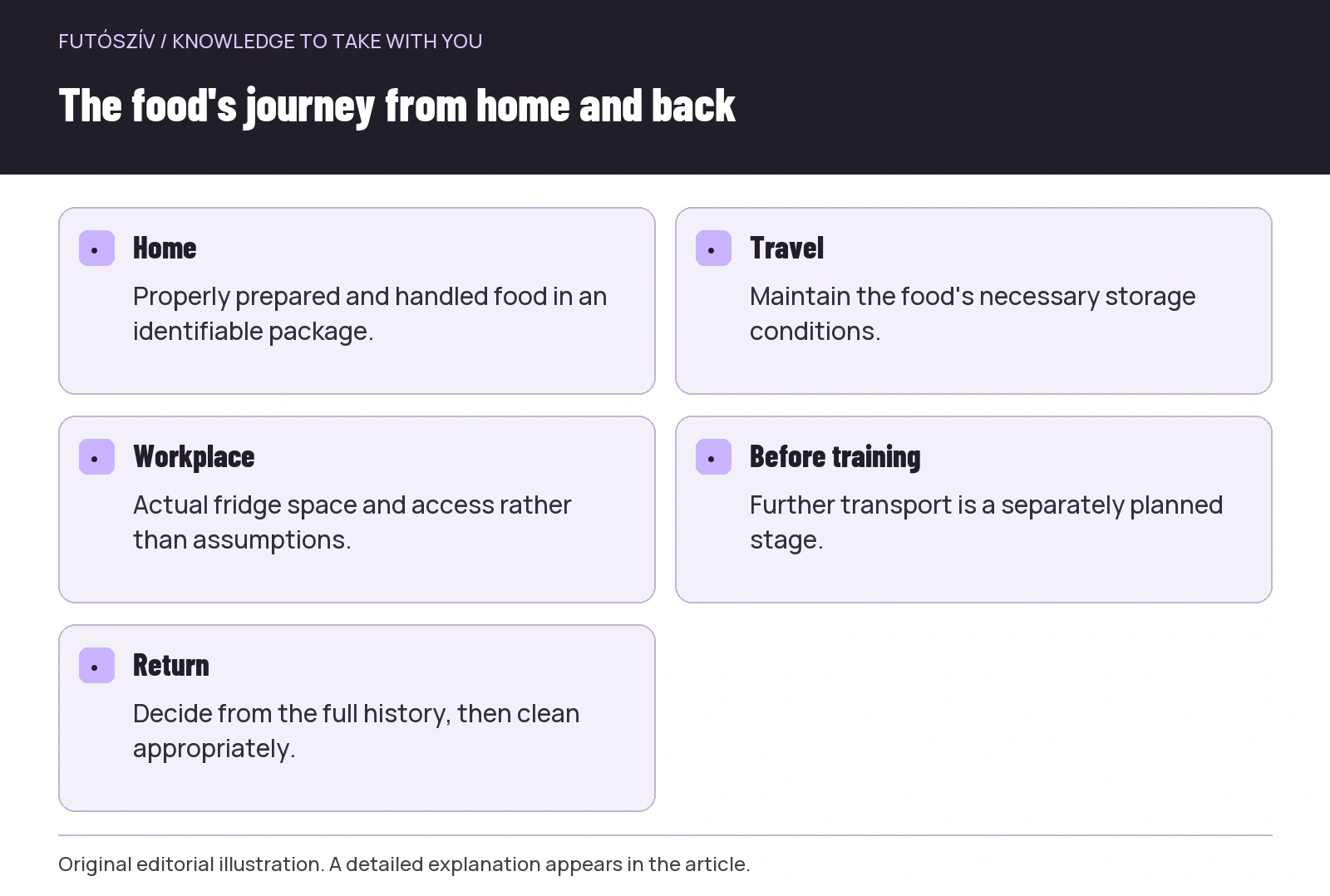
- Home
- Properly prepared and handled food in an identifiable package.
- Travel
- Maintain the food’s necessary storage conditions.
- Workplace
- Actual fridge space and access rather than assumptions.
- Before training
- Further transport is a separately planned stage.
- Return
- Decide from the full history, then clean appropriately.
Lids and seals are components in their own right
Check that the lid genuinely belongs to that container and the seal is positioned as instructed. Mixing similar-sized parts can easily weaken closure. Damage to a lid, valve or clip is more than cosmetic. If a container does not work as intended, another layer in the bag is not a permanent fix. Base the system on suitable containers in appropriate condition.
With a new box, learn the closure without food in ways the manufacturer permits. A simple leak test with room-temperature water in a safe place may reveal a mechanical fault, but is neither food-safety certification nor proof for every journey. Do not use a prohibited position or filling method merely for the test. Intended use still matters for your food.
| Property | What should you check? | Which other question does it not resolve? |
|---|---|---|
| Food-suitable. | Intended purpose and manufacturer information. | Does not automatically mean it withstands every heat treatment. |
| Appropriate closure. | Matching lid, intact seal and correct fastening. | Does not cool or disinfect food. |
| Temperature use. | Permitted applications for the specific product. | Does not change food storage life. |
| Cleanability. | Handling lids, seals and hard-to-reach parts. | Does not remove the need for regular proper cleaning. |
Plan liquid components separately if useful
Dressing, sauce or another moist component may be easier to handle separately and avoid changing bread or another drier base’s texture beforehand. This still needs a suitable small container compatible with its contents. Do not assume any small jar seals well. Check lid, filling conditions and a clean exterior before transport.
Separate packaging does not extend either component’s storage life. Each follows its own instructions, and the whole composition matters when assembled. Separating raw ready-to-eat vegetables from another properly prepared component can also make hygiene clearer. Do not change food form solely to carry fewer boxes. Safe feasibility matters more than the package count.
A cool bag is one tool within the system
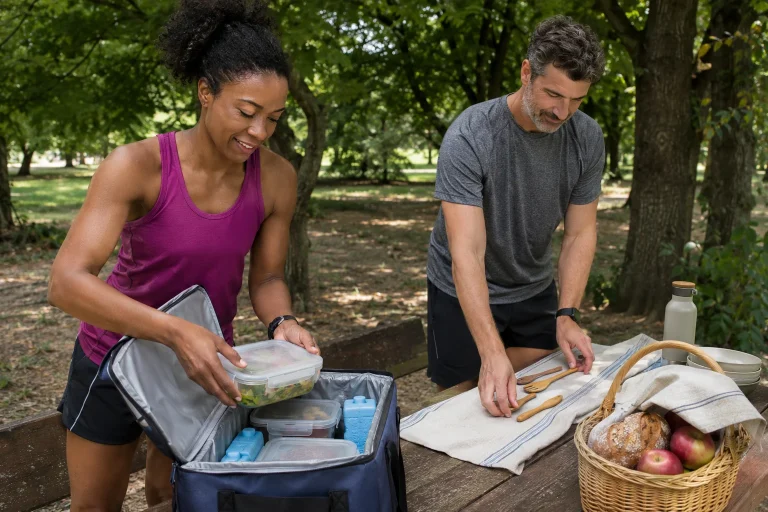
The Food Standards Agency consumer guidance for hot weather recommends cool bags, ice packs, avoiding direct sunlight and reducing unnecessary opening. The cold conditions the food needs must nevertheless actually be maintained. An insulated bag’s name does not prove suitable temperature throughout the day.
Use bag and cooling elements according to their instructions. Filling level, weather, journey length and opening create different conditions. Do not derive a universal summer duration from one successful cool-day experience. If required conditions cannot be checked or maintained, choose another food fitting your diet or appropriate access on site. Consider transport limits when selecting the menu.
The pre-training stage can be a separate journey
If you leave for another location after lunch, training food should not automatically remain in a sports bag all afternoon. Removing it from the workplace fridge begins a new transport stage. Know where and when you will eat and whether the chosen product can be handled appropriately. This article does not prescribe personal eating times; logistics need to serve your suitable schedule.
Pack food for that occasion separately if useful, avoiding reopening and rearranging the entire day’s supplies. Labels should show when each package was prepared for use and for whom. This helps especially when carrying family or team food too. Simpler packing should improve identification rather than erase necessary ingredient or storage information.
 Enlarge diagram
Text version of the illustration
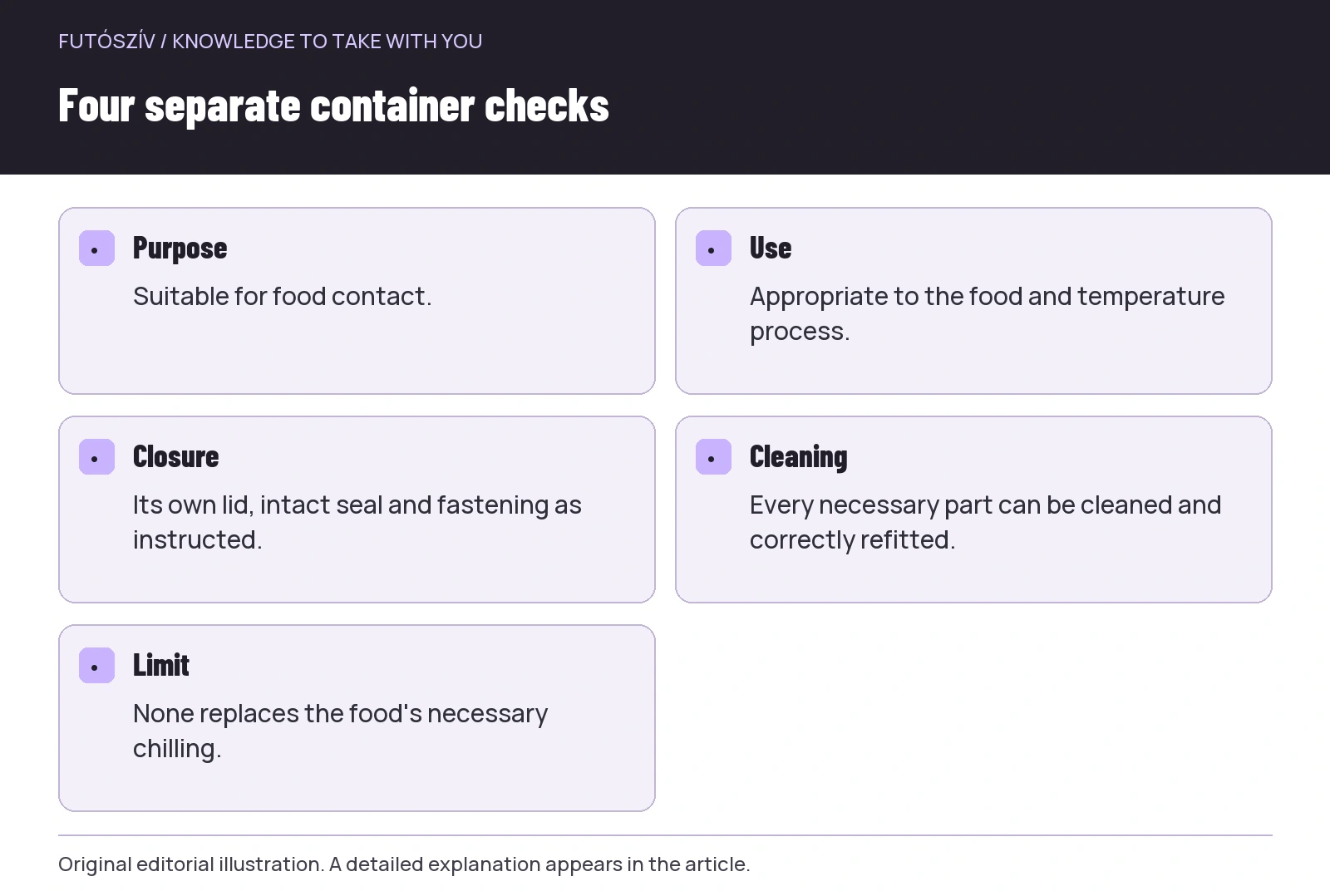
- Purpose
- Suitable for food contact.
- Use
- Appropriate to the food and temperature process.
- Closure
- Its own lid, intact seal and fastening as instructed.
- Cleaning
- Every necessary part can be cleaned and correctly refitted.
- Limit
- None replaces the food’s necessary chilling.
Microwave reheating requires another check
Container and lid may have different reheating conditions. Follow manufacturer guidance, including lid, valve and seal use. A suitable container does not guarantee every part of the food has heated appropriately. Follow the procedure for the dish and appliance, remembering the full history of raw or chilled components. Heating is not a general repair for previously incorrect storage.
If eating only part, plan this during packing. Portions appropriately separated beforehand may be easier to manage than repeatedly reheating and cooling one large box. A storage unit’s size is not a dietary prescription; several units can form your meal if needed. The aim is arranging necessary handling, rather than arbitrarily reducing quantity.
Give it a stable place in the bag
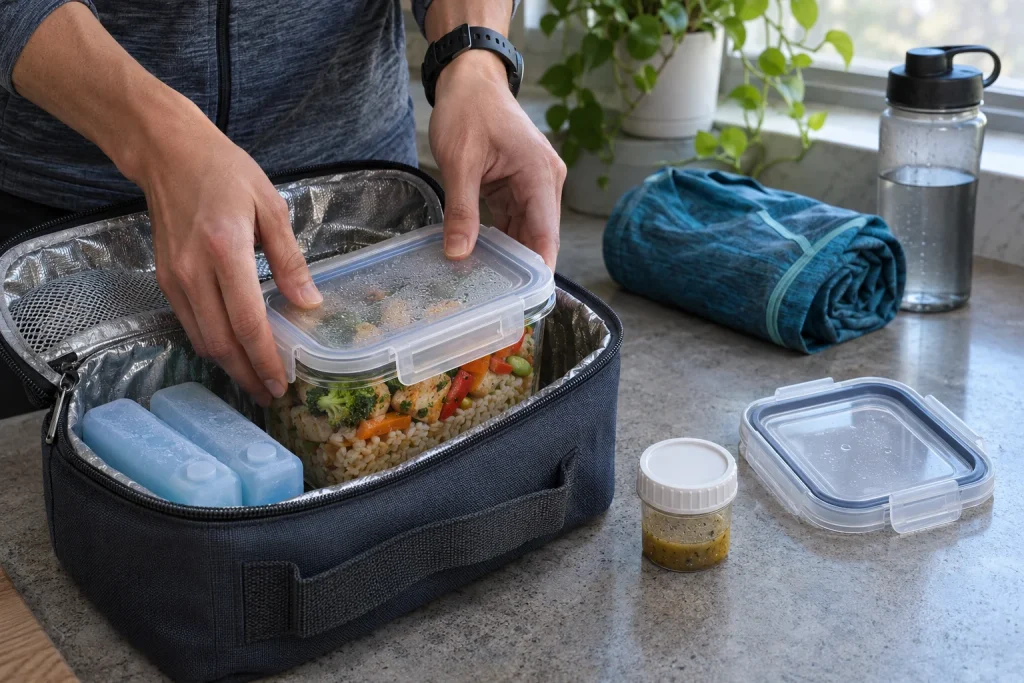
Position and secure the container as permitted. A heavy box should not crush other food or allow bag contents to open its clip accidentally. Necessary cooling packaging must remain functional, rather than squeezed into the last gap between sports kit. With glass, consider breakage and suitability at the destination. Check any special rules at a running venue or event too.
Separating food from electronics and other liquid-sensitive items can be practical but does not replace proper closure. Secondary packaging may reduce a leak’s consequences without automatically keeping food safe for longer. If a box opens or becomes contaminated, do not consider its contents suitable only because the rest of the bag stayed dry. The food’s actual condition determines the decision.
Do not leave cleaning until the next departure
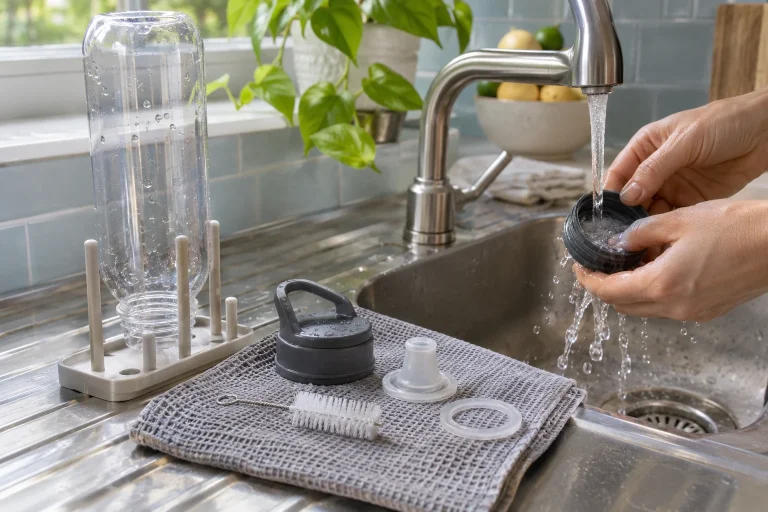
On returning, empty and clean the container, lid and necessary seal according to instructions. Attend to hard-to-reach parts and refill only properly clean equipment. Check correct refitting of removable components. A dirty lid or incorrectly replaced seal can create another problem during the next journey. Finishing the previous day simplifies the packing routine.
Decide about leftovers from the full day’s history and food-specific guidance. A package brought home does not automatically become fresh household stock again. If its time outside necessary storage conditions is unknown, do not invent a suitable history afterwards. Instead, adapt quantities, food format or the daily access plan next time.
A daily packing sheet to save
Record the actual food, eating occasion, necessary storage, journey stages and container conditions. Mark any utensils or suitable reheating needed on site separately. This need not become complex stock management: a few lines reveal the weakest stage. A new lid does not solve missing afternoon refrigeration; timing alone does not fix leakage.
Packed food for work and training becomes convenient when contents, container and the whole day’s journey fit together. Appropriate chilling, reliable closure and clean handling are separate tasks working together. Preparation at home then becomes an accessible meal, and the box in your bag carries a clear use plan alongside the food.
Sources and further reading
- BfR: Pre-cooking for several days — what should I bear in mind?
- European Commission: Food contact materials — general information
- Food Standards Agency: Food safety in a heatwave — advice for consumers
How Futószív articles are prepared: our editorial guidelines.