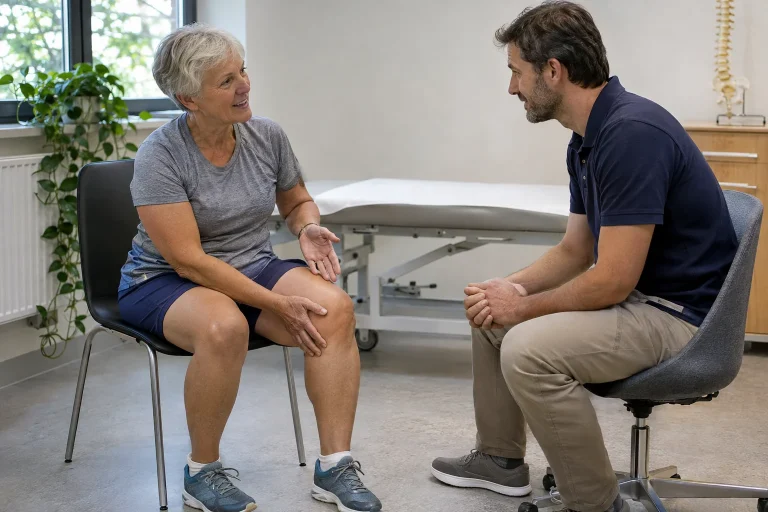
You get up and your knee is stiffer than usual. The calendar says running, then shopping, and later you need to collect someone. Earlier advice was to stay active without overdoing it. But in this specific situation, what counts as appropriate activity, what should be left out and when should you seek help? An individual plan for worse days can reduce that uncertainty by clarifying options in advance, so every occasion does not require improvisation.
The plan has an important boundary. Sudden severe joint pain, substantial new swelling, a hot or red joint, or symptoms with fever, shivering or feeling unwell should not automatically be treated as a familiar worse day alongside known osteoarthritis. Urgent medical assessment is warranted. An earlier diagnosis does not explain every new change; the NHS joint information also treats these warning symptoms separately.
First define what a worse day means for you
‘Worse’ may mean more pain, longer stiffness, greater difficulty standing up or needing to stop on a previously manageable journey. These can be related but are not interchangeable. A plan containing only a pain number may miss less steady movement around the home. A useful description refers to a familiar everyday situation: what changed from how the affected joint usually functions?
Record a few personal examples with your treating professional. They might include the usual journey to work, stairs at home, putting on shoes or getting off a bus. These need not become daily tests. The aim is a shared meaning for ‘today is worse than usual’. You can describe observations from activities already completed without deliberately provoking pain.
To distinguish a long-familiar pattern from a new symptom, discuss what falls outside that description. Previously unfamiliar locking, a change after injury or rapidly worsening function can raise a different question from familiar fluctuation. The plan should not require diagnosing the cause at home. It should show when reasonable independent adjustment ends and where to turn with the changed situation.
A flare-up is a description, not a ready explanation for every deterioration
Osteoarthritis symptoms can vary, with temporarily harder periods. The NICE NG226 guideline discusses flare-ups as part of information provision and ties management to symptoms and physical function. This does not mean every painful morning has the same meaning or that an established diagnosis reveals the cause of new swelling without assessment.
Separate observation from inference. ‘I stood a lot yesterday and find getting up harder today’ is a chronological observation. ‘I definitely destroyed my joint’ is an explanation that cannot follow from it alone. Calling every symptom after exertion harmless adaptation would be just as large a leap. An individual plan helps you avoid having to choose between those extremes.
A worse day does not judge your earlier efforts. Reviewing a plan does not admit insufficient discipline. If the prescribed task repeatedly conflicts with work, transport or your current condition, feasibility needs discussing again. A well-written plan answers more than the ideal, rested day with plenty of time.
 Enlarge image
Look at the whole day, not only the running session
Skipping training does not necessarily give the joint fewer tasks. Standing, carrying bags, stairs and a long journey home may await that day. In an editorial example, someone cancels a morning jog then uses the free time for a large shopping trip on foot. This is not a mistake or forbidden behaviour; it shows that the load visible in a sports log may differ from the real routine.
Bring more than weekly running mileage to the discussion. Explain which tasks cannot be omitted, what can be rearranged and where help is available. A realistic adjustment for someone working at home may differ from that for someone in a standing job or using several public-transport connections. Circumstances are not incidental conversation: they make an agreed solution executable.
Setting priorities is practical. If important errands await in the afternoon, mention them when discussing daily activity. You do not have to replace every cancelled sporting outing with another performance task. Planning may include less demanding organisation, asking for help or postponing a task; the individual professional plan must clarify which movement is advised for your condition.
An alternative should be specific and genuinely available
‘Do something easier’ is often too broad. A shorter route, another activity or a modified therapeutic task may be easier, but they do not automatically replace one another. If running is not among the advised options now, that does not make every other sport unlimited. Ask which versions were actually discussed and which need further agreement.
The CDC general activity information highlights accessible, enjoyable, sustainable activities that cause few symptoms. This is public-health context, not personal permission to run. Your plan also needs to consider reaching the alternative, suitable equipment and whether getting there is harder than the activity itself.
Imagine two previously agreed options, one at home and one requiring travel. If travel, changing or stairs present too large a barrier that day, the second option’s advantages on paper are insufficient. A practical plan can include access: where the task is done, what it needs, whether the setting is safe and what happens if it proves infeasible. This need not start with buying equipment.
Therapeutic exercise differs from an independent trial run
Personalised therapeutic movement has a defined purpose and follow-up. NICE considers therapeutic exercise adapted to individual needs an essential part of osteoarthritis management. But this does not tell an unknown reader which running workload to do on a painful day. A professionally agreed task differs from deciding to set off and see how much you can tolerate.
If you have exercises, ask how they change on a worse day. Does the purpose stay the same with different execution? Is there an element not to do until further discussion? The answer depends on your condition and earlier responses. A general article’s repetition count, pain threshold or rest period cannot safely replace it.
Adjustment should not become a hidden performance contest. If running is omitted, an alternative need not prove its purpose by making you equally tired, using equal energy or earning the same watch score. Those differ from current joint function and the therapeutic task’s purpose. State what you aim to preserve or improve and what need not be achieved that day.
Write the plan so it is understandable on a difficult morning
A good reminder is not a long medical record. Include the situation it covers, the agreed change, the response to observe and how to seek help. Mark its date so advice for an earlier condition does not quietly become an unlimited rule. If several professionals provide care, clarify whom to contact with questions about the plan.
| Part of the plan | What should be clarified together? |
|---|---|
| A familiar worse day | Which earlier symptom pattern does the adjustment apply to? |
| Daily task | What is unavoidable, and what can be rearranged? |
| Agreed version | Which adjustment to which activity or task is available? |
| Feedback | Which symptoms and everyday function should you report? |
| A new situation | Which changes call for a new assessment instead of the old plan? |
This table is a question framework, not completed therapy. Your example can be simple: usual movement around the home is harder that day, so you want feedback on a previously specified adjustment. What matters is not having to invent an entire session from a statement originally intended as general direction. Check understanding by describing in your own words what you will do.
 Enlarge image
Feedback should cover more than workout minutes
A few factual sentences may be enough next time: what changed, what you adjusted within the agreed framework and what happened to daily function afterwards. ‘The programme was shorter’ says little if getting home then became harder. Conversely, a missed workout is not automatically a failure if the day’s organisation followed the agreed goal.
You do not need to measure or provoke symptoms hourly. A short, clear note may help more than many incomparable data. Include everyday context such as unusually long standing, travel or another circumstance. This does not mean you found the cause. It provides background a professional can interpret alongside symptoms and examination findings.
If an adjustment repeatedly fails, do not simply repeat it with greater willpower. Feedback may explain that a task was unclear, equipment inaccessible or working hours require another time. These may be practical problems that can be improved. A usable plan can accommodate such obstacles without placing the whole responsibility on the reader.
Agree a next step if things do not improve too
NICE follow-up recommendations include clarifying when to seek further help if agreed management is ineffective or difficult. Your plan should therefore include contact details and an agreed feedback point. Timing is not identical for every condition; a universal internet waiting period cannot settle it. New urgent symptoms do not wait for routine follow-up.
Review may also be warranted when life changes. A new job, move, transport route or another health condition can alter feasible options. The plan is not a contract to perform identically under every circumstance. It is a shared reference so symptoms, daily tasks and important goals do not shape the day separately while ignoring one another.
A question for the next appointment could be: ‘If I have another morning like last Tuesday, what should I change in the agreed programme, what should I notice about everyday function, and which changes mean contacting you sooner?’ This includes your situation, a request for cooperation and the plan’s boundary. You do not have to prove in advance that you will run that day; you want to understand a usable decision for your current condition.
Sources
- NICE NG226: osteoarthritis, personalised management and follow-up
- CDC: general information on activity with arthritis
- NHS: joint symptoms and changes requiring urgent help
How Futószív articles are prepared: our editorial guidelines.