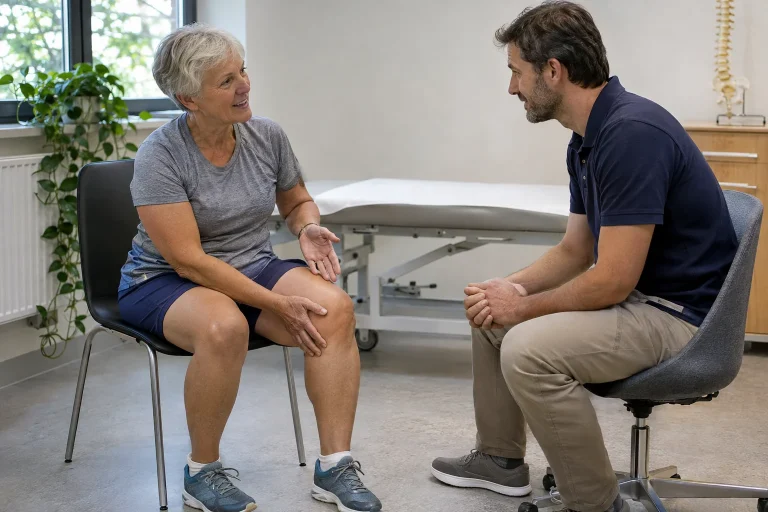
Reading a report, it is easy to turn the term ‘wear and tear’ into a whole vision of the future: the joint is worn out, so every movement must now make it worse. Yet at follow-up you are asked how you walk, use stairs and carry out daily tasks. This does not ignore the image. Symptoms and function provide information that can make the purpose of individual care and the next step clearer.
Seek urgent medical assessment for a suddenly very painful, hot and swollen joint, or symptoms accompanied by fever or shivering. The NHS treats these as specific warning signs. Do not automatically explain a new condition with an old osteoarthritis report. The explanation that follows concerns understanding an ongoing condition, not ruling out acute symptoms at home.
Imaging and function provide different information
Imaging describes structural features visible with that particular method. Function reveals how symptoms affect your life. Neither devalues the other. A report does not fully describe how you get to the shops, what the stairs at work mean for you, or how much stiffness interferes with a task important to you.
The NICE NG226 guideline links osteoarthritis care to symptoms and physical function. Follow-up is therefore more than reading an image again. Your account and an examination help interpret which problem needs addressing, what has changed and which goal is worth following. A term in a report does not contain all of that information.
If your function is better than you imagined from the alarming description, say so. If you have significant difficulty, do not feel that only a ‘bad enough’ image can validate it. Your symptoms and their effects are real information. In clinical assessment, they do not compete with the report; together, they help explain your individual situation.
‘Wear and tear’ is not the same story for everyone
According to the NHS, osteoarthritis symptoms can differ between people and joints; they may be mild, variable or make the day substantially harder. The condition does not necessarily worsen continuously in everyone. This does not justify promising improvement, but the term in a report does not dictate an identical, prewritten decline for every person either.
The everyday image of ‘wear and tear’ may suggest a machine part worn thin. It can imply that use only comes at a cost. Individual care examines more than that: symptoms, strength, movement, everyday tasks and the usability of the chosen plan. You do not have to follow the metaphor literally to take the condition seriously.
Another person’s story is not a reliable template either. They may have read the same word in a report but received advice for a different joint, different symptoms or a different health background. Instead of comparing, focus on your own changes: what has become harder or easier, and under which circumstances? This is a more precise starting point for follow-up than looking for your future in a shared story.
An important task can become a useful goal
‘I want a better knee’ is understandable, but often too broad for follow-up. A more specific goal might be getting to work more comfortably, managing necessary stairs or joining a family activity. These are examples, not prescribed goals. A different task may matter most in your day, and running need not take priority over everything else.
A goal should not become a home fitness test. If stairs are difficult, you do not need to repeat them several times before the appointment to produce more precise data. Describe what you already know: which direction, circumstance or daily consequence bothers you. Your story is useful without a test result measured to the second.
The 2025 ACR information also emphasises realistic personal goals and considering barriers to carrying them out. In everyday planning, this becomes a simple question: what fits your day, and why is it difficult now? A goal helps when it makes the discussion of the plan more precise rather than creating another pressure to perform.
 Enlarge image
Therapeutic exercise is not the same as any workout
The American College of Rheumatology distinguishes targeted therapeutic exercise, recreational activity and competitive sport. A therapeutic task relates to the condition and functional goal concerned. A general statement about the benefits of movement therefore does not mean that the same running distance or group class suits everyone.
The NICE guideline recommends personalised therapeutic exercise, such as local muscle strengthening or general aerobic elements. This article does not select a specific routine from them. The purpose and teaching of an exercise matter more than whether it looks simple in a video. If you are given a task, understand its role in your plan and how its effects will be followed.
This is not a promise that a particular exercise or running will rebuild cartilage seen on imaging. Changes in pain and function can be valuable care goals in their own right. You do not have to make successful practice depend solely on a new image looking ‘better’. Equally, general benefits do not justify treating new, strong or unusual pain as an automatic, natural part of every task.
| A follow-up question | What can it show? | Why is it more than a side issue? |
|---|---|---|
| What task matters to you? | It gives the plan a personal goal. | The image does not describe your priorities. |
| What has changed? | The course of symptoms and function. | An old report term does not explain every new condition. |
| What parts of the plan are you doing? | It reveals actual use and implementation. | A plan that looks good on paper is not feasible everywhere. |
| What makes it difficult? | Work, transport or a need for support may emerge. | Personal circumstances influence follow-up. |
Different activity elements may serve different purposes
The ACR describes several movement areas, including flexibility, strengthening, aerobic activity and mindful movement. These are not interchangeable labels. Joint movement, muscle function and completing a longer daily task may play different roles in an individual assessment. One favourite sport does not necessarily cover every goal.
If you enjoy running, for example, your plan may still include another targeted task. That is not necessarily because running is ‘bad’, but because a different capacity or specific functional difficulty needs support. Understanding the exercise’s role can help you avoid judging every element through the same pace-or-distance lens.
Access matters when choosing alternatives too. What is feasible may differ at home, alongside work or without travel. You do not need to abandon an entire individual plan because a programme is inaccessible. Describe the specific obstacle so that you and your clinician can retain the goal and reconsider implementation. Equipment or a location is not the therapeutic goal in itself.
Why is a new image not compulsory at every follow-up?
The NICE NG226 guideline does not recommend routine imaging at every osteoarthritis follow-up or to guide non-surgical management. This is not a general ban on imaging. A scan may address a specific question, and unusual symptoms or suspicion of another condition may call for a different approach. Routine use and a targeted question are different situations.
A follow-up can be meaningful without a new image. An individual examination, the course of symptoms and your ability to manage important tasks can all inform the plan. You need not regard your experience as less credible because there is no fresh image file. Following function is part of care, not merely a substitute activity.
If new imaging is proposed, ask which question it is intended to answer. Understanding the examination’s purpose also helps interpret the report later. Not every abnormality automatically means new treatment, and a difference between images does not by itself determine your sporting options. Your condition and the question belong alongside the result.
Do not hide a new symptom behind an old report
The NICE guideline lists recent trauma, prolonged morning stiffness, rapid worsening and a hot, swollen joint among atypical features. These are not items in a diagnostic scale to complete at home. They warn that the current story cannot always be settled simply by naming a previous osteoarthritis diagnosis.
If movement changed after a specific injury, describe that separately. New changes in sensation, significant swelling or feeling unwell should also retain their own place. You do not first have to prove they definitely do not belong to osteoarthritis. Clarifying the relationship is the assessment’s role. An old diagnosis may help explain the background, but it is not a prewritten answer to every change.
You can also report a milder change that remains troublesome. If a previously easier daily task becomes difficult, do not simply record it as an inevitable feature of age. Individual follow-up can assess what happened and whether a change is needed. The important question is not whether the same word appeared in an old report, but how your condition has developed now.
 Enlarge image
Follow-up also concerns whether the plan is feasible
Explain which elements you could use and which did not fit your actual day. An exercise being unclear, the surroundings being unsuitable and a new symptom appearing during it are different situations. Do not compress them all into ‘it did not work’. The distinction may help identify what needs changing in the plan.
The NICE guideline considers symptoms, activity, personal needs and difficulties with the agreed approach during follow-up. You therefore do not have to bring only improvement to the appointment. An uncertain or unsuccessful detail can also be important information for the next decision. You need not present the individual plan as more successful than it was in use.
According to the ACR, a professional can help adapt movement to your needs and follow your response. This article gives no pain threshold or rule for increasing workload. Individual feedback can clarify which task, organisation and further checks fit your current condition. Completing the toughest programme is not the goal.
A running plan can be one of your important goals
Running may mean community, a familiar rhythm or a sporting goal to you. Say that at follow-up. Your motivation matters in a clinical conversation, but it does not automatically override assessment of your current condition. The same running task is not appropriate for everyone with osteoarthritis, and one report term should not give everyone identical permission or restrictions.
A more specific question is: under which conditions and individual plan can your goal be discussed meaningfully, and what change needs to be followed? This is more precise than asking generally whether running is allowed with osteoarthritis. Symptoms, function, the affected joint and health background can all enter the answer. Your sporting identity and clinical assessment do not replace one another.
Osteoarthritis in your report therefore does not make a conversation about function unnecessary. That is precisely what makes follow-up personal. The image is important information; difficulties and goals in your day show what the plan needs to address. A useful follow-up connects the two and offers an understandable next step for your condition, without a promise of a cure or one running recipe for everyone.
Sources
- NICE NG226: osteoarthritis care guided by symptoms and function
- American College of Rheumatology: therapeutic and recreational exercise, 2025
- NHS: osteoarthritis symptoms and their differing course
- NHS: new joint symptoms and seeking urgent help, 2026
How Futószív articles are prepared: our editorial guidelines.