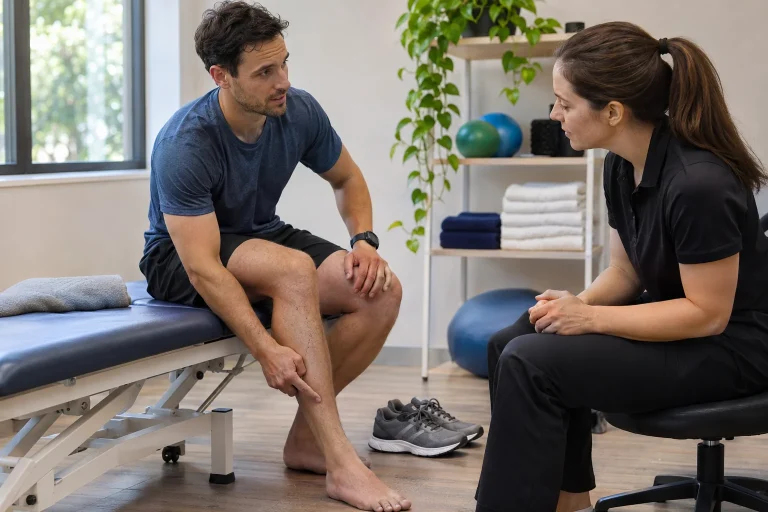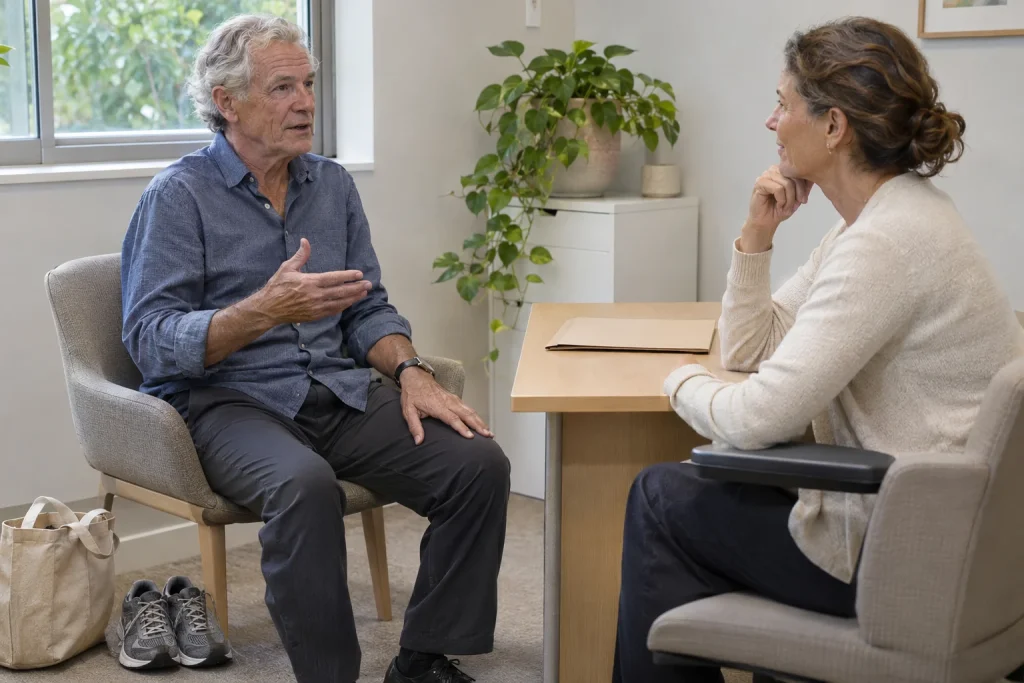
An ordinary trip ended in a fracture, even though the fall did not seem serious. After treatment, it is understandable to want to know when you can run again. As an older man, however, another question may become important alongside returning: should bone health and prevention of another injury receive a separate review? The accident not happening during sport does not make this irrelevant.
Osteoporosis does not affect women alone. At the same time, a reader cannot diagnose themselves from a fracture, and this article does not determine necessary treatment or activity. The aim is to make healing, bone health and everyday falls situations visible separately alongside a running goal.
Treating a new injury comes first
If the fall has just happened, severe pain, visible deformity, suspected head, neck or hip injury, or inability to get up independently require appropriate help, urgently when necessary. Testing whether you can bear weight is not the next step. The NHS information on falls also separates these situations from general prevention. Previously provided individual care instructions form the primary framework.
Later, do not check whether the bone has healed with a short test jog either. Changes in pain are important experience, but do not by themselves replace professional assessment of the injury. Permitted movement can depend on the fracture’s location, treatment and current healing. The same return week cannot be assigned to every fracture.
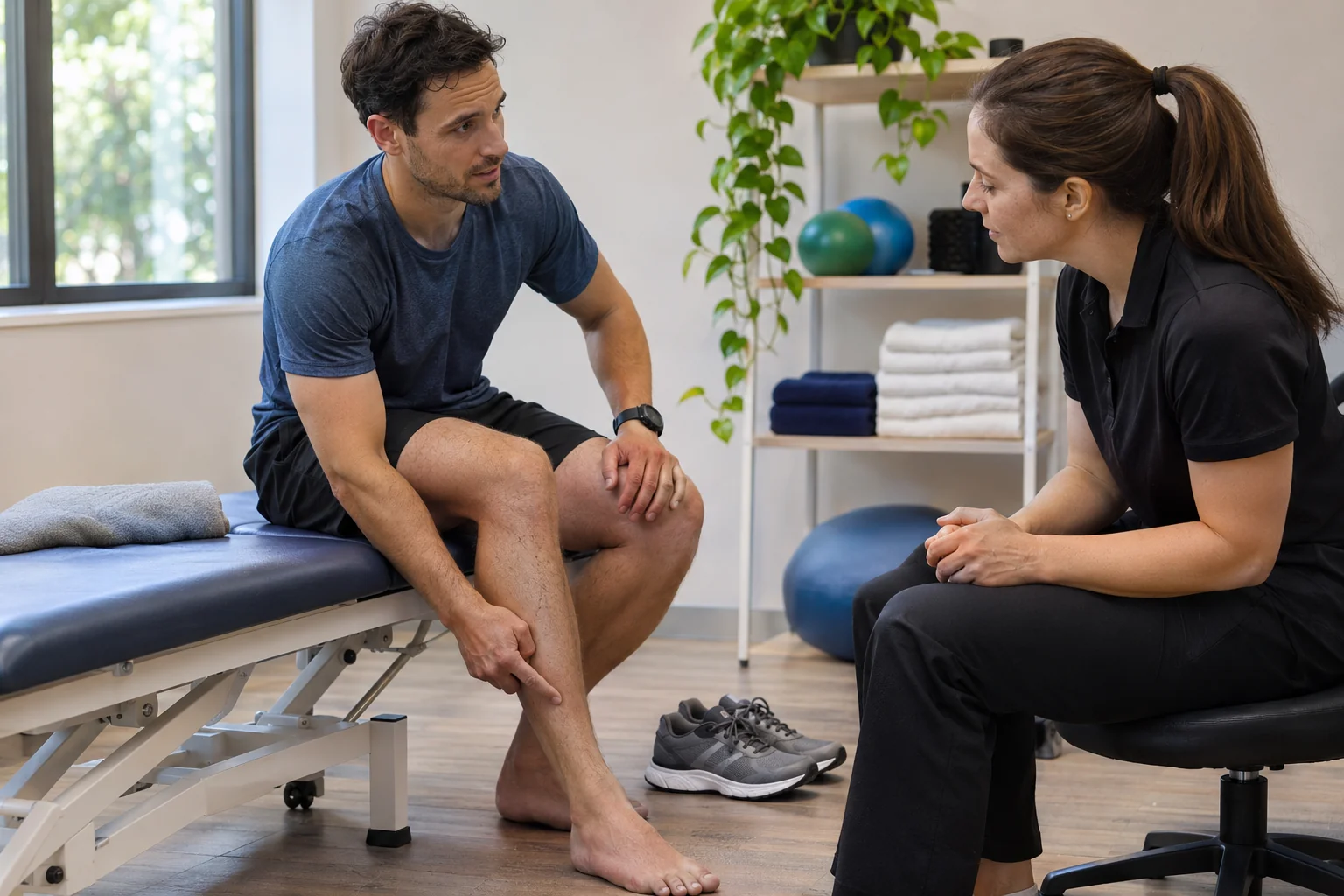
During care, therefore, make sure you understand which limb or movement you may use within which boundaries and when follow-up takes place. “Take care of it” and “Keep moving” alone may not guide everyday decisions sufficiently. Walking, stairs, carrying and sport can raise different questions. Clarifying them makes daily life easier too, beyond planning running.
What does a fracture after a small fall mean?
Keep precise circumstances behind the everyday phrase. Did you fall from standing, tumble down stairs, slip on the ground or hit something? The force reaching the bone and how the injury happened matter for interpretation. “Low-energy fracture” describes a clinical relationship, not an event or consequence that is insignificant.
According to the NIAMS information on osteoporosis in men, a fracture after age fifty can be an important signal for assessing bone health. Bone mineral content, mass and structure all relate to strength. An apparently ordinary event should therefore not be closed off as mere bad luck, particularly if bone health has not previously been discussed.
This is not an automatic osteoporosis diagnosis. Appropriate assessment needs the full history, fracture characteristics and, where relevant, tests. The important distinction is recognising the question rather than deciding it at home. An injury establishes neither that all future movement is dangerous nor that the next sporting week will simply resolve bone health.
 Enlarge image
A male sporting background does not rule out changes in bone health
You may have a long running history, a lifetime of regular work or a strong sporting self-image. These are important parts of your story, but do not make deteriorating bone health impossible. Being a man who does not experience menopause is not a reliable reason to assume bones cannot concern you either. Explanations tailored to women’s life stages need not be adopted unchanged, but your own circumstances deserve review.
The NIAMS account also identifies factors in men related to age, chronic illnesses, certain medicines and hormonal status. This is not a diagnostic checklist to complete at home. It shows why one sporting result or body characteristic cannot provide a complete answer. Present and previous care may also matter in individual assessment.
If you have received long-term treatment for another illness, for example, it may be important to mention that in a bone-health discussion too. This does not mean changing the medicine yourself. Interpret the relationship with your clinician: why treatment is needed, its benefits and whether further bone-health action is necessary. One healthcare aim does not automatically override another.
Three separate plans need to meet
The first plan concerns healing of the particular fracture. The second addresses bone health and possible further fracture risk. The third deals with circumstances related to falls and everyday functioning. They are connected, but perform different tasks. Focusing only on the first can leave out why the event happened and how another might be prevented.
| Area | The question to clarify |
|---|---|
| Injury | How is the fracture healing, and which movement is permitted now? |
| Bone health | Is further assessment or an individual prevention or treatment plan warranted? |
| Fall situation | Which individual and environmental circumstances contributed to the event? |
The table does not mean everyone must book three separate appointments. Care organisation varies, and several questions can be addressed within one process. What matters is knowing which area already has an answer and what remains open. A healing-fracture check does not necessarily include every bone-health or falls-prevention decision.
Bone-loading activity does not mean one compulsory sport
The NIAMS material on exercise and bones discusses several types of activity, including weight-bearing, resistance and balance work. A general list of examples does not establish that jogging is appropriate for you now after a fracture. Choose the form and progression to match individual condition.
“Loading is good for bones” is easy to use too generally. It does not specify which load, in which condition or for which purpose. A recent fracture, known vertebral involvement, balance difficulty or another illness may modify the task. A sporting option is not more valuable because it is more dramatic or higher impact.
Running can therefore remain a personal goal without being the only imaginable route. The NIAMS information on preventing another fracture also identifies the option of individualised help with movement. This may address everyday safety, strength and learning appropriate movement. It is not simply about replacing missed kilometres.
Reviewing the fall’s environment matters too
Falls prevention cannot rely only on bones or willpower. The CDC falls-prevention information mentions medication review, vision checks, appropriate strength and balance activity and arranging the environment. Specific action depends on individual circumstances; the same factor is not decisive for everyone.
Think through the event’s sequence. Did you enter a dark corridor, was something in the way, were you rushing or did feeling unwell precede the trip? This is not a search for someone to blame. The aim is to find details that can change and distinguish those needing professional assessment. “I was careless” often closes this thinking too early.
As a runner, your programme’s environment includes more than the running track. Preparing at home, stairs to the car, the changing room and arriving home are also parts of the outing. If one section is harder now, address it within the whole plan. Safer organisation is not the same as withdrawing from all outdoor movement.
 Enlarge image
Retain more than one number from a report
If testing takes place, understand which question it addressed and what the result changes in the plan. Bone-density measurement is a particular assessment, not a complete measure of readiness to run. History, fracture characteristics and other individual circumstances can matter alongside a reported number. Classifying yourself with online tables does not replace this.
A clear set of next steps is more useful to take home from the discussion than many unfamiliar terms. What happens because of the injury, what is the bone-health decision, whom do you contact with questions and when will the plan be reviewed? If several providers are involved, make clear who coordinates important information.
Medicines, vitamins and supplements also belong in an individual plan. Worry after a new fracture does not justify an independent high-dose course or hormonal treatment. Different products are not interchangeable answers and do not automatically replace warranted care. “Bone protection” on a label alone does not establish whether something is needed or appropriate for you.
When everyday walking becomes easier, the next question changes
Imagine a fictional man who fractured a bone after tripping at home. During recovery, walking becomes more comfortable, so he wants to resume his previous running programme at the same point. The first useful step is not completing a predetermined distance, but clarifying which earlier restriction has changed and which activity can follow within his own care plan.
Improved walking in the example is real progress. It still does not independently answer the whole bone-health question or establish whether feeling unwell before the fall has resolved. Improved everyday ability and a need for further assessment can both be true. Neither needs to be treated as refuting the other.
You can make a specific request to the running community too: a different kind of meeting, a more accessible place or shared time outside sport for now. Asking for help does not mean losing masculinity or past sporting achievements. Participation suited to your situation leaves more options than taking on a programme too early to prove an old role.
You can also check a new plan against details of your ordinary day: can you reach the meeting point in the permitted way, does equipment need carrying and will the journey home involve rushing? These are organisational conditions, not tests of bone healing. If reaching the sporting activity contains more difficulties than the assigned movement itself, address that separately. Another venue, help arranged beforehand or a simpler bag can answer such an obstacle more precisely than trying harder. Individual restrictions must still be followed.
Sources
NIAMS: osteoporosis in men; NIAMS: exercise and bone health; NIAMS: preventing another fracture; CDC: preventing falls and hip fractures; NHS: falls and seeking help. Checked: 21 November 2026. The returning man’s story is an editorial example, not a patient account or return protocol.
How Futószív articles are prepared: our editorial guidelines.