An old results list preserves how fast you ran on that particular day for a long time. After today’s loop, you may therefore find yourself looking for the same number, even if your circumstances, health or what you value about activity have changed in the meantime. A personal best can remain a treasured memory. You do not need to judge every activity today as a continuation of the same race.
Choosing a new goal does not mean denying your sporting past, and you are not obliged to give up every performance target. The question is what you want from activity now and under what conditions it fits your present life. A previous time is just one possible reference point. Your own functioning, participation and access to an activity you enjoy can answer different questions.
An old time tells the story of a particular day
Behind a personal best were a route, weather, preparation and a particular set of life circumstances. You may have had more free time, different daily responsibilities or a different sporting aim. The number preserves that performance, but cannot hold much of its context. If you bring only the minutes into the present, the background in which the result was achieved can easily disappear.
It is worth keeping your own story alongside the old result. Who did you train with, where did you go and what mattered at the time? Those memories remain valuable even if your current pace is different. Remembering does not have to become a continual assignment to try again. An earlier sporting experience does not remain yours only if you reconfirm it every year.
Comparison can still be interesting when you choose it deliberately. The question is what you use it for. If the difference is all you retain at the end of every activity today, consider whether the scope of your assessment has become too narrow. Different observations reveal different goals. A time alone, for example, says very little about whether a social outing was successful.
First name what you want to preserve now
The WHO explanation of healthy ageing connects functional ability with activities that matter to the person and with their environment. This is a broader perspective than a running time. Activity can also be about independence, connection, learning or reaching a favourite place. You do not need to compress its personal meaning into a single sports metric.
A specific question might be whether you want to get to a nearby park regularly, keep meeting a friend or make an important outing easier to organise. These do not immediately imply a particular form of exercise. How they are put into practice must fit your individual condition. The goal, however, can already be named, making the conversation more precise.
If sporting results still interest you, you can say that too. You do not have to choose the label “being active only for health” to please other people. Alongside a sporting goal, other considerations can remain important: the programme should not crowd out all social time, travel should be manageable and it should fit your individual healthcare framework. Having several considerations does not make your goal any less real.
Make a new goal specific without turning it into a compulsory test
The NIA activity guide highlights realistic goals that can be put into words and start from your current situation. Knowing what you want to do, where and under what conditions helps with practical arrangements. This does not have to become a rigid daily score. The purpose is to clarify your choice, rather than set yourself another examination.
| What might matter | A specific version of the goal | What can you observe? |
|---|---|---|
| Social participation | Getting to a shared activity that suits you. | Were the meeting place and arrangements usable? |
| A favourite environment | Regularly reaching a park that matters to you. | Did getting there fit into your day? |
| Independent organisation | Calmly preparing a suitable opportunity for activity. | Which preparations went well, and where was help needed? |
These examples are not clinical function tests. They do not assess your health, and one successful activity does not establish that every other load is appropriate. Personal observation relates to the particular goal. This keeps the subject of assessment clear: you are discussing what you actually wanted to accomplish.
If the goal is too broad—“I want to be like I used to be”, for instance—it is worth choosing one part that can be grasped in the present. Your former self had many different stories, not just a running time. Time with friends, experiences associated with places and the enjoyment of movement can each be named separately. This can make your choice more personal and manageable.
 Enlarge image
Look for comparisons relevant to your current starting point
You can connect today’s activity with the circumstances of the current week. Which route was available, how much organisation did it require and what has changed compared with the recent past? You do not need to use your speed from a decade ago as the baseline. Understanding how you function now may call for a different timescale from organising your sporting archive.
Keep the circumstances of comparison in mind too. A loop with the same name may involve different access arrangements, waiting or social organisation. You do not need to explain every difference through a single characteristic of your body. Conditions on the route and during the day also help shape the experience. Specific circumstances provide a more accurate background than simply judging that you have “got slower”.
Observation does not require detailed measurement of every activity. A few sentences of your own may be enough: arriving felt unhurried, the meeting was scheduled too late, or the chosen place is closer to your daily errands. These are details about organisation. A change in health or a symptom needs separate assessment; it need not simply be attributed to a poorly chosen goal.
You can tell companions what your activity is about now
Your old running group may enjoy talking about shared personal bests. This can remain a happy way to remember, while the present outing has a different purpose. Explaining beforehand that you want social time outdoors today, or a shorter activity that suits you personally, makes it easier for others to join in on that basis. You should not have to defend your choice again during every run.
A simple sentence can help: “I would like today’s outing to fit my current plan; I am not treating my old times as the target right now.” You do not need to provide your complete medical history. Naming the framework you have chosen and sharing your personal information are two separate decisions. The first may be enough for a shared outing.
If your companions have completely different aims, you can arrange different activities or another way to connect. Being apart from the group for an activity does not immediately mean distance in the relationship. You can meet before the start or somewhere else later if that suits everyone. Friendship does not require taking on identical exercise loads.
The NIA overview of healthy ageing also recognises the importance of social connections and enjoyable activities. We cannot infer a health gain from a single meeting on that basis. The useful perspective is that the social value of activity can have a place among personal goals alongside performance data.
An app and a memory box can have different roles
If your running app always displays an old record first, your assessment can easily keep returning to it. In your own habits of use, you can make space for what you want to see now: the location of the outing, its social aspect or a short written note. You do not need to invent another metric for every experience. Putting the phone away can be a choice too.
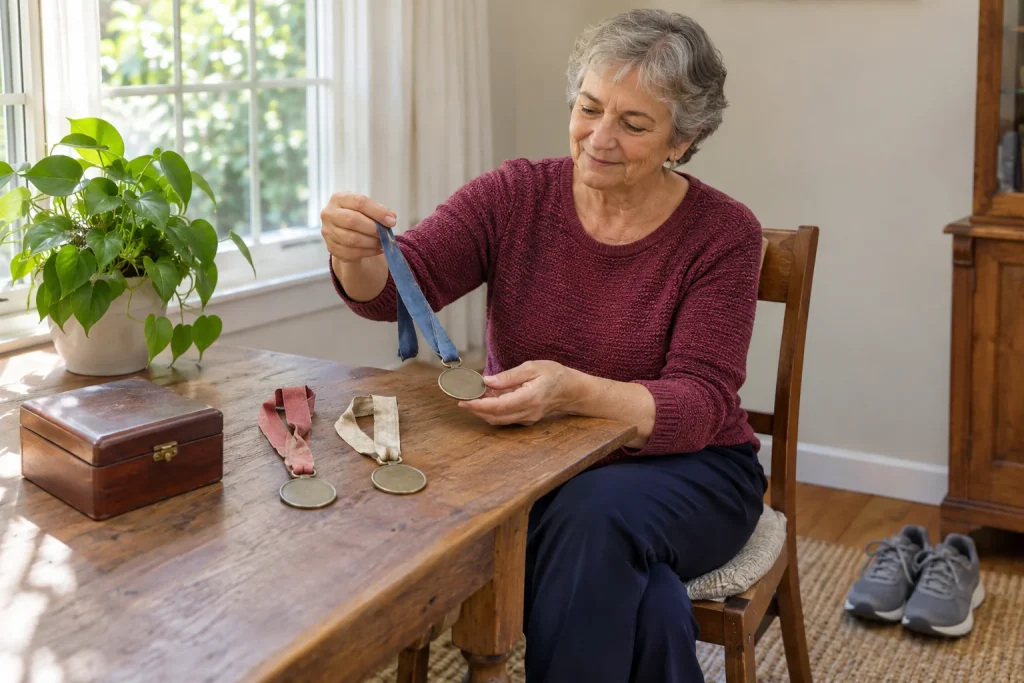
You can also keep old medals, race numbers and photographs as memories. You do not have to put them out of sight simply because your current aim is different. A memory box and today’s activity plan do different jobs. One preserves the past; the other helps organise a suitable opportunity now. Neither has to invalidate the other.
When remembering together, you can also name things that cannot be quantified: a journey, a supportive companion or an unusual location. This keeps the story of the old result more complete. It becomes part of your own running past, rather than appearing as a single lost pace. Meanwhile, activity today can have a new meaning of its own.
If a health change lies behind the change of goal, give it attention of its own
A new goal can help with organisation, but does not replace assessment of a new symptom. If a familiar activity suddenly becomes more difficult, or pain, dizziness or unusual breathlessness appears, it is unwise to call this merely a question of motivation. Clarifying your condition and defining a sporting goal are separate tasks.
The CDC activity guidance for older adults emphasises a plan suited to the individual’s condition and abilities. Looking for appropriate activity does not mean that every change can be answered with more willpower. In a professional discussion, you can also name the activity you want to preserve or regain access to later.
Encouragement about thinking more positively must not obscure help that is needed. Equally, a health difficulty does not automatically erase your personal goals. Both can have a place in a plan: appropriate care for your current condition, and what activity means to you. The chosen form and timescale can develop with both in view.
 Enlarge image
Two goals for today alongside the same old result
In the first fictional example, someone keeps an old half-marathon result but now chooses regular attendance at a friendly park outing as a personal goal. Success concerns whether the activity fits into the day and whether they can participate within their own limits and arrangements. At the end, they do not need to measure their presence against their old race pace.
In the second example, another person still wants to work towards a sporting result. They connect the target to their current situation and a suitable individual plan, while paying separate attention to social and daily practical considerations. They do not automatically require a simple copy of the old record. Sporting ambition thus remains a specific, present-day question.
The two examples do not rank the goals. Neither person has greater worth because performance or participation comes first for them. What matters is that the choice is their own and relates to real conditions. Another person’s approval is not an appropriate reason to override your individual healthcare or organisational framework.
At the next review, ask about the meaning of the goal too
What matters can change over time. You may find a different activity with a new group, or a goal chosen earlier may require too much organisation. A review should therefore consider more than how much you completed. You can also ask whether this is still what you want and which circumstances would support it better. Adapting a plan does not repudiate an earlier decision.
Your own observations can be simple: what worked, what remained difficult and what you want to keep. You are not obliged to build another series of numbers alongside past records. Look for information suited to the present goal. This can make assessment more precise while allowing the earlier performance to remain a valued memory.
A personal best can therefore remain part of your running history, while today’s activity belongs to your present life. Naming your own goal helps make visible what a finish time cannot show: your choice, your participation and the usability of an activity that matters to you. These do not have to compete with an old number of minutes to have real meaning.
Sources
WHO: personal value and functional ability; NIA: realistic goals and activity; NIA: healthy ageing and connections; CDC: activity suited to individual circumstances. Checked: 21 November 2026. The situations are editorial examples, not psychotherapy or methods of assessing fitness to participate in sport.
How Futószív articles are prepared: our editorial guidelines.