On the NordicTrack Commercial 2450 product page, it is easy to focus on the large screen and maximum speed. For a home purchase, however, another question matters just as much: will it fit in a way that allows you to run, stop, move around it and maintain it later? A treadmill occupies more than a piece of furniture’s floor area. A moving belt, a platform whose height changes, a forward-facing runner and a large display share a room. Start with the full operating space.
This article interprets manufacturer product pages checked on 21 November 2026 and the NTL19125-INT.0 manual, without our own device testing. The 2450 name spans several generations; US marketing figures, the UK model selector and the actual local version are not automatically identical. Your order’s complete model number, manual and service terms are the final reference.
The 24-inch screen needs room and viewing distance too
The current US Commercial 2450 specification advertises a 24-inch pivoting HD display, speeds up to 14 mph and incline from minus three to plus twelve per cent. These are hardware ranges. Content followed on the screen and associated automatic features are subject to separate service conditions. The current US product description.
Converting 24 inches gives a screen diagonal of 60.96 centimetres, rather than that width. Whether it is comfortable to read depends on your running position and the interface layout. A large video image can be impressive while important data remain in a small corner field. During a trial, look beyond the demonstration scenery: locate speed, time and the next step as you would when actually moving on the machine.
Clearance around the screen matters when pivoting it too. A nearby shelf, open cupboard door or windowsill can obstruct it. Check with the machine stopped; a pivoting screen does not mean unlimited rotation in any direction in every position. Placement should preserve both useful viewing directions and routes for moving around.
14 mph and the UK’s 22 km/h are not one shared specification
The UK 2450 page’s model selector shows 0–22 km/h, while a marketing section on the same page also mentions 14 mph. Do not merge these into one best-case figure applying to every version. Ask for confirmation of the local speed range using the complete regional model number and supplied manual. The specific fields on the UK page.
By our own calculation, 14 mph is approximately 22.53 km/h. That corresponds to a pace of roughly 2:40 per kilometre, compared with 2:44 at 22 km/h. When buying, do not treat this difference as though the two displays were definitely rounded specifications for the same machine. Identify the version first, then calculate from its range.
A high maximum does not tell you how quickly or smoothly the belt reaches a given speed. Acceleration transitions have particular significance for short intervals. If training includes thirty-second efforts, the selected target and the time actually spent at target speed are not necessarily identical. Without a trial and precise manufacturer data, there is no basis for claiming our own performance-test result on this.
Measure the operating rectangle first
The NTL19125-INT.0 manual states a length of 199 centimetres, width of 90 centimetres and machine weight of 129 kilograms. It requires 2.4 metres of clearance behind and 0.6 metres on each side. It specifies home use; the Commercial name does not imply institutional or rental use. These figures apply to the named version, rather than every earlier 2450. Manufacturer’s manual, pages 3 and 5.
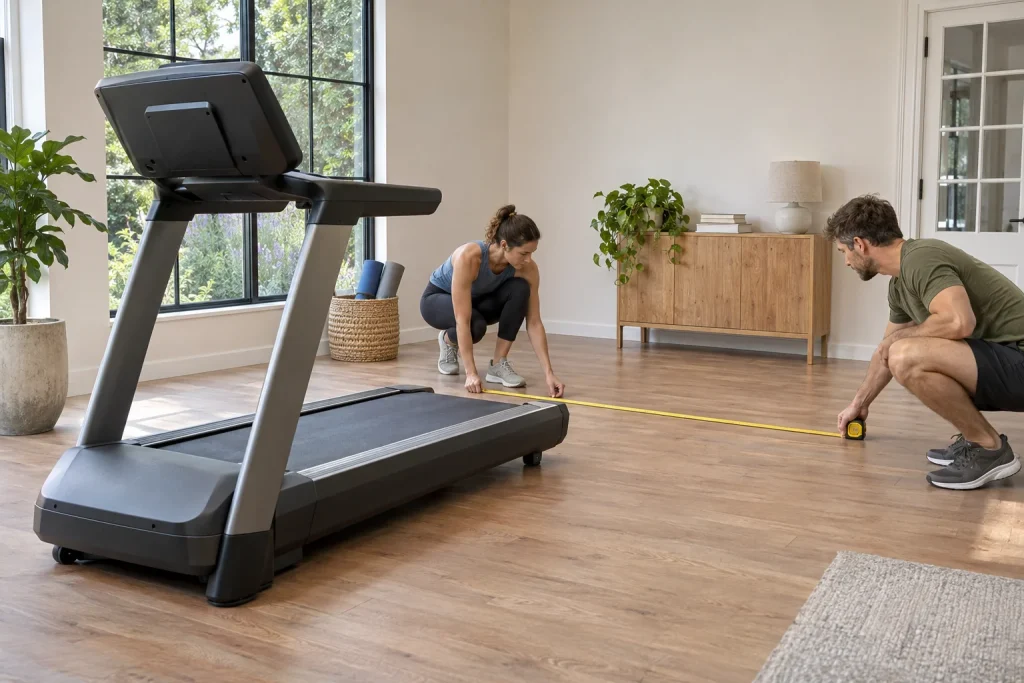
A floor-plan calculation using those figures gives a strip 2.10 metres wide. Machine length and rear clearance together make 4.39 metres. This is a rectangle of nearly 9.22 square metres, before separately considering front access. The figure is not a new safety standard: it simply combines the quoted manual requirement with the stated machine dimensions. It does show why looking only at 199 × 90 centimetres is misleading.
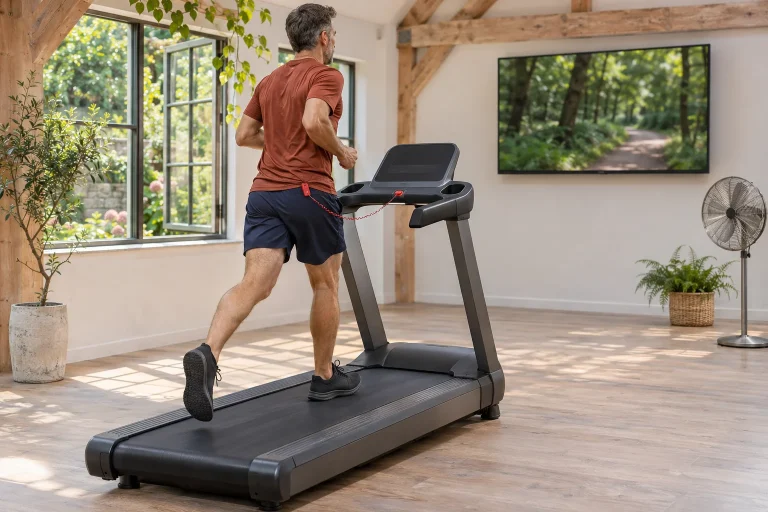
Draw the door’s opening arc, radiator, cables and frequently used cupboard on your room plan. The free area behind the treadmill should not double as permanent storage. If a laundry basket or children’s toys end up there, the actual operating layout already differs from the paper plan. Consider the space marked out with a tape measure in light of daily habits, as well as on the day you order.
 Enlarge image
Incline brings the ceiling closer too
An incline percentage expresses a geometric relationship: twelve per cent means approximately twelve centimetres of rise over one metre horizontally. It does not mean twelve degrees. The corresponding angle, by our own calculation, is approximately 6.84 degrees. This alone cannot establish precise clearance above the runner’s head, because the platform’s pivot point and the runner’s position matter too.
Ceiling clearance must accommodate the runner’s height, belt height above the floor, the altered position on an incline and the vertical component of running. If the machine would go in a room with a low ceiling, ask for confirmation of the actual regional model’s highest operating position. The proportions in a catalogue photograph cannot provide reliable centimetre measurements.
For the same reason, treadmill incline is more than a leg-training parameter. It also changes the machine’s position in space. The display’s viewing angle and distance from a light fitting above it may differ from those when level. Resolve this during installation before substantive training, especially when several users of different heights will use it.
A fast belt requires a clear operating routine
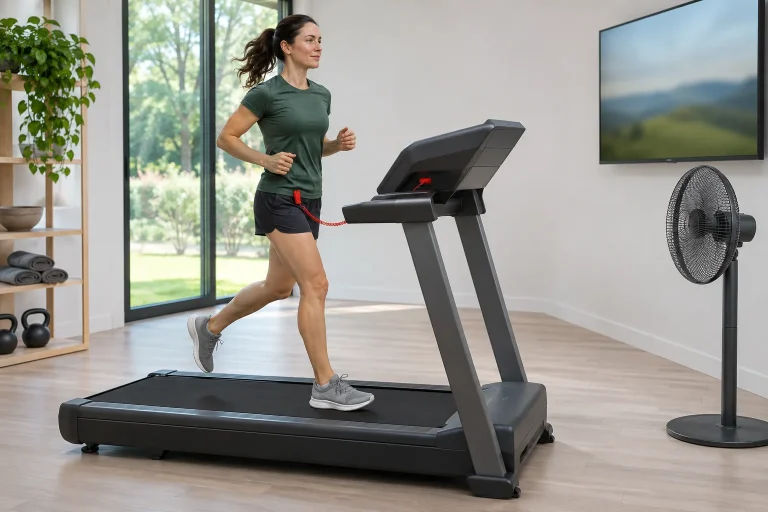
The specific manual requires attaching the safety-key clip to clothing and learning the stopping procedure. Speed should be changed in small increments. Before folding, it requires zero per cent incline, removal of the key and disconnection from power; moving it involves two people and the ability to lift at least twenty kilograms safely. Operation and moving in the manual.
Speed should not be the aim of your first trial. Find manual speed adjustment, observe how changes occur and know how a session ends. Distinguish everyday finishing from an emergency stop. If several family members use the machine, everyone needs to understand these operations equally; it is not enough for the more technically confident user to know them.
Operating the machine requires a free hand and an accessible interface. Phones, towels and bottles should not cover buttons, and a separate screen or audio should not distract you completely from the real machine. During interval training, a displayed target pace is information; belt acceleration is a physical event. Be able to follow the transition between them before choosing complex automatic training.
iFIT automation: what is planned, and what can you override?
The SmartAdjust guide discusses personal adjustments and returning to the trainer’s programme separately. Alongside routinely overriding settings, you can set an upper automatic speed limit. The feature is inactive in manual workouts. Check the conditions for supported workouts and current software on the specific console. SmartAdjust user options.
For example, the video reaches a hilly section, but you planned a shorter, easier session today. A good decision-making situation is one in which you understand the target before the next change and know how to adjust it. An automatic programme does not take over defining your own purpose. Keep the day’s task as the main consideration, rather than adapting to the scenery.
If heart-rate data appear on the console, check their source separately. A heart-rate value is neither an ECG nor a rhythm diagnosis; as an input for automatic speed or incline adjustment, it is only as good as the arriving data. With a poorly attached sensor or missing connection, resolve the data source first rather than expecting automation to correct an uncertain measurement.
The large display need not show video on every run
NordicTrack’s subscription FAQ says the machine can also be used in manual mode without an iFIT subscription. Trainer-controlled interactive services belong separately to membership. Manufacturer confirmation of manual operation. For a run planned with your own duration, it is therefore worth learning the manual workflow separately too.
Picture two starting screens for yourself: a simple everyday run and guided content. For the first, you look for a few basic data fields; for the second, you also follow the workout’s story and next change. If the large screen is useful only in the second situation, account for that in its purchase value. A more expensive display does not reduce the value of runs based simply on time and your own sensations.
Subscriptions and new features: services have versions too
iFIT Pro is the service tier for the built-in display; the phone-based Train tier serves another purpose. Check current membership prices at checkout for your country and purchase channel. The roles of iFIT plans. In your own cost plan, list service payments over the years separately alongside the machine price.
The detailed November Tailor list names the 2025 version of the 2450 among eligible models, but limits the console launch to December 2026 and specified countries. Hungary is not among the listed launch regions. When buying now, do not therefore treat the AI coach advertised on the product page as a locally available service already. Tailor launch conditions.
To assess an update promise, ask how the console generation is identified and how installed software can be checked. Do not infer a future service’s eligibility conditions from a similar screen on an older machine. Base lasting purchase value on what you can already do today with your own precise version.
 Enlarge image
Delivery, assembly and storage: three separate logistical tasks
Getting the machine into place must be resolved before ordering. Record clear door openings, stair turns, lift dimensions and where assembly will take place. Product footprint is not delivery-package size. Clarify the route into your home and any later removal with the provider too; do not think only of kerbside delivery.
A folding design may make storage easier, but does not turn the machine into a lightweight object. Consider your daily rearranging habit alongside the actual moving procedure. If every run requires shifting several pieces of furniture and moving a heavy machine, this may affect how frequently you use it. A permanent, orderly space is often worth more than a living room theoretically left free.
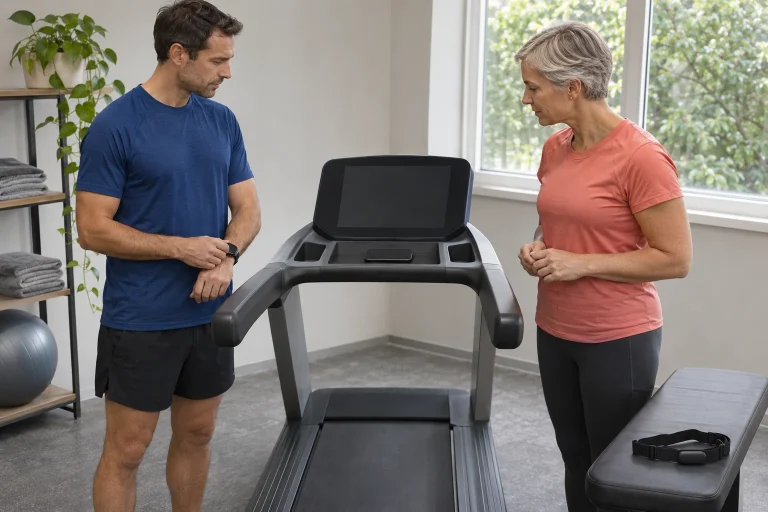
The acceptance check should preview your own run
The UK warranty description gives separate registration conditions; US motor-warranty terms or a UK promotion do not establish entitlement in Hungary. Ask for local written answers about parts and labour, call-out costs and the service process. A manufacturer warranty example tied to its region. Keep the complete model number, invoice and associated documentation easy to find.
On delivery, walk through your own planned use: getting on, starting manually, making a small speed change, reading the display, finishing and clearing the area. The 2450’s large screen and broad technical range provide real value when all this works comfortably in your home. Finish the decision knowing not only how fast the belt can go, but where and how you will run on it regularly.
Sources
- Commercial 2450 US product page
- Commercial 2450 UK product page
- NTL19125-INT.0 manufacturer’s manual
- Manual use without a subscription
- SmartAdjust operation in detail
- iFIT memberships
- Tailor launch models and regions
- Commercial series UK warranty
How Futószív articles are prepared: our editorial guidelines.