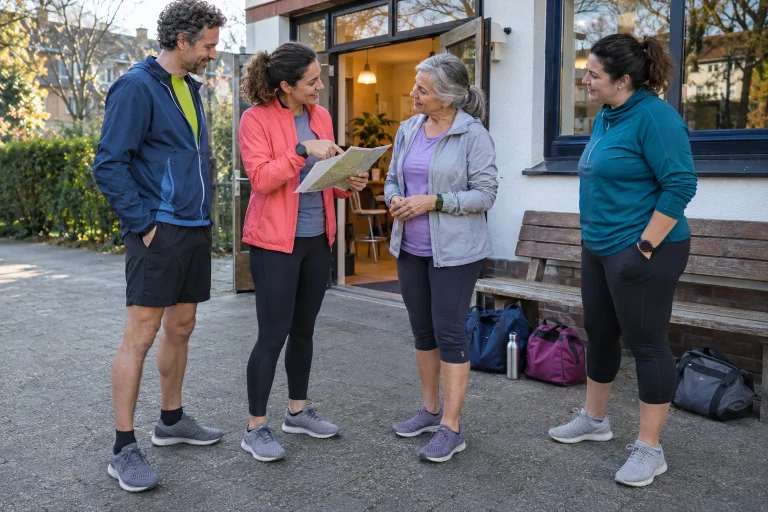
After moving together, it may be easier to say, ‘we did it together’. But what does that mean? Was being alongside others pleasant, do you feel greater trust or would you actually contribute more to a shared task? Research on social bonding treats these as different questions. A running community’s experience is interesting, but cannot be precisely captured by a simple promise that people who sweat together will certainly become friends.
This overview begins with dance and rowing experiments, then offers ways to interpret runners’ everyday connections. We are not recommending a club programme based on shared suffering or a plan for organising charity events. Instead, we examine what researchers call bonding, how they measure it and why a short laboratory task remains different from a lasting, supportive running environment.
Moving together can have several components
A group can be in the same place at the same time without members coordinating with one another. In another situation, they follow a shared rhythm or attempt a shared task. Exertion can also vary while the social setting looks similar. If everything changes together, identifying which component relates to the later experience is difficult.
Researchers can therefore manipulate coordination and exertion separately. Such a design goes beyond asking whether being together is good and creates a specific comparison. Everyday shared running is generally less controlled: conversation, familiarity, route and personal choice may be involved too. Research’s strength is its precise question; its limitation is being unable to capture every layer of a real community at once.
A shared purpose need not be a grand mission either. It can be an agreed meeting or a small act of mutual help. This differs from people merely happening to move to the same rhythm. Shared intention and physical coordination are not identical concepts, so results should not be quietly transferred from one to the other.
What did the dance experiment show?
In Tarr and colleagues’ 2015 research, dance synchrony and exertion were varied separately. Both factors independently showed favourable relationships with changes in within-group bonding and pain threshold in the studied setting. Pain threshold was used as an indirect indicator; it was not an endorphin level measured in blood or brain. A short dance task does not prove a general mechanism for every kind of shared running.
The limit of indirect measurement is especially important. Authors discussing a possible biological explanation does not establish that they precisely measured a chemical switch for belonging. Changed feelings within a group do not automatically mean greater trust or helpfulness towards people outside it either. Group boundaries and measurement type matter in the research wording.
For runners, this implies no shared pain test or session forcing everyone to the same load. A laboratory measurement is not a community programme idea. Movement coordination can be an interesting social question, while participants’ safety, freedom of choice and differing conditions remain priorities in a real gathering.
 Enlarge image
When actual contribution was measured too
The first study in Davis, Taylor and Cohen’s rowing experiment analysed data from 68 participants. In groups of three, they performed lower- or moderate-intensity movement, either synchronised or unsynchronised, then decided contributions to a public monetary fund. Contributions were greater in the moderate-exertion condition, while synchrony alone did not produce a corresponding cooperation advantage. Self-reported bonding and behavioural measurement were not simply interchangeable.
In this study, researchers found no evidence that the proposed opioid or endocannabinoid process explained the outcome. Limitations included the realism of the economic cooperation game and unequal presence of a confederate across conditions. A general claim that moving together makes us better people would omit these details, despite their importance for interpretation.
Together, the research examples do not provide one simple answer for every outcome. Relationships between coordinated movement and social connection can depend on the task and measurement. The useful lesson is separation: felt closeness, contribution in a particular game and mutual help functioning later in life are three different questions.
Belonging and cooperating are not always the same
Feeling part of a group can be pleasant even when you have little opportunity to contribute to a task. The reverse can happen too: you help with something without feeling close to others. These experiences do not necessarily contradict each other. Assessing community experience therefore benefits from attending separately to feeling and actual relationships.
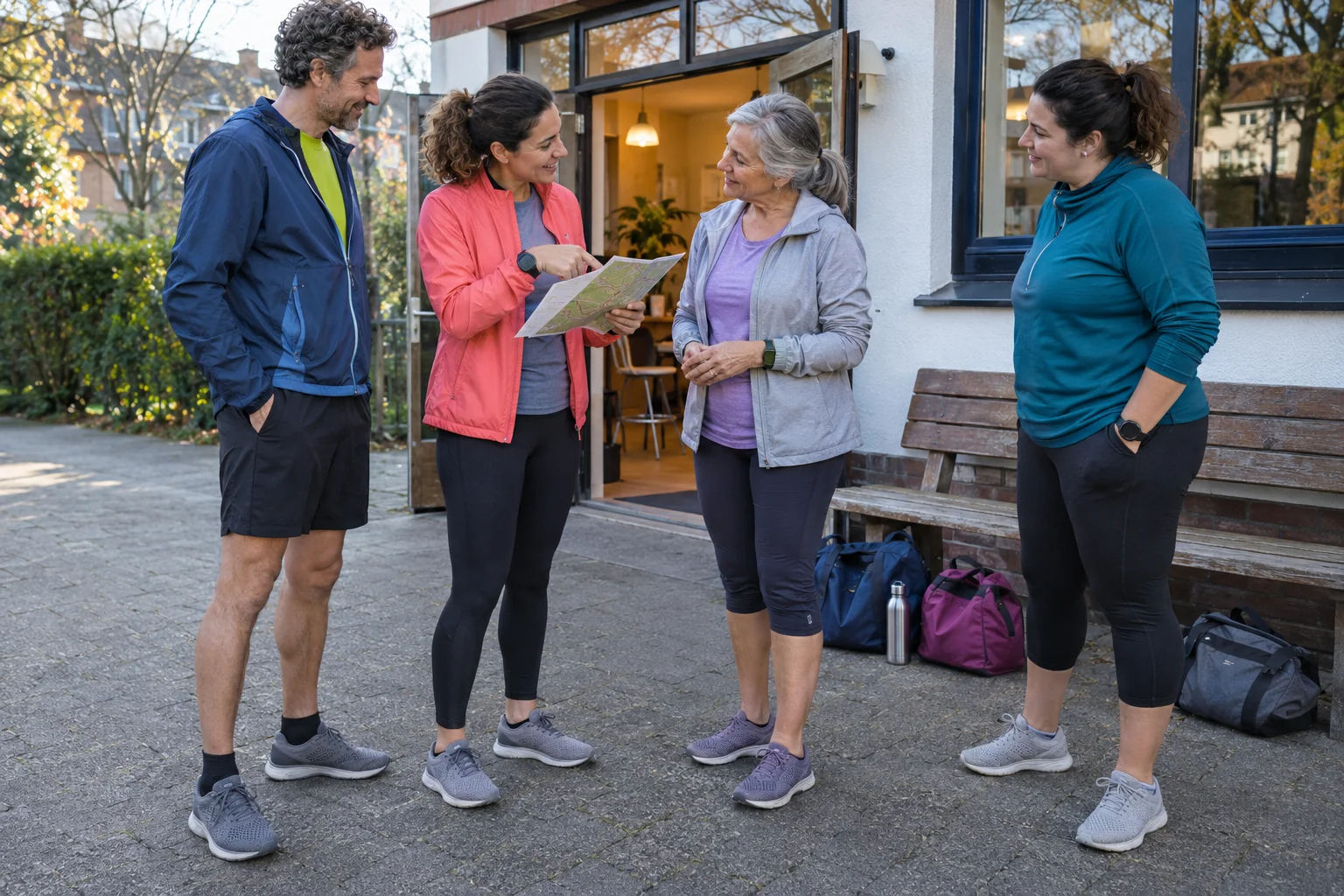
After a run, shared conversation may be pleasant while people participate differently in arranging the next meeting. This is an editorial illustration, not a story from the research participants. The difference need not immediately imply insincerity: time, roles and opportunities differ. Equally, a good mood alone does not prove lasting reciprocity.
Specific everyday events matter when understanding support within a group. Can you ask questions, change things, sit out or request help? These experiences concern something different from your bonding rating immediately after exercising together. A positive moment is valuable, but does not replace every further question.
A shared rhythm should not mean compulsory sameness
Differences are natural among runners: pace, experience and daily condition vary. A shared session is not made real by everyone moving identically. A research concept of synchrony need not become strict uniformity in a club. A shared framework can accommodate different forms of participation when the setting and programme allow it.
Connection can occur before or after movement, in a brief meeting or a shared task. These forms differ from the experiments presented, so we promise no identical measured effect. They show that real groups have several ways to be together. A laboratory condition need not become an entry requirement.
Someone wanting to participate differently is not necessarily rejecting belonging. Reasons can concern health, time or personal preference. A liveable community may include being able to discuss this. Freedom of choice cannot be measured by the uniformity of steps during a brief section.
Shared difficulty does not authorise coercion
Group experiences easily become heroic stories: you overcame something difficult together and grew closer. Such a memory can matter personally without implying that difficulty must be imposed on others to create connection. Research does not authorise organising shared suffering, pain tests or ignoring symptoms.
Stopping, modifying or staying away should not become a loyalty test. Someone choosing a shorter session today can still connect with others. Do not exceed personal loading limits as proof of affection for the group. An everyday sign of community support may be precisely that chosen boundaries can be voiced.
This does not reject the joy of a shared challenge. A chosen task differs from coercion, just as personal memory differs from a general recipe. Retain what actually happened in an experience rather than manufacture a rule that every new member must repeat.
 Enlarge image
Within-group closeness and openness
A sense of ‘we’ can bring warmth: familiar faces, shared memories and easier conversation. Yet the position of someone newly arriving or attending less often matters too. Strong ties among existing members do not automatically mean a newcomer easily finds a place. Internal belonging and inclusion can therefore be separate things to observe.
A new runner may initially not know the group’s stories. This need not immediately classify the group as closed or the newcomer as socially inept. Actual encounters reveal opportunities to ask, participate at a different rhythm or gradually get to know others. A brief experimental bonding measure cannot replace that process.
A shared purpose need not mean the same thing to everyone either. One person seeks movement, another social contact and another enjoys helping with a particular task. These roles can work together, but should be expressed. Group identity does not require every participant to attend for identical reasons and with identical enthusiasm.
A lasting relationship develops across several occasions
A good feeling after moving together can be a beginning, but does not fully describe every relationship. Everyday trust can include consistency, mutual attention and what happens after a different need or misunderstanding. These questions extend beyond a brief laboratory task, so experimental findings must not expand into a promise of lasting friendship.
You can notice how connection changes across meetings without making it a scored project. It may develop slowly, vary or remain pleasant familiarity without close friendship. A running group’s value does not depend on every participant becoming a close confidant. Manageable social presence can have several degrees.
The most useful lesson from research on shared movement and purpose is precise questioning. What did we feel, in which task did we cooperate and what appears later in the relationship? These questions provide a richer picture of running communities than one biological slogan or compulsory group experience. Connection can be valuable without needing justification through pain, total uniformity or a promise of lasting friendship.
Primary sources
Tarr and colleagues: Synchrony and exertion during dance independently raise pain threshold and encourage social bonding, 2015. A dance experiment; pain threshold is an indirect indicator, not direct endorphin measurement.
Davis, Taylor and Cohen: Social Bonds and Exercise: Evidence for a Reciprocal Relationship, 2015. The first study involved group rowing and a public-goods economic game, without an independent cooperation effect of synchrony. Running examples are our own editorial interpretations; the article is not the result of documented medical review or our own experiment.
How Futószív articles are prepared: our editorial guidelines.