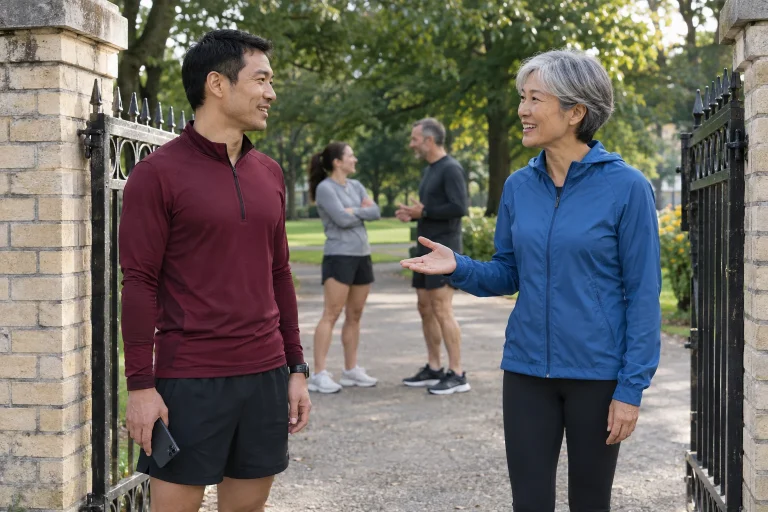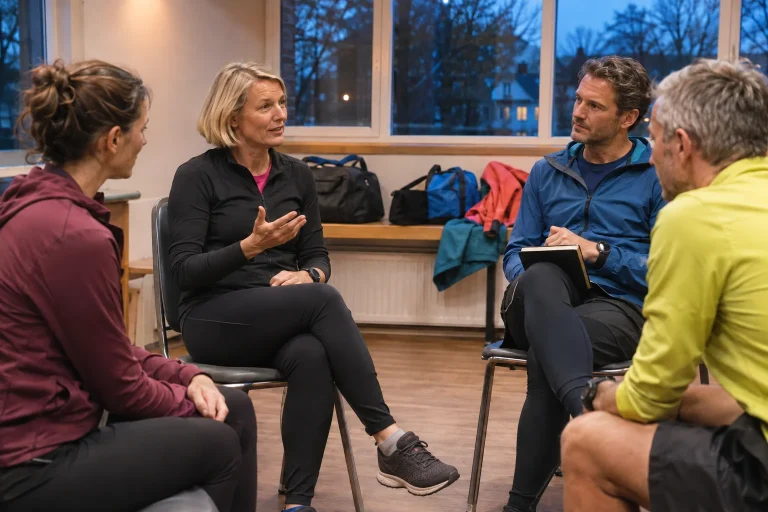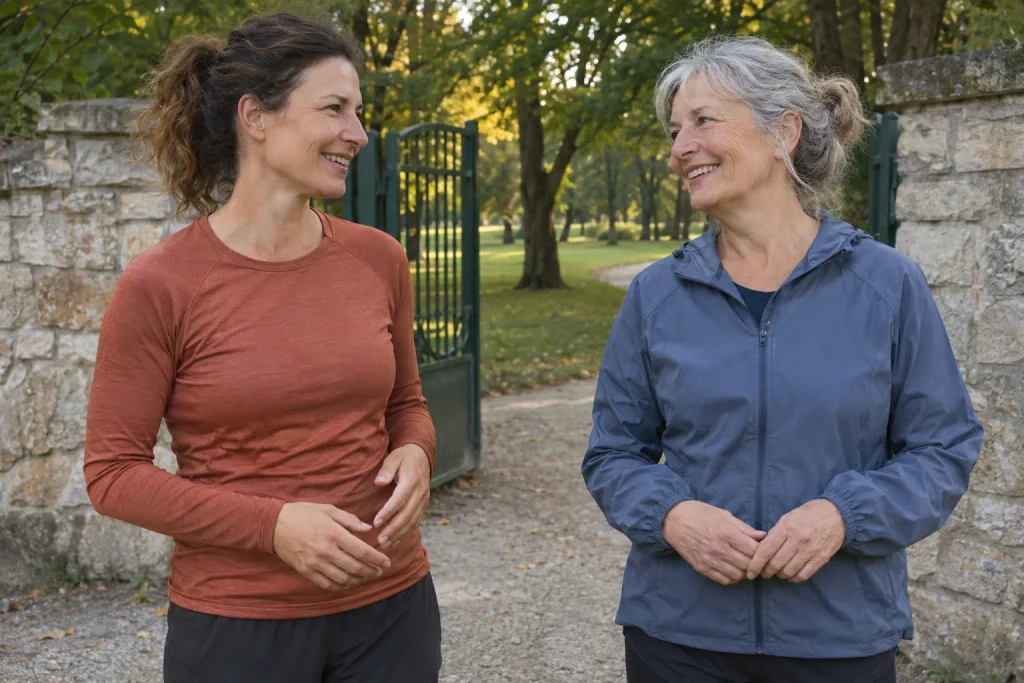
Did you start running together because you were already friends, or did friendship grow from shared sessions? Many personal stories have room for both directions. The activity may first provide an opportunity to meet; later, familiar people can make the same location attractive. The relationship between moving together and belonging is therefore more interesting than the simple statement that social sport automatically turns everyone into a community.
Researchers examine this relationship using different methods. Whether social behaviour changes after a joint task differs from how attachment to an existing group relates to later participation. Findings can also help you describe your own experience more precisely: what did the activity add to the relationship, and what did the relationship add to experiencing the activity?
Two directions, two everyday stories
In the first direction, shared exercise creates a framework for meeting. You arrive as strangers, later recognise faces and eventually share memories. A sporting activity can be one situation in which you spend time together. Not every session therefore produces friendship. Connection may mean a loose acquaintance, a pleasant greeting or a closer relationship, with different personal meanings.
In the second direction, a relationship already exists. A familiar companion’s presence can make a session different from arriving at the same route alone or with strangers. Understanding each other’s habits, knowing what you want to discuss or simply enjoying time together may matter. This need not imply a direct performance advantage. Many parts of sporting experience are not expressed in speed.
The two directions may eventually meet in one story. A shared activity produces acquaintance, which makes choosing to meet again more appealing. This is an everyday description, rather than a law for every group. Preserve the role of choice and circumstances: belonging can matter even when life circumstances temporarily reduce shared sessions.
What did a series of shared-exercise experiments examine?
Davis, Taylor and Cohen’s original 2015 paper asked related questions in two sporting settings. The first study varied intensity and synchrony in ergometer rowing. More cooperation in an economic game was measured after the moderate condition than after low intensity; synchrony had no effect on this endpoint. Questionnaire-based bonding did not show the same result.
The second study compared individual, non-synchronous and synchronous paired warm-ups among university rugby players who already knew one another well. A sport-specific anaerobic running test was better after the synchronous than the non-synchronous condition. Synchrony was interpreted here as a social cue to existing relationships; the researchers did not randomly create new friendships. No direct neurochemical mechanism was established.
The two tasks reveal two different questions. One examined social behaviour after exercise; the other examined cues within an existing team and a sporting performance. The same measurement was not simply reversed. Preserve this distinction when interpreting the research, rather than compressing findings into ‘community always makes running better’.
A social relationship is not one measurable property
Friendship, belonging, cooperation, trust and shared identity may seem related, but do not mean the same thing. Someone may behave helpfully in a one-off task without feeling close friendship. Another may feel strongly attached to a group while rarely able to attend. They can coexist in everyday stories, but research must specify exactly what was asked or observed.
A shared contribution in an economic game, for example, provides information about social behaviour in that setting. A questionnaire response about closeness expresses the participant’s judgement. Later attendance data show whether they came to the event. One indicator need not stand for all three. Preserving the difference also prevents an interesting finding becoming an excessive, general promise of connection.
In your own life, this may simply mean naming community experiences differently. You enjoy running with someone without discussing personal matters. An old friendship connects you with another companion despite different sporting goals. In a third group, the shared location provides familiarity. None need be considered lesser for failing to fulfil every imagined meaning of belonging.
 Enlarge image
What does observing real participation add?
Stevens, Rees and Polman’s original study, published online in 2018 and in a 2019 journal issue, examined data from 289 parkrun participants. Group identification and several experiences were measured through questionnaires, with objective attendance data. In the model, stronger identification was associated with greater participation, exercise-related satisfaction, group cohesion and life satisfaction.
This is a relationship from a real community setting, rather than random assignment to strongly or weakly attached groups. It does not prove identification alone produced every other difference. It complements the experimental approach by including actual attendance, rather than only future intention. The relationship’s direction and causes nevertheless remain separate questions.
For everyday interpretation, imagine an illustrative example: a venue is near someone’s home, its meeting time suits them and they enjoy seeing familiar people. These circumstances may relate simultaneously to frequent participation and their relationship with the community. The example is not an explanation established in the cited study. It shows why an association cannot be translated into one certain cause.
Three research questions, three kinds of answer
When reading about shared exercise, distinguish behaviour after a task, a result measured within a particular sport setting and longer-term participation. Each can matter, but concerns something different. The following table is our interpretive summary, rather than a claim that all three methods proved the same relationship. They can meet in one personal story, but their measurement differs.
| Question | What data may help answer? | What remains a separate question? |
|---|---|---|
| Did cooperation change after a task? | A social decision observed in that situation. | Did a lasting personal relationship develop? |
| Did a sporting task’s result change? | Performance measured in the specified test. | What explains the change, and does it occur in other settings? |
| Does attachment relate to participation? | Comparison of questionnaires and real attendance data. | Which direction and circumstances shape the relationship? |
The table does not pit methods against one another. A well-chosen experiment can alter a condition more precisely, while real attendance data relate to an everyday situation harder to reproduce in a laboratory. The interesting question is whether the method fits the question. A short experiment need not explain every friendship, and a questionnaire association need not be called direct causal evidence.
A shared activity’s personal meaning can change
The location or exercise may interest you initially, with meetings becoming more important later. In another story, a friend invites you and you gradually come to like part of the activity independently. You need not decide which is your real reason. Participation can have several meanings at once, and their proportions may change. A personal story can be richer than one motivational label.
In an example of our own, two people initially only greet one another on their shared park path. Later they talk together once, while retaining different sporting goals. They need not follow the same programme to value the encounter. In another story, longstanding friends begin organising shared sporting sessions. The relationship came first, with exercise providing a new setting. Neither example is a general sequence of development.
Different needs do not necessarily indicate a weaker relationship. Some people want plenty of conversation, while others sometimes prefer quieter shared presence. One would attend every week; another has time less often. Attachment cannot simply be measured by how identical your schedules or paces are. Clarifying research measures reminds us that everyday belonging can take several forms.
Closeness does not require compulsory adaptation
Interest in shared sport can easily become an expectation that a good group member always stays alongside others, is always enthusiastic and accepts every session. This exceeds the findings presented. Connection does not require abandoning personal preferences. A community can matter while you choose a different pace, route or separate activity on a particular day.
When running with a friend, honest discussion can be part of the relationship. You can say you are pleased to meet but do not want the same task. The other person can likewise express different wishes. A shared experience does not require accepting a situation you would not freely choose. Sports-psychology findings are not tools for persuading someone to adapt more strongly.
Health and training demands are also separate questions. A pleasant community atmosphere or performance-experiment result is not individual clearance to exercise. They do not imply accepting pain for belonging or everyone performing the same task. The relationship discussed is a human and research question, rather than justification for crossing boundaries.
 Enlarge image
What can you notice in your own story?
If the two directions interest you, recall an important occasion. What first brought you there: the activity, a person, the place or curiosity? Why did you choose it again later? These are open questions, rather than a scored community test. You need not reduce answers to one cause, and a different detail may become more important over time.
Separately name what the relationship added to experiencing that activity. Was finding your way easier beside someone familiar? Did conversation feel good? Did you appreciate not having to introduce yourself? These are personal details, rather than effects the experiments established for everyone. Their personal nature makes them informative. You need not attach faster running or a special bodily change to them.
If the shared session did not appeal to you, you need not interpret this as a failure to connect. Another time, setting or activity may suit you. Belonging has many everyday forms, and running is just one possible framework for meeting. A social relationship examined in research does not prescribe the same community path to every reader.
Understanding both directions gives personal choice more room
The relationship between shared exercise and connection is interesting because sport is not always an isolated individual activity. People, places and shared meanings can be involved. The studies presented examine different pieces: a social decision after a task, performance within an established team, and identification and actual participation in a community event.
As a runner, you need not extract one compulsory recipe. Keep the question of what the activity added to the relationship and what the relationship added to the activity. The answer may be friendship, loose acquaintance, a shared memory or simply pleasant time together. This makes the story more precise while retaining your boundaries and different wishes.
Sources
- Davis, Taylor and Cohen: Social Bonds and Exercise: Evidence for a Reciprocal Relationship, 2015.
- The original Davis paper’s PMC version.
- Stevens, Rees and Polman: Social identification, exercise participation, and positive exercise experiences: Evidence from parkrun, online 2018, journal issue 2019.
How Futószív articles are prepared: our editorial guidelines.