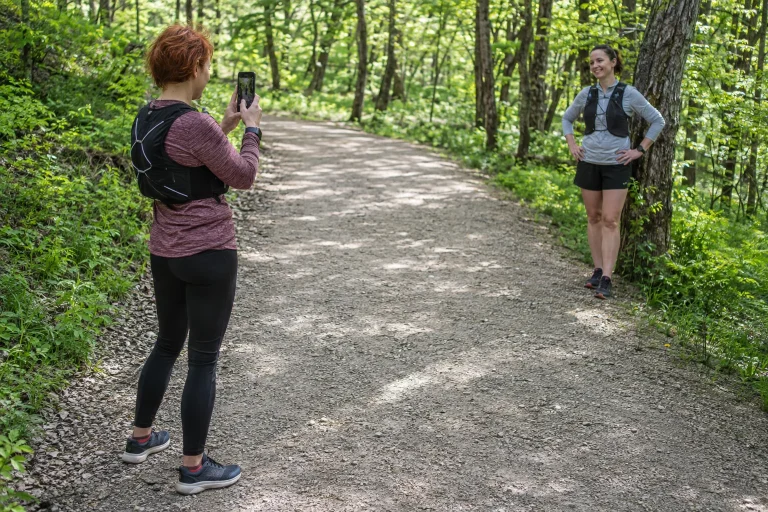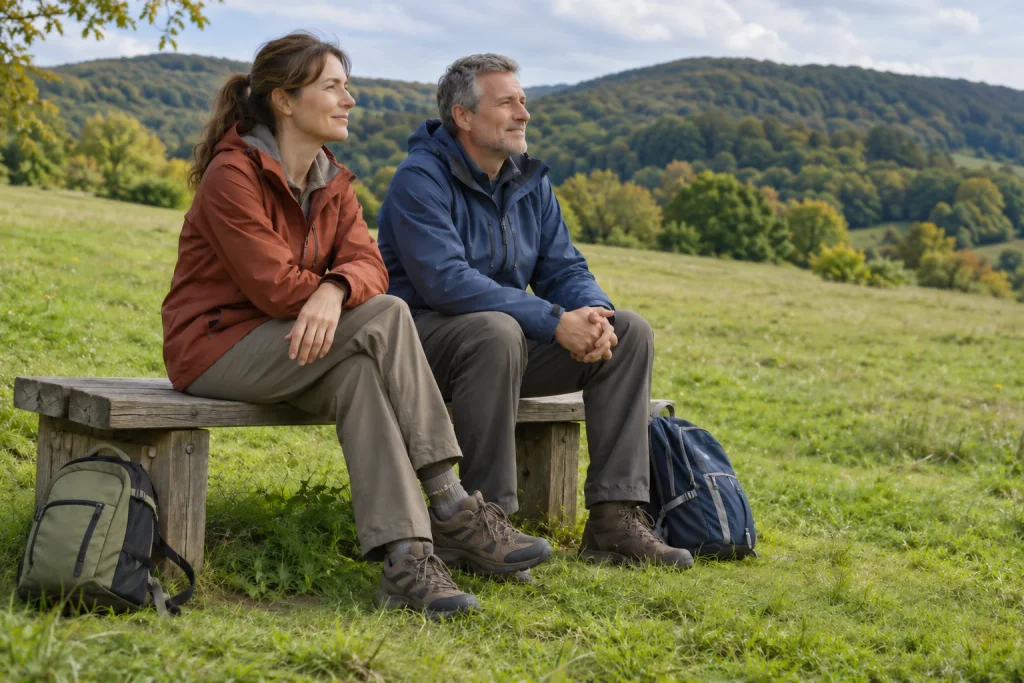
Why might a mountain walk feel different from indoor walking when your legs move in both? It is tempting to answer with one word: nature. Yet a real hike combines the path, view, climb, company, arrival and awareness of leaving familiar surroundings. If you feel better afterwards, identifying how much each part contributed is not straightforward.
For a runner, research on mountain walking helps most when you do not immediately seek a training rule. It shows how complex movement situations can be compared and where uncertainty remains even in a carefully organised experiment. This review starts with one specific study, then explores questions that can help describe your own outdoor and indoor experiences more precisely.
Three situations involving the same people
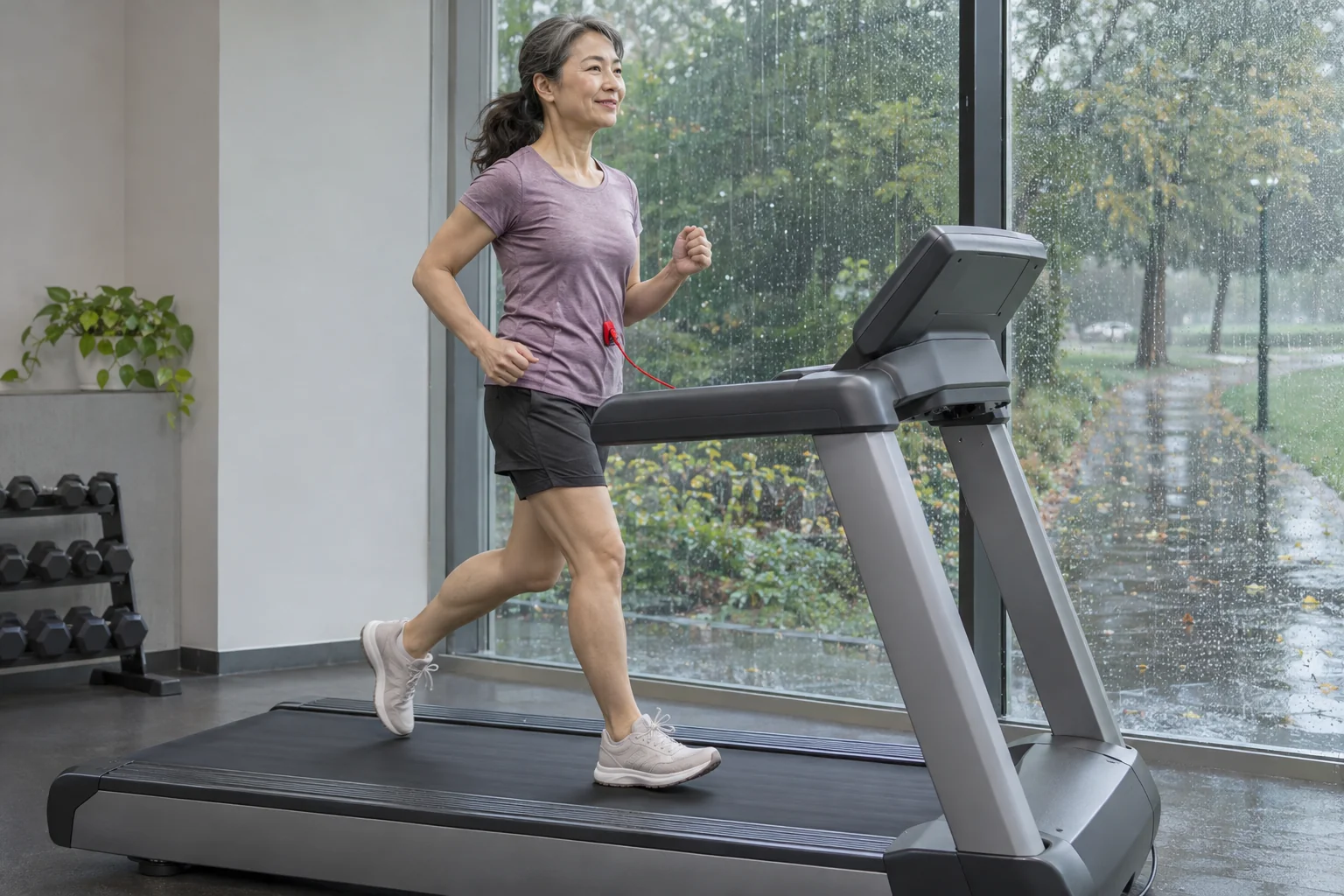
Niedermeier and colleagues’ 2017 randomised crossover study was completed by 42 healthy participants. Each took part in an approximately three-hour mountain hike, indoor treadmill walking and a seated control condition. After hiking, several affective measures changed more favourably than after sitting; compared with indoor activity, significant advantages appeared in pleasure–displeasure ratings, one activation measure and fatigue. Not every mood outcome distinguished the two movement conditions.
A strength is that the same person experienced several conditions. The comparison was therefore less dependent on one group already containing more enthusiastic hikers. Random order aimed to reduce order-related bias. But it does not mean every difference between situations disappeared: participants knew where they were, and a real mountain route could not become a perfectly identical treadmill programme.
‘The same people’ is thus an important methodological detail, not a magic phrase. Their days may have differed between visits, and knowing the task could shape expectations. The experiment remains valuable, but ask the question it was designed for: how did experience change in the three specified programmes? Not how every outdoor and indoor activity in the world should be ranked.
Similar exertion does not mean an identical programme
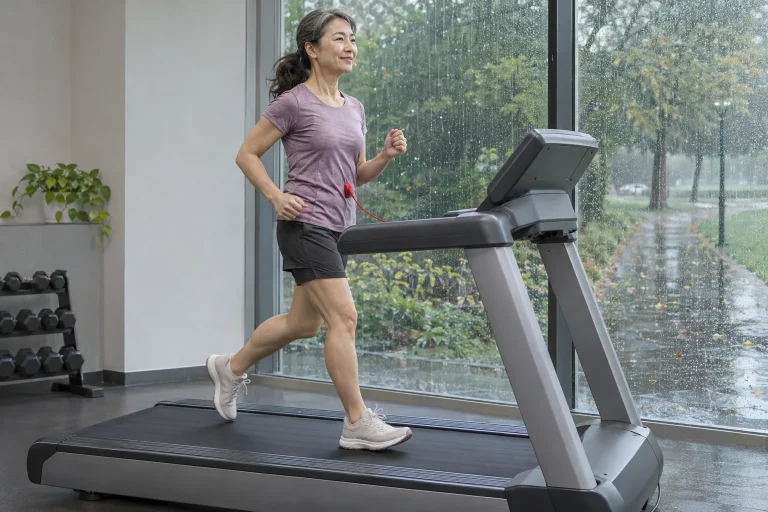
The researchers tried to match treadmill distance, time and incline to the mountain condition. An important difference remained: the outdoor return was downhill, but the treadmill could not reproduce that, so the second part became level walking. They tried to approximate the social setting by placing indoor machines side by side. Average perceived exertion did not differ significantly between the movement conditions, but heart rate was higher outdoors.
This helps explain why the result cannot easily be attributed to one component. When programmes are designed to be similar but the route and setting still differ, the difference concerns the complete arrangement. Simple subtraction cannot reveal ‘the effect of fresh air’. Uphill, downhill, changing scenery and the meaning of travelling can be intertwined in the experience.
Similar differences can occur in your sessions. Two equal-duration outings may involve watching junctions outdoors versus moving on a machine; one may include descents and stops, the other steady movement. The same number of minutes in a summary does not make the task identical. Name the activity actually completed alongside its environment.
 Enlarge image
Three hours is not a short after-work run
A longer programme occupies a different place in the day. You generally bring different preparation, available time and expectations to it than to a short weekday activity. Applying this result to a twenty-minute run would change the movement type, duration and probably location simultaneously. That is a new question without a direct answer from the three-hour experiment.
The study duration is not a recommended minimum, nor something you must complete for your own movement to count. A research condition has a particular length because it investigates a defined question. It does not automatically become a task for every reader. Suggesting that only several hours in nature offer valuable experience, making shorter options inadequate, would be especially misleading.
A runner’s goal may differ from a researcher’s. A busy day may allow a few calm minutes of movement; another may leave an afternoon for hiking. You need not judge them with identical expectations. An interesting result from a long programme can enrich your thinking without requiring an outing that does not fit your time or preparation.
What do separate measures of emotional experience mean?
‘I feel better’ can cover many states. You might be calmer, more alert, less tired or simply more satisfied with what you did. These do not always change together. After a long activity, you can feel cheerful and heavy-legged; after quiet rest, you may be less excited without judging the day worse. Naming these differences makes self-description more precise.
Do not convert the research measures into one general happiness score. If one condition performs more favourably on a particular questionnaire, examine the other outcomes separately. Saying that some affective responses differed is narrower and fairer than saying mountain hiking was better in every respect. Precise wording preserves rather than diminishes the finding’s real content.
In your own experience, a few simple distinctions may suffice. The view was enjoyable but organisation demanding; the company was pleasant but you wanted quiet; you were tired yet glad you went. These answers need not cancel one another out. Complex programmes can involve mixed feelings, and a good choice is not necessarily one followed only by positive words.
Company can provide a setting without being a separately proven cause
Moving together can give a mountain walk its own rhythm. You talk, wait for one another and share small events along the way. Interaction on a row of indoor machines may develop differently even side by side. Notice this everyday difference, but the study cannot independently establish how much of the result came from company. Several programme elements occurred together.
Preferring to move alone does not mean choosing an inferior experience. A group programme may have suited the research comparison without becoming compulsory for every runner. Company is part of relaxation for some; independent movement offers freedom for others. Different needs need not disappear for the sake of one favourable research average.
Before a shared hike, clarify practical expectations: relaxed looking around, continuous movement or conversation? Misunderstandings can obscure pleasant environmental details. This is an editorial planning idea, not a psychologically validated technique from the study. It helps the real outing fit participants rather than requiring them to complete an imagined ideal nature experience.
Another natural environment, another research question
Vert and colleagues’ 2020 crossover study involved 59 healthy office workers. Over three weeks, it included twenty-minute waterside and urban walks and seated control sessions. Immediately after waterside walking, wellbeing and mood responses were more favourable than in the other conditions; no favourable waterside effect was demonstrated in the cardiovascular outcomes examined. This differs in setting and duration from the mountain hike.
You cannot simply stack the studies as though a short waterside outing and a long mountain programme were two doses of one treatment. Participants, locations and tasks differed. Together, they illustrate why environmental claims need the study’s precise context. A natural setting is not a uniform substance whose every variant produces the same effect.
A runner can retain curiosity about where movement feels manageable and pleasant without assembling a medical prescription from different studies. Consider mountains, watersides and home environments alongside the actual circumstances. A more pleasant experience and medical suitability remain separate questions.
 Enlarge image
Why is a mountain route not a recommendation for everyone?
Real mountain environments can impose demands easily overshadowed in an account of mood. Access, trail conditions, weather and getting back all affect manageability. A favourable average emotional result does not make that programme suitable for every reader. Appealing scenery does not justify ignoring your condition or the real situation.
A study involving healthy participants particularly does not imply the same programme for acute symptoms, an existing condition or individual mobility limitations. Personal health and practical considerations then take priority over general expectations of the setting. This article supports interpretation of research; it does not assess fitness for hiking or prescribe workload.
An indoor choice can be entirely justified even if you love nature. Predictability, easier access or simpler interruption may matter to you. You are not missing a compulsory psychological benefit. A finding may highlight a possibility, but does not justify devaluing another person’s manageable form of activity.
Recall the whole outing
After a mountain walk of your own, consider leaving, moving, resting and returning separately. Where was it easy to be present, and where did tension arise? The landscape may be memorable while the group’s pace bothered you; you may have been occupied while moving and only looked around on arrival. These details may shape the next outing more usefully than one overall impression.
You do not need to reproduce the entire research on yourself. Everyday experience has another purpose: showing what is manageable and what you would organise differently. The joy of a good outing remains valid even if you cannot separate its causes. Scientific caution avoids claiming more than you experienced; it does not belittle the experience.
The most interesting lesson from comparing mountain hiking and indoor walking is the environment’s complexity. Movement does not happen in empty space, but scenery alone does not shape the day either. Holding both in mind supports more flexible outdoor and indoor choices. Every session need not prove a theory; it can simply be a usable, safe and meaningful part of movement in your real life.
Sources and scope
Niedermeier and colleagues: Affective responses in mountain hiking, 2017. The full original paper contains the conditions, differing route features and separate affective outcomes. It is not a short-running study or an individual workload guide.
Vert and colleagues: physical and mental outcomes of repeated short waterside walks, 2020. A separate research example, not a replication of the mountain study. Everyday situations are editorial interpretations, not results from our own experiment or documented medical review.
How Futószív articles are prepared: our editorial guidelines.