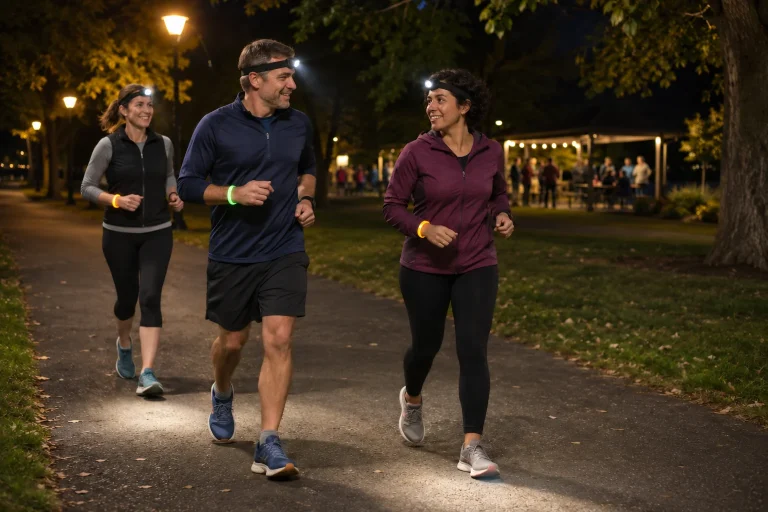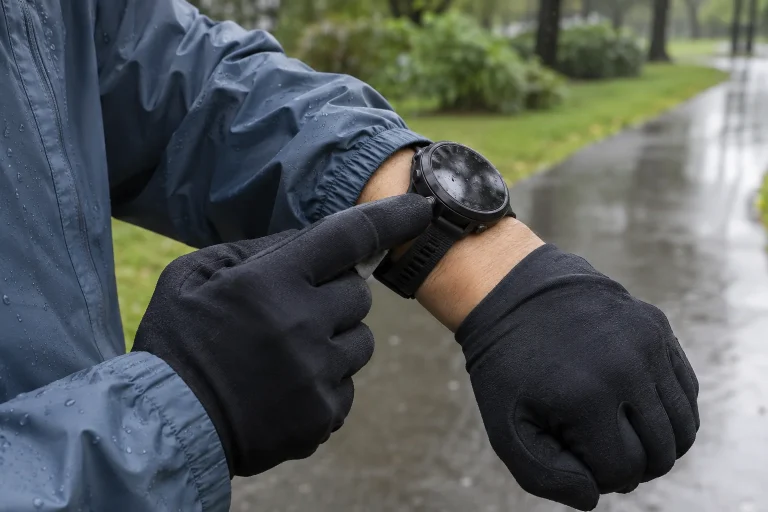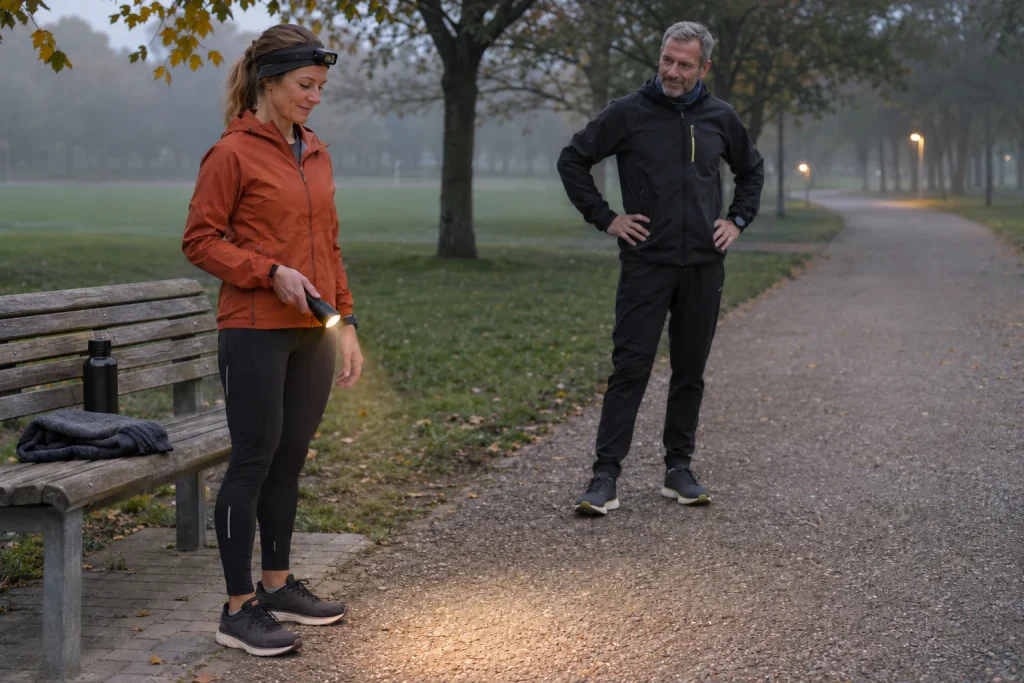
You switch on your headtorch, raise the output and the fog seems to build a bright wall in front of you. Nearby air glows more strikingly while route details become scarcely easier to recognise. It is tempting to think you need an even stronger lamp. Yet the situation involves more than how much light a device emits: what happens to light between your eyes and the surface you want to observe also matters.
Assess lighting for a foggy run through visible details and the actual task. Seeing a nearby kerb, recognising the route’s direction and knowing what a distant light belongs to are different questions. A larger lumen figure on packaging provides no certain answer to all of them under every condition. We examine fog droplets, beam distribution and placement, then develop a usable plan without experimenting in poor visibility.
Fog is a medium of tiny droplets rather than visible water vapour
The New Zealand MetService explanation states that tiny water droplets suspended in fog and mist scatter light passing through them, making objects harder to see. This differs from illuminating the same route in clear air. The meteorological definition of fog includes a visibility threshold, but we do not turn it into a single personal yes-or-no boundary for running. An official definition does not aim to decide the usability of every route and movement task.
As a runner, recognise which information is missing. If nearby air appears bright but you cannot follow the pavement edge, impressive light has not solved the task. A distant point may remain visible while surface details in front of your feet are uncertain. Begin evaluating lighting with whether you can actually see your movement environment clearly, rather than how powerful the beam looks in a photograph.
Condensation on a lamp’s outer surface or spectacle lenses may be separate from fog ahead. Do not merge them into one equipment fault. If cleaning or checking is needed, stop somewhere appropriate and follow your equipment’s instructions. Do not dismantle a lamp while moving or invent a universal home repair for internal moisture. Lighting condition and the weather medium remain separate things to check.
Lumens do not tell you which route detail you can recognise
The Petzl explanation of ANSI/PLATO FL1 distinguishes light output, beam distance and runtime. Reported beam distance relates to a specified illumination level and testing conditions; the manufacturer separately identifies beam pattern as important. This is not a personal running distance measured in fog. Read adjacent packaging numbers as distinct quantities rather than three proofs of a general ability to see better.
Two lamps with identical lumens may produce different illumination patterns. Ask how each lights nearby ground and how useful it is for viewing farther ahead. Petzl’s beam-pattern guide distinguishes flood, focused and mixed patterns serving different tasks. We do not claim one always wins in fog. The lesson is to add light distribution and the current task alongside light quantity.
When making a comparison table, copy more than the largest value. Record the operating mode, associated beam pattern and instructions governing use. A maximum available briefly may differ from the setting used during the outing. The latter is what matters for your aim. Do not tick off foggy conditions merely because a large number occupies the table’s first row.
 Enlarge image
Why can sending more light forward make the view worse?
The US National Weather Service fog-driving advice specifically warns that high-beam headlights can cause glare and make the road ahead harder to see. This is driving information, rather than a measured running-light comparison. We do not transfer vehicle lighting rules or geometry to runners. It does illustrate why more forward light cannot automatically mean better vision in every foggy situation.
The essential question for your equipment is whether a change improves clarity. Do not find this out on the route’s most uncertain section. Learn settings beforehand in an appropriate place away from traffic, following instructions. If conditions worsen in actual fog, do not assume trying more menu options must rescue the planned run. Changing the route or entire outing remains a real solution.
We do not declare a universal colour-temperature winner either. A manufacturer promise about warmer light would also need examination of the particular product and test. A fog-cutting advertisement does not provide results applicable to every reader and location. Plan through your equipment’s documentation, appropriate use and actually visible surroundings rather than a packaging adjective. A seemingly appropriate setting does not remove the need to check weather.
Waist-height light is a different placement rather than a fog-removing solution
The fog FAQ on the Petzl NAO RL product page suggests trying a lamp held at waist height to reduce glare. It also mentions switching to STANDARD or CONSTANT mode if fog interferes with REACTIVE LIGHTING. This is specific manufacturer advice to read alongside your own model’s complete instructions. It does not mean any headtorch can be remounted however you choose, nor promise that poor visibility will always be resolved.
Placement relative to the eyes changes, and handling changes with it. A handheld device gives your hand a different task; a fixed waist solution brings attachment and permitted device use to the fore. Do not treat these as identical. Without your own documentation, do not make an improvised holder, route cables in unknown ways or assume an online strap will work appropriately with your lamp.
Head and trunk movement may send light in different directions, so specify the task too. Illuminating nearby ground, examining a route sign and reading a map are different situations. In preparation, record which device is intended for which task and what happens if it does not provide adequate orientation. This avoids generalising one good impression to every further task. Several possible lighting positions do not replace a usable route.
Know manual options and their limits even with automatic mode
A system adapting to surroundings may be convenient, but learn its operation beforehand. Where can you change modes, how do an output level and a mode differ, and what indicates current status? Do not try to work this out while moving through fog and simultaneously watching others and the surface. Practise buttons somewhere appropriate using the exact model’s manual, rather than an older product with a similar name.
Do not infer every other property from automatic and constant labels. Reported output and runtime can differ between settings even within one lamp. Read the purpose of reserve lighting separately; Petzl explains that reserve light may be insufficient for dynamic activities. Remaining charge on a display is therefore different from being able to perform the original running task adequately and unchanged.
By the end of preparation, have a simple device-specific answer about where to read status and when to modify the outing. You need not use every menu option while running. If you cannot change settings calmly, stop somewhere appropriate first. The routine aims at easier use, rather than completing increasingly complex technical tasks on the move. The lamp should support following the route rather than draw your attention away for long periods.
Fog can be local: do not base the entire loop on the starting point
The October 2026 Met Office explanation emphasises that fog can be highly local and visibility can vary over short distances. Precisely forecasting formation and dispersal can also be difficult. A clearer starting point therefore should not produce certainty about the entire later route. Consider actual conditions alongside official forecasts and warnings; you need not visit a fog-hidden section for a technical trial.
| Observation | Useful question | What we do not assume |
|---|---|---|
| The starting point is clear, but a farther section cannot be seen | Is there an outing whose local conditions are visible that leaves it out? | That starting-point conditions apply everywhere |
| A higher setting gives impressive light without improving route details | Is the outing still appropriate, or should it change? | That further brightness will certainly solve the situation |
| Automatic mode is not working as expected | What do your model’s instructions say, and where can you stop calmly? | That all automatic lamps are handled identically |
| Route direction or surface cannot be seen clearly | How can you return appropriately or reach another location? | That knowledge of an earlier track replaces present vision |
The table is not an on-site danger scale. Its questions help ensure a modification option has been considered beforehand. Even a familiar shorter loop is a good alternative only if actually usable that day. The return and getting home remain part of the outing; prepare for more than the outward running section. Unsuitable conditions make postponement an adaptation to circumstances rather than an equipment failure.
 Enlarge image
What should you note about the lamp to compare its use later?
Put exact model, mode, placement and task on the same line with your experience. For example, viewing a nearby path edge was difficult rather than finding a distant sign. Describe surroundings as observations rather than invented metres of visibility. I could not adequately follow the kerb here is clearer than a range estimated from a photograph. Experience should refine the next plan and the question put to a manufacturer.
Consider another occasion’s result only with its circumstances. Different fog, surfaces and settings do not make a simple A–B comparison. Do not name a definite winner from two memories or claim this article’s own measurements proved something about a product. The main lesson of foggy lighting is to make the question precise: alongside quantity, distribution and placement of light, what matters is whether the actual task and environment can be seen clearly enough.
Sources and limits of application
MetService: Fog – fog droplets and light scattering. National Weather Service: Driving in Fog – driving information from which we do not derive a universal running-light setting. Petzl NAO RL: product page and fog FAQ. Petzl: ANSI/PLATO FL1 explanation; Petzl: Beam pattern. Met Office: local fog and forecasting difficulty, 2026. The table and personal note-taking suggestion are editorial methods rather than a product trial conducted in fog.
How Futószív articles are prepared: our editorial guidelines.