You used to get ready for a group run independently, but dressing, packing or reaching the venue now requires more help. The movement itself may still be familiar, yet organising the whole day has changed. Take this seriously without immediately deciding either to give up sport permanently or to train harder.
Naming exactly what help you need is not a declaration that you have lost your independence. It provides information about where and how everyday life is harder now. A sporting goal fits real life when preparation, travel, the occasion itself and subsequent tasks all have a place in it. The goal does not necessarily become smaller; it becomes more precise.
A new change in function first needs assessment
If the change appears suddenly, for example with new weakness on one side, difficulty speaking or severe confusion, urgent help may be needed. The NHS information on stroke emphasises immediate assessment of sudden neurological symptoms. Do not start by rewriting your training goal or introducing new self-checking tasks in this situation.
A new or worsening difficulty that develops gradually also deserves individual healthcare assessment. You do not have to treat everything as a natural consequence of age. When describing it, explain what changed, when, during which task and whether other symptoms accompany it. A specific story can sit alongside ‘I am not what I used to be’.
While receiving help, you do not have to wait for every cause to be clarified before reporting a current practical obstacle. A healthcare question and a task that needs organising today can exist alongside each other. For example, you may need help to reach an appointment while assessment of the functional change is still ongoing.
What exactly does needing more help mean?
Help can mean a reminder, preparation, accompaniment or actual physical support. It matters which you mean. A phone reminder about the session time is different from needing help to stand up or walk. Preserve that distinction in your own notes and discussions.
It also matters whether the task is new or familiar. Needing someone to accompany you because a bus service has changed is different from encountering a new difficulty on a long-familiar journey. Do not try to understand the situation through one broad label. Precise details may reveal whether it concerns function, information, the environment or a combination.
You can describe the change simply: which part you previously did yourself, what you now need help with and what happens without help. There is no need to create a deliberately difficult situation to prove it. An observation from an actual day may be more useful than a home test whose conditions and interpretation are undefined.
| General wording | A more specific detail to identify |
|---|---|
| I cannot manage getting ready to leave alone. | Is keeping track of the time, dressing or travelling difficult? |
| I get tired during the programme. | Already on the way there, during the activity or after getting home? |
| I need help with the task. | An explanation, preparation, accompaniment or physical support? |
| It used to be easier. | Which specific situation and what change over time are behind that? |
 Enlarge image
You can identify environmental changes too
The WHO explanation of functional ability approaches it through a person’s own capacities, their environment and the interaction between the two. Everyday opportunities therefore depend on more than physical performance. A usable venue, information and help can also influence which activities you can take part in.
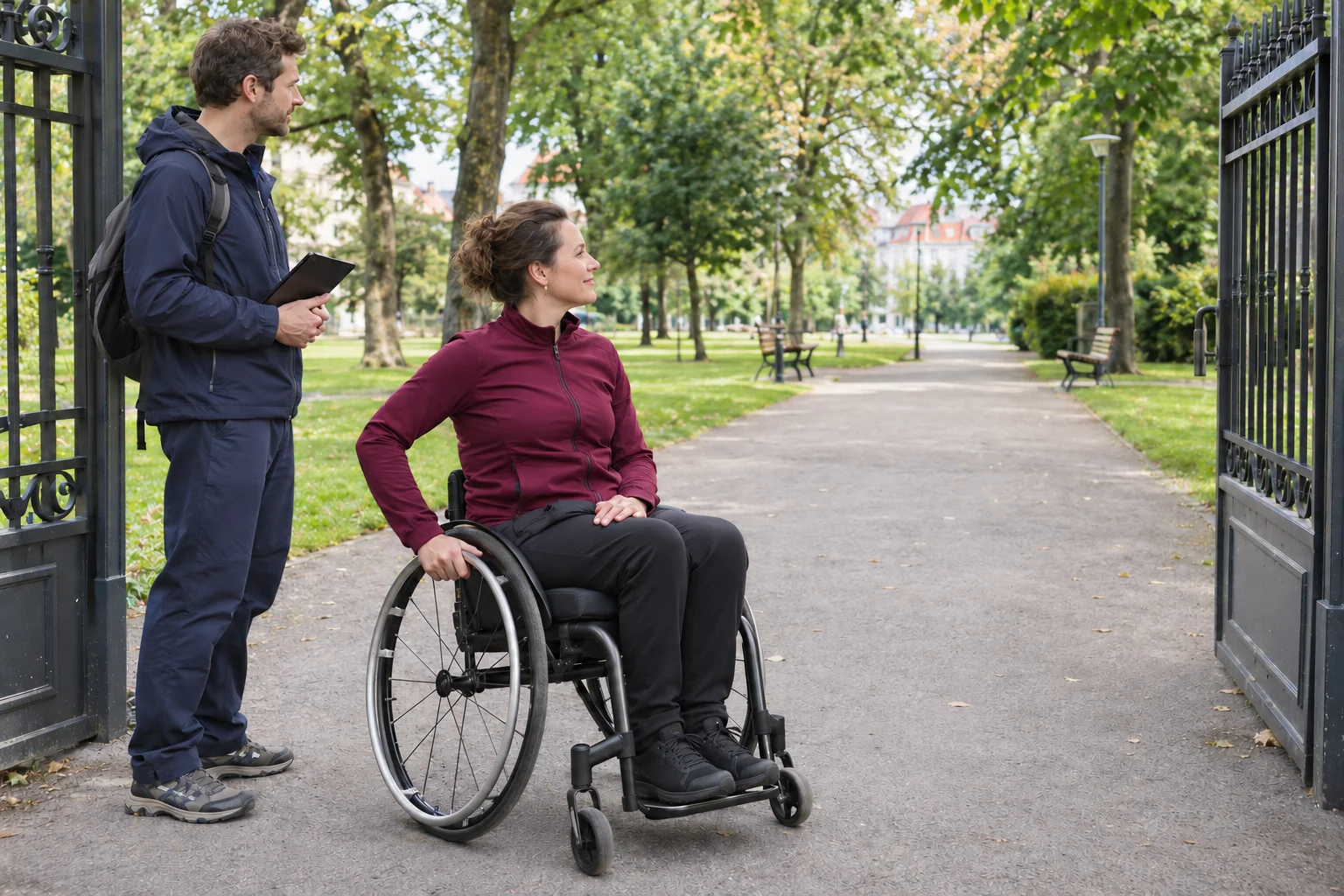
A harder-to-open door, a relocated meeting point or the loss of a direct service can change an established routine. You do not have to record every new difficulty as your own fault. Recognising an environmental barrier, however, does not prove that there has been no personal functional change. Both strands can be visible at once.
When organising things for yourself, first gather the necessary information. Where does the programme begin, how far is the actual journey after arrival, is there a usable resting place and how can you get home? These are concrete questions for the organiser. You should not have to guess a venue’s accessibility from an advertising photograph.
If you use an assistive device, programme arrangements can also take it into account. Its suitability and your individual use need clarification with an appropriate professional, but the venue’s width, approach and storage arrangements are practical questions you can investigate beforehand. Something that could have been addressed earlier in the planning should not be discovered only at the start.
Divide the whole sporting occasion into understandable parts
A shared walk or sports session begins long before you set off. You prepare what you need, get dressed, travel to the venue, participate and return home. Tasks may await you afterwards too. If a plan names only the session itself, much of the day is left out of the discussion.
You do not need to assign a load score to every activity. Identifying the sequence and difficult part may be enough. You can then look separately at what can change through organisation and what needs individual professional assessment. They are not interchangeable: a lighter bag does not resolve every symptom, while a healthcare plan does not book your bus journey for you.
Interpret the programme’s duration within your entire day. A shorter local occasion may need different organisation from a distant event with the same exercise time. Minutes spent doing sport are not the only factor in choosing. Travel and the availability of help are real parts of the decision and need not be treated as trivial excuses.
Tasks at home also need room in the day. If all the help associated with sport is organised for the morning but an important evening task has no solution, the programme as a whole may be hard to follow. The aim is not to make every activity compete, but to coordinate the tasks that matter to you.
Which goal matters to you now?
The NICE recommendation addressing multiple long-term conditions emphasises exploring difficulties affecting daily life and personal goals. Alongside a sporting goal, participating at home, a family occasion or reaching your community may matter. You do not have to describe what counts for you solely through training metrics.
Maintaining regular meetings may now come first, while entering a race can be a later question. For someone else, managing a familiar daily journey more independently becomes the priority. The order of goals can change without invalidating earlier experiences. A temporary priority is not a permanent judgement on your sporting life.
State the goal separately from the means you currently imagine using to reach it. Several kinds of participation may serve ‘I would like to meet my friends’. ‘Only completing the full running loop counts’ already selects just one solution. Keeping the first sentence visible may make it easier to find an option that is manageable in your current circumstances.
Your decisions can also include what you do not want to take on now. You do not have to accept every suggested social or movement programme. A personal goal remains your own when your interests and boundaries form part of it. Support is not there to push you back into an earlier role at any cost.
Discuss the form and limits of help together
If someone else helps, clarify the specific task well in advance. Accompanying you, preparing a bag and helping you remember information are different roles. It is more precise for both of you to understand what the occasion involves than simply saying ‘I will look after you’. The helper’s own availability and preparation matter too.
The NICE shared-decision-making recommendation says that how relatives are involved should also be discussed with the person concerned. This article is not a guide to Hungarian law; the practical principle is retaining your own participation. You can ask for help while continuing to speak for yourself about goals and the next step.
Family help is not necessarily unlimited, and not everyone can attend at the same time. Be honest about this in the plan. If a programme would work only with uncertain support, flag that beforehand. Recognising the need for help does not automatically oblige the same person to take on every role.
If a task needs physical support, do not improvise the appropriate method from a general article. Good intentions are not the same as knowing the right technique. Your individual plan can clarify what assistance and preparation are required. Within a community programme, people should accept only roles they genuinely can and agree to undertake.
 Enlarge image
What is worth keeping for the next discussion?
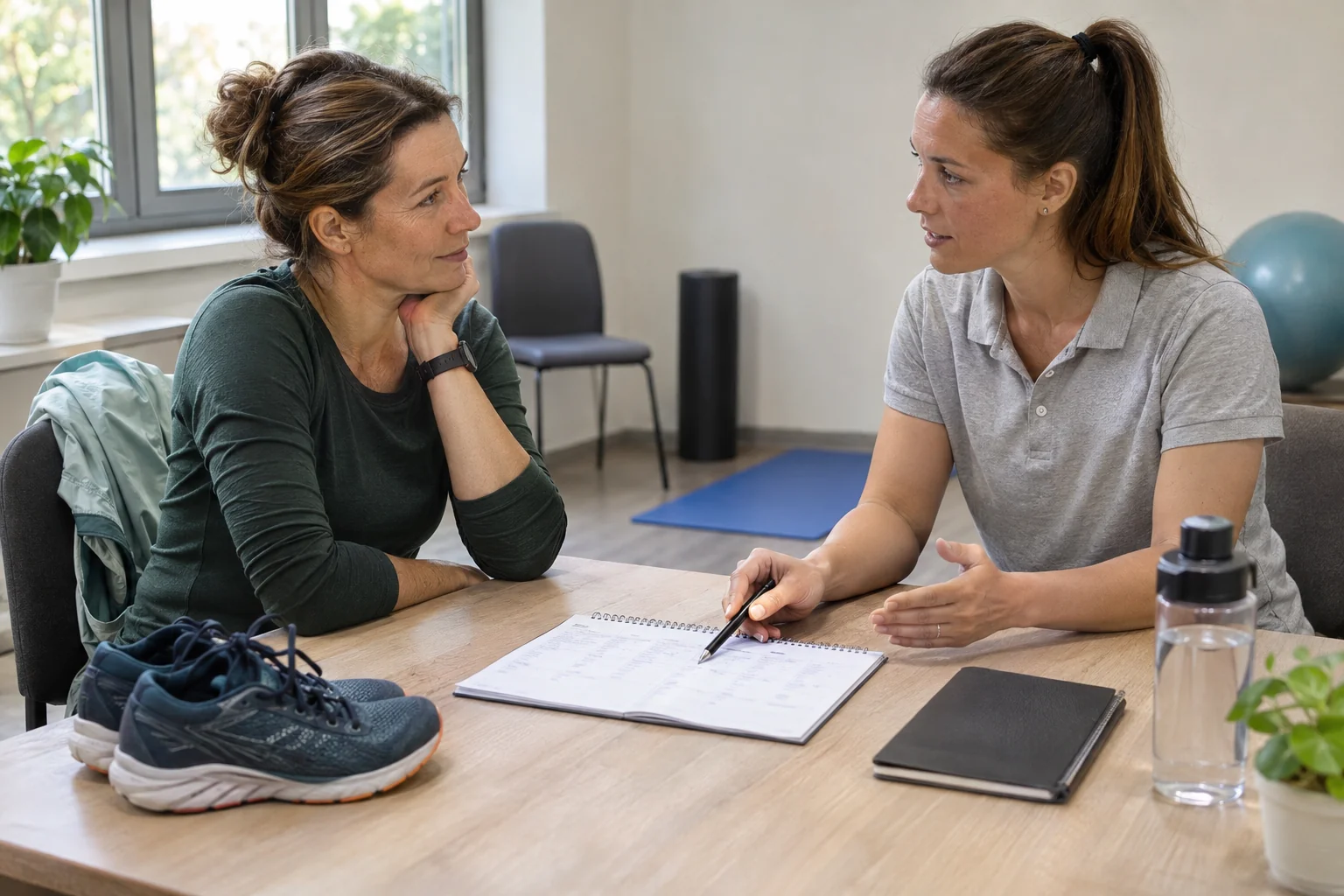
A few real examples may be enough: during which activity your need for help changed, when you noticed it and what you would still like to manage. Associated symptoms or an important history also belong in the story. You do not need to begin a lengthy data-collection exercise to discuss a new difficulty.
Organising movement and care tasks can overlap. Several appointments, journeys or instructions not visible to everyone involved can make the day harder. Coordinating the individual plan may then be valuable in its own right. The aim is not for you to change treatments yourself, but for the professionals involved to understand the full situation.
At the end of the discussion, know the current goal, the next task and when the question will be revisited. A personal framework you can follow may be needed instead of the general phrase ‘try to move more’. If you do not understand something, or it seems unworkable in real life, identify it straight away.
Your sporting story can continue in another form
For a fictional former runner, getting ready to leave and returning home have recently become difficult. At first, they see only a decrease in distance run. Reviewing the entire occasion reveals that the route, programme time and organisation of help are separate questions. Alongside these, the new functional change also receives individual assessment.
The next goal may be a suitably designed movement programme and maintaining meetings with friends. Memories of past races do not disappear, and a community role need not consist solely of completing a running loop. This story promises neither a return nor individual improvement. It shows how a previously narrow goal can become more precise.
If you need more help, your sporting plan should recognise your whole day and personal values. Necessary assessment, understanding the environment and suitable support are separate tasks, but they can connect. Adjusting a movement goal is therefore not a rejection of your previous life; it clarifies what matters and what is workable now.
Sources
NICE NG56: daily life, personal goals and a coordinated plan; NICE NG197: shared decision-making and chosen support; WHO: the relationship between functional ability and environment; NHS: sudden stroke symptoms. Checked: 21 November 2026. The note-taking examples are original illustrations, not a self-care test, prescribed rehabilitation dose or technical guide to providing assistance.
How Futószív articles are prepared: our editorial guidelines.