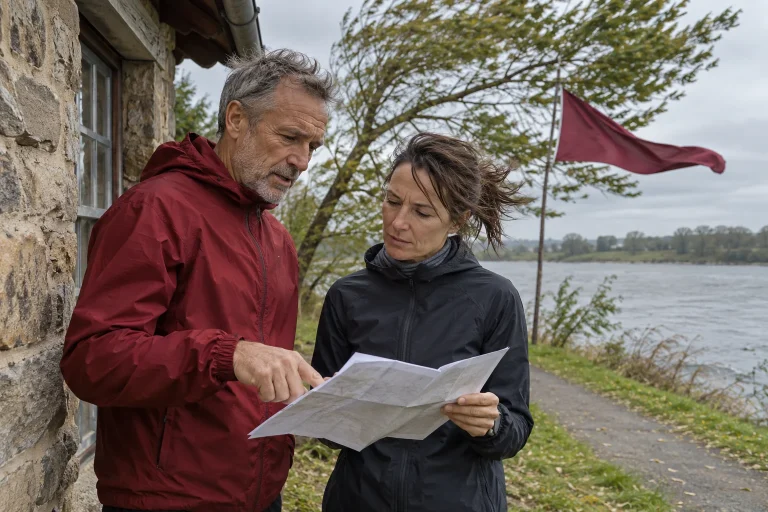
There are just ten days until the marathon, and the app alternates between a sunny morning and rain with cooler conditions beside the start time. It is tempting to switch between services until one displays a favourable number. A better way to handle uncertainty at longer lead times, however, is to stop trying to select a single future as certain. An ensemble examines several possible forecast outcomes and helps you understand how consistent or divergent the situation is.
This approach can also help with packing and organising your race preparations. Ten days beforehand, you do not necessarily need to make the same decision as on race morning: early on, you can keep options open, then choose later using fresher, locally relevant information. The following examples explain the foundations of this approach. We are not providing a forecast for a particular race, and the figures shown do not come from a current model run.
Ensemble members show several possible developments
The Met Office explains that an ensemble involves running the model several times with slightly different starting conditions. The individual forecasts are its members; together, they help describe possible outcomes and uncertainty. Not every detail of the initial atmospheric state can be observed perfectly, and differences can grow over time. An ensemble is therefore not a random collection of screenshots from a few apps, but part of a defined forecasting system.
For a runner, the useful question is how closely the possible conditions point in the same direction. If outcomes diverge, it may be too early to narrow your kit down to a single clothing option. If they are closer together, your route, the wait before the start and the local forecast still remain separate details. Ensemble information helps develop your plan; it does not replace the organiser’s weather-related instructions or guarantee that the particular course will remain usable without disruption.
Do not retrospectively pick the one member that favours your target time or favourite top. Doing so would discard precisely the information about different outcomes that the ensemble provides. ‘One member shows this’ and ‘Overall, this is worth preparing for’ are different claims. If a shared image shows only one curve, ask which product and model run it represents. A favourable image alone is not stronger evidence against the less favourable possibilities.
On an ensemble plume, the legend matters as much as the curves
The description on HungaroMet’s probability forecast page explains an ensemble plume based on ECMWF products. It identifies the 10–90 and 25–75 percentile intervals, the ensemble mean and the deterministic forecast. The ECMWF meteogram guide presents another display format: box-and-whisker plots with a median and percentiles. On different interfaces, therefore, start by identifying the legend. A thicker line or shaded area does not mean the same thing in every product.
Do not automatically interpret the height of a band as a duration or as another weather variable. A temperature panel may show the distribution of outcomes for a particular time, while precipitation may refer to an accumulation window. You can connect it to your own start time only after checking the time axis and units. Well-drawn lines do not remove the need to understand whether a displayed value represents an instant, a period, an average or another statistical quantity.
Check the location too: the start city, selected coordinates and chart title should match the place you are investigating. A forecast bearing a city’s name does not directly describe the microenvironment of every course section. For your own plan, record which location you checked and when. When comparing later updates, you will at least be asking the same question, rather than accidentally comparing images for another town or a different date.
 Enlarge image
The average can hide two very different possibilities
The following table is an original arithmetic example, not a forecast. Imagine two temperature datasets, each containing six numbers for the same moment. Both average 12 degrees Celsius, yet the distributions are very different. These six-value datasets do not model an actual ensemble system or its membership size; they illustrate only one property of averaging. We do not attach mandatory clothing, a permitted pace or personal exercise capacity to these figures.
| Fictional dataset | Six values, °C | Average | What is lost if you look only at the average? |
|---|---|---|---|
| A | 12, 12, 12, 12, 12, 12 | 12 °C | There is no difference between the values in this example |
| B | 6, 6, 6, 18, 18, 18 | 12 °C | There are two separate groups, and not a single value is 12 °C |
The average in row B really is 12: three times 6 plus three times 18 equals 72, divided by six gives 12. But that does not create a new, actually specified value of 12 degrees within the dataset. The mean is a meaningful summary; it is simply not the whole story. The ECMWF guide discusses the possibility of multimodal distributions separately, for example when the timing of a front varies. One central value therefore does not always describe divergent possibilities in sufficient detail.
Returning to the runner: do not use one central number to remove previously considered, familiar options from your bag when they serve other relevant situations. You do not need to bring an unlimited wardrobe. The aim is to retain flexibility where things remain unresolved and to know when you will check the information again. The average can summarise the chart; when preparing, it is also worth seeking information about the distribution and the specific circumstances.
Two separate panels do not automatically describe a combined weather situation
Seeing separate distributions for temperature and precipitation does not necessarily tell you enough about their joint occurrence. In our simple thought experiment, three of six possible stories are cooler and three warmer; of those same six, three are wet and three dry. In one fictional set, all the cooler cases are dry; in the other, they are all wet. The separately stated proportions are identical, yet the combined story differs. These are illustrative assumptions, not meteorological samples.
The ECMWF guide to standard meteograms uses distinguishing snow from rain to warn about missing joint information. Seeing many cold members and many wet members separately is not enough: they may not belong to the same stories. In your personal plan, therefore, do not construct a certain combined scenario simply by joining the numbers from separate panels. A product addressing the relevant joint event, or official interpretation, may offer more than this kind of home-made combination.
On your equipment list, this can mean leaving uncertain combinations as open questions. Which layer might you need while waiting, what change of clothes can you access after finishing, and how will you reach bag drop? These are organisational answers that do not require certainty about every joint meteorological outcome now. Thinking through your options reduces the need to improvise at the last minute, while avoiding claims about the forecast that go beyond what you actually read from it.
Ten days beforehand, prepare the decisions you can still change
At this lead time, sorting out packing options is a useful personal task. Which familiar top can you choose, what will you take for the wait before the start, and where will your dry change of clothes be after finishing? Match these questions to the race’s own bag-drop and access arrangements. An item in a bag represents a real option only if you can reach it when needed. This is a concrete part of the plan you can prepare despite weather uncertainty.
It can help to write two lists: what needs organising now, and what you will leave until fresher information becomes available. Equipment accessible during the journey, luggage size and the organiser’s information channel may belong on the first. Selecting the familiar layers you will actually wear may go on the second. These lists are personal organisational tools, not rules forcing every entrant to make decisions at identical times. Adapt them to your travel and personal circumstances.
Do not introduce a new technical system in race week simply because uncertainty exists and a distant model run shows an interesting number. A new jacket, bag or attachment requires familiarity in its own right. If you genuinely need to replace something, examine its purpose and usability, rather than a marketing promise selected for a single expected temperature. You can build a flexible plan from options you already know; it does not automatically require a large shopping list.
Different questions become relevant as the start approaches
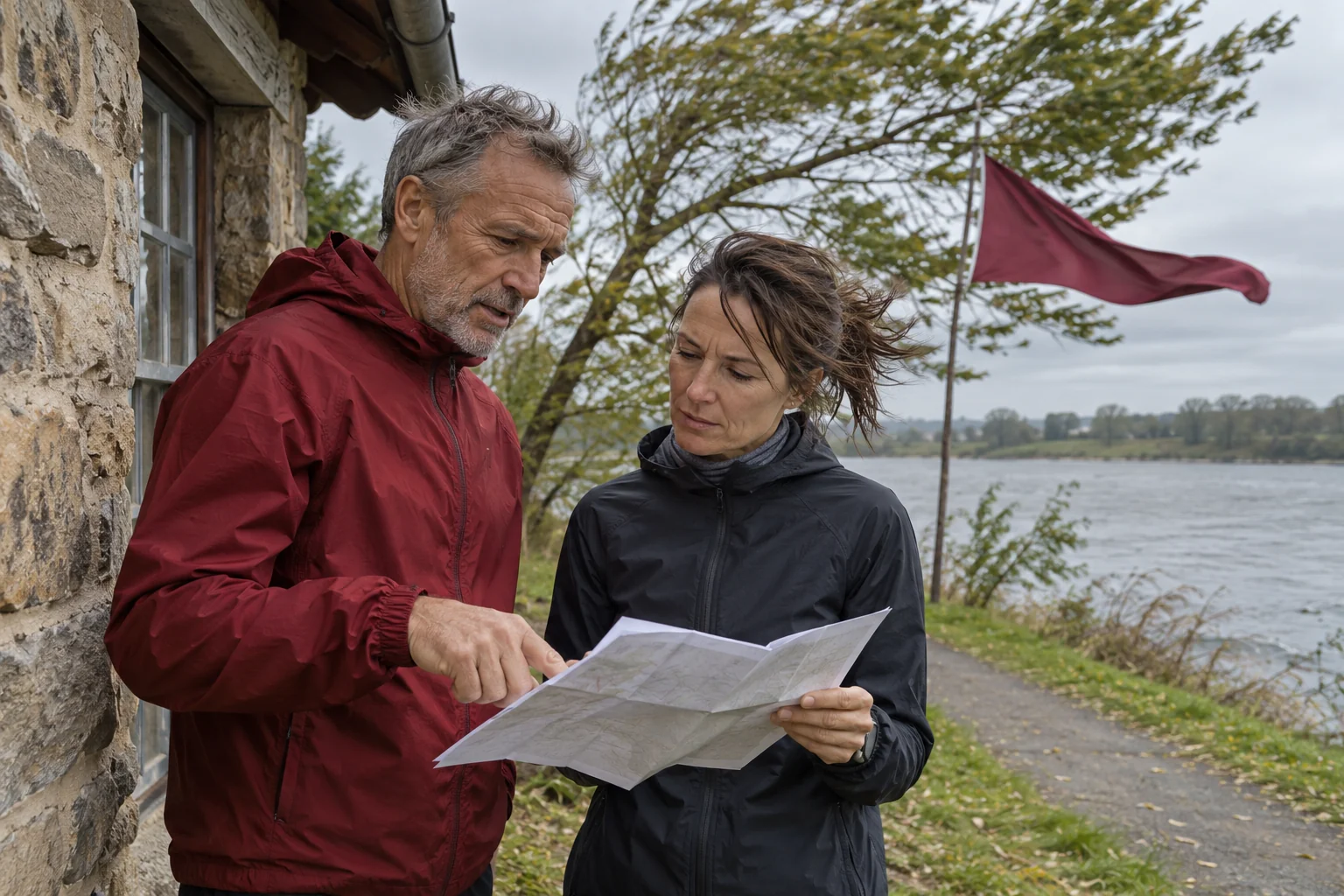
When checking an update, look for new information for the same location and period. What has changed in the outcomes, which official written forecasts are available, and has the organiser announced a change? Choose manageable checking points within your own routine instead of searching for a new number in every spare minute. The goal is not to view as many screens as possible, but to have the right information in time for the decision you need to make.
| Planning stage | A task you can address | A detail to refine later |
|---|---|---|
| Earlier preparation | Organise familiar equipment options and access to them | The final combination selected for conditions that are still changing |
| A check before travelling | Review fresh local information and the organiser’s announcements | Conditions on site and any further changes |
| Checking around the start | Follow the actual conditions and current instructions | Any necessary adjustments during the event |
The specific race’s rules and decisions take precedence over your own weather interpretation. If the organiser changes the time, route or event arrangements, do not try to justify the original plan using a favourable ensemble member. The start time and your total expected running duration are separate questions: a longer event may span several weather windows. Treat waiting and the journey home as parts of the day too, rather than considering only the minutes your watch records as running.
 Enlarge image
Uncertainty is information, not a personal failure in preparation
The Met Office decision-support guide presents the value of ensembles through possible ranges and the likelihood of specified events. It also notes that probabilistic communication is not a perfect representation of reality. A runner’s aim, therefore, is not to eliminate uncertainty permanently by looking at a diagram. What helps is recognising what remains open and retaining suitable choices in your preparations.
Do not automatically tie your target-time plan to one distant temperature or wind value by subtracting a fixed number of seconds. Race-day performance combines personal and environmental factors, while a forecast distribution is not a performance model. If you are preparing with a professional, you can discuss uncertain weather as a circumstance rather than a ready-made target-time instruction. This article helps you read the information; it does not provide a personal training plan or prescribed exercise load.
Ten days before a marathon, then, an ensemble is valuable when it makes several possibilities visible and gives you better questions for your preparations. Check the location, time, variable and distribution, avoid turning summaries from separate panels into one certain story, and organise accessible equipment in advance. As the start approaches, refine your choices using fresher information and the actual situation. Your preparation can remain concrete even while the hourly icon keeps changing.
Sources and interpreting the examples
Met Office: What is an ensemble forecast? – members and uncertainty in initial conditions. Met Office: Using ensemble forecasts in decision-making – ranges and probabilistic decision support. HungaroMet: probability forecasts and ensemble plume charts. ECMWF Forecast User Guide: Meteograms, guide updated in 2026 – distributions, multimodality and the limits of jointly interpreting separate variables. The six-value table and the two combined stories are original mathematical examples; the packing and decision process is an original editorial suggestion. None is a current race forecast.
How Futószív articles are prepared: our editorial guidelines.