Do not rewrite a windy race goal with one correction number
When wind blows on race morning, it is easy to seek a quick answer: how many seconds should be added to every kilometre? The question is convenient because it lets the original time plan stay almost unchanged. A real course, however, is not constant headwind. It may contain sheltered streets, an exposed bridge, several turns and sections where wind direction changes relative to your movement. Your first task is therefore understanding the situation, followed by adjusting the goal.
This article concerns planning before and during a road race. It gives no weather threshold for starting or training intensity valid for every runner. In dangerous conditions, organiser instructions and official warnings are the basis, while your condition needs separate consideration. A race going ahead unchanged does not mean an unchanged goal suits every participant.
First separate discomfort from a safety question
Wind is often discussed solely as a pace problem. For race organisation, however, it can affect course installations, access, supporters’ plans and the official timetable too. Before recalculating splits, check for fresh organiser information. If the programme or use of an area changed, adapt the day accordingly.
According to the HungaroMet explanation of weather warnings warning forecasts and alerts are different information levels. Check the phenomenon, affected area and validity period, then read the text too. A map colour alone does not describe conditions in the start zone or the event organiser’s decision.
Even without an obstacle ruling out starting, the race goal remains a separate question. It should not be treated as an exact copy of the latest calm-weather workout. A useful goal belongs to the task that day, rather than being retained merely because you already sent it to friends.
 Enlarge diagram
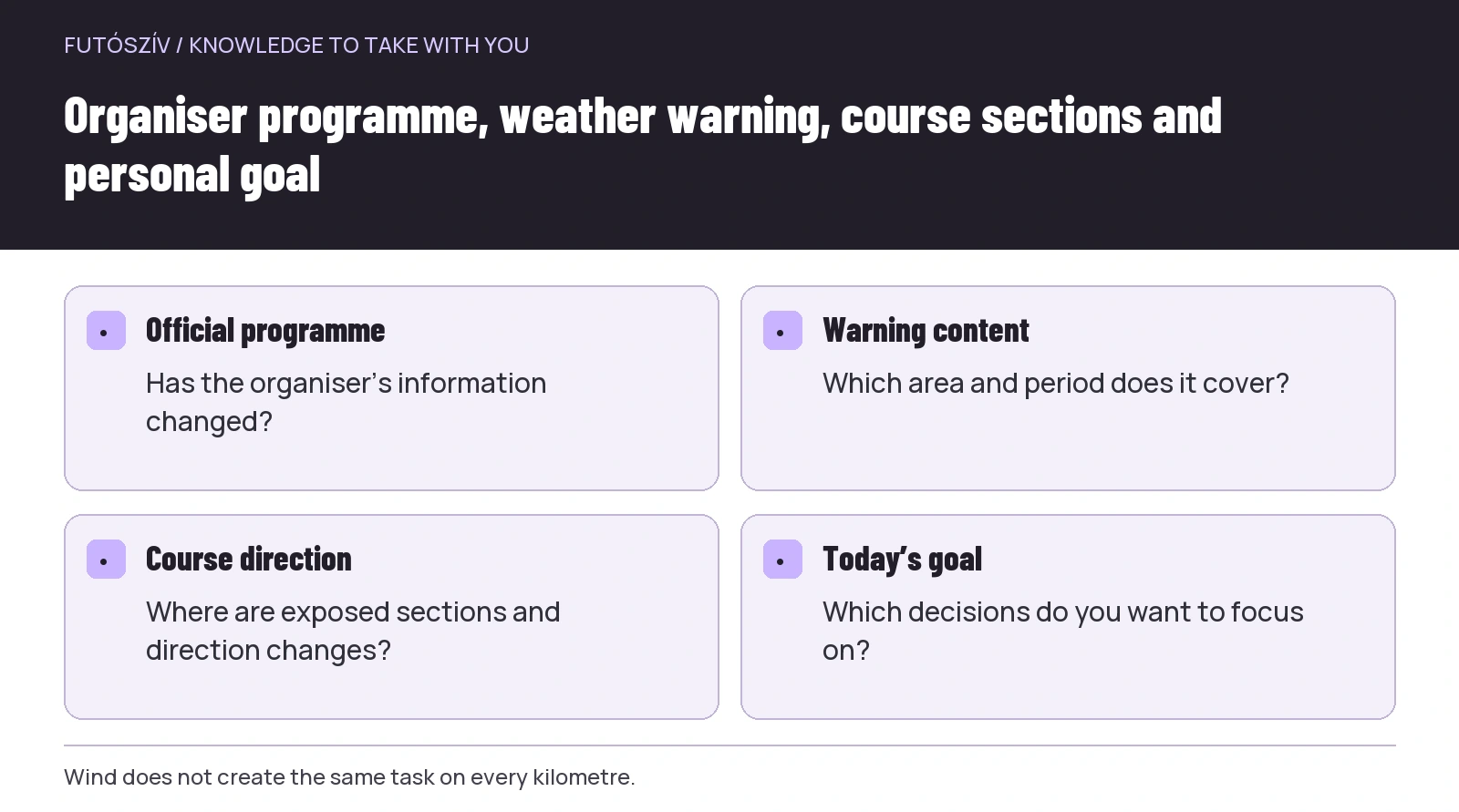
Text version of the illustration
- Official programme
- Has the organiser’s information changed?
- Warning content
- Which area and period does it cover?
- Course direction
- Where are exposed sections and direction changes?
- Today’s goal
- Which decisions do you want to focus on?
Make a simple wind-focused course map
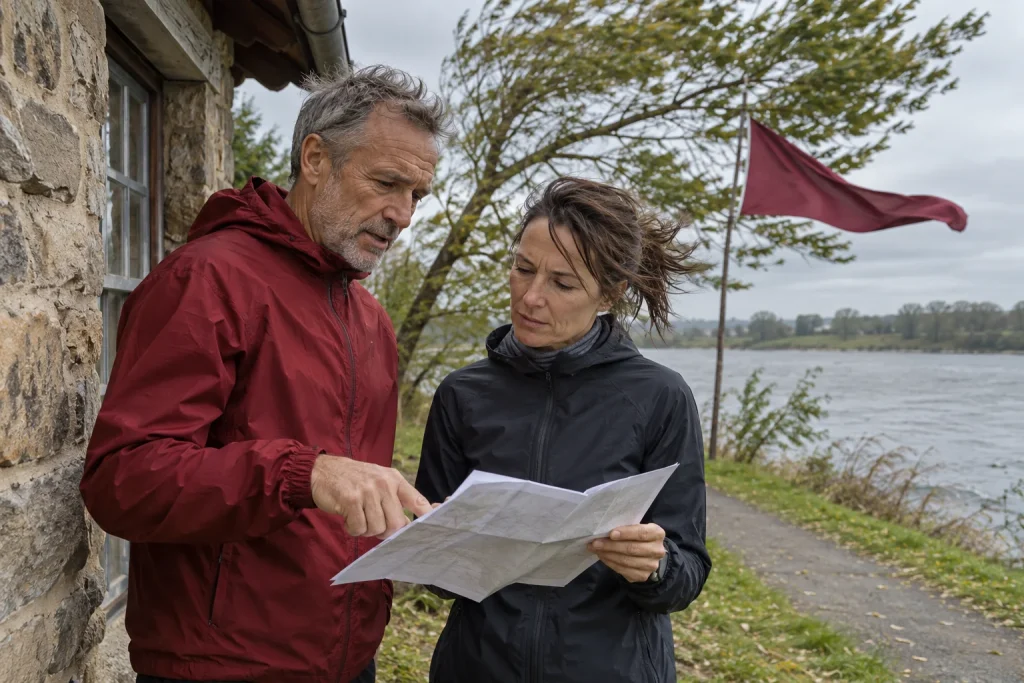
You do not need a meteorological simulation. From the official route map, identify a few recognisable parts: a long exposed straight, a direction change, a street between buildings, a bridge or waterfront. Marking them does not guarantee local wind conditions. It helps avoid judging every different kilometre by the same standard during the race.
| Course character | What is worth observing beforehand? | What should you not assume? |
|---|---|---|
| Long straight | Which direction does it follow and where does it end? | The same situation applies throughout the distance |
| Turnaround | When does the direction of travel change? | Every lost second will return |
| Built-up section | Where are bends and narrow points? | There is constant shelter beside every building |
| Exposed crossing | What are the official route and current instructions? | Every detail of yesterday’s reconnaissance remains valid today |
You can add forecast wind direction to the observations, but do not force actual experience to fit your drawing. A map is a tool. If conditions on the course differ, update the plan rather than rename reality.
Do not make wind direction an automatic acceleration command
In a World Athletics article about extreme weather the author emphasises monitoring effort on windy runs rather than rigidly following pace. The author does not regard headwind and tailwind splits as simply comparable either. This principle is not a number sequence transferable to everyone: it shows why forcing identical displayed pace in differently conditioned sections is unhelpful.
On reaching a tailwind, do not automatically make recovering the earlier discrepancy your task. First examine what happened, what remains and which parts of the original idea still apply. A more favourable number for a while does not mean the whole race has returned to the calm-weather scenario.
An out-and-back course makes this trap particularly easy. Somebody calls the outward section an “investment”, expecting every loss to disappear on return. This creates a self-imposed obligation to surge. Treating the turnaround as a new checkpoint is more useful: update the task using earlier decisions and remaining distance.
Set an outcome goal and an execution goal
The outcome goal concerns finishing time. The execution goal concerns decisions you want to handle well. On a windy day, the latter helps interpret participation even if the former needs changing. A lengthy mental programme is unnecessary: two or three observable tasks suffice.
Execution goals might include avoiding rushed successive overtakes at an exposed section’s start, reassessing at the agreed point or switching to your independent backup after losing a pacing group. These can be reviewed factually afterwards. “I will stay tough”, by contrast, does not tell you what to do in a new situation.
| Original statement | More useful version |
|---|---|
| Every kilometre will be the same | I attend to the current task on different course sections |
| I will recover everything after the turnaround | I reassess the remaining plan at the turnaround |
| I will stay with the group at any cost | I know my own plan if we separate |
| In bad weather, the result does not matter | I name beforehand which decisions I want to evaluate |
Do not change the outcome goal only in your head. If supporters expect you at specified times, tell them beforehand that the earlier estimate may change. If running with somebody, do not automatically rewrite their goal to match yours.
A group is not a moving object to be used
On a windy course, many runners seek company moving similarly. Everyone still remains an independent participant. Do not step on heels, squeeze somebody off their line or expect strangers to work for your pacing plan. Moving with a group is useful only when its pace and circumstances suit your plan.
If friends agree shared work beforehand, clarify what each can manage and how changes will be signalled. State that anyone can depart from the shared plan too. Do not discover mid-race that one person understood the outing as company and another as compulsory leading duties.
A pacer does not remove independent decisions either. The flag may indicate a target time undertaken, but the actual event rules and daily conditions matter. If the group’s rhythm no longer fits, do not assume the pacer knows your condition better. Have a plan for continuing independently or ending the day differently too.
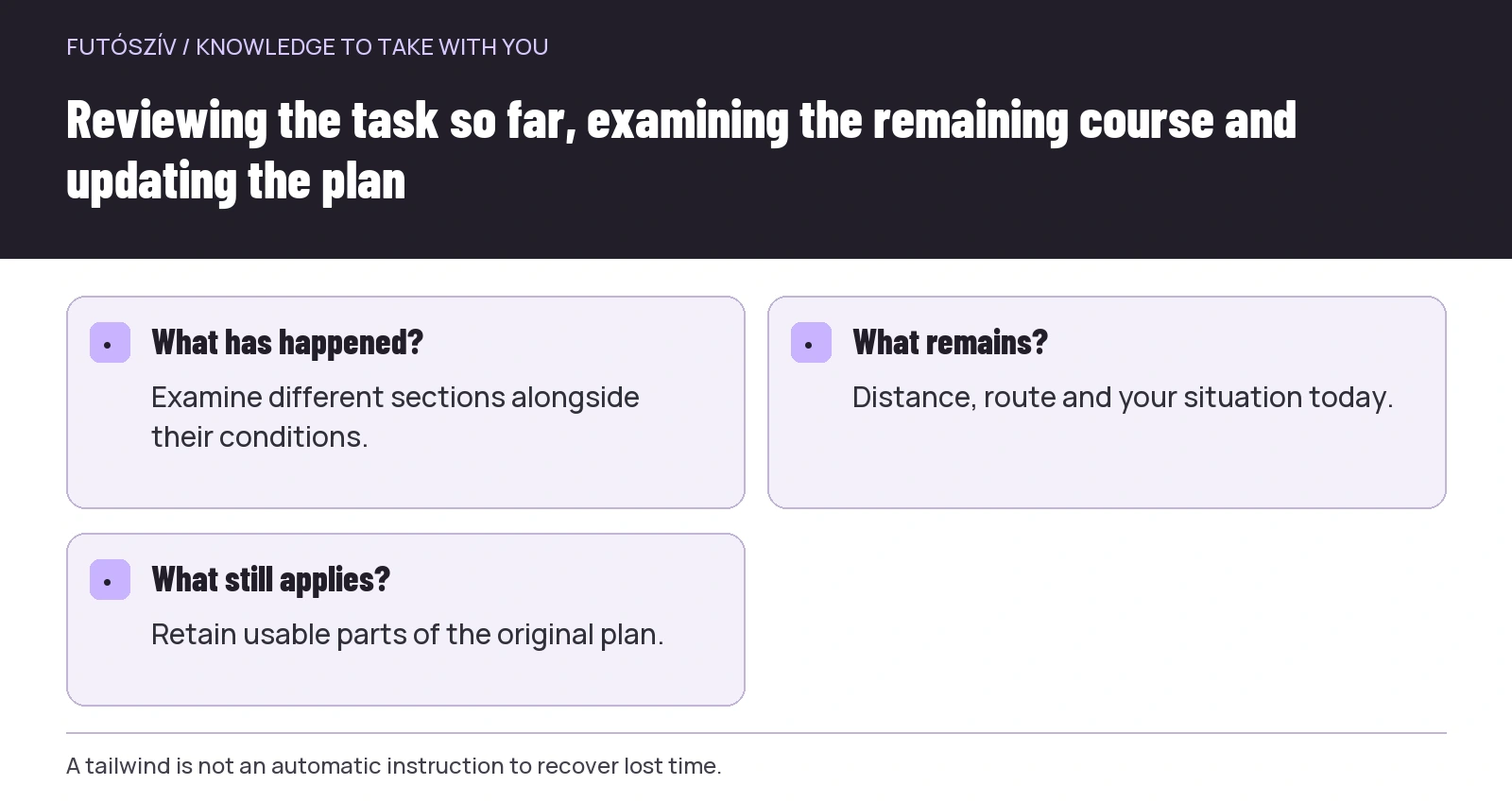 Enlarge diagram
Text version of the illustration
- What has happened?
- Examine different sections alongside their conditions.
- What remains?
- Distance, route and your situation today.
- What still applies?
- Retain usable parts of the original plan.
Watch data: fewer fields, a better question
During a windy race, the display can easily become a constant judge. A few seconds’ discrepancy prompts another correction while you have changed direction or the field has tightened. Learn beforehand which data on your device is instantaneous and which is averaged. Do not leave testing settings until the start zone.
For section-based evaluation, select recognisable official course points. At them, examine the task completed and remaining plan together. You need not invent a new goal at every post or gust. If making data-based decisions, name the measurement conditions too: an entire kilometre’s average differs from a figure displayed over a few steps.
Frequently refreshing a phone forecast during the race does not necessarily improve decisions either. Official information before departure and the event’s on-site instructions matter more than stopping in the running lane to compare several app models. If new information is needed, first create a suitable situation for checking it.
Illustrative example: ten kilometres beside a river
Suppose a runner is preparing for an exposed riverside out-and-back race. Earlier, they wrote even kilometre paces on a sheet. The morning check indicates a windier day, while the organiser confirms the current programme. The runner first examines the course: where direction changes, where narrow sections require attention and where the official intermediate marker is.
The adjusted goal is not arbitrarily adding a number for headwind then subtracting it at the turn. The runner selects a checkpoint, drops the identical display target for every kilometre and defines execution tasks suited to their familiar effort framework. They tell the supporter that the earlier finish estimate remains guidance only.
The first exposed section’s split falls behind the original sheet. This need not immediately be judged bad running. After the turn, the runner examines how the day has unfolded and decides the continuation from that. The example provides no specific target pace because a responsible adjustment cannot be calculated without personal history and real conditions.
Adapt supporters’ plans to the changed goal too
If family or friends wait at several points, do not give them only the old split table. A wind-related adjustment should ideally simplify meeting. One reliable, precisely named post-finish location is often more useful than several uncertain crossings and a last-moment photo position.
Check access alongside official closures. Supporters should not try to move with you on the race course or step into the field at the last moment. If you miss each other at an agreed point, use the preselected next step rather than crossing paths while searching.
Also record the post-finish bag’s location and journey home separately. Running’s time goal and the whole day’s organisation relate but are not identical. A more flexible running plan can still have a precise meeting place. Good logistics remove unnecessary tasks from the race’s end.
What should you note about the wind afterwards?
Three types of information suffice: what was known beforehand, what you experienced on the course and what decision you made. Do not manufacture a calm-weather “true result” afterwards without a reliable method. An estimated correction can easily look precise while resting on several unchecked assumptions.
It is more useful to describe holding the old display target too long at an exposed section’s start, or how reassessing after the turnaround helped organise the continuation. This can generate a next task: trying another watch screen in training, a clearer meeting plan or reading the forecast text more carefully.
You then carry useful decision experience into the next race rather than another rigid wind-correction rule. You know which information mattered, where the original idea ceased to apply and how you adapted. That remains valuable even when finishing time alone says little about the day’s task.
How Futószív articles are prepared: our editorial guidelines.