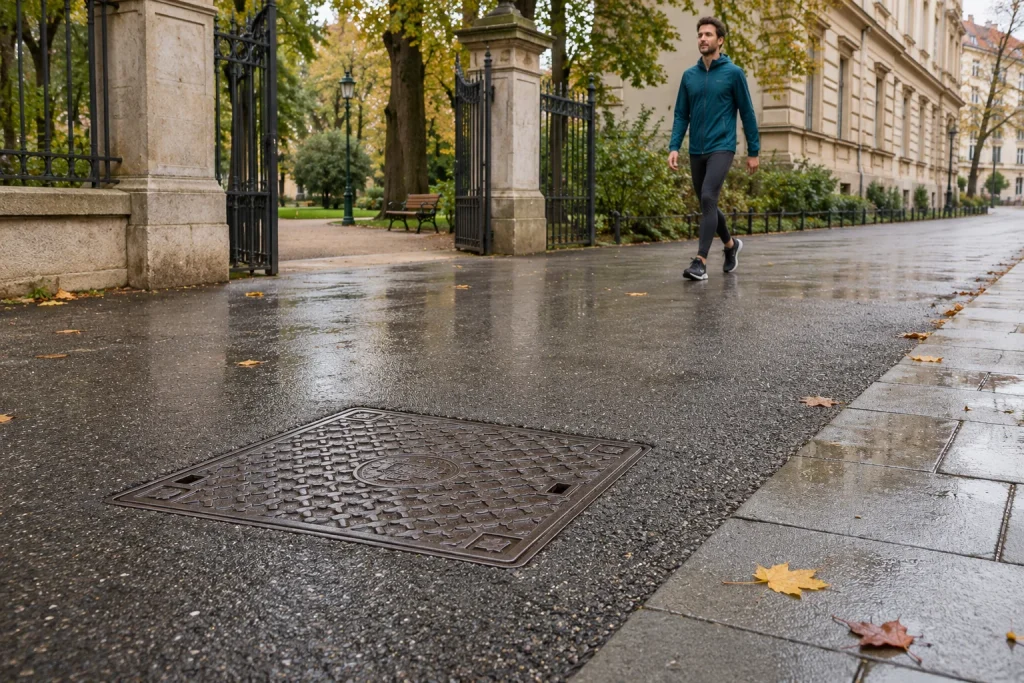
A rainy urban loop is not a single wet surface. A metal cover interrupts the asphalt pavement, smoother stone slabs follow at an entrance, and you pass between painted stripes at a crossing. Add fallen leaves, water collecting in a hollow and reflections from evening lights. Feeling secure over the previous fifty metres does not mean conditions will remain the same for the next few steps. Knowing your own route therefore requires particular attention in rain.
We do not offer a list that classifies every metal cover as dangerous and every stretch of asphalt as safe. The actual surface, material on it and how well it can be seen all matter, and looking at it does not measure its precise grip. We help you divide a familiar urban loop into recognisable changes in surface, consider when to choose another direction and identify useful details to remember about an uncertain section. The aim is a route suited to the conditions, rather than testing the point at which you slip.
Large patterns and fine surface roughness are different things
A raised pattern on a cover or visible grain on a paving slab can easily suggest a good foothold. However, the HSE guidance on flooring assessment discusses measuring microscopic surface roughness separately from controlled friction testing. This is a reminder that visible shape does not provide all the information about grip. A photograph or the name of a manufacturing material alone does not describe the specific condition of a street cover for your run.
In practice, noticing a change in surface is more useful than drawing conclusions about materials on the spot. Notice where the original pavement ends, where the route continues and where a section begins whose wet condition you do not know. You need not know the alloy of a cover to avoid planning an abrupt turn on it. Recognition prepares your next decision; you do not need to identify every detail by name as you go.
Do not attempt a test by touching the surface with bare hands, kneeling on it or deliberately making your shoe slide. These do not provide interpretable test results from which to select a running speed. If a particular public area appears persistently problematic, an accurate location description sent to its operator is the appropriate approach. A runner’s task is to choose a route usable in the conditions, rather than certify or repair public space.
Paint matters after it has dried too
An HSE case study of a painted workplace surface explains that dried paint can also create a smoother surface that behaves differently from the original when wet or dusty. This is not a uniform assessment of every road marking. The important distinction is that a painted area may differ from its surroundings; knowing it once dried is different from knowing its slip characteristics as tested in the relevant condition.
At a crossing, treat the traffic situation as the priority. This article does not suggest weaving around painted stripes to cross unlawfully or unpredictably. Prepare to cross in advance, follow the rules at that location and pay attention to vehicles and other road users. If part of your route is difficult to use in rain, you can choose another crossing that can be reached lawfully, or an entirely different loop, for your next outing.
Markings at a sports-ground entrance, along the edge of a car park and in an internal courtyard do not necessarily serve the same purpose. Record the location and situation in your own notes, rather than a general claim that all white paint is slippery. Respect closures for recent work. A familiar shortcut does not become usable because your watch still draws the old track through it.
 Enlarge image
The appearance of stone paving does not reveal its entire condition
Polished, dark, sparkling and smooth are descriptions of appearance, rather than instrument-based categories. Colour alone does not tell you about moisture, surface treatment or wear on stone. The HSE technical material explains that interpreting slip testing requires an appropriately trained professional; the direction of testing may also matter on profiled surfaces. This cannot be turned into a simple shininess scale allowing a runner to judge every street paving slab with certainty.
Where a pavement crosses the entrance to a shop or building, pay particular attention to where the paving changes. A short smoother stretch can easily be absent from your mental picture of a route if you have always used it in dry conditions. Remembering the location and seeking an appropriate alternative is enough. You need not stop directly in a doorway during your run while others enter and leave; choose somewhere to assess the situation without obstructing or endangering anyone.
Even familiar paving is not a fixed environment. Construction dust, sediment or something you have not seen before may be present. Standing water covering part of the surface leaves you with even less information about what lies underneath. You need not step into it to discover its depth or grip. A detour that appears drier is only an option if traffic and other circumstances make it genuinely usable, without leading onto the road or into a closed area.
Leaves and mud add another layer to a familiar route
Your memory of a route often concerns its underlying surface: an asphalt loop or a stone promenade. In autumn, however, this may not be what your shoe touches directly. Fallen leaves can hide the surface, while mud carried from a park entrance can reach the urban section. Give what lies on the path a separate line in your planning from what the path is made of. You can use this distinction even before opening a map.
Not every layer of leaves is the same, and this article assigns none of them a numerical grip value. The observable fact may simply be that part of the paving is covered, its precise condition cannot be seen and your previous experience of the loop is therefore incomplete. That can support a specific decision: leave out that section today. If there is no good alternative, you can change the entire outing; a scheduled distance does not oblige you to take on a section in an unknown condition.
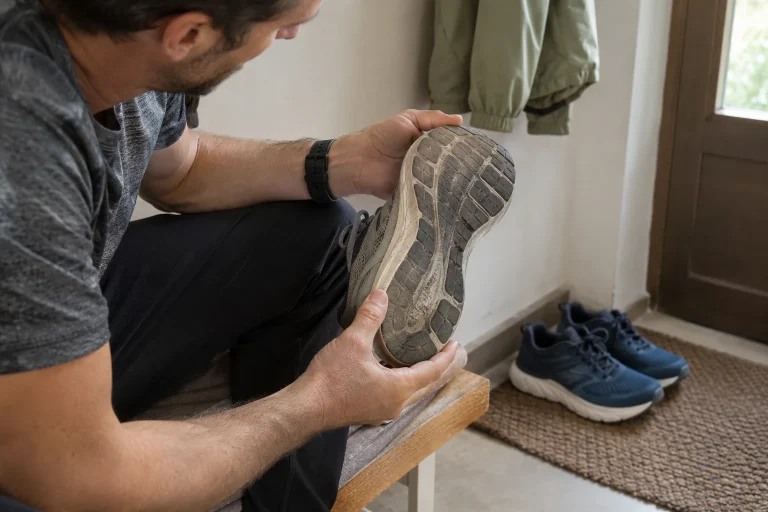
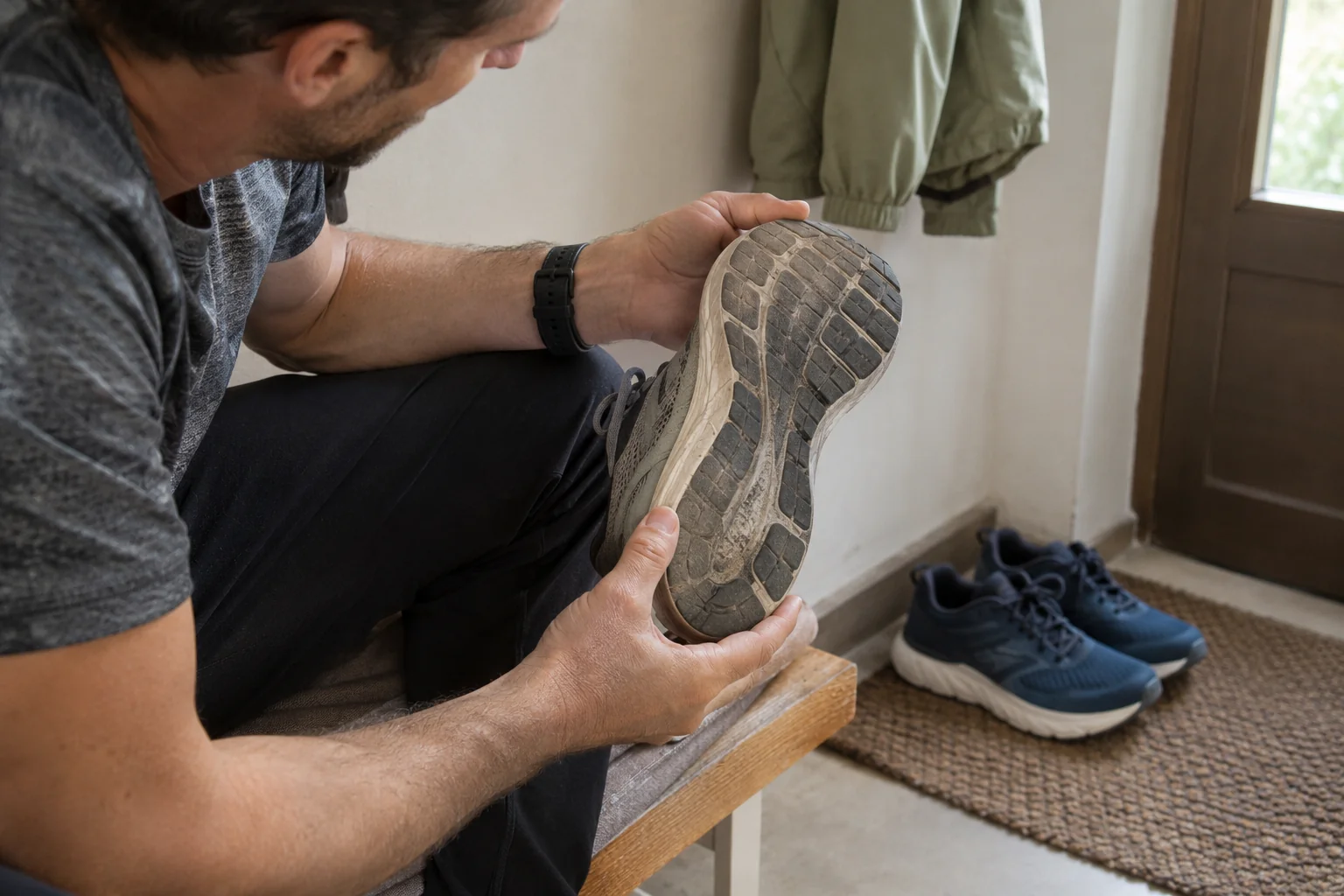
Material on a sole can travel elsewhere with you. Leaving a park and entering a building can therefore create different situations for the same shoe. Treat equipment care and entrance rules as part of the outing: where is there a designated cleaning area, and where can you stop without occupying the circulation route? This concerns route organisation as well as choosing which shoe to put on before setting out.
Light can reveal water and also hide details
The HSE guidance for educational settings specifically identifies inadequate lighting and glare as factors that interfere with recognising hazards. This is not a comparative test of running lights. For an urban runner, it highlights the question of whether the next change in surface can actually be recognised. Merely having a light, or a generally bright street, is different from being able to see the condition of a particular stretch of pavement clearly.
When planning your own loop, you can distinguish a lit section with many reflective shop windows from one that is more consistently easy to see. This does not measure brightness; it describes where you find it harder to orient yourself. If you cannot see a surface adequately, do not fill the information gap with assumptions about your shoe’s grip. A brighter time of day, another familiar loop or an indoor activity that day may be reasonable options.
A picture taken along the route also depends on the light. A wet section may shine in one photograph and look quite different from another angle. Do not therefore share a single image as certain evidence of grip. When reporting something to an operator, add the time, precise location and what is actually observable. Stop somewhere appropriate to use your phone; do not focus on its screen while moving along a pavement full of changes in surface.
Four imagined urban situations and four decisions to consider beforehand
The following situations are editorial examples, rather than accident case studies. None claims that the alternative described is accessible in every town or to every reader. They help you break a general feeling that the road is slippery into a specific section and a decision you can actually carry out. Always choose an alternative according to the location and traffic rules, rather than mechanically following the example here.
| Situation | What information is missing? | A possible planning approach |
|---|---|---|
| A row of metal covers on a familiar bend | The specific wet surfaces and whether the transition is usable | Find another lawful loop that leaves out this section |
| Water covers a lower section of an entrance | The underlying surface, depth and possible obstructions | Leave out the entrance rather than testing it in the water |
| Leaves cover a shortcut through the park | The surface beneath the leaves | Find a clearly visible, usable designated path |
| Evening reflections make the change in paving hard to see | The environment for the next few steps | Change the time of day or the whole outing |
The shared idea is a task that can be planned. If keeping to a particular loop requires you to complete an uncertain section regardless, changing the loop is a real solution. Treat a shorter route as more than an emergency scenario: you can save it to your watch or write it in your diary beforehand. That way, changing the outing on the day does not require inventing a new destination and return route on the spot in difficult conditions.
 Enlarge image
In a group, the front runner’s experience is not everyone’s
Someone else having crossed a surface does not certify that section for you. You may not arrive in the same shoes, using the same movement or following the same line, and the person in front has not performed a test either. Before a group run, it can help to agree how to signal a section that is hard to see clearly and where to wait for each other. The signal should allow a calm decision, rather than encourage everyone to imitate the group’s fastest member.
Do not begin a detour with a last-second sideways move either. Someone behind may see a different detail, and other people may also be using the pavement. A group leader can regroup the outing at a suitable place chosen beforehand and modify the loop. If that is not possible, stopping the outing remains an option. A shared training session is not intended to let a plan override any participant’s circumstances.
Keep the agreement simple and understandable: which signal means stopping somewhere appropriate, who maintains contact with those behind and how you return. Adapt these arrangements to your own group. They require no new app, and elaborate hand signals that nobody remembers are unhelpful. Technical equipment can at most support communication here; it does not resolve the route’s actual conditions for you.
A useful location report describes observations rather than assumed causes
When reporting a recurring problem to an operator, separate what you saw from its explanation. A precise address or entrance, date, time, weather situation and observable surface are useful information. Water collecting before smooth paving is more factual than naming a fault in an unknown material. Do not enter a dangerous place, open a cover or put your own obstruction in other road users’ way to make a report.
For your own use, a brief map note may be enough: I leave out this entrance in rain; the other loop needs checking. You need not write a detailed diary every time. Its value is in reminding you of a previously observed location when you plan next. Update the information over time: after repairs, a closure or roadworks, neither the old route nor the old alternative may remain usable in the same way.
You need not reduce paving that changes every few metres to a single good or bad route. More precise thinking gives you more choices: another entrance, a different time of day, a shorter loop, a different location or postponement. Clothing and shoes are important preparations, but the usability of an urban run also depends on knowing the actual route and that day’s conditions. Add a fresh assessment of the situation to your previous positive experience each time.
Sources and editorial application
HSE: Caution! Wet paint! – a workplace case involving painting and a change in surface, rather than a ranking applicable to all road markings. HSE: Assessing the slip resistance of flooring – principles and limits of interpreting surface assessment; not instructions for your own street testing. HSE: Slips and trips in education – lighting, environment and slip hazards. The urban situations, table, group agreement and note-taking arrangements are original editorial examples applied to planning a running route, rather than test results or local authority instructions.
How Futószív articles are prepared: our editorial guidelines.