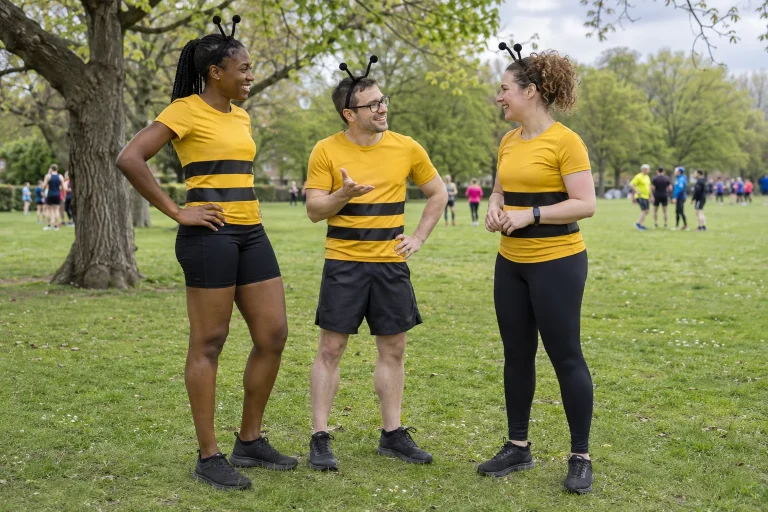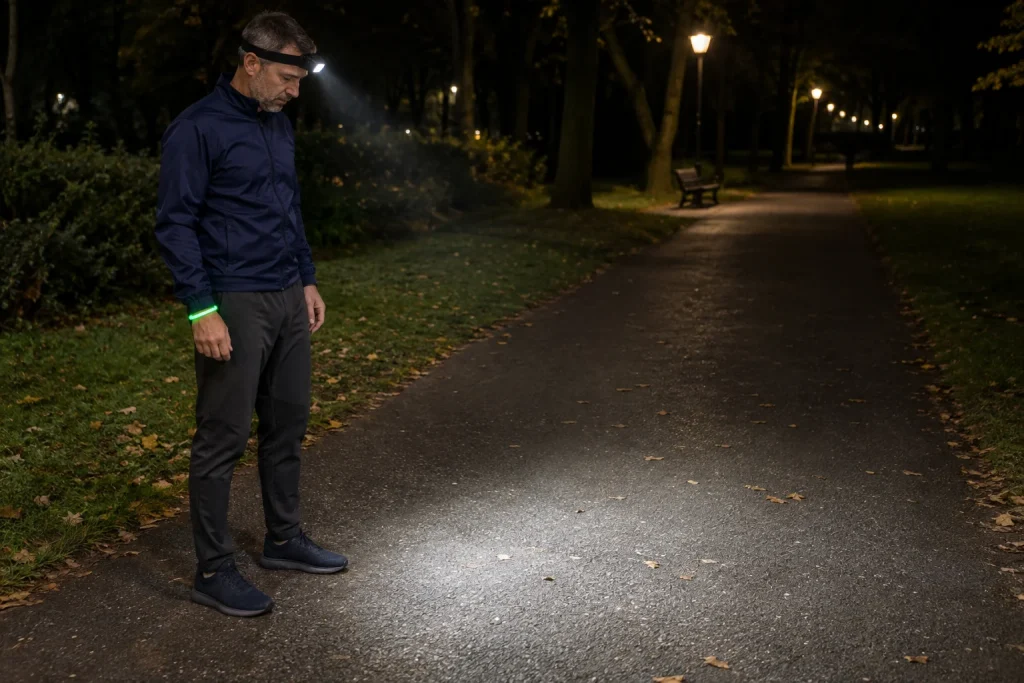
In photographs of a light run, glowing accessories, projected lighting and route illumination can easily merge into a single spectacle. For participants, however, there may be three separate tasks: creating atmosphere, making yourself noticeable and actually seeing where you are going. A colourful wristband can serve the first well without resolving the other two on its own.
When choosing an event, read the visual appeal and conditions of use separately. The organiser can specify the route and lighting provided, and any equipment you need to bring. You then need to add the whole evening: getting there, waiting, the race and returning home. The following method provides practical organisation, rather than headlamp recommendations or a general brightness requirement.
Decorative light, signalling light and route illumination have different jobs
The colour and movement of decorative light contribute to appearance. It may be on clothing, a wrist or an event installation. A signalling light or reflective element may support the wearer’s visibility, with its own conditions of use. Illuminating the walking or running surface, by contrast, helps make the actual route and surrounding details recognisable.
One device may serve several functions, but its name does not decide that. A glowing band does not establish that it also lights the ground appropriately, and a bright clothing colour does not illuminate a dark section. Stage lighting at the event likewise does not prove uniform lighting throughout the course. Understand the actual arrangement.
| Function | Which question does it answer? | What does not follow automatically? |
|---|---|---|
| Visual element | How do I join the luminous theme? | That I can see the ground with it |
| Visibility | Under which conditions do I become more visible to others? | That I am noticed from every direction in every situation |
| Route illumination | Which light supports actual movement? | That the highest setting suits everything |
| Event lighting | What does the venue and course system provide? | That the journey there and home has the same environment |
The table is our own functional breakdown. It does not rate a particular item’s safety or replace traffic or race rules. The aim is to prevent a decision about attractive appearance from hiding the actual question of use.
Find the specific course in the light-run information
Check where and at what time you will run, whether sections have different lighting and whether the organiser requires your own lamp or other equipment. A programme inside a stadium, an urban route and an evening forest run involve different environments. “LED” or “night run” does not denote a uniform equipment category.
The official Sportoló Nemzet page for LED’s Run on 27 March 2026 , for example, presents an event at the National Athletics Centre with luminous accessories and visual effects. By 18 November 2026, this was an archived programme, rather than an invitation to enter a future event. It illustrates that a glowing accessory can belong to the event experience while practical conditions still need reading separately.
If the information does not clarify personal equipment expectations, ask about the chosen race and edition. Do not try to estimate course brightness from the camera exposure in a promotional video. The same place can look different on film from what a participant sees, and a video often shows only a few selected points.
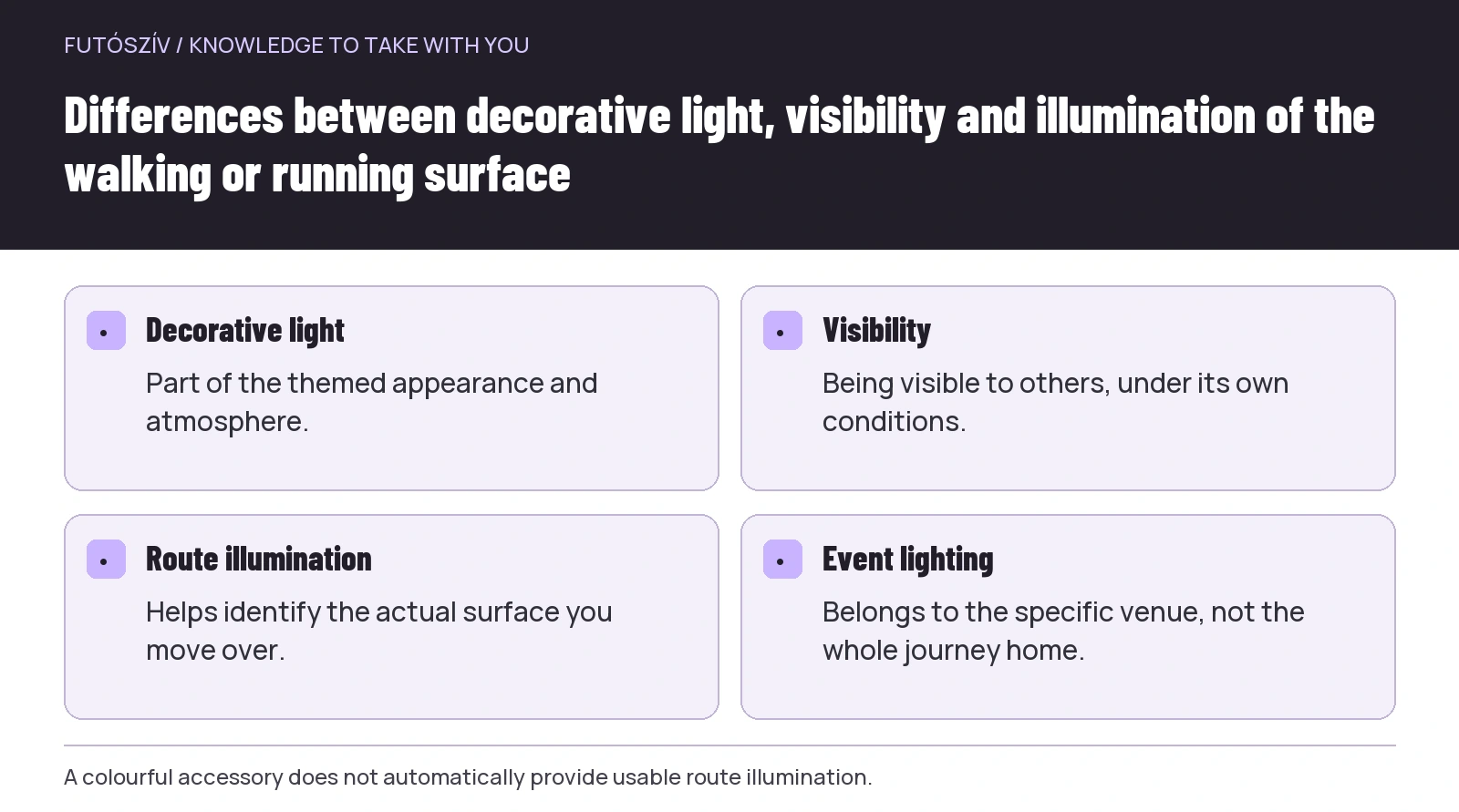 Enlarge diagram
Text version of the diagram
- Decorative light
- Part of the themed appearance and atmosphere.
- Visibility
- Being visible to others, under its own conditions.
- Route illumination
- Helps identify the actual surface you move over.
- Event lighting
- Belongs to the specific venue, not the whole journey home.
Lumens alone are not a complete description
The lumen value on a headlamp specification relates to luminous flux. The distribution of the beam and selected mode also form part of what you actually see. Two lamps showing the same number do not automatically give the same view ahead. Detailed technical information and the product’s own manual help explain operation.
The lighting overview in Petzl’s official 2025 technical catalogue treats luminous flux, beam pattern, lighting distance and runtime separately. We use that distinction here, rather than recommending a product from the industrial catalogue for running. Find the appropriate use of your own device in the specific model’s description.
Focused and broader illumination can give different views of distant and nearby areas. Do not base the decision solely on the biggest number on the box. Check which setting you would actually use and which information the manufacturer supplies for it. There is no single general compulsory lumen value for every route and participant.
The brightest light and longest runtime are not necessarily the same mode
Specifications may list several settings with different light output and runtimes. Do not pair maximum luminous flux with the longest time belonging to the lowest mode. Find the correct pairing. How the manufacturer defines the stated runtime and under which conditions it was measured also matter.
Petzl’s technical overview explains the relationship between light and runtime and several types of regulation. The practical lesson is to look at measurement and mode explanations alongside the number. Do not treat a catalogue figure as a personal guarantee of unchanging light in every situation. Conditions of use belong to the specific product.
The official Black Diamond headlamp guide likewise considers activity, the nature of illumination and power source separately. This is manufacturer information, so we do not use recommendations for its own products as a general ranking. Whatever the brand, the aim is to read actual function together with its accompanying description.
Account for use throughout the evening
The lamp may be used for more than the interval between the race start and finish. Depending on circumstances and rules, it may be needed while finding your way after collection or leaving the event area. Assess intended use from your entire personal programme. Do not forget travel and waiting simply because the race distance is short.
Check the actual condition of the power source according to the manufacturer’s instructions. It is not enough to know a device stored in a bag worked last time. Check whether the planned setting is available and whether you have the backup the event requires. Do not copy the form of backup from another race’s list: your own device and the specific rule matter together.
If something does not work as planned, do not begin experimenting with unfamiliar modes on a darker course section. Arrange to stop or request help according to the situation and organiser’s procedures. The event’s luminous theme does not mean an installation will definitely replace faulty personal equipment. Do not assume that beforehand either.
Test fastening with the complete outfit
The headlamp strap, hat, hood, glasses and costume decoration together shape use. Pieces that work individually can still interfere with one another. Somewhere familiar and calm, check whether the lamp moves, the switch is accessible and the light can be pointed appropriately in a way permitted by the manufacturer.
Examine the wiring or fastening of glowing decoration too. It should not need constant reattachment or have dangling parts that catch in your own movement or surroundings. Decoration should not cover functional light or identification required by the event. Something that works only with continual adjustment in rehearsal is worth simplifying before the event.
Do not shine into other people’s eyes as a test or test in traffic when people notice you. Even a functional check in your own controlled setting is neither safety certification nor elimination of every risk in a situation. The aim is to learn the device and recognise obvious problems, rather than experimentally test personal limits or road users’ reactions.
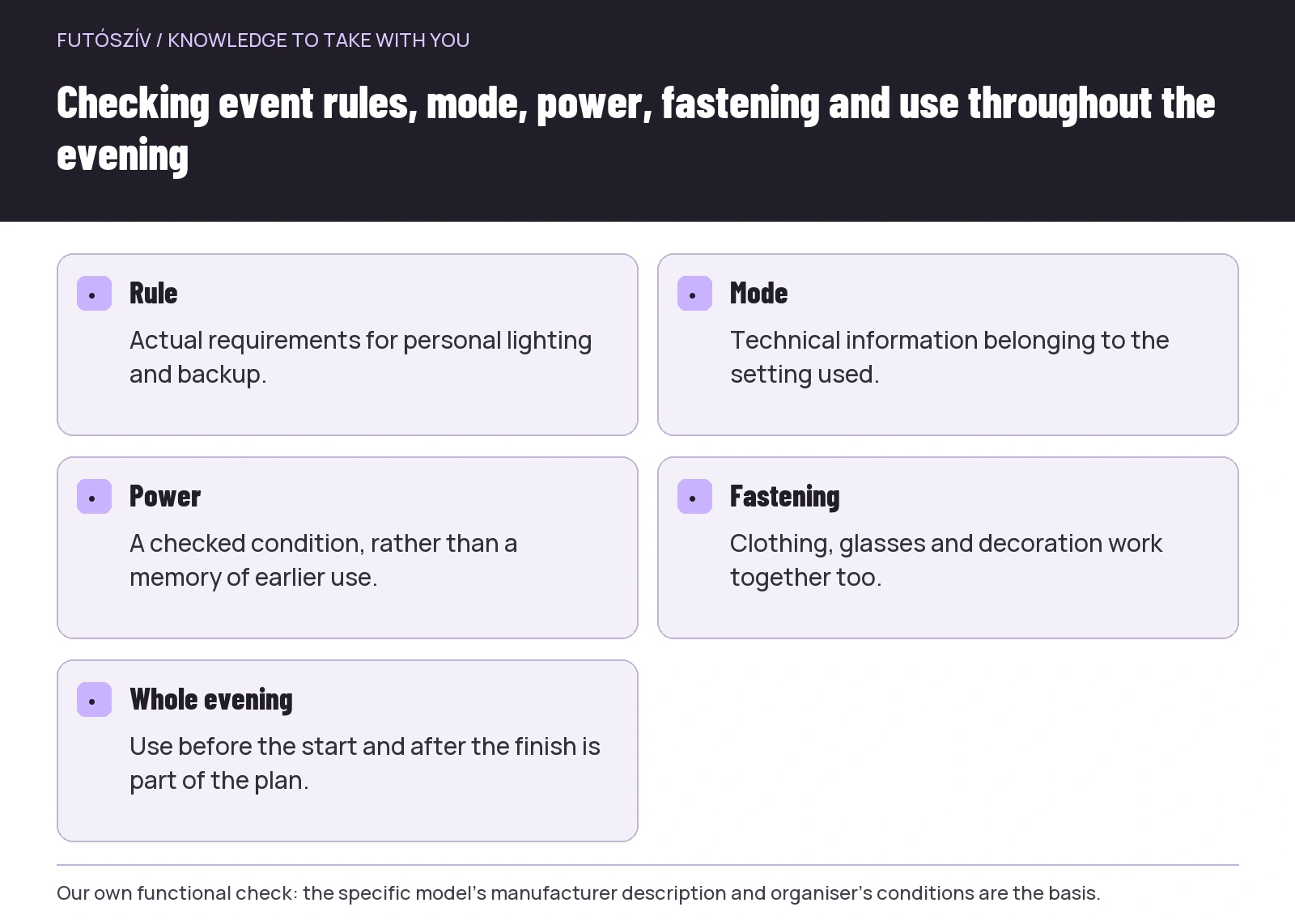 Enlarge diagram
Text version of the diagram
- Rule
- Actual requirements for personal lighting and backup.
- Mode
- Technical information belonging to the setting used.
- Power
- A checked condition, rather than a memory of earlier use.
- Fastening
- Clothing, glasses and decoration work together too.
- Whole evening
- Use before the start and after the finish is part of the plan.
Your own short rehearsal sheet before a light run
Complete the following table using your own device and event requirements. The rehearsal deliberately focuses on everyday functions. It does not require buying new equipment if what you have meets actual requirements and use.
| Check | Specific question | What means the plan is not ready yet? |
|---|---|---|
| Event condition | What does it say about your own lamp and backup? | You infer the rule from a video |
| Mode | Which setting would you actually use? | You know only the largest number |
| Power | Has the actual condition been checked? | You remember only previous use |
| Fastening | Does it work with clothing and decoration? | You have to adjust it constantly |
| Controls | Can you find the necessary switch operation? | You would first open the manual at the start |
| Finish | Are lighting and route arranged for departure too? | The plan runs out after the finish |
If a question mark remains, choose an appropriate next step: read the specific manual, ask the organiser, test fastening or simplify the costume. “It will be bright anyway” does not answer a condition about your own equipment. The rest of the whole day exists alongside a venue that looks bright.
The direction of light affects others too
In a crowd, your light affects more than the path ahead. While talking, looking around and stopping, it may turn towards participants or volunteers. Manage settings and use according to the manufacturer’s guide and event arrangements, considering those around you. Constant use of the strongest mode is not the best shared solution in every situation.
Link permission for flashing or special decorative lighting to event rules too. Do not invent personal health thresholds for what others should tolerate. If someone asks about particular lighting effects, pass on the organiser’s factual information. Missing information is not replaced by most of the group enjoying the spectacle.
Do not turn every lamp towards approaching runners for photography either. A designated photo point and your own family picture are different situations; course use cannot be adapted around a recording. If you stop, do so in a permitted place where you do not block others. A good memory does not require disruptive lighting or a sudden direction change.
Comparing two imagined equipment arrangements
The first imaginary participant has an impressive glowing wristband but knows only that their own lamp is somewhere in a drawer. The second chose simpler decoration but has read the event requirements and knows the device and route out. The difference is not the value of purchased items, but how functions are organised.
The first participant does not necessarily need new equipment either. First they must check what the specific programme requires, the condition of their existing device and how it fits the whole evening. The decoration might stay while functional lighting gets a separate place in the plan. If a condition cannot be met, another participation format or event may be a realistic choice.
The examples do not judge two kinds of runner. They show how easily a theme hides everyday questions of use. A light run can remain special when you check basic functions separately. The spectacle then becomes part of the programme, rather than the only answer to how the evening works.
Watch earlier video as belonging to its own year
Footage of LED’s Run 2026 and archives of other light runs can offer atmosphere ideas. But a new edition’s course, race pack, venue or equipment conditions may change. Put the actual year beside the video and current official event information beside the present decision. The two need not be merged.
Preparing for a light run therefore gives decoration, visibility and actual route illumination separate places. Seek appropriate information for each function: the course and rules from the organiser, device operation from the manufacturer and the whole evening’s use from your own plan. Alongside a glowing appearance, this keeps participation understandable and manageable.
How Futószív articles are prepared: our editorial guidelines.