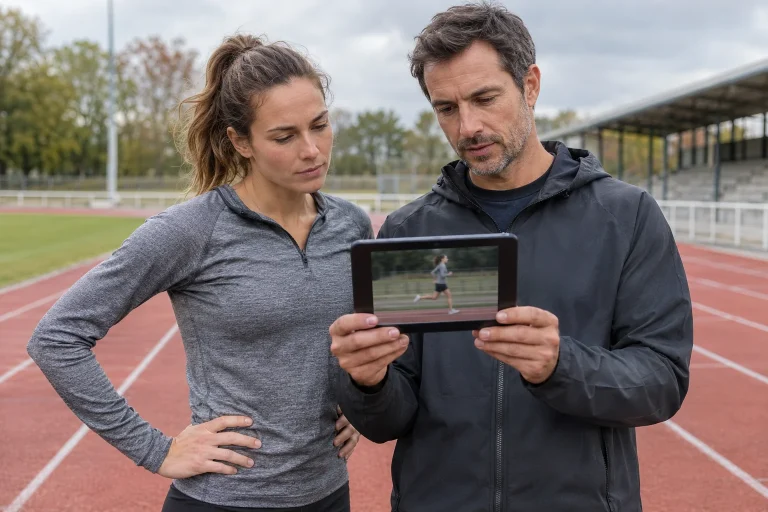
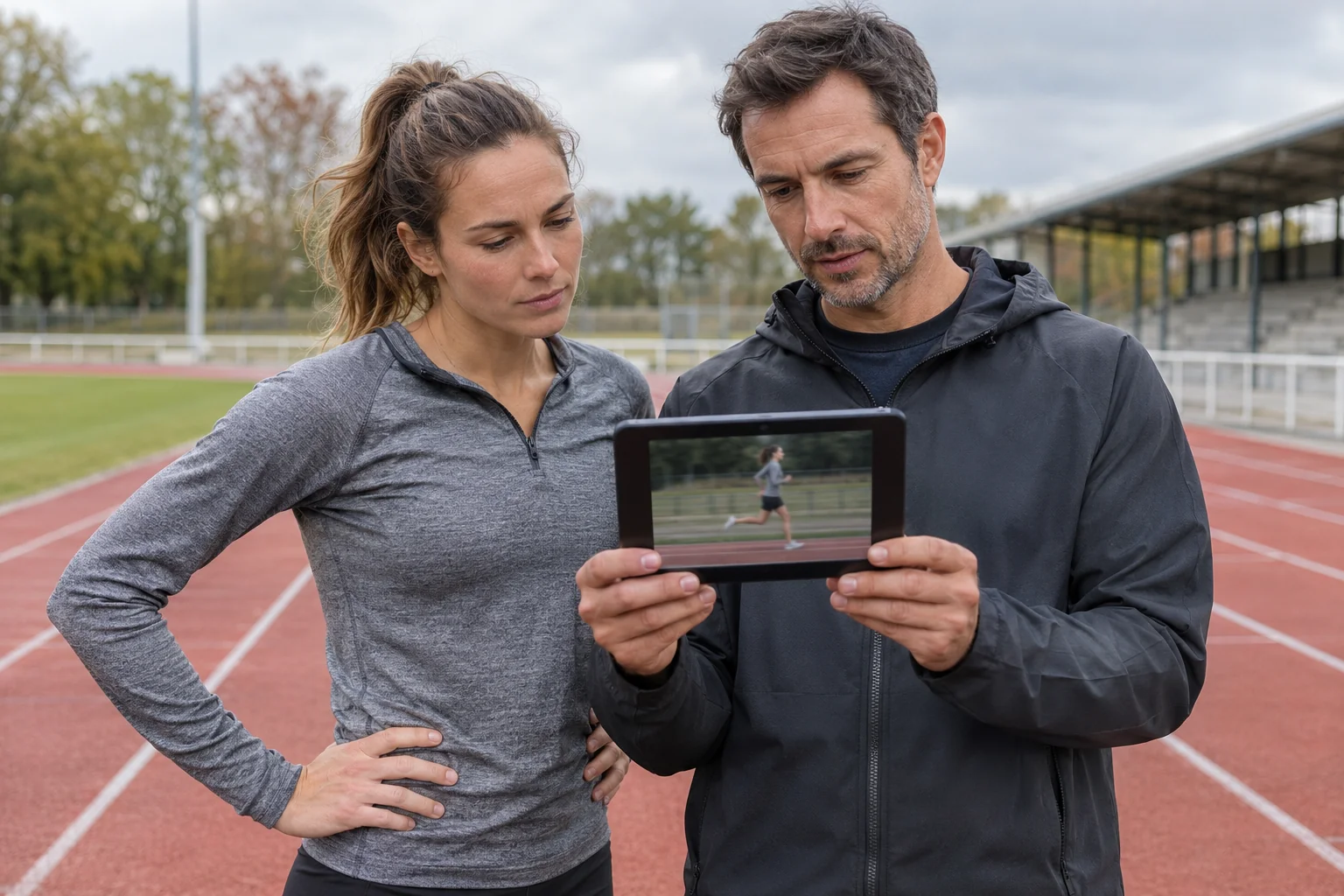
In one recording, your knee seems to travel almost straight forwards; in another, it looks noticeably farther inwards. Between the videos, there was no new training block, you did not change shoes and your running felt no different. Yet it is easy to think that one image has finally ‘exposed’ a fault. First compare the recording conditions: where was the camera looking from, which direction was the runner travelling, and which leg and moment are we seeing?
A camera is not a transparent window onto three-dimensional movement. It creates a flat image of a spatial scene, so rotation and depth alter the proportions we see. This is not a special phone malfunction, but a property of projection. Understanding it helps keep video as an observational tool: we can select comparable situations rather than calling a new viewpoint a change in technique.
Three movement planes, one flat image
In simplified terms, a side view shows forwards–backwards movement and height well; a front view shows sideways movement and height; a view from above shows the relationship between forwards–backwards and sideways directions. Meanwhile, the runner’s body moves and rotates in all three directions. If the camera stands obliquely between front and side views, a knee positioned forwards may also appear displaced sideways. Horizontal displacement observed in the image is therefore not necessarily purely sideways movement.
Try observing this with a chair before using a person. The same two chair legs may appear closer together from the front and farther apart from an angle, without anyone touching the chair. A runner’s knee, ankle and hip are more complicated still: the points may lie at different depths, and the body rotates during the step. You do not need the runner to force their knees into particular positions to illustrate the effect.
An original laboratory model study simulating heel position photographed known spatial configurations and compared the actual angles with those visible in the pictures. Rotation in other planes also affected the apparent angle. Importantly, this was a device model, not a study of injuries in runners: it demonstrates perspective’s role rather than providing a personal formula for correcting knees.
An original geometry example: how depth can appear sideways in an image
Imagine two points: the upper one is 40 centimetres higher and 10 centimetres farther forwards, but laterally it is directly above the lower one. In a simplified, perfectly frontal projection, they would form a vertical line. If we view this arrangement from 30 degrees to the side, part of the forwards–backwards difference appears horizontally in the image. The body’s spatial position can remain unchanged throughout.
In a deliberately simple model assuming parallel projection, the apparent horizontal component is 10 × sin(30°), or 5 centimetres. In the image, the line joining the points therefore forms an angle with vertical of approximately arctan(5/40), or 7.1 degrees. This is an original geometric illustration, not a measured human knee angle. We calculated the apparent inclination of one segment, not the knee’s three-dimensional joint angle; with a real camera, perspective magnification also contributes.
The point is that no movement fault had to be assumed for the image to change. We changed only the viewing direction. More factors act simultaneously in a human recording, so 7.1 degrees cannot be used as a general error limit or a correction to subtract. The useful question is instead whether the visible difference remains when the next recording views the same section from the same position.
 Enlarge image
Do not just rotate the camera: record its position too
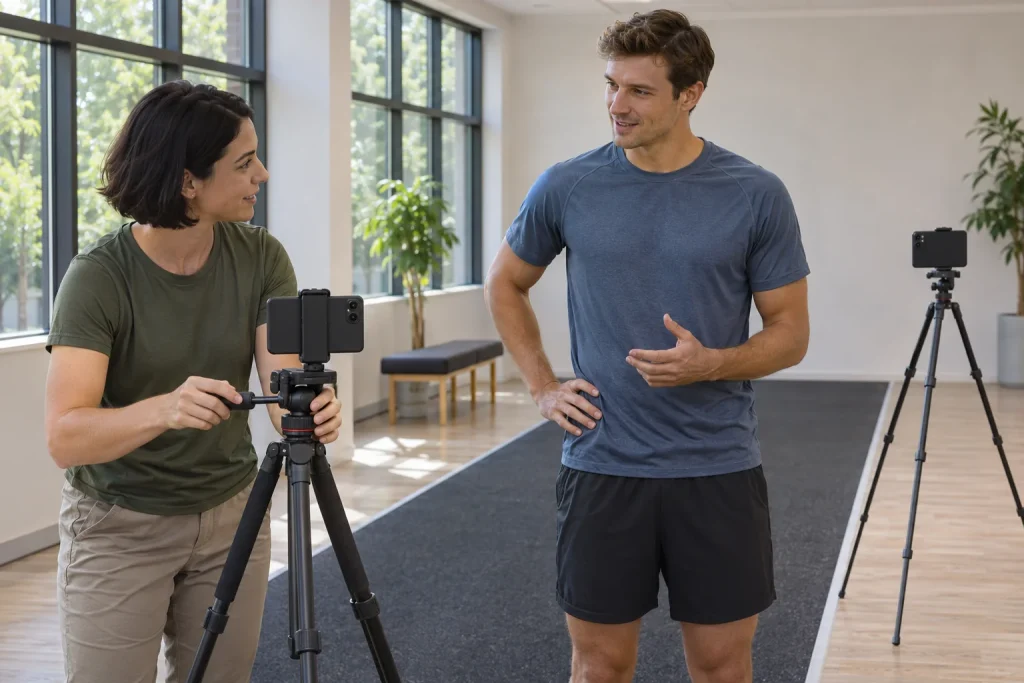
Two setups are similar when both camera position and direction can be restored. If you step sideways with the phone and point it back at the runner, the runner still occupies the middle of the image, but the view has changed. The same happens when the running path is moved relative to the tripod. On a simple site sketch, therefore, mark the running direction, observation section and tripod location separately.
Enlarging the body to the same size afterwards does not remove the difference between close and distant recordings. With a closer camera, the ratio of distances to nearer and farther body parts may be greater. A suitably cropped image taken farther away may provide a different perspective. Cropping afterwards enlarges the projection already recorded; it does not relocate the photographic viewpoint.
You do not need to build an optics laboratory for every amateur recording. A tripod position aligned with an existing floor joint, a recorded distance, the same camera height and the same lens setting may suffice. ‘The phone was always beside the bench’ is less precise than identifying which tripod foot stood at which floor point. The aim is to make repetition easier, not to overcrowd the location with equipment.
Do not compare your knees while turning or accelerating
In a short corridor, a runner may still be accelerating when entering the camera’s field of view and already slowing or preparing to turn at the other end. Two images may then show different movement tasks. One is not simply a version of the other seen from a different camera position. Where safe space is available, allow sufficient room before and after the observed section for a natural passage through it.
Direction of travel matters too. If the runner follows a diagonal towards the camera in the second recording, the viewing angle relative to the body changes with each step. The centre of the screen is not necessarily where the camera looks perpendicular to the intended plane. For a side-view observation, compare the predefined middle section passing in front of the camera rather than arbitrary points anywhere in the video.
Treat speed as a separate variable too. Imagine two tests: in one, two fixed cameras record the same run simultaneously; in the other, the same camera records easy running first and faster running afterwards. The first lets you examine viewpoint differences; in the second, the running situation also changes. If camera position and pace are both new, the result makes it difficult to tell which changed the knee’s appearance.
The same moment, the same side, several steps
The knee of the front leg already bearing weight is in a different position from that of a leg approaching ground contact. When placing videos side by side, do not merely seek similarly striking images. Choose an event or movement phase in advance and identify it on the same side. Switching from the left leg to the right also introduces a side-to-side difference into a camera-position comparison.
Mirroring is a separate trap. Some front-camera recordings or sharing settings may reverse the image. The limb on the left of the picture is not necessarily the runner’s left leg. You can identify the side examined in the filename and retain an environmental reference in the original recording that makes direction recognisable later. Note image processing, such as mirroring and rotation, separately too.
Reviewing several consecutive, clearly visible steps shows whether you selected a consistent pattern or one unusual instant. This does not prescribe a compulsory number of steps for every situation. The point is to avoid selecting only the image in which the knee looks farthest inwards. Keeping the file and documenting the selection rule allows someone else to review the same sequence.
Which study reliably answered which question?
Neal and colleagues, in twenty-one runners with patellofemoral pain, compared phone-based two-dimensional data with three-dimensional data. Validity was poor for the hip-adduction and knee-flexion variables examined. This is a relevant warning about quick phone-based judgements of knees, but the conclusion concerns the procedure and variables studied: it does not mean that video is unsuitable for every observation.
A different question may produce a different result. Weber and McClinton examined a defined video measurement of upper-trunk rotation in sixteen runners and found favourable repeatability and good agreement with the three-dimensional reference. The difference between these studies teaches precisely that ‘2D video’ alone is not a specific measurement method. A different body part, view, landmark selection and outcome require different checks.
The original study of automated side-view analysis also found varying agreement across angle variables. If a provider attaches a single accuracy claim to every running movement, ask which variable was checked, with which camera setup and against which reference. The question actually answered reveals far more than a general description of the method as ‘laboratory-accurate’.
 Enlarge image
Create a simple, repeatable filming process
A useful exercise is first to make two recordings on the same day, repeating the setup without changes. With the same settings, direction and a similar running situation, examine how consistent the appearance and selected variable remain. This is not full method validation or calculation of a personal clinical error limit. It does help reveal everyday problems such as a rotated tripod, a relocated observation section or uncertain frame selection.
| Item to record | Why include it in the log? |
|---|---|
| Camera location, height and direction | So the viewpoint can be restored later. |
| Running path and observed section | To avoid confusing diagonal passage with straight running. |
| Pace and movement phase | So similar tasks and the same event are placed side by side. |
| Side and processing | So mirroring, rotation and landmark selection remain traceable. |
In recordings over the coming weeks, follow one question instead: for example, whether the image at a particular moment in stance looks similar with the same setup. If you try new shoes, a new pace and a new camera view together, the recording may be interesting but the origin of a change is less clear. Good observation also includes stating: I do not currently regard these two videos as directly comparable.
Turn what you see into a question that can be answered
If you find a difference, distinguish three possible next steps. First check the recording; second repeat it under the same conditions; third, if movement, symptoms or performance genuinely raise a professional question, discuss it with the full video and relevant history. One circled knee position carries less information than the whole step and the runner’s account.
Keep your wording proportionate to what you measured. ‘My knee looks farther inwards in the oblique recording’ is a precise observation. ‘I am definitely overloading my knee’ would be a conclusion about force and tissue loading, for which the image alone is insufficient. Equally, parallel lines that look prettier do not automatically imply better running economy or a lower injury risk.
Getting camera placement right often helps more than adding another decimal place. If you retain the raw footage, viewpoint and rules behind your choices, video can support meaningful comparisons. The aim is not to make every runner’s knees look identical in an image, but to recognise when you are observing a real movement difference and when you are viewing the same movement from somewhere else.
Sources
- Espinosa-Moyano and colleagues: perspective distortion investigated with a device modelling heel position.
- Neal and colleagues: phone-based 2D running measurement and a 3D reference.
- Weber and McClinton: evaluation of video measurement of upper-trunk rotation.
- Peebles and colleagues: variable-specific validation of side-view running angles.
How Futószív articles are prepared: our editorial guidelines.