A workplace running team can offer a chance to meet colleagues in a different role. It can also become a corporate showcase if participation is an unspoken expectation and reports focus only on the fastest people. A slogan does not make a team inclusive. Invitations, costs, programme choices and communication of results together determine who can genuinely join freely.
This article primarily addresses male runners and team organisers who want a positive workplace sporting environment. It does not assume all men are competitive or all colleagues relate to running alike. The process is an editorial organisational example. Specific employment-law, tax and data-protection decisions require the company’s responsible staff; this article examines practical programme design.
First decide the team’s purpose
Are you creating a social activity, regular opportunities to move or a race team specifically pursuing results? All can have a place, but need different invitations and arrangements. If several goals operate under one team name, show them openly. ‘Everyone welcome’ should not hide an expectation that joining means preparing for the same performance.
A useful opening might be: ‘Next month we are organising two open sessions and separately gathering interest in a relay race.’ This makes clear that attending the shared run does not automatically mean race entry. Someone already running but not wanting a workplace race team can choose another role or occasion too.
Do not place corporate goals onto each participant’s personal story. Colleague relationships may matter, but a run need not promise to resolve every team conflict. Sport should not be a compulsory detour into organisational problems. People attend the activity actually offered, rather than an unannounced test of performance or loyalty.
Make voluntary participation visible in words and practice
A manager’s enthusiasm is not inherently a problem. Uncertainty arises when a colleague cannot tell the consequences of not joining. Make choice explicit in the invitation, and do not later request personal explanations from everyone absent. ‘Why didn’t you come?’ can express interest, but repeated demands for an account easily acquire another meaning.
Company communication should not present active membership as proof of being a committed employee. Someone choosing another activity, unavailable because of care duties or unwilling to spend free time with colleagues can be equally valued. Organisers do not need to guess the reason; respecting the decision is enough.
A fictional invitation excerpt: ‘Participation is optional. The shared run and later race have separate registration; neither requires the other. If you do not join now, no explanation is needed.’ Only write this if practice genuinely follows it. Precise wording does not replace managerial behaviour.
 Enlarge diagram
Text version of the illustration
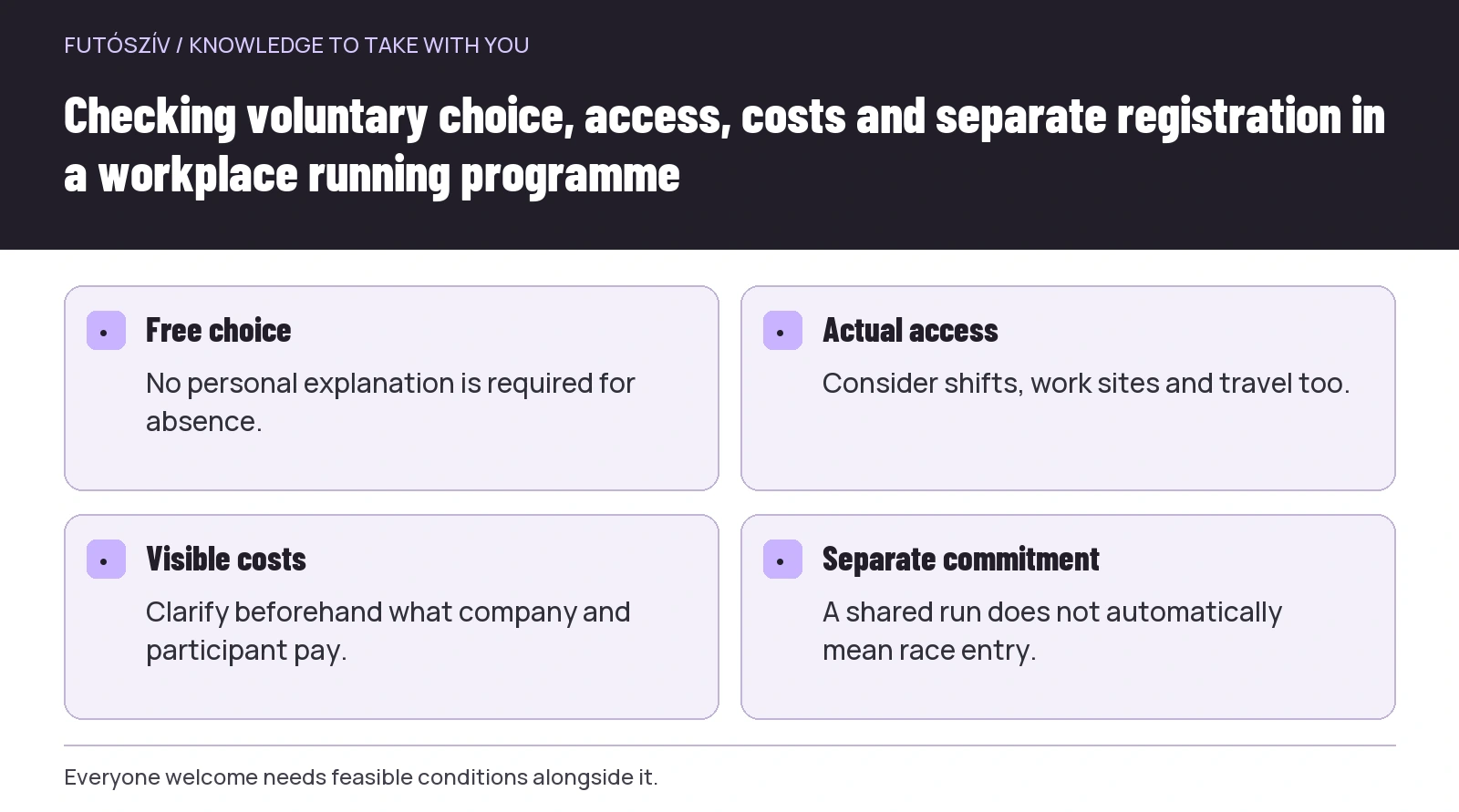
- Free choice
- No personal explanation is required for absence.
- Actual access
- Consider shifts, work sites and travel too.
- Visible costs
- Clarify beforehand what company and participant pay.
- Separate commitment
- A shared run does not automatically mean race entry.
A needs survey should not request a sporting biography
Planning mainly needs available times, preferred participation formats and obstacles. There is no need to request results, weight, medical histories or app access from everyone. Unnecessary details increase the barrier without helping organise a meeting. Provide an appropriate private channel for discussing specific needs.
Sport England’s Active Employee Toolkit, published in May 2021, includes involving staff and asking about their needs among workplace-activity tools. It was produced during the pandemic; its restrictions are not used as current instructions here. We take only the brief principle of planning from participants’ needs. Sport England: Active Employee Toolkit
Three simple questions may suffice initially: which time windows are accessible including travel; whether people want social runs, walking or organised competition; and which practical requirement is missing. Offer real opportunities based on the answers. Do not ask opinions on choices already finalised.
Shifts and location affect access too
An afternoon start suited to office staff may be inaccessible to shift workers or colleagues at another site. Inviting ‘all colleagues’ means more than sending everyone the same email. Examine who can actually arrive around their work pattern and what alternative occasion or connection can be offered.
Not every event needs to be accessible to everyone if this is impossible. State differences openly: ‘This session is easy to reach from the city-centre site; we are seeking a separate time for the other location.’ This is more honest than hiding one narrow window behind a nationwide-team label. A shared report connecting colleagues does not replace actual participation.
Count the full programme time: travel, changing, movement and getting home. If linked to the working day, clarify the window and local arrangements with those responsible beforehand. The first participant should not have to discover retrospectively what work arrangements allowed. A short, clear organiser notice can remove considerable individual uncertainty.
Make costs visible in advance
Entry fees may be only one part. Travel, team shirts, accommodation or other chosen services may arise too. State what the company pays, what participants pay and which items are optional. A colleague should not learn after registering that a personally significant sum needs paying upfront.
| Cost type | Detail to clarify beforehand |
|---|---|
| Entry | Who pays, how and by which deadline? |
| Travel | Shared arrangements or individual travel, with what support? |
| Team clothing | Compulsory, optional or available to borrow? |
| Additional activities | Is participation a separate choice, and who pays? |
| Withdrawal | Who handles changes, and which organiser conditions apply? |
Invoicing and support details belong within company processes; do not improvise rules in the running chat. Organisers should at least identify the appropriate contact. Clear financial conditions often contribute more to participation than another motivational sentence.
Corporate entry has its own administration
A shared shirt or internal team name may not establish corporate classification with an organiser. The registration system may require specific fields, a contact and payment procedure. Follow the race’s current instructions rather than recalling last year’s approach from memory.
For example, the official entry page for Fut a Ring 2027 contains a separate corporate-registration section and requests the company name for Fut a cég participation. It describes options for administration through a contact person. This is one organiser’s example, rather than a universal race process. Read the complete current conditions when registering. Fut a Ring 2027: Entry information
Separate the designated contact’s administrative role from sporting guidance. Someone who manages entries well does not thereby decide other people’s capacity. Let participants check their own details and choices before finalisation. Do not collect passwords in a shared spreadsheet; use the organiser’s provided administrative route.
 Enlarge diagram
Text version of the illustration
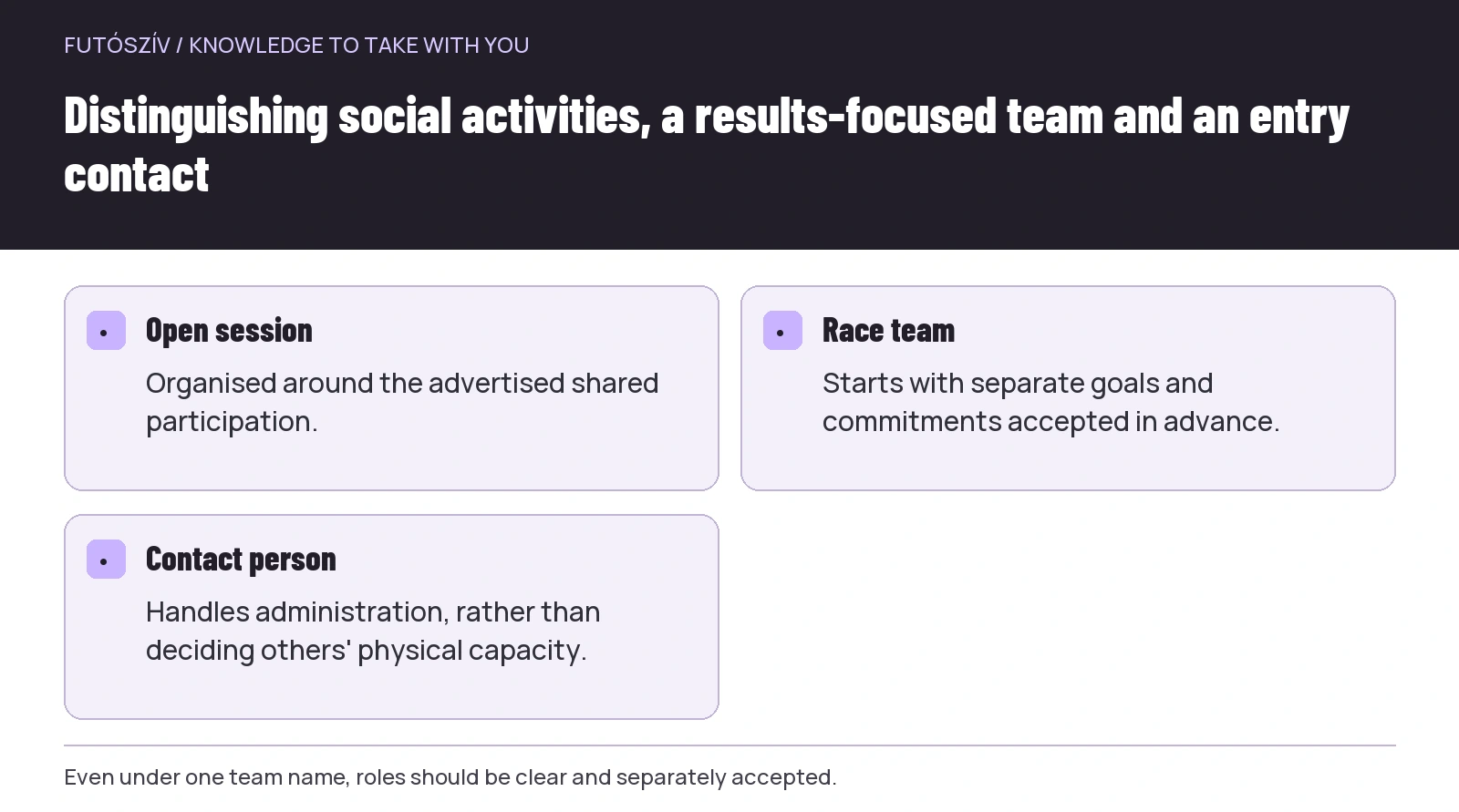
- Open session
- Organised around the advertised shared participation.
- Race team
- Starts with separate goals and commitments accepted in advance.
- Contact person
- Handles administration, rather than deciding others’ physical capacity.
A relay should not reproduce the workplace hierarchy
Discuss relay sections and roles according to race rules, participants’ commitments and practical possibilities. Managers should not automatically receive a prominent role, and less experienced colleagues should not feel obliged to take the section everyone rejects. Commitments need to be discussable beforehand.
If a results-focused team forms, name its selection and participation framework separately. Teams with other purposes may coexist if organiser conditions and company resources allow. Everyone need not fit the same relay. Communication of different goals should not become a hierarchy between ‘real’ runners and those ‘just doing it for fun’.
Reserve roles require advance consent too. Colleagues should not discover the evening before an event that they have already been entered as replacements. Check substitution options and deadlines with the organiser. Team interests cannot override personal decisions or participation rules.
A shared platform should not become compulsory monitoring
An organisational chat can help without requiring constant running-data sharing. Routes, starting times and training diaries can reveal personal details. Separate information needed for arrangements from sporting updates freely shared. Saying yes to one meeting does not mean sharing all subsequent data.
Clarify the platform’s purpose: departure details, changes and questions. A separate challenge needs its own opt-in and understandable measurement rules. Someone attending only a shared session should not automatically enter a weekly leaderboard. Discuss detailed data handling with the company’s responsible person rather than copying a general online template.
When planning photos and company reports, clarify participation options and usage arrangements with those responsible beforehand too. Shared enjoyment can be communicated without appearing in a photograph becoming a test of belonging. Do not respond to photography-related requests with jokes or pressure.
What should the report celebrate?
Fast results are enjoyable and colleagues’ work towards sporting goals deserves recognition. Alongside them, make visible a well-organised first participation, a precise relay exchange, an accepted helping role and creating the shared activity. Not everything needs an artificial award category. Simply avoid telling the story as though only the three fastest people constitute the team.
Do not present non-running helpers as mere background if they genuinely undertook tasks. Equally, absent colleagues should not have to prove they have earned belonging another way. A corporate running team is an optional community within the workplace, rather than the full measure of a colleague’s worth.
A fictional report sentence: ‘Three relay teams with different goals and several voluntary support roles came together; based on feedback, we’ll choose an earlier meeting next time.’ This shows cooperation and learning. Exact results can be presented separately within arrangements agreed with those concerned.
Let actual experience improve the next programme
Afterwards, ask about practical obstacles as well as enjoyment. Was the timing accessible? Did costs stay clear? Did the activity match the invitation? Did any detail prevent someone joining? Choose a feedback method that allows honest answers within workplace relationships.
Every wish need not be fulfilled at once. Explain which change can be made next time and what remains open. Involvement is credible when at least some concrete decisions reflect participants’ experience. A purely marketing-driven questionnaire can create another administrative burden without useful outcomes.
An inclusive workplace running team can contain fast athletes, first-time participants and colleagues with different aims. Clear invitations and freely chosen commitments are the common ground. Predictable conditions, costs and communication give shared time a framework. The company name on a shirt can then represent a joint choice, rather than another workplace performance board.
How Futószív articles are prepared: our editorial guidelines.