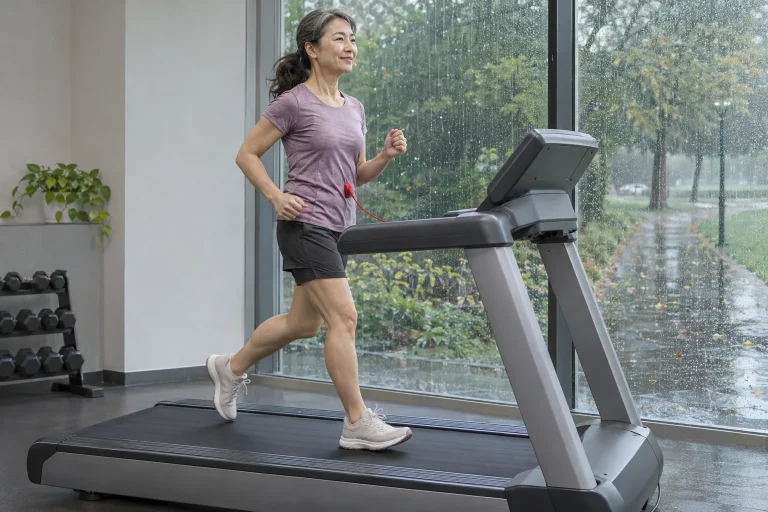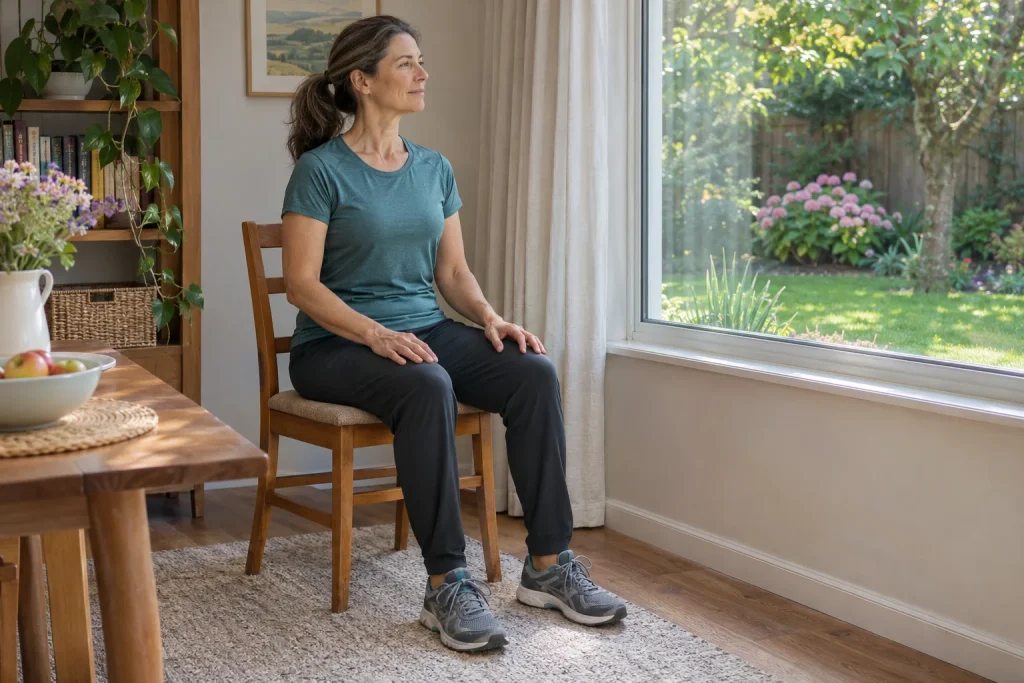
Before setting off, you may picture the first street, the park gate or the pleasant moment of arriving home. At other times, you deliberately imagine how exercise might fit into your day. Mental imagery can relate to both experiences, but a guided research task differs from everyday mind-wandering or a pleasant picture of finishing.
What did physical-activity experiments actually examine? In one larger programme, imagery was combined with risk information and reminders; other studies found no activity advantage. These findings help separate a useful personal thought from an excessive promise. Imagining your next run can be interesting preparation, but is neither physical training nor a guaranteed route to action.
Imagining the process and imagining the outcome
A future image may centre on how you will feel at the end. Another version depicts the process: when you prepare, how you reach the location and what you do about an unexpected obstacle. These may direct attention differently. You need not decide beforehand that one is better for everyone; meaning also depends on the task and your question.
An image can be detailed or more conceptual. Some people recall places almost as scenes; others arrange possibilities in words. Everyday self-observation need not become an examination of imagery ability. The aim is to understand how you want to use the idea, rather than produce the most spectacular internal film.
A pleasant outcome image can also have a personal place. Looking forward to a quiet route or meeting may feel good. This is not established behaviour change in itself, but need not be. Joyful anticipation differs from an activity effect measured in an experiment; accurate language calls neither by the other’s name.
What did the larger imagery programme contain?
In an initial sample of 500, Ackermann and colleagues combined three types of personalised risk communication with physical-activity imagery or sleep-hygiene imagery as an active control. An audio recording helped participants imagine a goal and the problem-solving needed to achieve it; a goal card and several weeks of message reminders were included too. The main 90-day analysis used data from 420 participants.
Overall, the activity-focused condition showed a 19.5-minute greater increase in self-reported weekly activity than control. This difference was driven by the risk-ladder display group; tabular and bulleted formats showed no similar advantage. The programme therefore involved more than an isolated imagery task, and results also depended on the presentation context.
Imagery vividness, self-efficacy and affective attitude did not significantly predict subsequent activity in the weekly model examined; goal planning did. This is a separate analysis, rather than a final resolution of every possible mechanism. It is therefore wrong to claim that a clearer image makes additional running more certain.
The finding does not provide an independent risk-communication recipe
In the study, personalised information came from a specified system. This does not mean you should estimate your own disease risk or generate fear to get started. One component of a scientific programme does not automatically become a tool to copy at home. Individual professional interpretation of health questions differs from considering a future running occasion.
Risk presentation and information accuracy are also separate questions. A vivid figure is not necessarily appropriate for assessing your condition if its underlying data or assumptions do not fit. This article provides no personal disease-risk calculation. The result presented helps us understand the imagery intervention within its complete research framework.
For everyday running plans, attending to your own practical question may suffice. What is the next manageable session, and what does it require? You need not imagine severe consequences or convince yourself a missed day is dangerous. Realistic planning can retain calm, personal language instead of threatening encouragement.
 Enlarge image
What do the studies with null findings say?
In two randomised studies, Meslot and colleagues compared conditions using mental simulation and implementation intentions. They followed students’ self-reported activity and attendance among new fitness-centre members. No significant group advantage was found for the relevant behavioural outcomes. The authors also discussed intervention and measurement limitations.
This did not replicate the same larger programme. Technique names may conceal different instructions, reminders and circumstances. The different findings therefore cannot be reduced to imagination always working or never working. The precise question is which task was studied, with whom, in which setting and for which outcome.
Give your own experience the same limited scope. Thinking through a start helping once does not establish success on every later occasion. If it does not help now, that does not prove you imagine things incorrectly. Interpreting a method need not become a judgement of personal suitability.
Mental preparation and physical training are separate tasks
Imagining a run is not the same physical demand as running. It does not automatically replace endurance work or rewrite your present physical condition. The activity studies described examined later behaviour; they did not establish that imagery alone creates the same bodily adaptations as actual movement.
This matters especially when preparing for an event or returning after a break. A pleasant image of a future goal does not establish that any load leading towards it is appropriate today. Defining training and health parameters is a separate professional question. Mental preparation can support organisation while a manageable physical task still needs realistic selection.
Ease in an image is not an expectation for the real run either. An imagined route does not contain changing ground, traffic and current fatigue in the same detail. Feeling different outside is not necessarily faulty preparation. Imagination simplifies; the real occasion supplies new information to which you can respond attentively.
What might you imagine to clarify a practical question?
Begin with one everyday situation: when does preparation start, and what follows? You need not mentally rehearse the entire session in detail. This is our own thinking example, rather than a copy of the research recording or a validated abbreviated intervention. The aim is to notice which detail is clear and which still needs discussion.
If the meeting place comes to mind, for example, ask whether you know precisely where you will wait for each other. If you picture rushing before leaving, perhaps you need to clarify where necessary items are. These are concrete information questions. Not every image conceals a deep psychological obstacle; a brief practical answer often helps more than further internal practice.
Alongside imagining a pleasant finish, allow the real occasion to change. You need not assume a certain pace, distance or mood beforehand. Your image remains flexible when exact repetition of its details is not required. Imagery is one possibility for preparing a decision, rather than a tool for controlling the future.
When imagining creates more tension
Not everyone likes constructing scenes beforehand. Planning reassures some people but lines up more possible errors for others. If a mental task leaves only more worry, you need not continue because it is theoretically considered useful. The studies presented do not make imagery compulsory for every runner.
The gap between a pleasant picture and real life can also create excessive expectations. Naming the desired experience separately from the actual commitment may help. Every run need not turn out as imagined. An ordinary, neutral session can belong in your exercise without exceptional success in preparing mentally.
If persistent or strong anxiety, intrusive disturbing images or experiences impairing everyday functioning arise, individual professional help may be appropriate. This differs from voluntarily chosen sporting imagery. The research summary is not a therapy guide, and difficulties need not be dismissed as merely needing a more positive scene.
 Enlarge image
Keep your expectations proportionate to the task
Spending a few minutes thinking about a future session may realistically produce a more precise question or simpler organisation. Immediate lasting behaviour change is unnecessary. Personal usefulness and an experimentally demonstrated group effect exist at different levels. Separating them may reduce pressure for every self-regulation idea to deliver instant, conspicuous progress.
Notice separately what actually changed. Did the plan come to mind more readily, did you clarify a route or did exercise happen? Perhaps session count stayed the same but involved less rushing. These are separate observations. They need not yield certain causal conclusions about every detail; several circumstances can change simultaneously in your own days.
Dropping imagery can also be a good decision if it adds no value. Another tool, such as a simple discussion or a clear calendar slot, may be more useful. A psychological technique is not another compulsory item of training equipment. You are seeking help suited to your exercise, rather than proof you can use a popular method correctly at any cost.
Imagination belongs alongside a real next step
Imagining your next run can offer personal preparation, organisational guidance or simply joyful anticipation. Research does not establish that it alone reliably produces more activity or better running performance, however. Programme composition and measured outcomes remain important, while null findings belong in the information too.
Seeing one real question more clearly may be more useful than creating a perfect internal picture of your whole running life. The next session ultimately happens in the present, under changing circumstances. Imagery remains proportionate help when it allows that reality and supports your decisions instead of prescribing what you should feel and achieve.
Sources and limits on application
Ackermann and colleagues: Mental imagery-based self-regulation — a programme combining risk communication, goal planning and reminders. Meslot and colleagues: Theory-Based Interventions Combining Mental Simulation and Planning Techniques to Improve Physical Activity — null findings from two randomised studies. The running examples are neither validated shortened versions of the original tasks nor exercises replacing physical training.
How Futószív articles are prepared: our editorial guidelines.