
On Sunday evening, you look back at the week and your first thought is that nothing went as planned. Two runs did not happen, a shared session unfolded differently and the app does not show the sequence you wanted to see. It is easy to put even more tasks into the next week, or set everything aside. To find a usable next step, however, you first need to name more precisely what happened.
This guide concerns reviewing the week’s organisation. It does not provide medical explanations for fatigue, pain or persistent emotional difficulties, and it does not prescribe make-up workouts. If a change involves those issues, address it with an appropriate professional rather than a calendar trick. In everyday planning, however, separating facts, expectations and the few things you can actually change over the coming days can often help.
First describe the week without judging it
Instead of summarising it as ‘a bad week’, briefly list what was planned and what happened. For example, a late work task arose on Tuesday, the group meeting was cancelled on Thursday and part of Saturday’s planned route turned out to be closed. These are specific events. Saying you lack perseverance is a different kind of statement. It does not identify which organisational condition needs changing.
Include things that did happen among the facts too. If a shorter session fitted, do not retrospectively turn it into zero because you planned something longer. Arranging a new meeting or researching a route can also be completed tasks even if they do not appear as kilometres run. A whole week contains more information than a single app graph shows.
Do not confidently fill missing details from memory. If you do not know exactly how long a journey took, record an estimate or note that this is worth observing next time. The review aims to produce a picture that supports a sensible organisational decision, not a flawless set of minutes.
Identify the standard against which it feels unsuccessful
Your own original plan may have been too crowded, or you may have started comparing your week with other people’s. These are different questions. If you wanted two local outings on Monday but judge the week on Sunday against a friend’s three race posts, you are no longer evaluating the same commitment.
Write down the original expectation and its background. Was there a real time allowance, or did you simply hope it would somehow fit? Was the shared activity agreed, or did you treat an expression of interest as a firm commitment? Clarifying an expectation is not excusing yourself. Knowing which assumption underpinned the previous plan makes the next one usable.
Success can have several dimensions. The week’s running volume, organising shared activities and keeping commitments made to others are different things. You do not need to compress them into one green or red rating. A more detailed picture allows something to have been difficult while another part worked well.
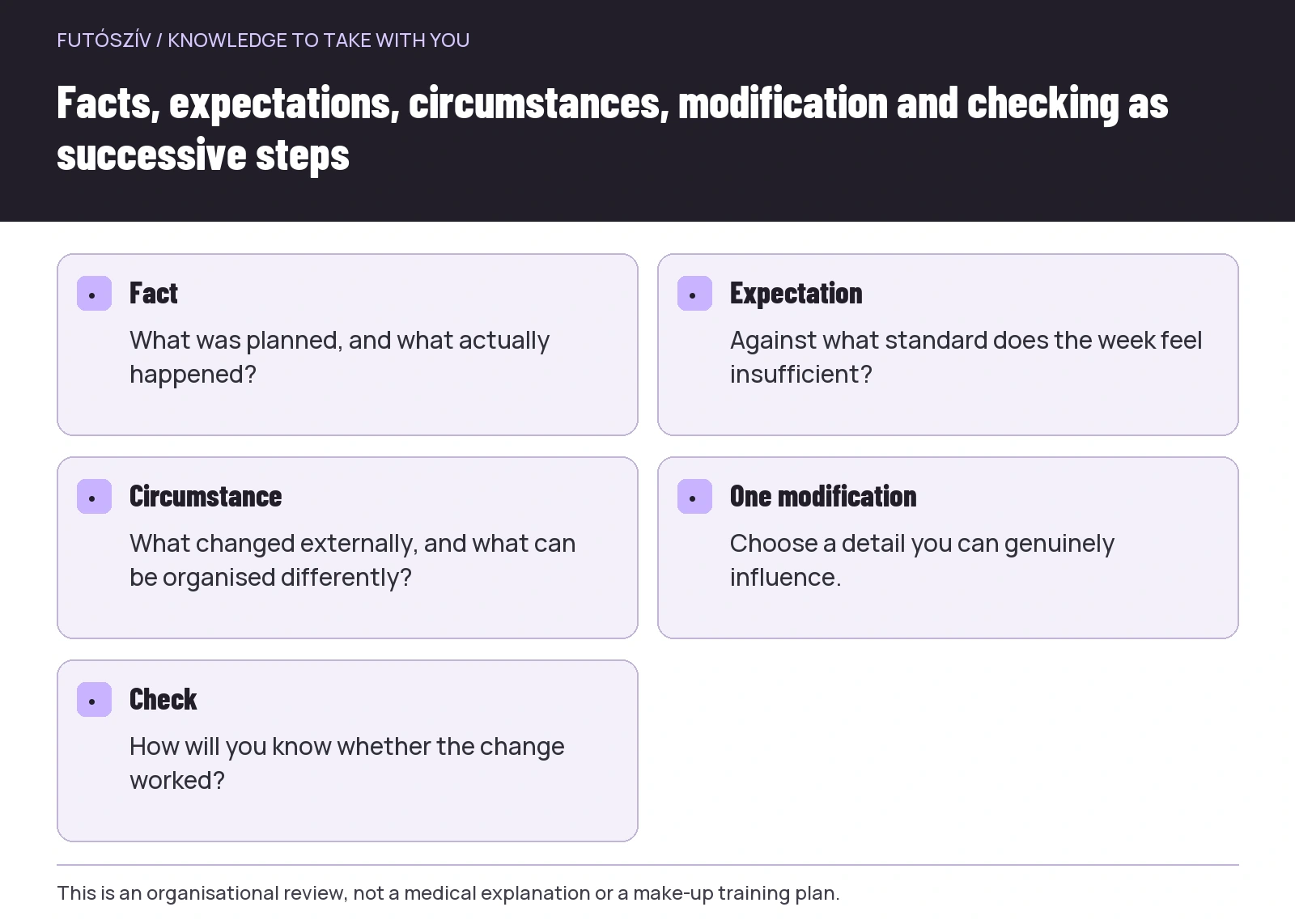 Enlarge diagram
Text version of the diagram
- Fact
- What was planned, and what actually happened?
- Expectation
- Against what standard does the week feel insufficient?
- Circumstance
- What changed externally, and what can be organised differently?
- One modification
- Choose a detail you can genuinely influence.
- Check
- How will you know whether the change worked?
Separate external changes from organisation you can improve
Unexpected work, a cancelled transport service or a public-space closure differs from not checking the meeting point beforehand. Neither automatically supports a judgement on you as a whole. The next step can nevertheless differ: a backup or more flexible framework may help one, while a specific checking task helps another.
The Sport England Activity Check-in research page also discusses circumstances and competing demands on time. It cannot establish what happened to you in a particular week, but reminds us that participation is not shaped solely by individual intentions. Describe actual circumstances in your own review rather than merely scoring motivation.
One useful breakdown distinguishes four groups: a condition that changed outside your control, a detail that could be checked beforehand, too little time allowed and a cause not yet clear. The last group is valid too. You do not need to produce a complete explanation at every week’s end when information is still insufficient.
| What happened | Which question follows? | Possible organisational response |
|---|---|---|
| The working day unexpectedly shifted | Was there any manageable time left? | A framework in the next plan suited to the actual constraint |
| The meeting was not precise | What did each person expect? | Communicate the place, time and confirmation clearly |
| Travel took longer | What did the original estimate omit? | Count the whole period from departure to returning |
| You reached a closed route | Was current information available? | Check the source and know an alternative beforehand |
| The obstacle is unclear | Which information is missing? | One observation question for the next week |
Do not turn one week into a permanent rule
One missed group session does not prove you cannot run with others. One difficult morning does not establish forever that an earlier time never suits you. Look for a repeating pattern or a one-off situation. Instead of generalising, identify the specific condition you want to check next time.
Do not ignore repetition either. If a particular time slot repeatedly clashes over several weeks, examine the slot itself rather than entering the same plan with ever greater determination. Consistency is not necessarily an unchanged calendar. Moving a session in response to experience can also be a consistent decision.
A few short notes may be enough to recognise a pattern. You do not need to evaluate every day in detail or copy other people’s weekly figures into a comparison table. Seek the information your own planning question needs: which condition repeats, what its actual consequence is and what can be changed.
Do not make next week a punitive copy of the missed list
Do not automatically copy unfinished tasks alongside every original new commitment. The next week has its own time allowance and constraints. First examine what fits now and which tasks still make sense. Discuss changes to running-training load with your coach if needed; an organisational list does not justify prescribing extra volume to make up for missed sessions.
You can decide to let administrative tasks go too. If an earlier idea is no longer relevant, you do not need to carry it into the next week. Checking an entry deadline may still matter, however, if you genuinely want to participate. ‘What stays?’ is just as important as ‘when will I do it?’
Review recurring reminders separately. If an alert concerns a task you have not clarified or no longer undertake, repeated notifications will not resolve it. Clarify, modify or delete it. Keep only tasks in the next week’s overview that still have an owner, purpose and manageable next step.
Choose one change with a visible consequence
After overhauling an entire system at once, it is hard to tell what helped. Choose a change directly related to the previous week’s observation. If searching before departure used the time, prepare necessary items in a designated place beforehand. If the meeting remained vague, make precise confirmation the change. These are organisational solutions, not performance guarantees.
The UK Coaching guide to reflective practice connects considering experience with further planning. Although it addresses coaching practice, the basic distinction also helps a personal review: looking back leads somewhere when you identify a concrete next step. You do not need to adopt the entire method to use that connection.
Beside the change, write how you will notice whether it worked. For example, the aim is not ‘be more organised’ but to avoid searching in three places for keys and a light before leaving. An observable sign gives a simpler evaluation than another general judgement of yourself.
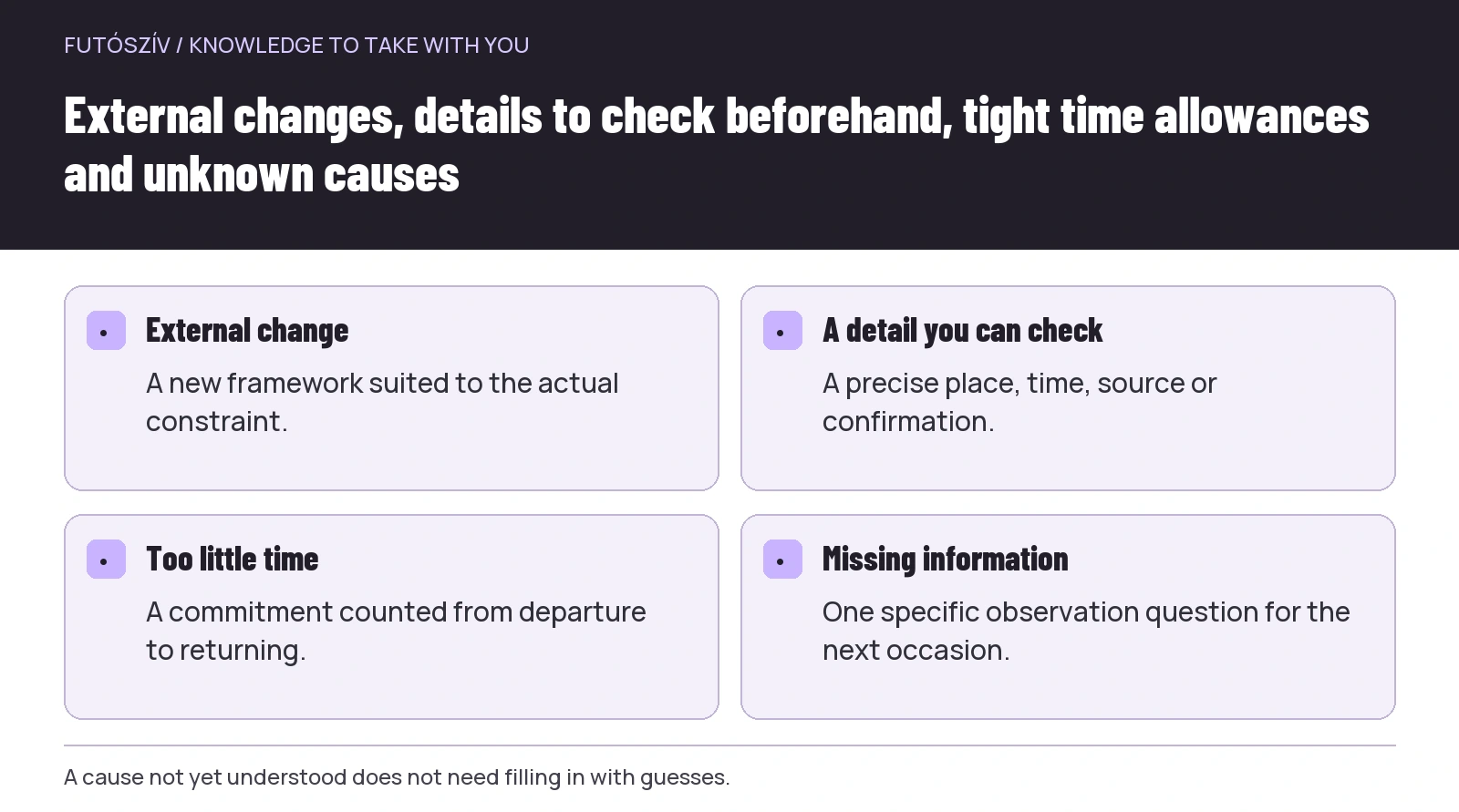 Enlarge diagram
Text version of the diagram
- External change
- A new framework suited to the actual constraint.
- A detail you can check
- A precise place, time, source or confirmation.
- Too little time
- A commitment counted from departure to returning.
- Missing information
- One specific observation question for the next occasion.
Discuss shared commitments again with those involved
If someone was counting on you, explain which agreement needs changing. You do not need to send a long explanation to every group, but make the new situation clear. Instead of ‘maybe next week’, state specifically what you can and cannot undertake. Others can then avoid continuing to plan around an old assumption.
Make requests for help precise too. Asking someone to confirm a meeting in time differs from expecting them to organise your entire week. A smaller, clearly named request is easier to answer realistically. The other person should be able to decline partly or entirely without that casting doubt on the value of running together.
Do not fit your time solely around gaps in everyone else’s schedules either. A shared activity is manageable when participants’ real availability is visible. If no suitable occasion exists for everyone now, you can run separately and meet another time. Organisational compromise does not necessarily mean starting together every week.
A fictional example of a next step emerging from a review
Júlia put three sessions in her calendar, but only one happened. Her first thought is that her week fell apart again. A factual review reveals that one session followed an already uncertain work finish, while another lacked a precise agreed meeting. The time allowance for the weekend activity that happened worked well.
She does not put five sessions into the next week to make up for it. First she reviews her actual constraints, then discusses her current programme as needed. For an organisational change, she chooses to confirm the group run: the message includes the place, time and reply deadline. For now, she does not label the idea tied to the end of the working day a firm commitment.
At the week’s end, she checks whether the meeting was clear and whether the associated uncertainty was resolved. She does not judge the change by whether every other circumstance also became perfect. She looks for a concrete result for the concrete question. The review then improves an organisational detail rather than scoring Júlia’s personality.
Leave room for what you cannot decide yet
Sometimes the next step genuinely is further information. The work roster may still be unknown, the organiser may not have replied or a family commitment’s time may remain uncertain. You do not need to force that into a completed plan. Mark what you are waiting for and when you will look again. Temporary openness is more orderly than a yes you already know lacks a reliable framework.
It is also acceptable for running organisation to play a smaller role for a period. Consider that against your own goals and situation. Every change need not be called a setback. The calendar describes your life; if life has changed, the plan can take a new shape too.
Do not try to decide every future goal permanently on the basis of one week. A more precise meeting, more realistic travel allowance or unnecessary task dropped may be enough for the immediate next step. You can choose separate time and appropriate support for bigger questions if needed.
Close the review once the next step is clear
Useful reflection has an end. Briefly record the fact, the chosen modification and when you will check its result. You do not need to spend the whole evening revisiting the same missed tasks. Without new information or a new decision, repeated rumination does not necessarily provide more organisational insight.
Put a plan into next week that you commit to based on your current situation, rather than one meant to morally redeem the previous week. A missed session is not a calendar debt in its own right. What you can do is clarify the next real decision: when, with whom, within which framework and under what conditions you want to run.
If you can name that by the end of the review, something useful has already emerged. You do not need to rewrite the whole week as a success afterwards. It is enough for experience to produce a next step connected to what actually happened and fitting the life in which you now want to run.
How Futószív articles are prepared: our editorial guidelines.