A personal race-day information sheet gathers in one place what you actually need for your own start. It does not have to contain the race’s entire website. Its purpose is to help you find the next location, time or task quickly and know which official source supplied the information. It can work on a phone or paper if legible and up to date.
The sheet’s value lies in selection. One event may include several distances, start waves, teams and collection procedures. Your personal extract keeps these separate. Missing or not-yet-final information gets a distinct label, preventing it from quietly becoming a certain fact. The method below turns official guidance into a personal, traceable working sheet.
First state at the top who and what the sheet covers
Include the event name, season, race category and your identifier as necessary. If competing in a team, put the team name and your own leg on separate lines too. A large event’s shared logo or weekend date is not precise enough. The sheet should remain intelligible if it turns up among old notes later.
Include the time of your last check in the header. This is not the race’s official update date, but the status of your own work. If a new announcement has appeared since, review the sheet. Do not confuse the two dates’ roles. A personal extract always follows the sources.
Do not automatically distribute details that need not be public to the whole group. Keep your own registration identifier and personal contact details within the appropriate circle. A shorter meeting and travel sheet may suffice for supporters. Select the necessary information rather than sharing the complete document.
Organise the content into five blocks
Departure and travel. Where are you leaving from, which route have you chosen, and where is the actual pedestrian entrance? If connections matter, the correct stop and return journey matter too. Check precise travel details for your own day. Add your own approach to the event’s central address.
Collection and preparation. Where and during which window will you receive your bib, what is required, and which task comes next? Bag drop, changing facilities and toilets may also appear. Extract only details needed for your own programme. Alongside a service’s name, a deadline may matter more than a long description.
Entering the starting area and starting. Your own zone, entrance, entry requirements and start time belong on separate lines. Include your wave designation if assigned one. You can briefly record necessary points about interpreting net timing and the cut-off too. Keep wording precise: do not change a rule’s meaning while shortening it.
Course and personal task. This is where the key route points, mandatory equipment and your own previously established programme belong. It is not a training plan recommended to others. Label your own decisions separately from the organiser’s conditions so their origins remain clear later.
Finish and return home. Include bag collection, meeting point, onward travel and the relevant people’s contact details where needed. Finishing the race is not the end of the whole day. Access to clothing and return transport is an important part of the sheet, especially if the start and finish are in different places.
Your own sequence matters more than the website menu
An event page may be organised by subject, while your day progresses chronologically. The Budapest Half Marathon information for pairs describes collection, bag drop, starting and timing in separate places, for example. Your sheet can arrange these in the sequence of your own next steps. Check the current season of the details separately.
You can also plan backwards: starting from your own start time, identify what must happen beforehand and which task has an official closing time. Then fit travel around it. An appropriate time frame is not one arrival allowance valid for every race. Your own on-site task list provides its basis.
The sheet should not force an excessively tight timetable. Mark fixed times and your own planned times differently. An official gate closure, for example, is a definite condition, while your earlier arrival is an organisational decision. If both look identical, recognising which permits flexibility becomes harder later.
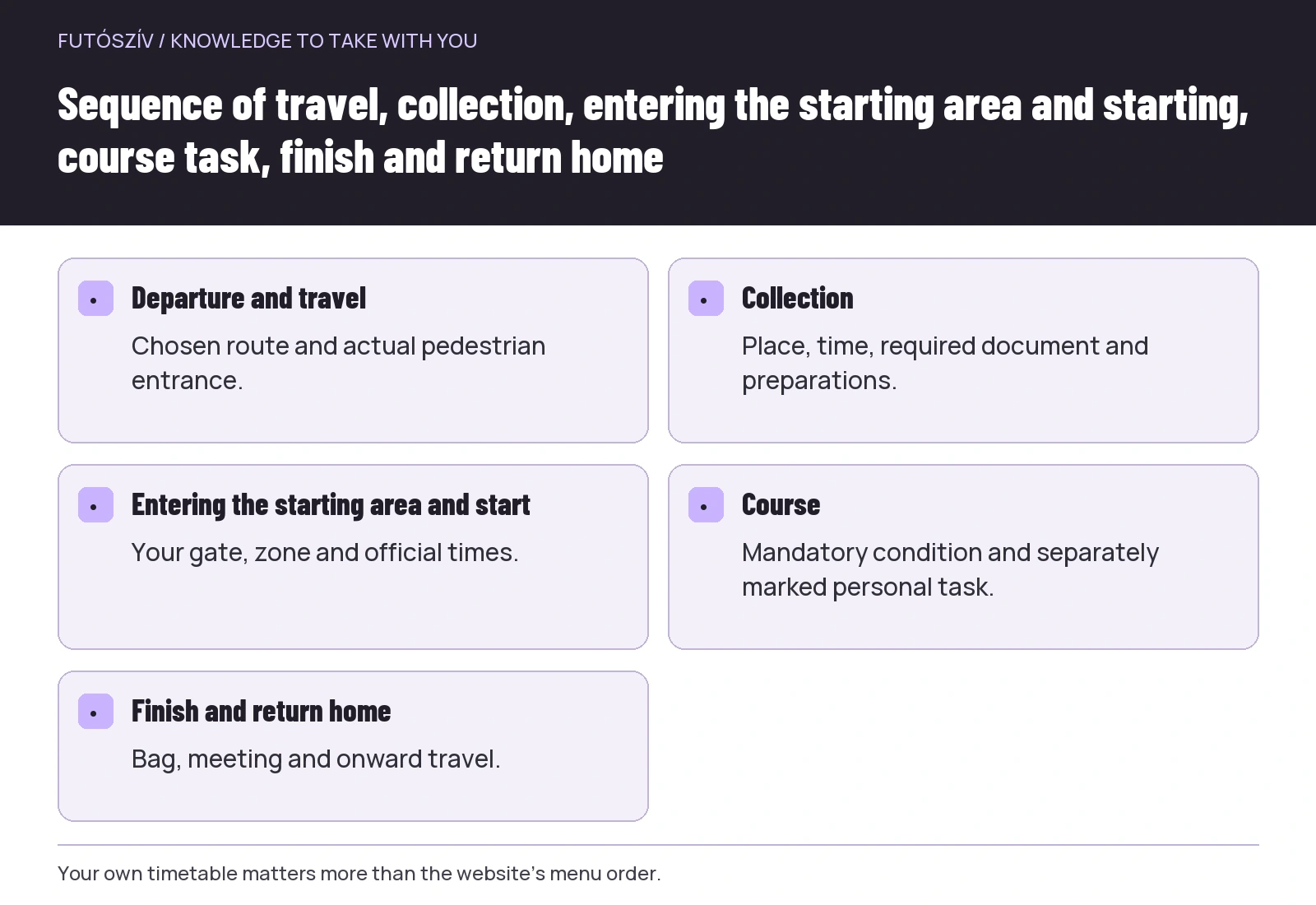 Enlarge diagram
Text version of the illustration
- Departure and travel
- Chosen route and actual pedestrian entrance.
- Collection
- Place, time, required document and preparations.
- Entering the starting area and start
- Your gate, zone and official times.
- Course
- Mandatory condition and separately marked personal task.
- Finish and return home
- Bag, meeting and onward travel.
Use three clear status labels
| Label | Meaning | Task |
|---|---|---|
| Verified | Current information extracted from the appropriate official source | Update before departure as necessary |
| To clarify | Incomplete or contradictory information | Ask the responsible source |
| Personal plan | Your chosen time or programme | Handle according to circumstances and your individual situation |
The label can be text, a simple abbreviation or another legible format. Do not rely solely on colour if the sheet may be used in black-and-white print or on a poorly visible screen. The important thing is unambiguous meaning. Decoration does not replace accurate information.
A “to clarify” row should not disappear at the bottom of the final sheet. Resolving an important open question may be a prerequisite for the programme. In particular, the start location, collection and participation conditions should not be filled in by guessing. Precisely identifying a gap is one of the sheet’s most important functions.
Know the source for every important line
You need not fill a page with long references, but the sources should be retrievable. You can use short titles and a link list at the end. Retain a downloaded document’s name and edition too. If something changes, it is easier to discover which row came from older information.
The organiser’s latest announcement and an older general page may differ. Do not choose between them from memory. Look for clarification or ask through the appropriate channel. Your personal sheet is not an arbitrator between two sources; its role is to reveal the contradiction and then record the clarified answer.
Transport information belongs to a separate family of sources. The BKK timetable and journey-planning page provides a journey planner and current traffic information, for example. Your sheet should show access checked for the appropriate day. Current changes may need to supplement an organiser’s older travel description.
A short content template to fill in
| Block | Your details |
|---|---|
| Event and edition | … |
| Race category, team, leg | … |
| Bib number or required identifier | … |
| Time checked | … |
| Your departure and approach | … |
| Collection: place, time, required document | … |
| Bag drop and next location | … |
| Your zone, entrance and entry procedure | … |
| Start and important time limit | … |
| Mandatory equipment | … |
| Post-finish bag and meeting | … |
| Return home and contact if arrangements change | … |
| Open question and next task | … |
| Official sources | … |
The template’s empty fields deliberately contain no invented start times or services. Fill them from your own event. Omit an irrelevant block or add another important condition. The sheet’s length should suit the task rather than a compulsion to complete every template row.
Have a short and an expanded version
The version held in your hand or opened quickly on your phone should show the next tasks and important times. Expanded background notes can contain the full source list and less frequently needed details. This avoids searching several pages for a gate before the start without losing the explanation.
Preserve meaning when shortening. “Bag drop” alone may not suffice if there is a time or size condition. A cut-off must not lose its timing reference if that matters for your situation. The information sheet should not be as short as possible, but as clear as the task allows.
For phone use, test opening and reading it. Can you actually find the document? Will it be available on that device under the necessary conditions? Prepare according to your own file management and the provider’s current operation. A paper copy is useful if legible, current and suitably storable.
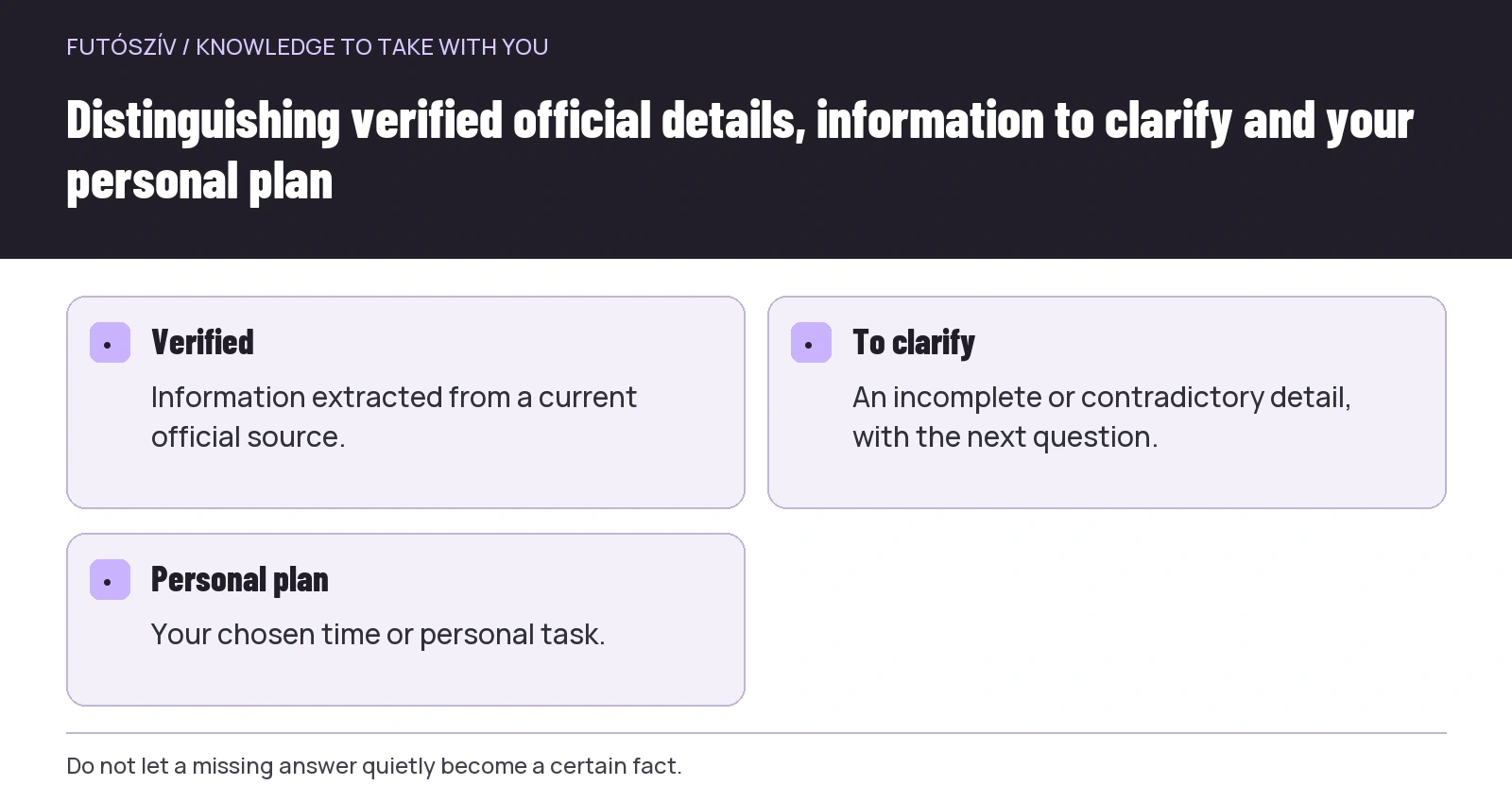 Enlarge diagram
Text version of the illustration
- Verified
- Information extracted from a current official source.
- To clarify
- An incomplete or contradictory detail, with the next question.
- Personal plan
- Your chosen time or personal task.
Companions can receive a separate meeting extract
A supporter often needs arrival, cheering location, post-finish meeting and contact arrangements. They may not need every detail of your own start zone. Make the meeting point specific and recognisable on the site plan. “Around the finish” is too broad at a large event.
Agree what happens if the timetable changes or you do not find each other immediately. A specific point and agreed contact procedure are simpler than setting off in several directions through the crowd. The event’s own arrangements determine access to spectator areas. Not everybody can necessarily enter through the competitors’ gate.
In a team, you can also make a separate extract for your own leg. Include the start or changeover point, required device, expected arrival and onward travel. Alongside updates to the whole team sheet, the individual extract should follow the current status too. Two different versions can easily cause misunderstanding.
Finalise with two checking rounds
First compare the fields against the sources. Are the season, race category, time and wording correct? Then imagine your own day using the sheet. Can you set off, find collection, identify the next gate and know the post-finish task? These two checks may reveal different mistakes.
If somebody helps organise things, ask them to read through the part relevant to their role. Are the meeting arrangements and task they accepted clear? Shared information works when people other than its author can understand it. Use unambiguous points rather than abbreviations and nicknames.
After finalising, mark the current version and do not leave an old sheet at hand under the same name. If there is a printed copy, update that too when something changes. Complex version control is unnecessary. A date and clearly separating obsolete copies can prevent many mistakes.
Return to fresh announcements before departure
Check the event’s new official information and travel changes. If anything affects your sheet, correct that row and tell the companions concerned. The personal extract is the result of your work, but remains updatable. On race day, on-site staff instructions and current circumstances also matter.
If a detail changes, you need not mentally start the entire day over. Trace which next task it affects: later collection may require a different departure, another gate a longer walk, a changed finish a new meeting point. Connections become clearer when you see them in one personal plan.
After the race, improve the template and retain dated details
Look at what you searched for on site that was missing from the sheet, and which line was unnecessary. Adapt the template for next time. Do not automatically transfer this year’s specific start time or service to another event, however. The method is reusable; the data needs separate checks.
A good personal race-day sheet ultimately gives a short, clear answer to these questions: what is my programme, what happens next, and how do I know the information is current? If you can find that quickly, the long event pages have genuinely become a plan for your own use.
How Futószív articles are prepared: our editorial guidelines.