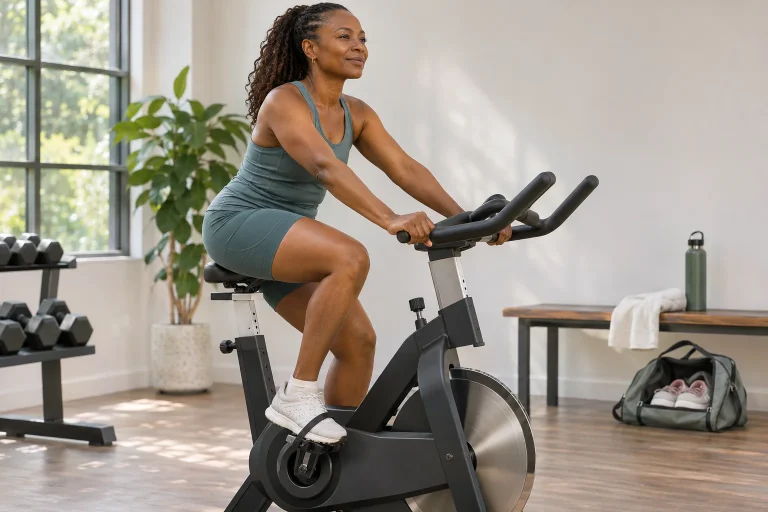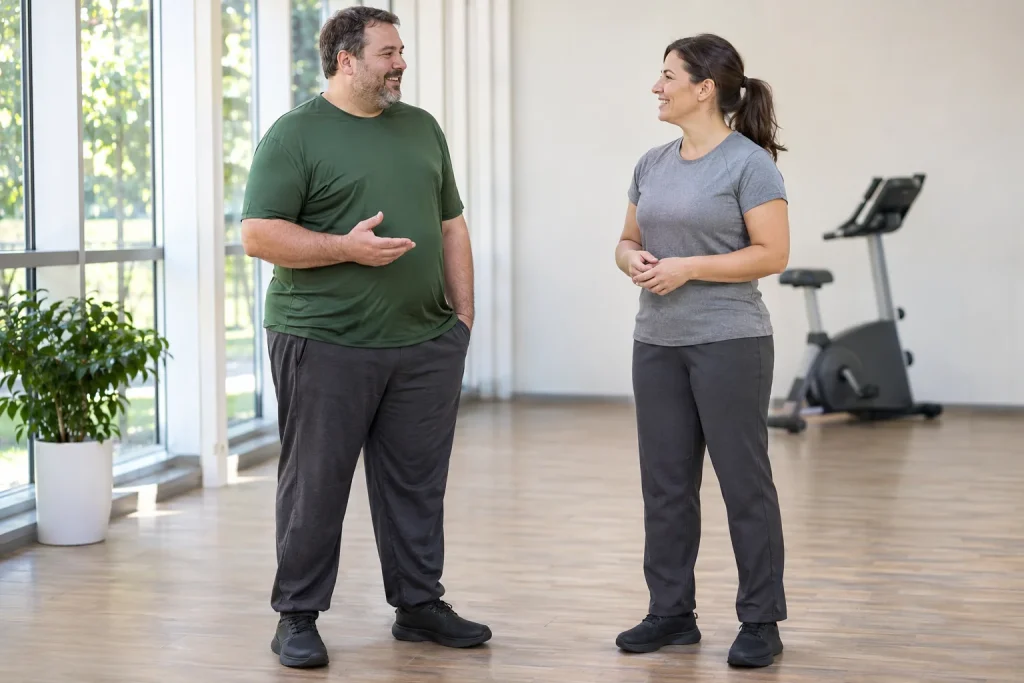
Short, effective, intense: HIIT is often recommended as though higher body weight alone determined the exercise you need. The offer may contain more calorie promises than information about what will happen in the room. As a beginner or returning participant, you rightly want to know what you are undertaking and how it connects with your own goals.
HIIT means high-intensity interval training. The term refers to the structure and intensity of effort, but does not describe every movement, piece of equipment or participant. It is neither a compulsory task assigned by body shape nor one universally prohibited category. A suitable choice considers your current activity, health, interests and the specific programme’s details together.
What does the HIIT label tell you, and what else do you need to know?
The US physical activity guidelines discuss interval training as alternating higher-intensity efforts with lower-intensity recovery periods. There is no single universally accepted formula for HIIT duration, the ratio of phases or repetition count. The abbreviation therefore cannot determine how demanding an advertised session is or how much time the complete programme occupies.
An exercise session might involve cycling, running or a circuit of different tasks. The periods between faster efforts can differ too: easier movement or another form of rest. The name is not a description. Knowing only that it will be short and intense does not establish whether you must jump, change direction quickly, go to the floor, mount equipment or match everyone else’s rhythm.
Good information explains these details in everyday language. What will I do? Who chooses the version? How do I request an adjustment? What happens if I stop a phase? These questions do not show a lack of enthusiasm. Learn about a new sporting task as you would any service: an appealing name needs real content and understandable conditions alongside it.
What feels hard for you is not the same as what is fast for the group
The CDC information on intensity distinguishes absolute and relative intensity. The latter describes how demanding an activity is for the particular person. The same external task can mean different effort for different people. A gym display’s speed or a companion’s pace does not establish your load by itself, and higher weight does not replace learning about it individually.
Discussing the ability to talk or perceived exertion can help interpret intensity. The CDC presents the talk test as a simple guide: at moderate intensity, people can generally talk but find singing difficult. This is not health screening or a guarantee that a task is safe for you. Nor should it turn breathing symptoms into evidence of meeting a compulsory intensity target.
If an instructor requests a shared number, speed or movement count, ask about individual modification. A group working simultaneously can still use different tasks. But that requires real instructor attention, not merely saying everyone should do as much as they can. As a beginner, you may not independently know which version suits you or when help is needed.
 Enlarge image
Intensity, impact and complexity are three separate dimensions
Movement can be described from several perspectives at once. Intensity concerns demand; jumps or steps describe the movement form; a complex sequence also creates learning and coordination tasks. Removing jumps does not automatically make a class low-intensity. Demonstrating a complicated task more slowly does not necessarily make it easy for you to follow.
This distinction is practical because it allows more precise requests. Not wanting to jump is different from needing an easier-to-follow movement, and different again from an effort interval being too demanding. You need not compress all three into ‘I am a beginner’. A specific need helps the instructor understand which alternative to demonstrate.
| Question | What does it concern? | A need to clarify |
|---|---|---|
| How demanding is it? | Individually experienced intensity | A different effort level or phase arrangement |
| What movement does it contain? | Stepping, jumping, running or equipment | Replacing an unsuitable element |
| How complex is it? | Learning, transitions and execution | A simpler, understandable task version |
| How is it organised? | Group rhythm and instructor help | Freedom to stop, ask questions and receive individual adjustments |
Your starting point is more than weight
The NICE NG246 guideline considers current physical condition and ability when choosing activity. A discussion about weight does not override previous injury, symptoms, other conditions or activity history. These cannot be replaced with one training type on the grounds that you should use more energy.
The pre-exercise screening guidance from Sports Medicine Australia and partner organisations treats a significant intensity increase as a distinct planning situation, giving a transition from walking to running or HIIT as an example. This is not a Hungarian care rule, and the document does not guarantee freedom from injury. The important principle is understanding your starting point, symptoms and necessary professional guidance before a major change.
For your first discussion with a coach, describe what you actually do now. Not your best fitness years ago, but current activity, difficulties and instructions for known conditions. Necessary healthcare questions belong with the appropriate care professional. Do not complete an online questionnaire as though its final tick were personal permission for every later intensity.
Why do you want to try it, and what is promised instead?
You may enjoy varied, clearly defined phases, be interested in the group atmosphere or have limited free time. These are valid discussion points. It is different if HIIT feels compulsory solely because someone immediately turned your body size into a weight-loss task. Your own interests and health goals can have a place in exercise choice; you do not have to justify every activity through changes on the scales.
Behind the promise of a short workout, ask about total time. How long are the introduction, equipment setup, learning tasks and finishing? An advertisement naming only the most intense phase does not show how the programme fits your day. Appropriate preparation should not be omitted to fit training into a marketing sentence.
Nor should a promise emphasising calories burned or later energy use become a personal outcome prediction. Ask exactly which change is expected and under what circumstances. A study or watch estimate does not automatically describe your experience. Wanting enjoyable activity sustainable in daily life is enough reason for a considered choice, including without high-intensity phases.
A more adaptable programme can also have a development goal
If another activity currently suits you, that does not mean you are merely waiting for real training. An individually appropriate programme can aim for regular participation, learning equipment or supporting everyday function. NICE does not link activity’s health value solely to weight loss. An easier-to-organise or less demanding option can therefore have its own place in your plan.
In a fictional example, a returning participant first chooses a session where they can learn one task calmly instead of a group with rapid transitions. This is not because a larger body automatically excludes all intense activity, but because it suits their current starting point and interests. Someone else may choose differently after individual assessment. One body-shape measure does not determine the difference.
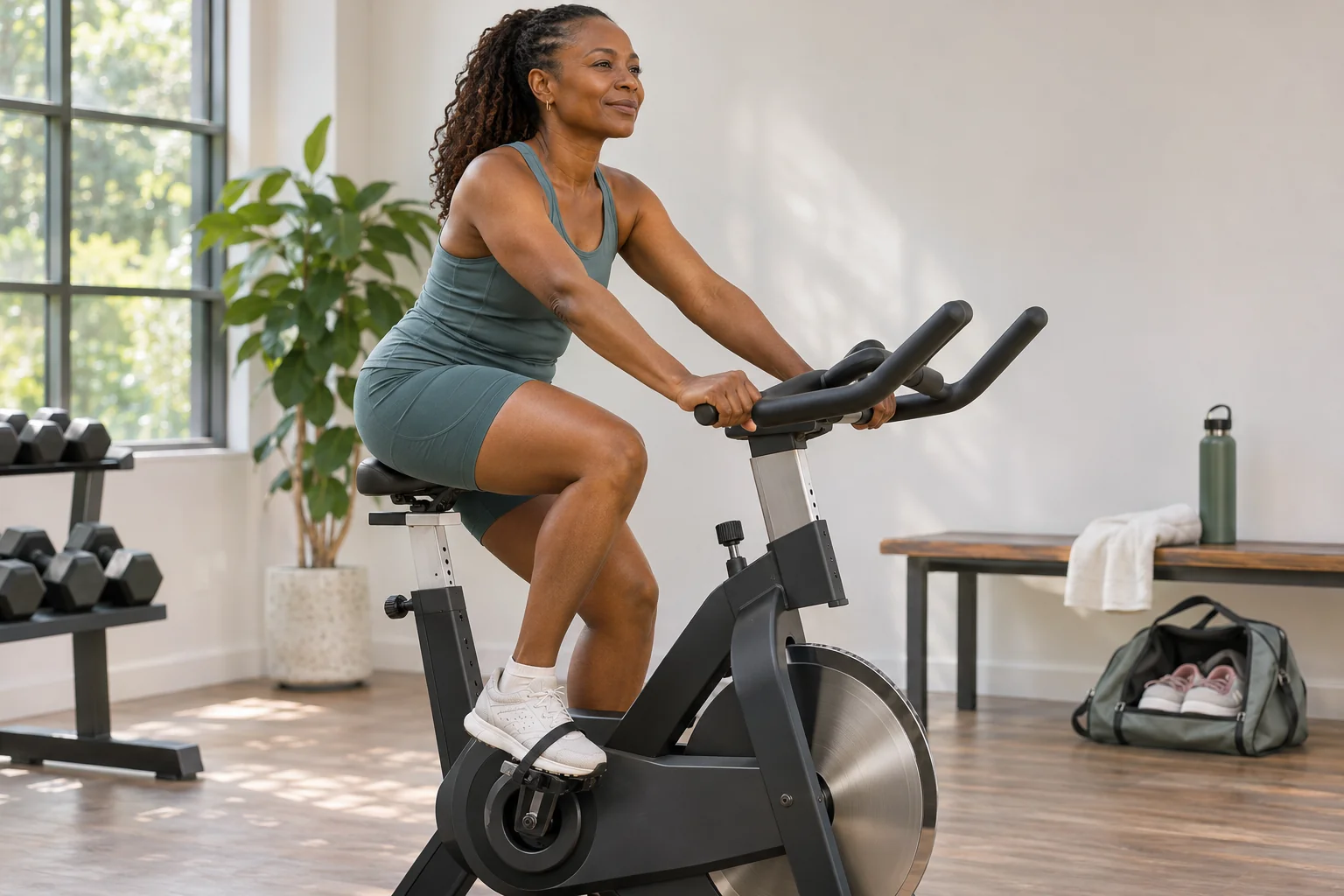
The concept of intervals does not require high intensity either. A programme divided into phases is not necessarily HIIT. Alternating movement and rest or two different tasks can simply be an organisational format. If you enjoy that structure, tell the instructor that variety interests you while you want intensity aligned with your individual plan.
 Enlarge image
Stopping and feedback should be part of the programme
At a session’s start, know how to ask questions, where to stop and whom to approach if something is unsuitable. The edge of the room, an accessible seat and instructor attention are concrete organisational elements. Shaming or public weight comments after someone stops do not support individual feedback. The service’s atmosphere affects whether you can make responsible decisions during it.
Perceived exertion is not the same as suppressing symptoms. New chest pain, severe shortness of breath or fainting during exercise require immediate medical help. Do not automatically translate pain, dizziness or unusual illness into proof that you are finally training hard enough. Individual healthcare instructions and appropriate care take priority over the class schedule.
Feedback afterwards can also be specific: I understood the task but rushed the transition; the equipment suited me but the group rhythm did not; an adaptation was demonstrated, so I could choose. These reveal more about the programme than ‘it was tough’. One strong impression does not require committing to annual membership or a new intensity target.
How to assess a specific offer
Organise the offer around four questions: its goal, content, individual adaptation and available help. If answers refer only to expected weight loss or willpower, request more precise information. A personal training plan requires discussing your current condition, not just stressing the programme’s general success. A responsible organiser can name the service’s boundaries.
- Ask for a specific task description, not only a HIIT label and duration.
- Describe your actual activity starting point and individual adaptation needs.
- Clarify which question requires healthcare or other appropriate professional help.
- Assess instructor attention, freedom to stop and trial options.
- Consider your own goal rather than an automatic assignment based on body size.
HIIT can be an interesting training format for someone, but an individual choice cannot begin and end with weight. You deserve more information than being told to do this because of your body. When the goal, specific tasks and starting point are clear, intensity can be discussed meaningfully. Together these determine the appropriate next step, and choosing another activity can be a fully valid decision.
Sources
- CDC: How to Measure Physical Activity Intensity
- NICE NG246: Physical activity and diet
- Physical Activity Guidelines for Americans, 2nd edition
- Sports Medicine Australia and partner organisations: APSS guidance
- NHS: Fainting
- NHS: Shortness of breath
How Futószív articles are prepared: our editorial guidelines.