HRV is not a record that must always rise
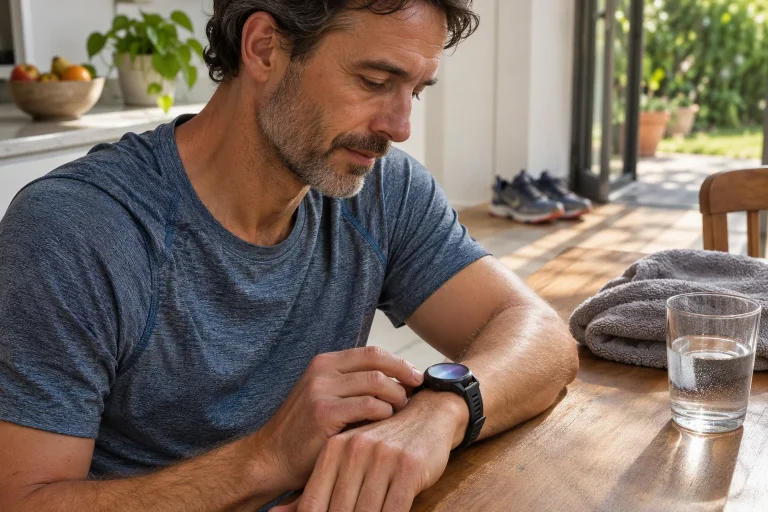
The watch shows a higher HRV value in the morning than last week. You may welcome the change, but this alone does not establish better recovery or clearance for a harder run. The meaning of a metric derived from variation in timing between heartbeats depends on measurement method, personal history and circumstances too. A larger number is not an independent training goal, nor a smaller one a personal failure.
In the current Garmin Forerunner 570 description, HRV Status compares the seven-day average with the personal baseline range. Unbalanced can mean an average above or below that range. The feature itself is therefore not a simple “more is better” scale. Its classification is manufacturer algorithmic feedback to read according to its description. Source: Forerunner 570, HRV Status.
The useful question becomes: how does this value relate to my own pattern established in similar circumstances, and what else happened recently? The watch adds an observation to the log rather than replacing experience of sleep, wellbeing or training. If your first morning response is completely rewriting the day around one number, separate measured data, classification and the actual decision first.
One night, a seven-day average and a baseline range
You may see three different things within the same group of screens. The nightly value summarises a particular period. The seven-day average combines several days. The personal baseline range provides the reference against which the manufacturer assesses the current pattern. These are different timescales. Even with today’s nightly number rising, the seven-day average can fall if a higher earlier value leaves its window.
In a simplified numerical example, six days show 50 milliseconds and one night 80. The week’s arithmetic mean is approximately 54.3, not 80. If an earlier 80 leaves a later window, the average may fall even with a new 60. These are invented data rather than a particular watch’s complete calculation. They explain how one night’s value and a rolling summary can move differently.
A baseline requires appropriate history. Garmin’s cited manual specifies three weeks of consistent sleep data before status appears. Insufficient data and an absent status need not mean a poor condition. Nor is the baseline an optimal target copied onto you from an internet table. Your device and feature must meet their prerequisites before the classification can be interpreted appropriately at all. Source: data requirements for HRV status.
 Enlarge image
Why can an unusually high value also deserve attention?
For a value above your personal range, the first step is context rather than deliberately reducing it. Do not try worse sleep or unnecessary exertion to “get back into green”. The category is not a points game to correct. If the pattern differs, consider whether it may represent real change, a different measurement situation or an uncertain recording. The manufacturer’s label does not itself name the cause.
It is particularly important not to equate greater variability automatically with healthier heart function. HRV analysis is processing sensitive to signal quality and beat identification. The Kubios professional guide separately discusses noisy sections and beat correction. A misidentified event can influence the number too. This does not say every high value is wrong; it supports checking origin and measurement quality before a major conclusion. Source: Kubios HRV Scientific guide.
In your log, for example, note a higher-than-usual nightly value alongside an apparently fragmented recording or different watch wear. These are observations rather than diagnoses. If data are repeatedly uninterpretable, check device support and wearing instructions. If symptoms also occur, do not entrust their assessment to the HRV colour you consider desirable. The two questions need separate paths.
Different manufacturers’ recovery features may summarise different questions too
Polar Nightly Recharge is not simply another name for Garmin’s classification. Polar describes its own assessment of sleep and overnight metrics related to the autonomic nervous system. The ANS component uses heart rate, HRV and breathing-rate data from roughly the first four hours of sleep, relative to the usual level. This is an independent manufacturer method. Do not automatically translate one product’s labels into another’s colours. Source: Polar Nightly Recharge.
If two watches give different morning feedback, first examine whether you are comparing the same metric and period. A whole-night summary, a brief morning measurement and multi-component feedback can be different data. The difference does not immediately prove one measures badly. They may not even perform the same task. Clear comparison requires the time window and calculation purpose alongside the metric name.
Mark switching devices separately in the log, therefore. Do not blindly transfer an earlier personal range to another device’s method. Even with identical units, signal paths and aggregation may change. Recording the device change as a measurement-method change makes the series traceable. Your running performance did not necessarily transform on the night you put on a new watch.
Measurement reliability and physiological interpretation are two steps
Johansson and colleagues’ 2026 study compared separate ECG, chest-strap and phone-camera HRV app measurements in 37 trained participants. It included two short recordings on the same day in controlled surroundings. This exemplifies investigation of a method’s reliability and agreement. It does not automatically validate every sports watch’s overnight algorithm or training advice. Source: Johansson and colleagues, original HRV research.
Good measurement agreement is only one step. Another is which practical conclusion can follow from a measured change for a particular person on a particular day. An instrument may record something well without independently specifying the exact load for the next workout. Goals, history and other observations also belong in the decision. Measured data and training recommendations derived from them need separate evidence and separate reading.
Do not estimate a personal clinical error margin between nights from one research percentage. The study’s participants, devices and protocol differ from your complete night. Take the methodological question from the research too: what was measured, against what and under which conditions? This approach avoids overinterpreting favourable findings while not rejecting possible usefulness without justification.
Add a short, concrete note beside a morning value
A few sentences may suffice. When did you go to bed, how interrupted was the night, was there unusual late activity and what training did you do the previous day? Every day need not become a laboratory report. The aim is preserving real events beside unusual HRV when reviewed later. A number alone helps less with pattern finding than data retained with your circumstances.
Polar names various daily-load and lifestyle circumstances in relation to overnight feedback. This does not mean one unusual night reliably identifies its trigger. If training late and sleeping badly occurred, record them separately rather than declaring one a proven explanation. Even after several similar occasions, describe your own pattern rather than a causal rule for every runner. Source: circumstances around overnight feedback.
Measurement uncertainty belongs in the log too: a missing night, unusual wear, updated software or a new device. These are not embarrassing flaws to fix, but information determining the series’ meaning. Do not delete inconvenient data merely for spoiling the picture. Mark suspected technical faults as suspicions and retain the original. Later comparisons then avoid an invisibly beautified baseline.
 Enlarge image
Make training decisions from the whole situation
Suppose you slept well, feel as usual and already planned easy training, but HRV colour differs from normal. A useful next step is understanding the displayed metric and circumstances rather than automatically attempting a record or inventing a rigid prohibition. This article gives no individual exercise clearance. The example shows that one algorithmic label does not contain the complete decision situation.
It differs when unusual illness, symptoms or persistently worsening wellbeing accompany the data. A favourable watch value neither explains nor excludes these. Healthcare appropriate to symptoms and individual circumstances provides health assessment; the watch screen cannot replace it. A log and traceable timeline may supply context rather than a homemade diagnosis. Necessary help-seeking need not wait until the next green night.
Resolve persistent uncertainty in two directions. For a technical question, manufacturer support can clarify wear, data collection and feature conditions. Health questions require appropriate professional assessment. Neither replaces the other: a software update may solve a measurement issue but cannot investigate symptoms. Separating the question makes help-seeking more targeted rather than expecting the watch to do something it was not designed for.
Your own range is a reference, not competition with others
Ranking two runners’ HRV says little about which workout each is ready for. Garmin’s manual also emphasises individual differences and personal baseline. Useful group discussion may therefore concern consistent measurement or logging methods rather than the highest overnight value. Someone else’s number is not your compulsory target, and yours does not grade your worth as an athlete.
If watching the display repeatedly distracts from how you feel, simplify your data-viewing routine. Before a morning decision, for example, describe how you slept and feel, then look at the metric. This is a personal observation exercise rather than psychological treatment or a method working for everyone. It aims to prevent watch data retrospectively overriding your experience before interpretation.
Higher HRV is therefore not an automatic reward, nor a value outside baseline a ready-made diagnosis. Measurement quality, time window, personal history and daily circumstances give it meaning together. Separating these lets the feature raise useful questions: what changed, are data reliable and what else needs attention? HRV then remains one reference in the running log rather than an event in which the result must grow at any cost.
Sources
- Garmin Forerunner 570: HRV Status
- Polar Nightly Recharge
- Johansson and colleagues: investigation of HRV devices
- Kubios HRV Scientific 2026 guide
How Futószív articles are prepared: our editorial guidelines.