A running watch originally answered straightforward questions: how far did you go, where did you run and at what pace? When you are worried about your health, however, it can take on another role. Instead of a description of the session, you expect the display to guarantee that nothing bad can happen now or later. No device can give a definitive answer to that question. The distinction between useful recording and constant checking therefore depends on the purpose of the data, the next decision and its effect on your life.
This topic requires two kinds of attention at once. A new or changed symptom must not automatically be labelled anxiety. At the same time, repeatedly seeking reassurance after previous investigations can be a difficulty that needs help of its own. This article does not decide which situation you are in; it offers questions to take to your treating doctor and, if needed, a mental health professional. Meanwhile, your watch can have a clearly defined role without becoming a constant judge of your health.
What are you seeking when you wake the display again?
Imagine two movements that look similar from outside. One runner checks the agreed training data, makes a decision accordingly and gets on with the day. Another opens the same display several times in quick succession because the previous reading no longer feels reassuring enough. No single number of glances determines what is happening. Instead, describe the question that preceded the action and whether the answer actually settled it, or whether you immediately began seeking new evidence.
The NHS information on health anxiety describes worry about illness that takes over everyday life. This can include frequent body checking, seeking reassurance from others, repeatedly browsing health information and fearing that investigations have missed something. It does not prove that a physical experience is invented. Anxiety can have physical symptoms too, but that alone cannot establish the origin of a particular new symptom.
As an example of our own, imagine taking a screenshot after a run, comparing it with one from last year on the bus, then searching for every small difference at home. The question is not whether you are allowed to take a screenshot. What matters more is whether the search has a purpose established in advance. Data kept for a medical discussion and a folder accumulated in the hope of ever more certainty may look alike on a phone while serving very different stories.
A useful way to describe the difficulty might be: “Even when I feel nothing new, I reopen the app because I’m afraid I’ll miss something; afterwards I need to do it again.” This identifies the situation, fear and behaviour without a diagnosis. You do not need a graph to prove that you worry enough. You can also mention staying home near the display instead of joining a group run you used to enjoy.
The measurement’s purpose matters more than a reassuring colour
The 2026 AMA information on consumer health technology distinguishes trackable data from scores estimated through algorithms. Such information can start a conversation with a doctor, but cannot by itself provide a diagnosis or determine treatment. The article also discusses the potential anxiety-provoking role of constant monitoring and notifications. This does not mean every watch is harmful or every notification must be deleted.
First, identify the feature on your own device precisely. Heart rate displayed during training, a device-calculated stress value, a rest recommendation and a feature with a specific medical purpose are different things. Being near each other in a menu does not make them confirmatory tests for one another. Opening three more screens after an uncertain reading does not necessarily give you three independent pieces of evidence. The feature description and conditions of use say more than the reassuring or frightening colour of a signal.
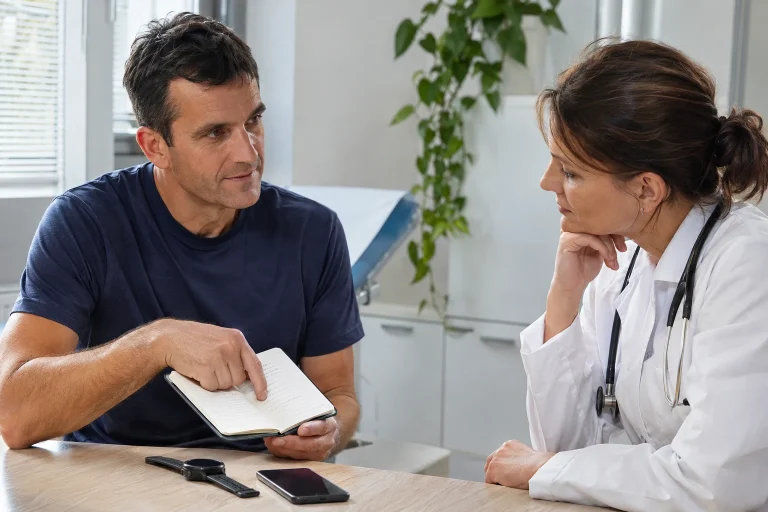
It is worth bringing a brief device description: exact model, feature used, circumstances in which the data appeared and whether symptoms accompanied it. This is not a shopping comparison. It helps the professional understand what information is actually available. Rather than “my watch showed something bad”, “an estimated summary score changed while I felt this and this” is a much more precise starting point. If you do not know the feature’s name, say so; there is no need to guess.
Not every piece of data needs a role in your running. Finding a planned route or recording an agreed duration may be enough of a task in itself. This is not a general instruction to abandon measurement: if you have individual medical monitoring instructions, discuss their arrangements with your care team. The aim is a clear description of the device’s role: what you use it for, which signal you show to whom and which question you do not expect it to answer.
 Enlarge image
The app does not determine the care pathway for a new symptom
If palpitations occur with chest pain, shortness of breath, feeling faint or fainting, urgent help is needed; in Hungary, 112 can be called for such an acute situation. You do not need to record a suitable trace first or confirm the symptom with another device. The NHS guide to heart palpitations treats these accompanying symptoms as urgent warning signs. Even if they have stopped, they warrant urgent medical advice.
Recurring, increasingly frequent or prolonged palpitations should also be discussed with a doctor. A previous reassuring assessment is not an explanation issued in advance for every later symptom. Likewise, a known anxiety diagnosis does not remove the need to assess a new symptom. A favourable watch reading does not override what you feel, and a companion cannot exclude an emergency from the display. Keep this boundary clear when working on health anxiety too.
When the situation is not acute, it can help to clarify with your doctor beforehand which changes call for which type of contact. This is not a personal permission system assembled from online numerical thresholds. It is a plan informed by your individual condition, with room for both routine review and reporting new symptoms. If you do not understand a point, ask for a plain-language explanation. “When should I contact you again?” matters at least as much as what the previous result means.
Bring a brief history rather than a complete data archive
Two separate storylines can help you prepare for the conversation. One concerns symptoms: when they appeared, in what situation, what accompanied them and what changed from before. The other concerns checking: what prompts it, what you seek, what happens afterwards and what it takes away from your day. This is an idea for organising your account, not a compulsory diary task. If making notes itself triggers more checking, mention that rather than expanding the table further.
| What might you say first? | What makes it more precise? | What do you not need to decide from it? |
|---|---|---|
| I keep seeing a bad value. | Which feature, in what circumstances, and were there physical symptoms? | Whether the change alone means disease. |
| I must check too often. | What prompts another check, and what do you have to interrupt because of it? | Whether you meet an invented diagnostic number of checks. |
| Everyone says nothing is wrong. | What assessment took place, and exactly which question remains open? | Whether continued worry is something to be ashamed of. |
A brief, representative situation may be enough. Perhaps you set off for the shop but turned back to check the watch left charging, or missed a breakfast with friends because you were seeking another interpretation on your phone. You do not need to dramatise these events. A concrete life situation shows what a long data series cannot: how your relationship with uncertainty has changed and which activities checking has pushed aside.
At the start of the discussion, also explain what you want to regain. This might mean being present with your running companion, having breakfast without an app or spending a work break on something other than health searches. That does not mean concealing symptoms. It makes clear that support is also about everyday functioning, rather than merely reducing check counts on an attractive graph.
Treatment is more than someone reassuring you once again
The CHAMP randomised trial compared 444 participants attending hospital outpatient clinics who met specified health-anxiety criteria. Outcomes of targeted cognitive behavioural therapy were compared with usual care, and its benefit was also examined in longer follow-up. Coexisting physical illness was not automatically excluded. The research therefore provides an important counterexample to the idea that health anxiety can only be addressed when someone definitely has no physical illness.
The eight-year follow-up continued to find a difference favouring targeted therapy on the measure of health anxiety. Long-term interpretation needs to account for the fact that follow-up data was not available for every original participant. This was not a study of athletes using running watches, and it does not prove that removing a watch is treatment in itself. The point is the availability of professional help designed for the specific problem, rather than a universal prescription for life without a device.
In a therapeutic conversation, then, you are not simply trying to obtain another guarantee about your health. It may also address how you interpret physical signals, how you respond to uncertainty and which habits maintain the difficulty. An individual assessment helps determine which approach is appropriate for you. Do not copy the study’s number of sessions or tasks into a running programme, and a club leader does not become a therapist by being good with sports data.
According to the NIMH information on psychotherapy, someone seeking help can ask about the professional’s qualifications, experience of treating that difficulty, the method’s purpose and how change is evaluated. You can translate these into questions about the watch-related problem: how will the work address repeated checking, what role does the plan agreed with your doctor have, and what happens if a task proves too difficult?
A running companion can help without becoming an on-call interpreter
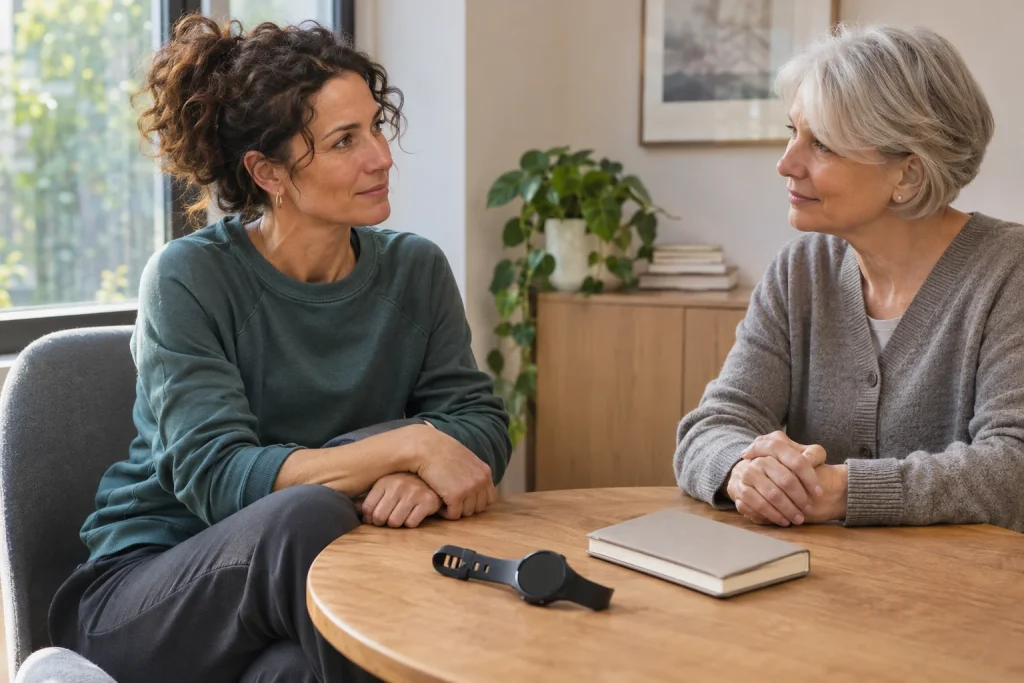
A companion may kindly look at the screen again and say: “I think that’s completely fine.” But if every meeting centres on seeking the same confirmation, it is worth discussing another kind of help. There can be room in the relationship for: “I’ll listen, but I can’t interpret medical data.” This clarifies the companion’s role; it is not permission to ignore a new episode of illness.
A useful agreement might involve a friend helping you get to an appointment or gather questions, without demanding proof of health performance during shared activities. The agreement should not become a secret test: nobody should hide your watch or change your alerts without consent. Align any boundaries around checking with the professional plan, rather than inventing them during an argument. In a supportive relationship, respectful cooperation matters more than winning a clever dispute over the app.
You can also choose how much to share. You do not need to upload your complete health archive to a group chat to feel entitled to ask for help. An organiser may only need practical information: you are clarifying certain questions with a professional and do not want public data interpretation or jokes about your display. Technical help and passing on a personal history are separate decisions; the community should not assume either automatically.
 Enlarge image
A clear boundary does not mean abandoning every measurement
The NHS recommends seeing a professional if health-related worry interferes with everyday life or self-help attempts are not helping. You do not need to wait until you miss every run. You can describe uncertainty after previous investigations just as you can report checking that interrupts sleep, work or social activities. Raising a psychological difficulty does not withdraw your right to appropriate assessment of later physical symptoms.
Three clear questions can be a useful outcome of the next conversation: which symptoms call for which service; what data is worth keeping for the agreed purpose; and how to get help so checking does not dominate your day. This can create an individual framework for device use that is not built around achieving complete certainty. The watch can become an object used for a task again. Appropriate care, an understandable plan and taking your difficulty seriously are what support safety.
Sources
- NHS: Health anxiety
- NHS: Heart palpitations
- AMA: What doctors want patients to know about health wearables
- Tyrer and colleagues: CHAMP, five-year outcomes
- Tyrer and colleagues: CHAMP, eight-year follow-up
- NIMH: Psychotherapies
How Futószív articles are prepared: our editorial guidelines.