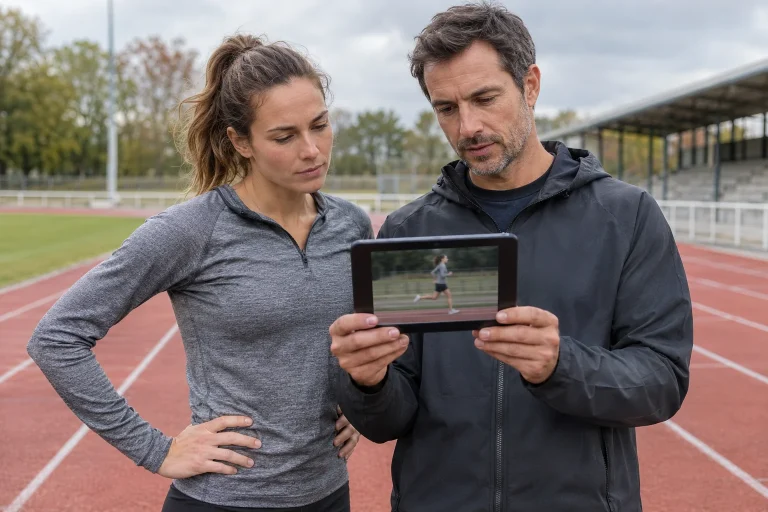
Advice often appears beneath a running video: lean forwards slightly and your knee will be less loaded. Biomechanical research does relate to the first part, but without the sentence’s continuation the result is easily misunderstood. If a particular task at one joint decreases, another joint or muscle group may take on more. Changing posture alters work distribution, rather than simply removing running’s demands.
Trunk position is therefore an interesting tool for understanding movement, but not a universal angle prescription. We examine what researchers measured, how joint moment, work and cumulative loading indicators differ, and why the hip’s response and total energy demand matter too. Our own numerical examples help read reports and graphs; they do not provide a personalised technique-transition programme.
Trunk angle only makes sense with a specified reference
‘Forward lean’ can describe several observations. The trunk may point differently relative to vertical, its position relative to the pelvis may change, and whole-body movement is not identical to bending separately at the waist. Research must define which segment is measured, using which points and relative to which coordinate system. Without that, two values called ten degrees do not necessarily mean the same thing.
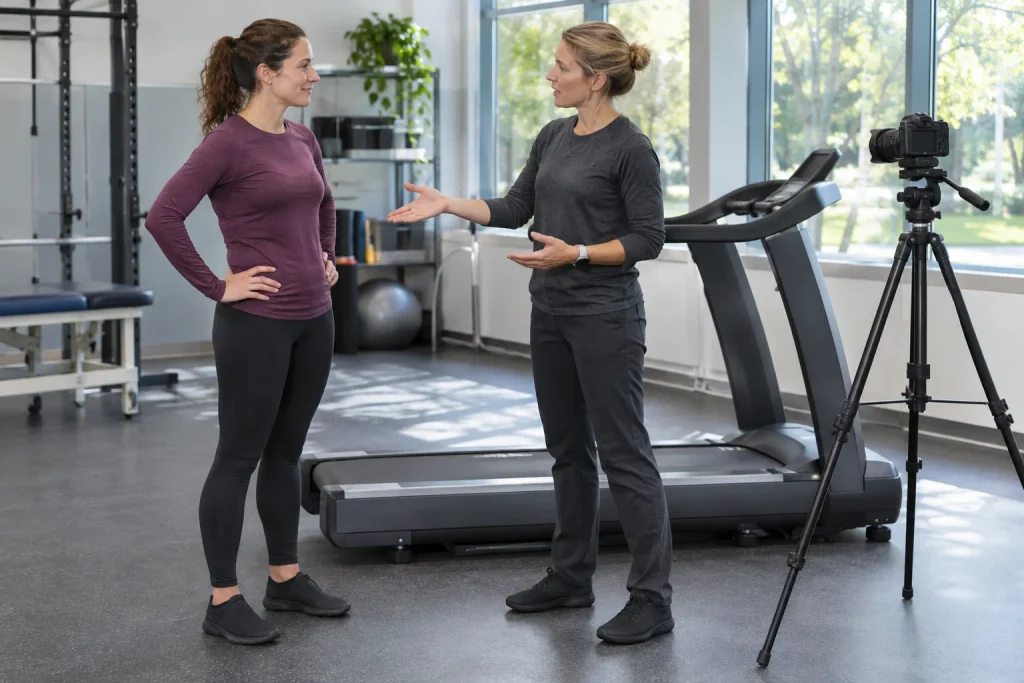
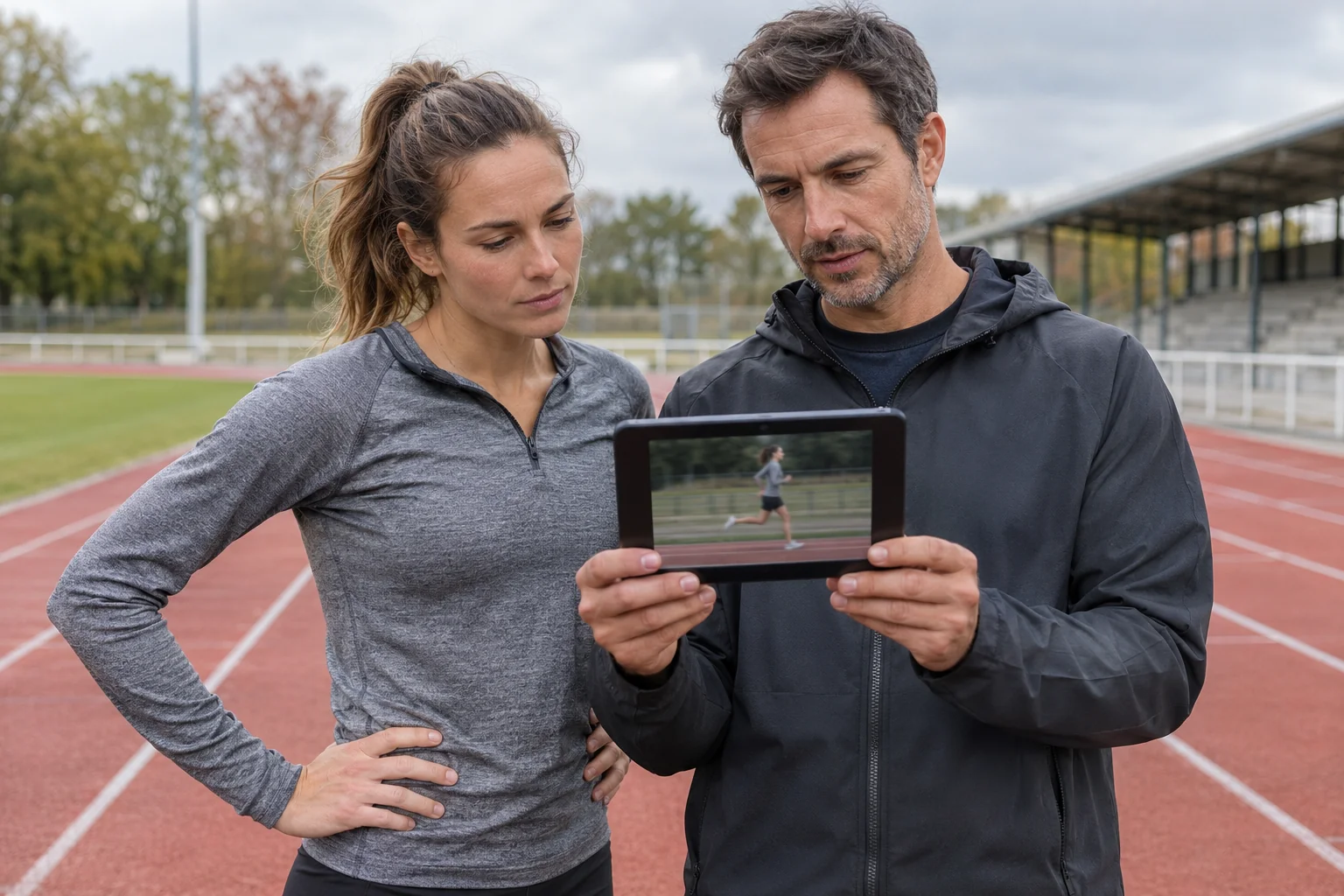
Camera position and the moment within a step matter too. A trunk line visible from the side in one frame differs from mean trunk position during stance. Oblique footage from behind and beside introduces further perspective. If running uphill, the image relative to ground differs from that relative to vertical. Video helps observation, but a number must always be accompanied by its measurement’s meaning.
In a practical example, a note says only: ‘the trunk was farther forwards relative to vertical at mid-stance’. This is more precise than ‘posture was poor’. It records a defined phenomenon without prejudgement. Whether the change is desirable for a runner depends on training goals, history and the whole movement’s response. Description and a decision to correct are separate steps.
Greater forward lean may shift tasks towards the hip too
In Braun and colleagues’ study with thirty recreational runners, five feedback-controlled trunk positions were compared at the same speed of 2.5 metres per second. Greater forward lean reduced certain knee-extension moment and cumulative metrics while increasing sagittal- and transverse-plane hip demands. The authors interpreted this as load redistribution. They examined a brief, controlled biomechanical change, rather than the success of a general injury-prevention programme.
This redistribution is the article’s central idea. A decrease in one selected knee metric alone does not show what happened across the whole lower limb. Increased hip demands may be intentional in a professionally planned situation, but remain real additional requirements. Knee and hip figures should not be added into one ‘good technique’ score, especially when describing different movement planes or units.
In Teng and Powers’ work comparing forty asymptomatic runners, the group running naturally with greater trunk flexion showed greater hip-extensor energy generation and lower knee-extensor energy absorption and generation. This was an observation between groups, rather than the same prescribed change for every participant. An association in a similar direction is interesting, but provides different evidence from a controlled intervention.
 Enlarge image
The moment arm can change without force disappearing
A force’s turning effect about a joint depends on its magnitude and the perpendicular distance from its line of action to the joint. Changing body position can modify this moment arm. This helps explain why a joint’s net moment may change despite unchanged runner mass and speed. Posture is therefore more than an aesthetic property: it rearranges spatial relationships between body parts and forces.
In a simplified illustration of our own, a thousand-newton force with a thirty-millimetre moment arm gives thirty newton-metres of turning effect, compared with fifty for fifty millimetres. These are not real runner knee values, only numbers for force × moment arm. The example shows that the relationship between force line and joint matters. It does not establish that a particular trunk-angle change gives everyone exactly twenty newton-metres of difference.
In actual movement, several forces and segment accelerations also enter calculation of net joint moment. External motion and ground-reaction force together support inverse-dynamics analysis. Net moment is still not identical to one muscle’s force or contact between cartilage surfaces. A lower knee-moment curve in a graph cannot directly establish pressure at every point of a particular tissue.
Peak, duration, contact count: summation can change the picture
Peak moment is a selected maximum value. A moment indicator integrated over time also considers how long the moment persisted; its unit includes seconds. Multiplying it by the same-side contacts needed for a specified distance produces another cumulative indicator. Each views the same run from a different perspective, so ‘loading decreased’ must specify which is meant.
In an illustrative calculation of our own, suppose one joint’s mass-normalised moment time integral is 0.20 newton-metre-seconds per kilogram per contact, with five hundred such same-side contacts per kilometre. The product is one hundred units. In another movement, the per-contact value falls to 0.18, but there are six hundred contacts: the product is 108. The component indicator fell ten per cent while the cumulative indicator rose eight per cent.
These are not actual trunk-lean research data or injury probabilities. The example shows why the chosen summation matters. Contact counts must also be named precisely: the same foot landing again and total steps from both feet are not the same counter. A one-sided indicator must not inadvertently be multiplied by twice as many steps. Understanding the method matters more here than selecting the smallest number in a table.
Work and energy demand tell different stories too
Joint mechanical work comes from the relationship between moment and angular velocity over time. It may have positive and negative sections, describing energy generation and absorption within the model. This differs from the moment time integral. Two movements with the same moment peak may produce different work if angular change and instantaneous movement differ. Indicators in joules and newton-metre-seconds should therefore not be interchanged.
Whole-body metabolic cost is another level. Activity of some muscles may decrease while others increase, with the net total reflecting their complex combination. Braun and colleagues’ 2026 research combining experiment and musculoskeletal simulation found a U-shaped relationship between trunk position and total metabolic cost; the self-selected position aligned with the lower-cost range. Muscle-specific energetic explanations are model estimates, rather than separate direct measurements of every muscle.
Lower knee-extension moment therefore does not automatically mean lower total oxygen demand. In evaluating research and your own experience, ask separately whether the chosen knee indicator changed, how the hip responded and what happened to the whole run’s energy demand or usability. One favourable graph does not answer all three. A deliberate change’s aim must therefore be named beforehand.
An anticipated step down differs from a level treadmill
When surface height changes abruptly, the runner must do more than maintain trunk position: support moves to a new location, and mechanical-energy absorption and return may change too. A relationship observed on level ground should therefore be examined separately in this situation. Continuous downhill running, a visible small step down and an unexpected surface defect are also different tasks from one another.
In AminiAghdam and colleagues’ study, twelve recreational runners ran on level ground and over an anticipated ten-centimetre step down with several trunk positions. Posture changed distribution between knee and hip, but only slightly influenced the step down’s pronounced ankle demand. The measured situation was not an unexpected fall. It does not establish that leaning forwards removes every consequence of uneven ground.
This distinction also matters practically. If a route has many high kerbs, surface selection and recognising obstacles relate directly to the task. Every environmental change should not be ‘solved’ through one constant posture. The body needs movement options suited to the situation, and the runner’s task includes choosing a usable route and pace, rather than only maintaining a predetermined angle.
 Enlarge image
What should you ask at a technique consultation?
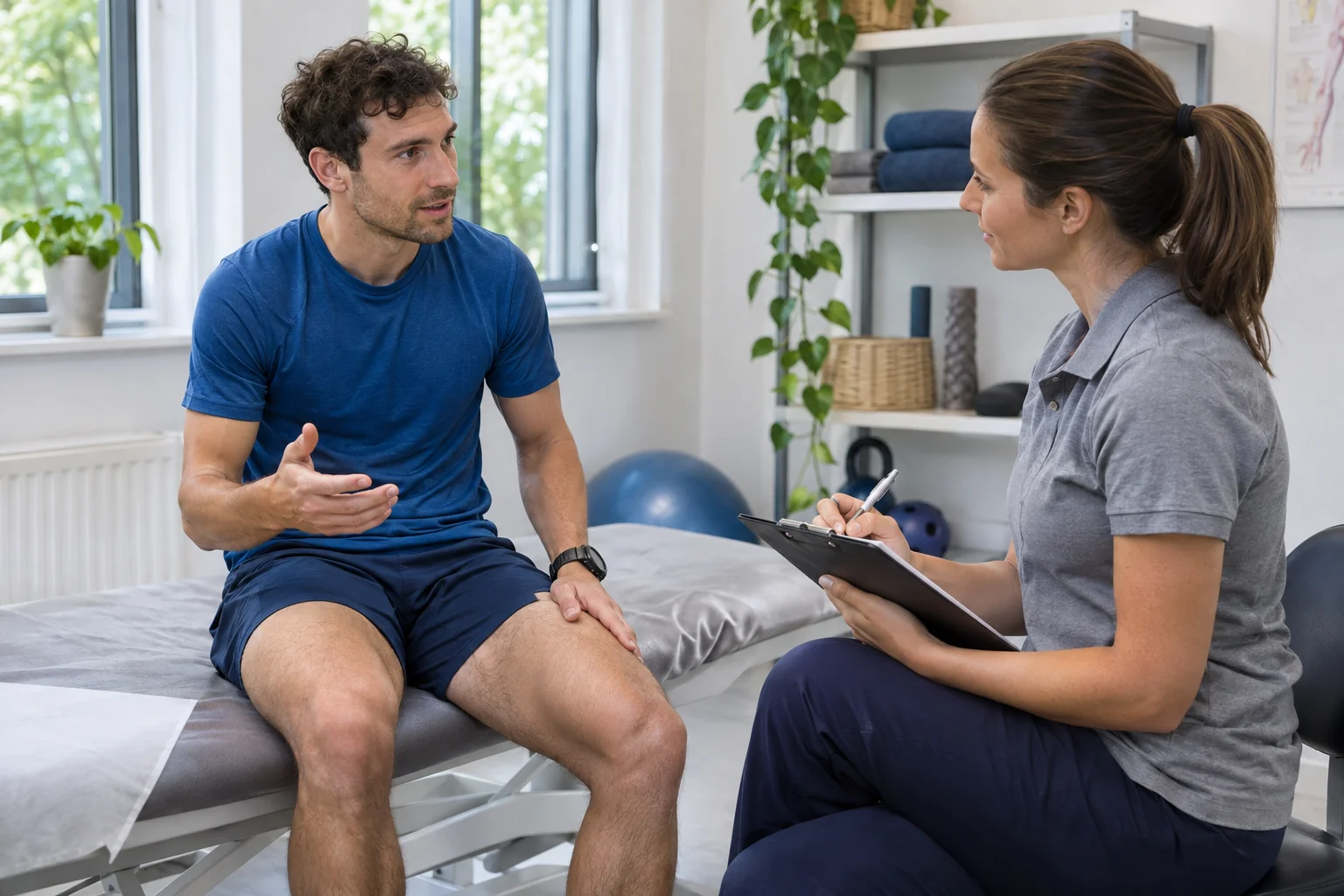
First ask the specific aim. Changing loading associated with a recurring symptom? Altering a chosen biomechanical indicator? Or simply understanding running comfort? Without a named goal, any new movement can be interpreted as improvement merely because it differs. A clear aim helps determine which measurements and personal feedback are worth following.
Second, clarify what is called trunk angle and during which movement it is measured. Third, ask which other indicators are followed alongside the knee. If change puts greater demand on the hip, assessing that belongs to consultation too. Finally, discuss how usability during and after running is evaluated. One successful frame is insufficient if movement remains uncomfortable over time.
With symptoms, this process can be interpreted with a professional who knows the symptoms and training history. This article’s numbers do not personally authorise trying greater and greater angles during painful running. Yet consultation does not require a ready-made self-diagnosis: describing when an experience occurs, at what pace, on which surface and for how long may be more useful. A precise question is again a better starting point than ideal posture chosen online.
Describe the result across several lines
A fair summary might say: at the same speed, a defined trunk-position change reduced a selected knee-extension indicator; some hip demands increased; total energy demand needs separate assessment. This takes more words than ‘technique improved’, but describes events more precisely. The runner can then understand the trade-off a change may involve.
Retain the study type when comparing results too. Natural group differences, brief feedback-guided posture changes and muscle-energetics simulation provide different evidence. Agreement in direction may strengthen understanding of the phenomenon, but does not turn them into a single large recovery trial. Measured moments, estimated muscle costs and long-term symptom development remain separate outcomes.
Forward trunk lean can therefore affect distribution of running’s task between knee and hip. Used meaningfully, this is a loading question, rather than a video beauty contest. The aim is not the largest possible angle, but understanding the whole runner and task: what changes, where a new demand appears and which evidence supports the decision.
Sources
- Braun and colleagues: controlled trunk lean and joint-loading indicators.
- AminiAghdam and colleagues: trunk position and an anticipated step down.
- Braun and colleagues: trunk position, total metabolic cost and a muscle model, 2026.
- Teng and Powers: natural trunk position and lower-limb energetics.
How Futószív articles are prepared: our editorial guidelines.