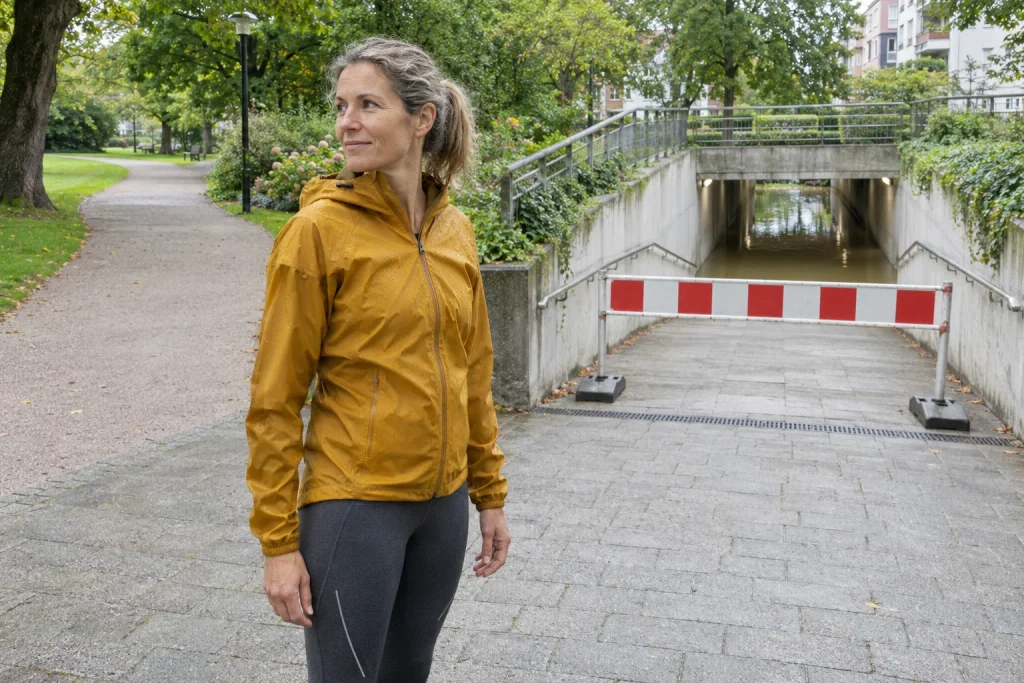
An underpass lies on your familiar running loop, but its lower section is now covered in water. From outside, it looks short, and it is easy to think your shoes are wet anyway, so a few steps will not matter. A flooded crossing is more than a footwear question. Water can hide paving, steps, damage or debris, while current can be dangerous even at apparently shallow depth.
As a runner, choose a dry, permitted alternative or turn back rather than testing passage through uncertain water. This article explores hidden information, planning a detour and useful on-site reporting, with our own route example and sample message. We do not grant crossing permission based on ankles, lower legs or shoes: a flood of unknown extent does not become safe because it looks short.
The water surface does not reveal the ground
NWS flood-safety guidance specifically warns that a road beneath water may be damaged or missing. Even on foot, do not treat a flooded road as though familiar paving will definitely be present at every step. Memory of a familiar place and the present surface condition are separate information. Visually calm water does not establish an intact surface beneath.
For our thought experiment, imagine steps and a ramp leading to the same crossing. If the lower area is invisible, the water surface cannot show exactly where the next step begins or depth changes. One exploratory step farther in does not resolve every uncertainty beyond it. The decision can be made from dry ground: this crossing is not part of the run now.
Distance estimates can mislead too. A nearby exit on the other side does not describe the intervening section. “Only ten metres left” describes proximity to the goal, rather than crossing conditions. A route planned on your watch has not checked current water levels. Digital tracks and actually usable paths may differ, and the plan must adapt.
Shallow flowing water is not a simple puddle either
The US weather service warns that approximately fifteen centimetres of fast-moving water can knock an adult over. This illustrates danger, rather than setting a depth below which passage is safe for everyone. Actual flow, ground and individual circumstances can differ; entering the flooded section to determine depth is not justified either.
In runners’ language, “ankle-deep” is particularly imprecise. It is not a standard measurement, says nothing about water speed or the next metre of the route. Do not automatically turn that phrase in a companion’s message into permission to pass. Useful information is that water covers the crossing and the route needs changing. Missing precise depth does not prevent avoidance.
Hungary’s National Directorate General for Disaster Management provides context for rapid events in its flash-flood explanation: surface runoff can develop quickly after short, intense rain, with terrain, soil and land cover also mattering. This does not mean calling every urban accumulation a river flood. For runners, the point is that the obstacle can change and an earlier glance does not secure later passage.
 Enlarge image
Closures change the running route too
NWS guidance also warns against bypassing barriers closing flooded roads. As a pedestrian, do not treat a closure as a puzzle to solve by slipping beside or beneath it. Tape, fencing or another barrier is not there to delay your running time. It may indicate hidden surface and environmental conditions you cannot assess on arrival.
Make the group rule clear: no separate “I will cross quickly and report back” attempt at a closed crossing. The lead runner should signal from a dry place without obstructing others. The decision needs to reach everyone before the group crowds into a narrow descent. A gathering point belongs to route planning, rather than improvising a waiting area at the water’s edge.
Without an official barrier, the flooded section still has not been confirmed usable. Danger may develop before official equipment reaches the site. Your role is to stay away and report accurately, rather than uncover the surface or clear drainage yourself in the flow. Information for the operator can be provided from a dry, safe place.
Our detour example: a shorter line is not always a usable route
Consider a fictional eight-kilometre loop with one crossing through an underpass. Flooding leaves two options: return along the known route or use a previously known, lawful pedestrian detour. This example advises on no actual streets. It distinguishes map distance, real pedestrian access and current passability as three separate conditions.
| Option | What information is needed? | What is insufficient? |
|---|---|---|
| Turning back | Current condition of the return route and keeping the group together. | Insisting on the original distance. |
| Known dry detour | A permitted pedestrian route and an actually accessible crossing. | A line that looks shorter on the map. |
| Unfamiliar side route | Current, appropriate local knowledge or official information. | Assuming the other underpass is definitely dry. |
| Ending the activity | Safe waiting and a new plan for getting home. | Finishing the phone’s track at any cost. |
In our planning example, the group message names the last known junction before the underpass. A shared decision is easier there than when everyone seeks an exit on different stairways. Do not add prohibited road crossings, railway tracks or unknown embankments to the detour because they look close on a map. The route should be both dry and a lawful, predictable pedestrian option.
After changing the route, you need not immediately restore the original distance. If the safe detour is longer or takes an uncertain time, the programme’s aim can change too. Agree who returns where and how to confirm arrival. Success here means avoiding the obstacle and getting home in an orderly way, rather than having exactly the planned kilometres in the diary.
Waterproof equipment is not crossing equipment
A membrane shoe, waterproof sock or protected phone describes a property of that equipment. It does not describe current, paving, hidden steps or electric-shock danger. Keeping shoes dry should therefore not be the principal question at a flooded underpass. A waterproofing specification is not an on-site safety assessment.
Use sporting experience in the right context too. Encountering wet ground in a trail race does not make the hidden surroundings of an urban flood familiar. Good balance and swimming ability do not check electrical or concealed mechanical hazards either. Do not base the decision on a previous successful crossing: the present conditions of this water and this route matter.
The NWS page on actions during flooding notes that water can hide sharp objects, damaged road surfaces and electrical wires. These are different hazards that a stronger tread pattern cannot solve. Consistent equipment use here means communicating by phone from a dry place and changing your programme, rather than testing an unknown obstacle.
What should you tell fellow runners and the operator?
A useful on-site message has four parts: precise location, time, condition observed from safety and the route decision. Our example: “The lower part of the park’s southern pedestrian underpass is flooded; we saw it from the upper stair level at 18:20. We did not enter the water and are not continuing along this branch.” This is fictional; its structure makes genuinely known information clear to companions.
Avoid unmeasured figures. If depth or flow speed is unknown, do not add a numerical estimate to make the report seem fuller. “The walking surface is not visible” is important by itself. Include a time with a photograph; an image forwarded later may no longer show current conditions. Do not approach unknown water to take a picture either.
For immediate danger to life or someone in trouble in Hungary, call 112, give location and access details, then follow emergency instructions. Entering water for a volunteer rescue attempt may create another casualty; considering your own safety is fundamental. Report an observed obstruction without personal danger through the responsible operator’s channel, giving the precise location.
 Enlarge image
If you nevertheless came into contact with floodwater
The CDC says floodwater can contain contamination, waste and objects causing injury. Wash affected skin with soap and clean water as soon as possible after contact. Injury, an embedded foreign object, redness suggesting infection, swelling, discharge or fever require medical help. Assessing vaccination protection after a puncture or contaminated wound belongs to a healthcare professional, rather than the running group.
Handling contaminated clothing and shoes is a post-activity task, rather than a reason to return into flooding for a lost small item. Consider manufacturer care instructions together with local health information when cleaning. Do not describe contact with urban floodwater as simply washing shoes in fresh rainwater if you do not know what entered it.
This short section is an information framework, rather than a complete first-aid course or personal treatment plan. Feeling unwell, injury or electrical danger makes appropriate help the priority. Later, record events separately in the diary without treating passage as an achievement. Improving the route and decision point for next time can be the lesson.
Updates apply to the return route too
The NWS says floodwater levels and flow can change quickly. A crossing dry on the outward journey is no guarantee of later usability. Rain stopping likewise does not establish that accumulated water below has disappeared or the surface has recovered. Adapt the return journey to current information, rather than merely remembering earlier passage.
HungaroMet’s warning system may present cloudburst and prolonged heavy-rain information in different product groups. Read written information for the specific area and time. A weather alert is not a condition report for every urban underpass, however; operator closures and local obstacles must be considered separately. Together, both information sources help plan changes.
Before the next run, identify crossings that can be omitted while still forming a shorter familiar loop. Include a dry return route and a way to notify companions. On reaching flooding, you then need not seek information in the water: changing route from a safe place becomes the next step. Assess shoe waterproofing and the kilometre plan under other conditions.
Sources and our examples
Checked: 21 November 2026. The eight-kilometre loop and on-site message are our own teaching examples, rather than reports on a specific Hungarian underpass. The water-hazard example is not a safe-depth threshold; there is no crossing test of our own or documented medical review.
- NWS: Turn Around Don’t Drown® – flooded roads, closures and water’s force
- NWS: During a Flood – changing water conditions and hidden obstacles
- CDC: Safety Guidelines: Floodwater – contact, wounds and contamination
- Hungarian National Directorate General for Disaster Management: disaster types – development of floods and flash floods
- HungaroMet: description of the warning system
- Hungarian National Ambulance Service: Who can call an ambulance and when? – 112 and stating the location
How Futószív articles are prepared: our editorial guidelines.