A five-kilometre race can be a goal for many kinds of runner. One wants to complete it with controlled movement for the first time, another hopes to improve an old time, while an experienced runner seeks a challenge specifically at this distance. The same entry distance therefore does not mean the same training task for everyone.
Preparation is easily oversimplified: a shorter race means every session should be fast. Or, conversely, plenty of easy running is enough and pace will appear by itself. A more useful balance gives different tasks distinct roles and fits the whole week to your background.
First define your goal and starting point
The first question is whether you are preparing for a comfortable completion, better pacing or a specific time. The second is how much running you actually did in recent weeks, and what kind. Between an old personal best and the next race entry lie your current life and training routine.
If establishing regular running is still the main task, you need not immediately introduce several kinds of intense training. With a stable routine, you can choose more precisely which capacity or race skill deserves attention. The distance’s name cannot replace this assessment.
A useful goal statement might be: “I want to run my next five kilometres with a more even start.” Or: “I want to add one well-controlled faster task to my existing weekly routine.” These make planning easier than simply resolving to become faster every time.
The result is not one physiological number
In research involving thirteen trained female runners, several aerobic and anaerobic measures together related to five-kilometre performance. The small-sample correlational study is not an individual training recipe, but illustrates that this distance’s result cannot be explained by one value on a watch.
An estimate of maximal oxygen uptake, a fast short section and a comfortable longer run provide different information. You need not test all of them at home. The point is to avoid narrowing the entire preparation to improving a single measure.
Practical race performance also includes pacing, environment and knowledge of the task. A better laboratory result or faster training section does not guarantee a specified finishing time. On race day, you must manage the whole task.
Give easy running its own place
An easy session is not a failed fast workout. It offers regular running at manageable effort and helps organise the weekly programme so more targeted tasks have room too. If every run becomes moderately hard, this distinction fades.
Your current sensations and environment also matter when judging whether a run is easy. You need not force a pace derived from a previous race time every day. Uphill, in wind, heat or unusual fatigue, the same speed can be a different task.
Do not establish consistency by suddenly adding many sessions. First make the existing rhythm sustainable. Travel, changing clothes and the time left for sleep all contribute to what fits.
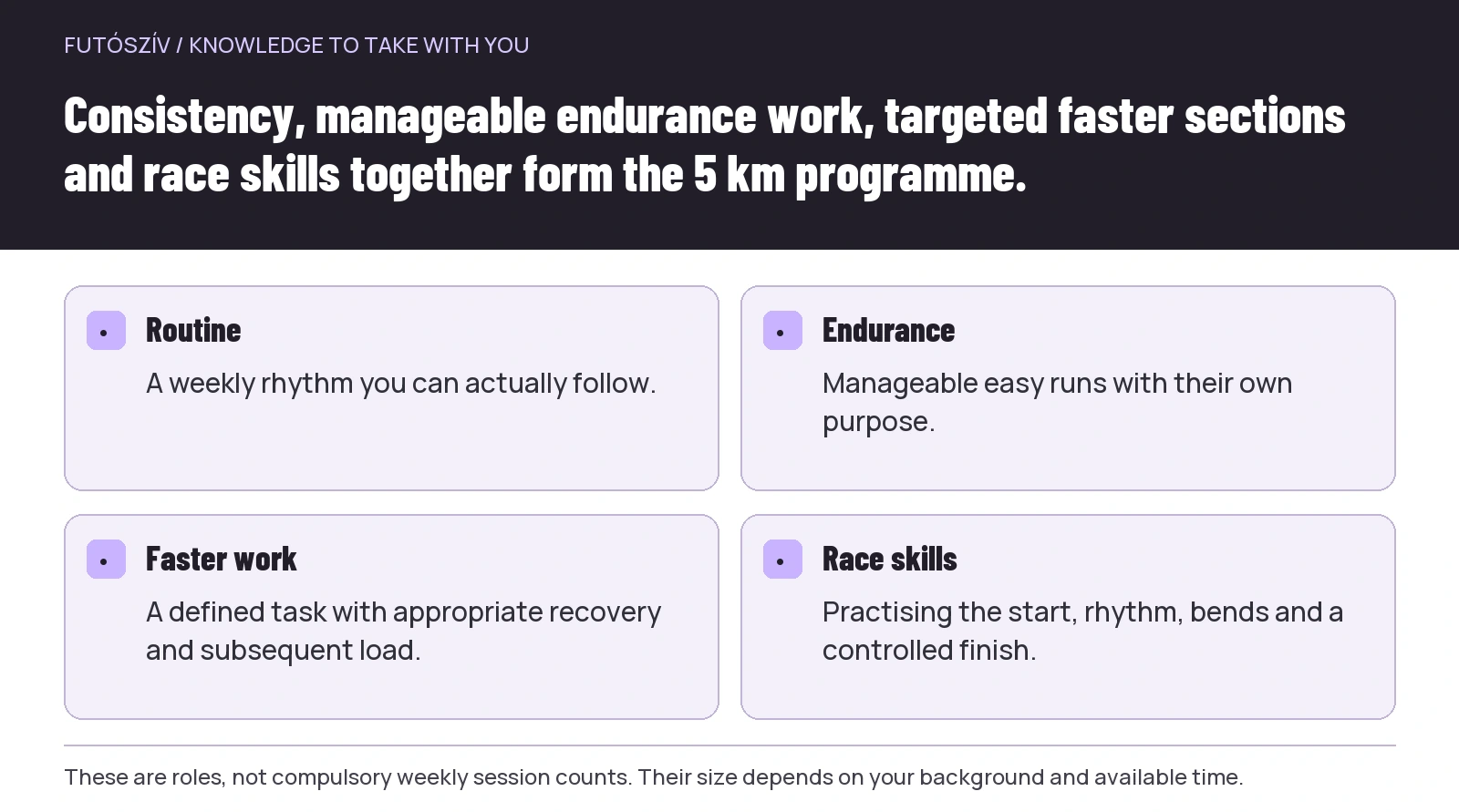 Enlarge diagram
Text version of the illustration
- Routine
- A weekly rhythm you can actually follow.
- Endurance
- Manageable easy runs with their own purpose.
- Faster work
- A defined task with appropriate recovery and subsequent load.
- Race skills
- Practising the start, rhythm, bends and a controlled finish.
Faster training should not become a five-kilometre race every week
Targeted faster work may be divided into sections or an appropriately planned continuous effort. Chosen speed, repetition length and recovery together form the workout. Calling it a “fast day” alone does not explain what you want to achieve.
You need not stage a full five-kilometre time trial every session. Such a test creates real load and, with an important result expectation, a racing situation too. Training and assessment can have separate roles in preparation.
Do not automatically seek complete exhaustion at the end of faster sections. Controlled execution and effects on the following days matter more than having absolutely nothing left in the final metre. The week should remain manageable after the fast workout too.
Intensity can be prescribed in different ways
A five-week study with twenty-two male recreational runners based training on two different track-measurable indicators. Five-kilometre performance improved in both programmes, with no clear between-group difference in the main variables. The research does not establish a single compulsory method for everyone.
When planning independently, current race experience, effort and the task’s purpose can offer guidance. More detailed assessment or coaching may help when the programme becomes complex, or when you cannot understand why prescribed paces do not fit your experience.
The key is consistent interpretation. Judging each session’s difficulty by a different measure can easily create contradictory expectations. Alongside the selected pace, describe the intended execution.
Structure the week before collecting workouts
Do not put favourite fast sessions into the calendar first and then squeeze everything else around them. Begin with available days, demanding work or family periods and your existing running routine. Then choose the week’s main training task.
If only a few sessions fit, each need not carry a separate physiological objective. A simple programme can still be deliberate. More available time does not oblige you to fill every free day with running or add fast sections to the end of every easy run.
Make rest and other sports visible too. An intense group workout or substantial strength session influences where a running task fits. A five-kilometre goal does not make total weekly load irrelevant.
How big should the longer run be?
You need not copy a marathon long run when preparing for five kilometres. Fit the longer session to your background and weekly system. What is familiar easy work for an experienced person may be someone else’s hardest task of the week.
Give the longer run a defined role, such as manageable continuous movement at familiar easy effort. If race pace always appears at the end, it is a different workout. Do not hide that change behind the word “base-building”.
Evaluate after-effects too. If the rest of the week’s running repeatedly revolves around fatigue from the longer outing, its size or placement may not fit. Completing one distance target does not determine the quality of the whole programme.
Strength training can complement running, but requires learning
A study with twenty-eight young, well-trained male runners found improvements in several performance measures and five-kilometre time alongside endurance training using different strength approaches. The specific programme is not a home exercise list for beginners and does not justify immediately adding heavy weights or jumping loads.
If strength training is new, first learn appropriate execution and a manageable amount, with knowledgeable help if needed. The aim is not to immediately add another sport’s entire demanding programme alongside running.
Fit complementary sessions around important runs too. If you regularly begin the main running session with unusual muscle fatigue, an adjustment may be needed. Evaluate strength training’s benefit within the whole system rather than solely through post-workout tiredness.
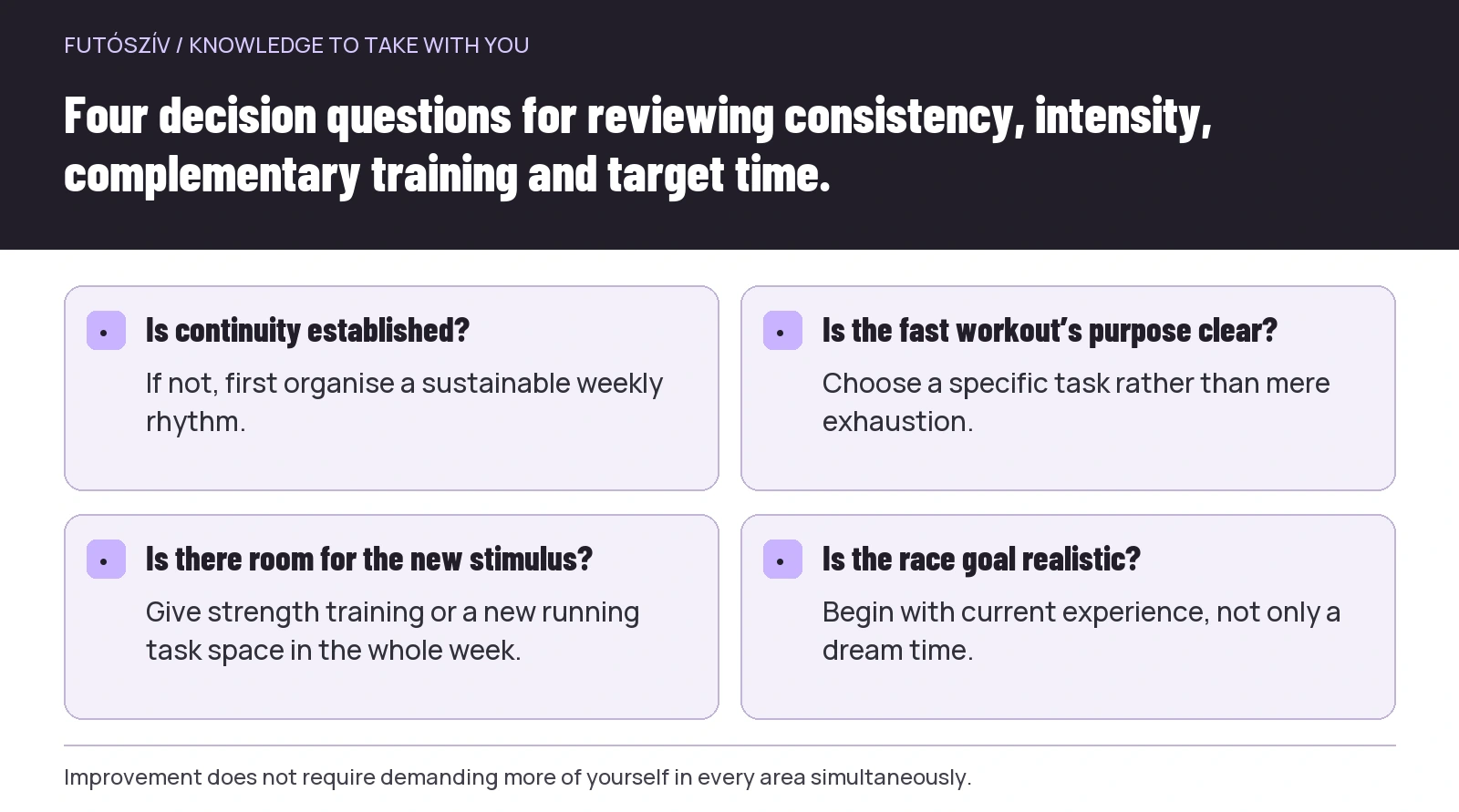 Enlarge diagram
Text version of the illustration
- Is continuity established?
- If not, first organise a sustainable weekly rhythm.
- Is the fast workout’s purpose clear?
- Choose a specific task rather than mere exhaustion.
- Is there room for the new stimulus?
- Give strength training or a new running task space in the whole week.
- Is the race goal realistic?
- Begin with current experience, not only a dream time.
Do not treat daily condition as an inconvenient exception
A study of thirty-six male recreational runners compared individual adjustments based on self-reported stress or heart-rate variability with a predetermined programme. The short training study suggests that adapting to condition can offer useful information; it does not instruct unconditional obedience to a consumer readiness score.
Observe unusual fatigue, sleep, general well-being and how running feels. Not every harder day indicates a problem, but neither must every signal be dismissed as insufficient willpower. Adjustment can mean a shorter task, easier running or rest.
For persistent or concerning symptoms, do not diagnose through training-theory guesswork. Appropriate healthcare help may be needed. A race goal does not override assessing your current condition.
Learn race pace rather than constantly testing it
When practising target pace, observe how you settle into it, hold it and how much checking it needs. On a known section, connecting a split with your own sensations may help. You need not watch the display at every moment.
Hitting target pace over short sections is important experience, but not an automatic race prediction. Work interrupted by recovery and a continuous distance are different situations. Keep the positive training experience without assigning it greater certainty than it actually provides.
The race course’s character matters too. If it is winding, hilly or crowded, think through managing these alongside rhythm. A faster displayed pace is not necessarily better preparation if practical tasks remain disorganised.
Have a simple plan on race day
Know where and when to arrive, which pre-start movement is familiar and how to reach the starting area. Last-minute rushing can easily override a carefully chosen opening. A five-kilometre race being short does not remove logistics’ importance.
After starting, do not infer your own rhythm from other people’s initial acceleration. Focus on your chosen task and adapt later changes to the current situation. The display need not show precisely the same pace at every metre, particularly across differing course sections.
If you feel unwell or develop concerning symptoms, safely stopping and appropriate assistance take priority over the race plan. Few kilometres remaining do not make every symptom ignorable.
How should you evaluate the result?
Alongside finishing time, record pacing, conditions and the main execution lesson. A windy or hilly run’s time is not directly equivalent to a calm, flat race. Do not judge the whole preparation from one start.
Look for recurring patterns: starting too fast, rhythm that works well, an uncertain bend or easy runs repeatedly missed during preparation. One concrete adjustment for the next period offers more than a general resolution to do more of everything.
Five kilometres can remain an independent, varied long-term goal. You need not immediately move to a longer distance after every success. Preparation’s value lies in bringing endurance, speed and your own running experience together within a sensible system you can follow.
Primary research
- Anaerobic work capacity’s contribution to 5-km-race performance in female runners – associations in a small sample, not a training prescription.
- Peak Running Velocity vs. Critical Speed – comparison of two methods for prescribing training.
- Complex and heavy-resistance strength training in young, trained male runners – a specific supervised programme.
- Individually guided training and stress feedback in recreational runners – a short study in a defined group.
How Futószív articles are prepared: our editorial guidelines.