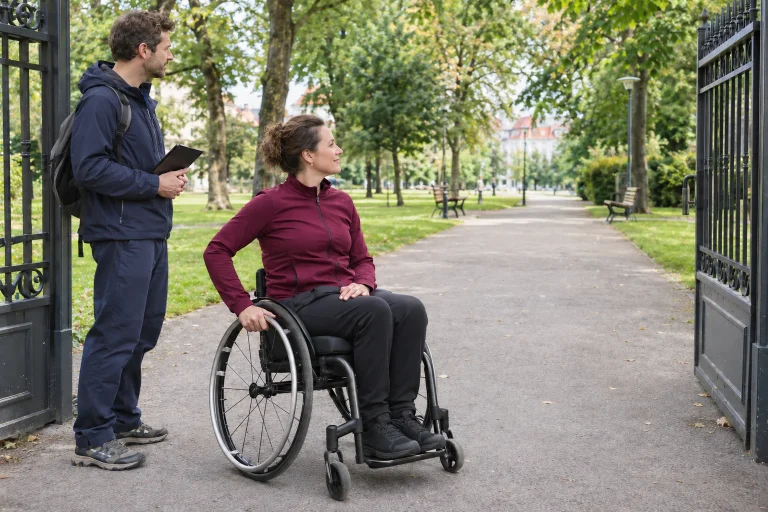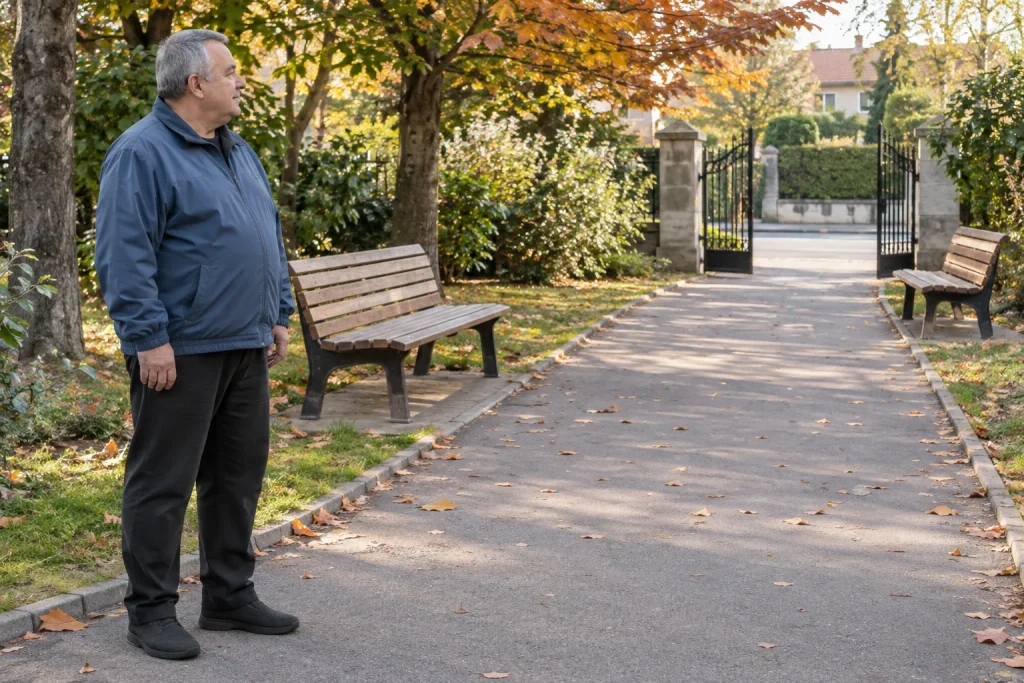
You may want to restart in a park advertised as pleasant, yet travel, reaching the entrance and finding a suitable place already involve considerable time on your feet. You are tired before the planned movement begins. Motivation is not necessarily the problem. Organise the occasion around the whole route, from your front door until returning home, rather than only the middle section called sport.
In a larger body, appropriate seating, a usable surface and a return route that does not force prolonged movement despite symptoms may be especially important. These are practical access needs. You need not first achieve a certain fitness or smaller clothing size to seek a usable environment. The first location’s task is to create conditions for an achievable occasion, rather than test your performance.
If remaining on your feet has newly become noticeably difficult, or pain, dizziness, unusual breathlessness or leg swelling occurs, do not explain it solely through location or body weight. Medical assessment may also be needed. Unexplained one-sided, sudden or painful swelling is urgent; accompanying breathlessness or chest symptoms requires immediate help. The NHS page on leg swelling explains why another walk is not the way to test whether it improves.
Mapping the whole occasion tells more than distance to the park
List journey sections: home to vehicle, travel, stop or car park to activity location, time there and the return. A park close on a map may involve a long underpass, distant entrance or waiting. Even a short drive does not guarantee nearby parking. A place can be comfortable when the whole chain works, rather than only looking beautiful at the destination.
You need not turn every minute into training load. For organisation, simply notice which section is uncertain or tiring. A promenade full of benches may be usable, for example, while the way to the bus stop offers nowhere to sit. Another entrance or transport option can change this substantially. The solution may be organisational adjustment, rather than only trying to stand longer next time.
The NIDDK information on movement in a larger body also discusses accessible, safe places and appropriate equipment. For your own location choice, translate this into questions about available help, being able to stop calmly and whether the area is genuinely usable with your needs. The park’s official name answers none of these alone.
Seek a route you can shorten, rather than a compulsory full loop
A marked loop is appealing because it is easy to remember and measure. Its drawback may be having to return from the farthest point. If stopping is often necessary, a short section near the entrance with an easy turnaround may initially help more. You need not reach the loop’s end for movement to count, and its signposted distance is not your personal minimum.
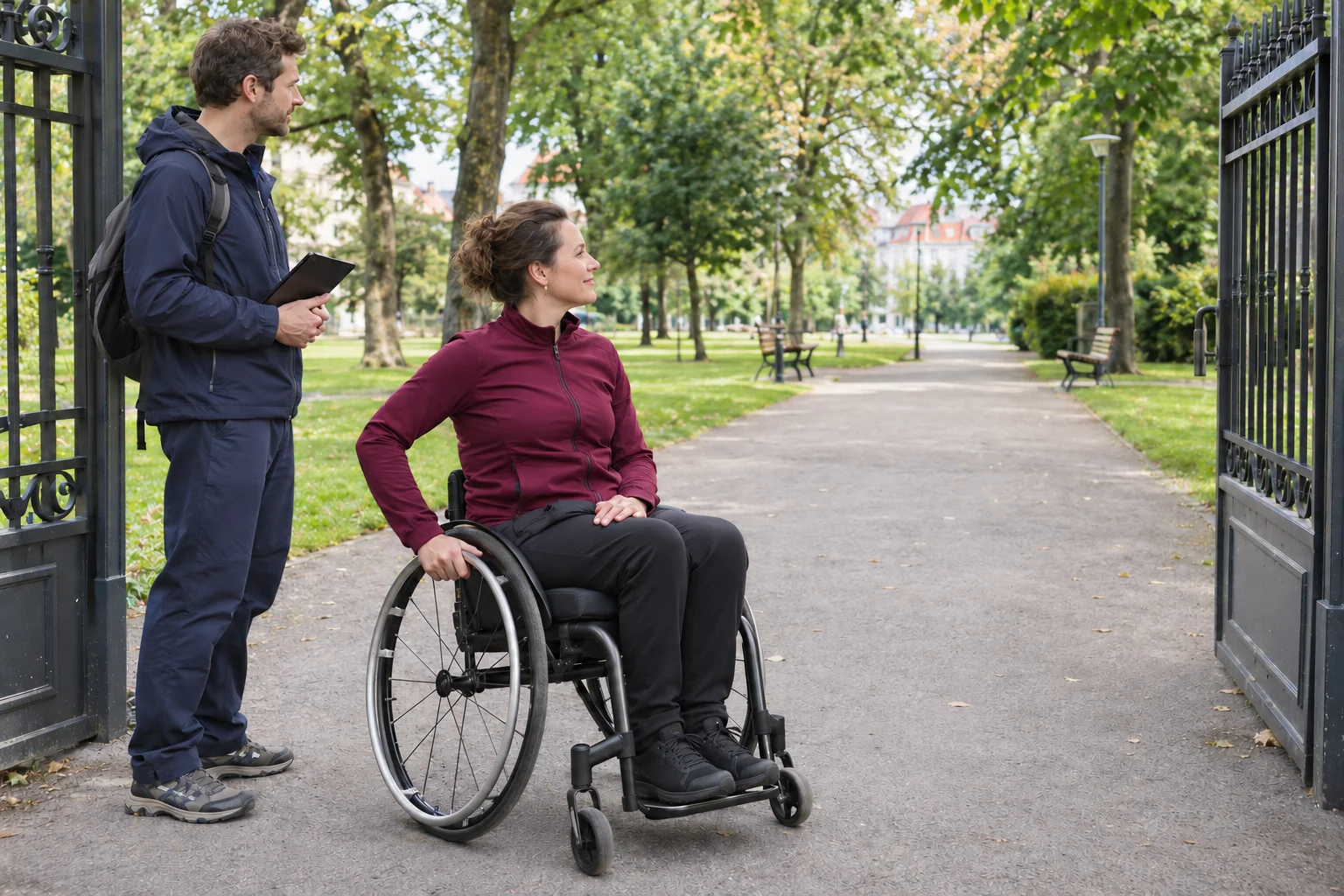
The turnaround should be more than a theoretical point. Can you fit comfortably, avoid turning in a busy cycle lane and find a clear, orderly stopping area? A narrow bridge or long fenced route without exits may be hard to shorten. A small gate shown on a map may be locked; check current access with the operator or through unhurried familiarisation of your own.
Instead of the planned movement, the first occasion may aim to locate the entrance and nearby seating. You need not establish your longest achievable distance along the way. Seeking a maximum and discovering a usable place are different tasks. If familiarisation itself would require much walking, request a precise description beforehand or a companion to help clarify questions.
 Enlarge image
A bench is suitable when you can actually use it
A bench marked on a map does not reveal seat height, dimensions or condition. Check whether you can sit comfortably and rise using your usual support. A narrow seat divided in the middle differs from a wider surface. Deep, soft or very low seating may also be unsuitable despite initially looking comfortable.
You need not use an unstable, damaged or hard-to-access bench. Ask the operator about uncertain load capacity; appearance cannot establish a reliable number. For your own folding seat, check that product’s intended use and user conditions too. Portability does not override difficulty carrying or setting it up for you.
Examine the few steps to the seat too. A muddy ditch, high kerb or steep grass in front can obstruct access despite a suitable-looking bench. Room for your bag and passing people matters too. Complete access makes a stopping place usable, rather than merely appearing on the park’s equipment list.
Surface, crowds and weather: the same place can work differently
An even route with clear visibility may be more predictable than a narrow root-filled path. This is not a general medical ranking of surfaces: examine actual condition and your movement. Wet leaves can cover asphalt, while displaced elements may interrupt apparently smooth paving. A good experience weeks earlier does not guarantee unchanged circumstances.
A quiet morning park may become a busy travel route in the afternoon. Ask or observe when many people run, cycle or walk dogs there. The aim is not isolation from everyone else, but more predictable traffic may help organise a first occasion. Choose stopping points that avoid sudden sideways steps among passing people.
Check lighting, shade and expected weather for your own time slot. Even a short planned occasion can change if the place is too slippery, hot or difficult to see through. You need not persist with an outdoor location solely for an earlier resolution. An already agreed indoor option or rescheduling may serve the routine better than struggling against circumstances.
Toilets and waiting also belong to access
If a toilet matters, do not settle for knowing the park has one. Where is it, when is it open, how far from the activity area, and does it require entry or a separate fee? A map may still mark a seasonally closed building. Check current availability through the operator, rather than an old review.
Waiting easily becomes hidden time on your feet. A toilet queue, delayed bus, payment queue or waiting for a companion can add to the occasion. Consider where you could sit and what to do if no seat is free. You need not carry equipment for every possibility, but have a simple backup for the situation most important to you.
Usability of public toilets or changing rooms may be a more personal detail. You need not justify it to the whole group. Ask the organiser or staff matter-of-factly about access, space and seating. Obtaining needed information is part of planning; wanting an available service to work in practice is not fussiness.
Do not seek rest only after using your last reserves
Stopping can be planned into the occasion. You need not wait until reaching the next bench is already very difficult. If short sections and breaks belong in your plan, choose a suitable place and explain arrangements to your companion. Rest is not a race penalty, so you need not explain your watch or the group’s pace in embarrassment.
The WHO’s current overview states that any appropriate physical activity counts; there is no compulsory ten-minute minimum bout for everyone. This does not mean moving regardless of symptoms. The point is that a shorter, individually appropriate occasion need not be considered worthless because it was not a long continuous period.
If unusual dizziness or pain appears after a break, do not automatically restart because planned rest time has elapsed. A schedule does not override current symptoms. A location helps when it allows changing or finishing the occasion, rather than forcing further travel because the start is far away.
 Enlarge image
The larger park is not always better among two nearby places
Imagine an impressive park with a large loop, a long approach from the bus stop, benches on the far side and toilets open only at weekends. It may be excellent for another occasion, but contains many uncertainties for the current first trial. Beautiful photographs and easily measured loop length do not solve these access questions.
A smaller, less striking promenade may instead have a nearby stop, several usable seats and an easy turnaround. It may fit a short, calm occasion better. You need not worry that your aim is too modest. Suitability depends on supporting your movement and journey home, rather than the park’s prestige.
These examples do not rate actual parks; they illustrate a comparison method. Make a similar short list for two local possibilities. Do not assign a health score: mark what is verified, uncertain and essential for you. One important unresolved barrier may outweigh five pleasant but less essential features.
After the first occasion, assess the place as well as yourself
Once home, note in a few sentences what worked: was the entrance easy to reach, did the bench remain usable and was the return predictable? Separately describe bodily experiences and organisational difficulties. If waiting for the bus tired you, the planned walk was not necessarily too long. If a new symptom appeared during movement, however, a good park does not make it unimportant.
The NIDDK material on getting started recommends identifying personal barriers and planning support. For location choice, this may lead to concrete changes: another entrance, time, arrival with a companion or shorter local section. General advice need not become mechanical adherence to the page’s older duration examples.
A usable location can also simplify organising the next occasion. Know when to recheck, such as after construction, winter closures or timetable changes. A familiar environment and flexible plan together help prevent every departure becoming a new logistical challenge. Success here means being able to decide about movement, stopping and returning home under your own conditions.
Sources
- NIDDK: Staying Active at Any Size
- NIDDK: Tips for Starting Physical Activity
- WHO: Physical activity
- NHS: Swollen ankles, feet and legs
How Futószív articles are prepared: our editorial guidelines.