
Your friend enters a marathon, everyone in the group shares a new challenge, and the app is already displaying its next suggestion. It is easy to feel that you must choose the same thing for your running to move forward. Yet finding your own rhythm does not necessarily mean pursuing the same goal at a later date. It may mean another distance, a different way of running with others, or a period when regularly available activity matters more than a race.
This article is a planning guide for male runners, but it does not tie any particular motivation to gender. It does not prescribe a personal number of sessions or training load, or provide medical clearance. Its purpose is to clarify how to choose your own project, what information to take from others and when to reconsider the organisational framework. All the weeks and people described are fictional examples.
First ask what attracts you to the other person’s goal
Your friend’s half marathon may appeal to you not because of the twenty-one kilometres themselves, but because of the shared trip, the planned weekend or the atmosphere of their account afterwards. Recognising this opens up several choices of your own. You might choose another distance at the same event, a separate social activity or a later goal that fits your available time. These are possibilities to investigate, not options guaranteed at every event.
Write down exactly which detail appealed to you: discovering a new location, having a clear deadline, preparing with others or achieving a sporting result. ‘I ought to do this too’ then becomes a specific wish. You can compare that with your own circumstances. You do not need to adopt the entire project to learn from a good idea.
Even in a group of men, you do not have to scale your own goal to match someone else’s ambition. You can acknowledge a challenge that matters to your friend without entering alongside them. ‘I am glad you chose this; I am putting together a different programme right now’ is a complete response. Shared interests need not be expressed only through matching race numbers.
Describe your situation before choosing a goal
How much time do you actually have, and how much of it can you plan in advance? Which routes and group activities are available? Which other commitments matter during the same period? These are not excuses against enthusiasm, but starting information for your own project. A plan is useful when you can recognise it within your real week.
UK Coaching’s goal-setting flowchart separates preparation, setting a goal, planning and follow-up. The document also gives a role to the environment and the participant’s needs. We use that distinction between stages here: choosing the goal need not come before identifying the basic circumstances. UK Coaching: The Goal Setting Process
Your own situation statement might be: ‘My work schedule will vary over the next six weeks, but I know two nearby routes well. I would like to arrange time for sport in advance each week, with a group outing when my shifts allow.’ This is not yet a training plan and does not guarantee a sporting result. It does, however, provide an organisational framework you can build on with appropriate professional help or a familiar programme of your own.
 Enlarge diagram
Text version of the illustration
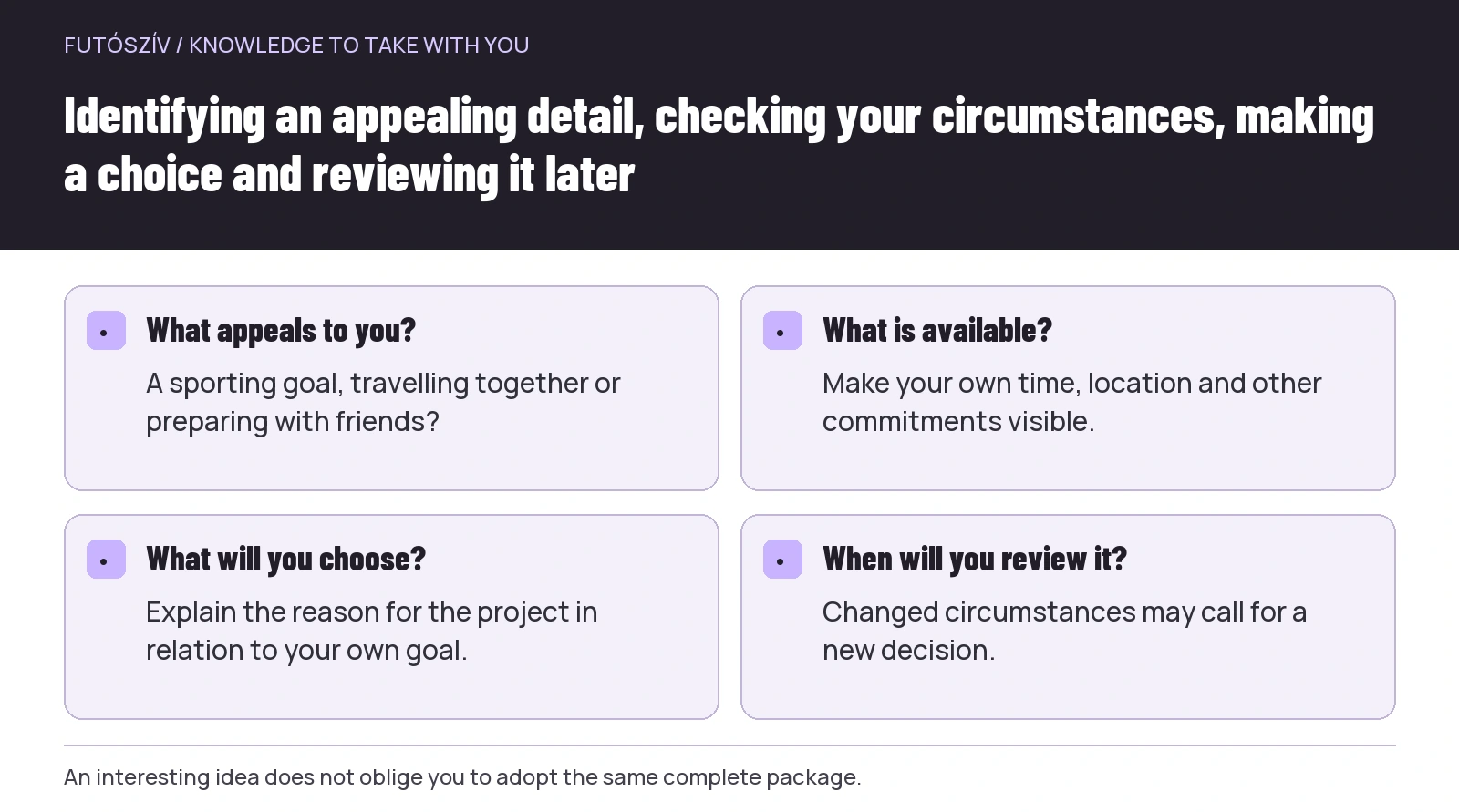
- What appeals to you?
- A sporting goal, travelling together or preparing with friends?
- What is available?
- Make your own time, location and other commitments visible.
- What will you choose?
- Explain the reason for the project in relation to your own goal.
- When will you review it?
- Changed circumstances may call for a new decision.
Analyse the whole package instead of copying it
You usually see the most striking part of someone else’s plan: the race, the route or an image from their app. Their sporting background, available time, support and series of adjustments are less visible. Copying just the weekly schedule does not give you those underlying conditions as well. The same task therefore does not mean the same situation.
| An idea you can borrow | What to check separately in your own situation |
|---|---|
| A meeting time that works well | Can you manage it too, including travel and preparation? |
| An interesting race | Does it fit your own goal and participation requirements? |
| An organisational solution for a route | Do you know the local access arrangements and ways to get back? |
| An idea for structuring a training plan | Does that professional plan actually apply to you? |
| A shared result | Which event and circumstances produced it? |
If your friend is happy to talk, ask about specific organisational experiences. What was difficult about scheduling, which information needed separate checking, and what would they change next time? This may offer more than a screenshot of a successful week. Their personal experience still does not become a universal training prescription.
Have your own reason for your own goal
You do not need a solemn mission statement, but a sentence or two helps distinguish a choice from simply going along with things. ‘I would like to discover places to run nearby.’ ‘I am preparing for a particular race with suitable help.’ ‘Right now, I want to bring shared time outdoors back into my week.’ These are different goals and may require different arrangements.
The explanation need not serve as a defence in front of the group. It helps you choose between conflicting invitations or another tempting race entry. If your aim is a regular local routine, a distant weekend may be interesting without needing to shape the whole period around it. If your chosen event matters, however, you may need to arrange some group activities differently in advance.
It is also acceptable to say you are still finding out what interests you. Your next step may then be gathering information or agreeing to a familiar group outing, rather than embarking on a long project. Do not try to remove uncertainty by entering something bigger. A deadline does not become your own goal simply because you have written it in your calendar.
Do not try to make every goal the top priority at once
Getting faster, choosing a new distance, discovering more places and attending every group outing can each be appealing. If all take priority during the same period, the arrangements soon become contradictory. You do not need to give everything up for good. Simply state the main direction for now and what will remain a possibility for later.
Bringing training demands together may require appropriate professional support. On the organisational side, you can make some clear decisions yourself: which event determines the travel arrangements, which group invitation is optional, and when you will review the period again. An option explicitly described as secondary creates less pressure than a whole list that has silently become compulsory.
A fictional example: someone wants to find a community in a new city while their friends are preparing for a distant relay. Local outings become their primary project for now, and they will join the relay only if, once its conditions are clear, it genuinely fits. They need not promise an immediate decision to remain an interested friend.
Setting up a digital plan also starts with your own information
A programme displayed in an app can easily look like a ready-made solution. Yet the goal, date and starting information you entered matter, as does what the service promises to do. A task on your friend’s screen does not necessarily mean the same thing in your account. Check compatibility and the service’s current operation in the official help for your own device.
Garmin’s manufacturer announcement of 19 September 2024, for example, presented Garmin Run Coach as a plan responding to the user’s data. We use that announcement to illustrate why personal inputs matter, not to list all devices and features available today. A manufacturer’s description alone is not medical approval or a guarantee of results. Garmin: Garmin Coach announcement, 2024
If you receive a digital suggestion whose meaning or suitability for your situation you do not understand, do not automatically copy your friend’s settings. First check your own inputs and the type of programme, then seek appropriate help if necessary. The technical system is a planning tool; your circumstances do not disappear simply because a schedule has already been produced.
 Enlarge diagram
Text version of the illustration
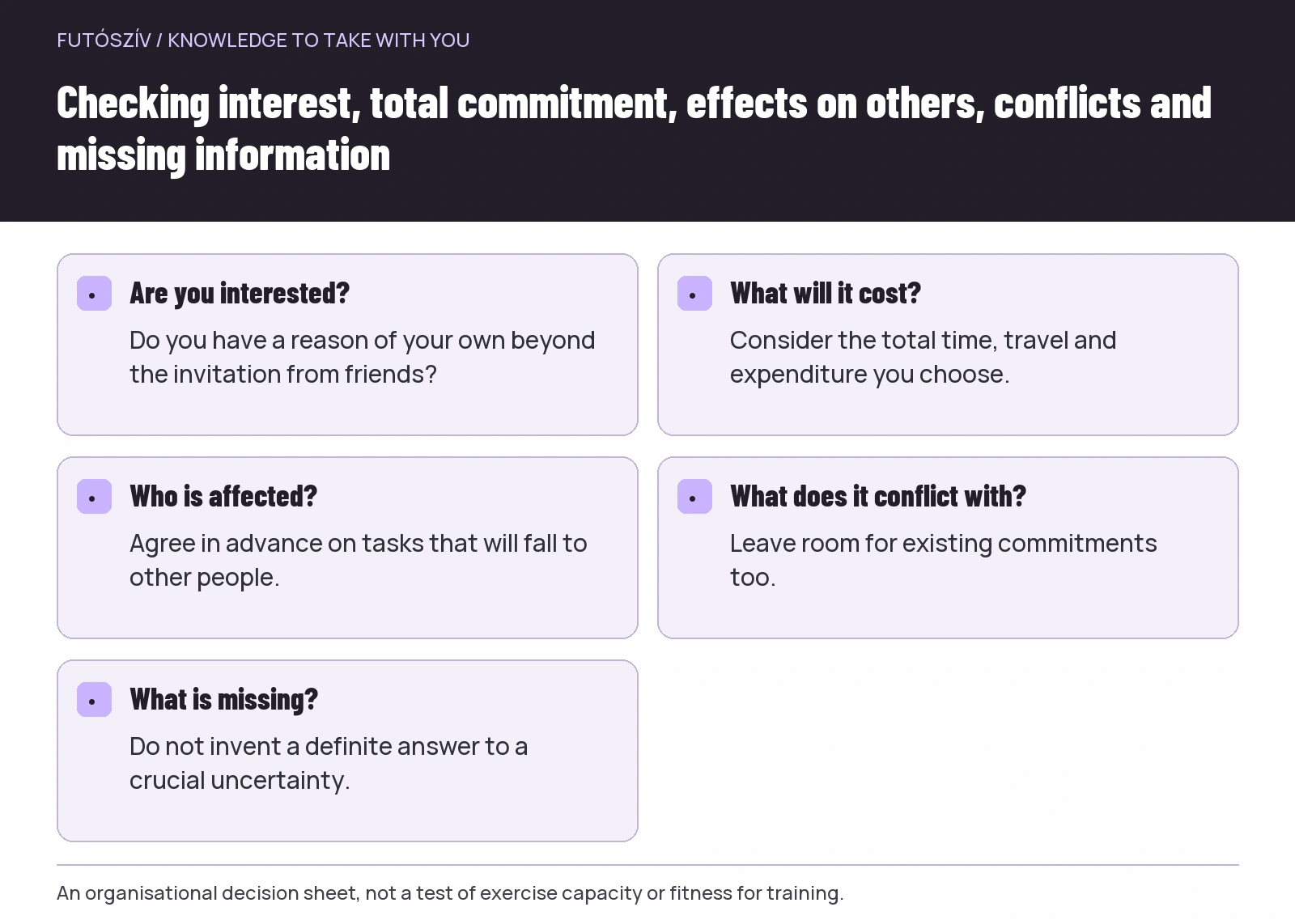
- Are you interested?
- Do you have a reason of your own beyond the invitation from friends?
- What will it cost?
- Consider the total time, travel and expenditure you choose.
- Who is affected?
- Agree in advance on tasks that will fall to other people.
- What does it conflict with?
- Leave room for existing commitments too.
- What is missing?
- Do not invent a definite answer to a crucial uncertainty.
Make a short decision sheet before accepting a new invitation
Before a new race or group project, write down a few questions: are you genuinely interested; what is the total time and financial commitment; who else is affected; which current commitment does it conflict with; what information is missing for the decision? Every small meet-up need not become paperwork. For larger commitments affecting others, however, this pause can be useful.
‘My friends are going’ can be an important reason, but it should not be the only known fact. If the social side appeals, ask whether there is another way to join in. Travelling together while following a separate programme, meeting after the finish or arranging a run on another day may be possible if they can actually be organised. The organiser’s specific conditions must be checked separately for each participant.
Leave room on the decision sheet for postponing a decision too. ‘I am not deciding yet because these two essential pieces of information are still missing’ is a precise statement. You must still watch the deadline: if registration closes before a necessary condition can be clarified, that is a real limitation too. Filling uncertainty with imagined definite answers is not helpful.
Your rhythm can change without your having ruined it
A change at work, a move or a new family responsibility can alter the previous framework. You do not necessarily have to squeeze the same goal into an even tighter schedule. First identify which basic condition changed: available time, the route, support from others or interest in the project. Different questions call for different solutions.
Keep an organisational review specific. If you get home later from a new workplace, perhaps the meeting time has become inaccessible, rather than your interest in running having disappeared. If an event no longer appeals, you do not need to look solely for a logistical excuse. You can state a change to your own goal too: ‘I do not want to continue this right now; I am choosing a different direction.’
Substantial changes to a sporting programme need coordinating within an appropriate professional framework, particularly when it is already part of targeted preparation. This article does not recommend cramming in missed tasks or arbitrarily adding new training loads. Finding your own rhythm here means adapting a chosen project’s organisational and social conditions to your actual situation, rather than setting aside every professional framework.
What can you tell the group when you choose something different?
Briefly explain the decision and how you would like to stay involved. ‘I am not entering for the long weekend this time, but I would happily join the local group loop.’ ‘I have my own programme for the coming period, but I would love to hear about your race.’ These statements tell others what to expect. You do not need to justify your choice by belittling someone else’s goal.
If someone tries to persuade you, you can repeat your commitment: ‘I understand that doing it together would be nice; this is the arrangement I am choosing now.’ You do not need to disclose another personal detail in response to every new argument. At the same time, resolve shared organisational tasks connected with your decision promptly: do not leave a booking uncertain or a team place waiting for you once you know you will not take it.
You can nurture a friendship through other specific activities too. Meeting need not always revolve around the biggest shared goal. A shorter occasion agreed in advance or a conversation unrelated to running can also provide time together. Your own rhythm remains yours when both yes and no can be understandable choices within it.
Do not turn the review into another leaderboard
At a time chosen beforehand, check whether the framework works. Was getting there and back manageable? Did the group outing offer what you chose it for? Did any organisational obstacle keep disrupting the plan? Assess the outcome against your own goal and actual circumstances, rather than your friend’s different project.
The next decision may be to continue, simplify, seek further professional input or choose another goal. Not every review needs to produce a longer distance or another race entry. Your own running rhythm is not a staircase assembled from social expectations. It is a chosen framework in which you know why you are setting out, what you have committed to and when you want to reconsider it.
How Futószív articles are prepared: our editorial guidelines.