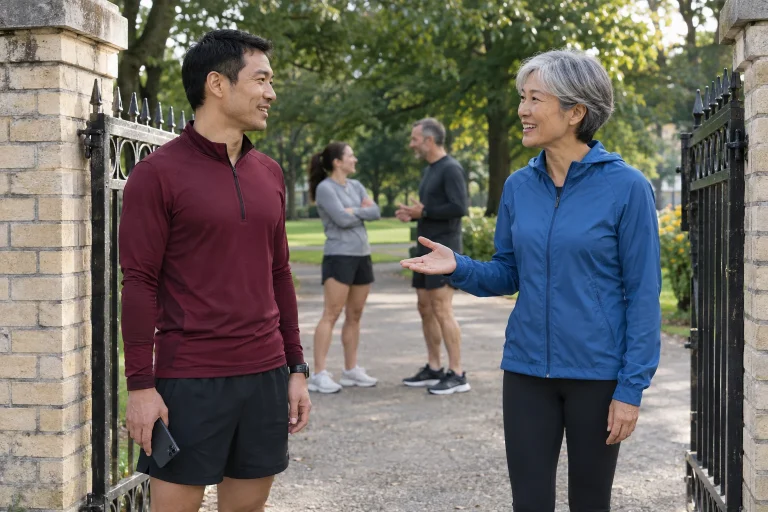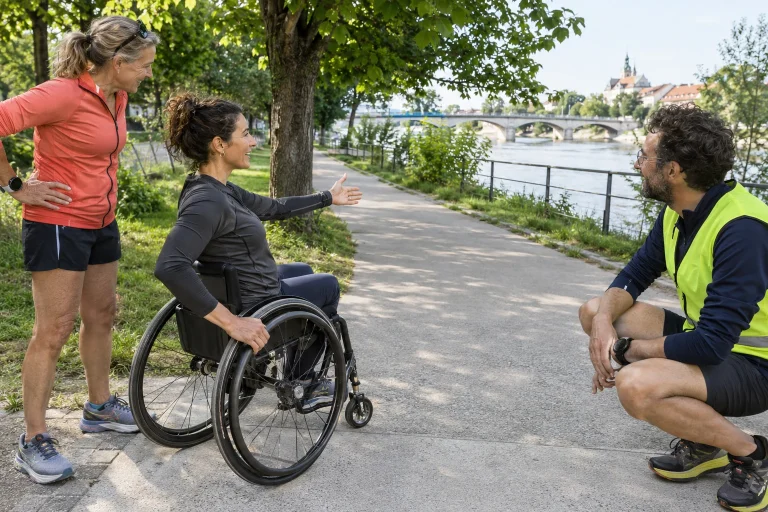
A familiar face, greeting and known meeting point can give shared exercise a distinctive place in your week. You may mean not close friendship, but the sense that this place and some people are no longer strangers. An attendance list reveals, at most, that you appeared. How you experience belonging is a different question.
Research on parkrun participants makes linking recorded attendance with personal reports particularly interesting. Community sport consists of more than sessions, while belonging cannot replace observing actual participation. Seeing them separately lets us discuss more precisely what research shows and what a recurring shared activity may mean to you.
Familiarity can have several degrees
You need not know everyone by name for a place to feel more welcoming. You may recognise people waiting at the start, know where to ask questions or simply understand the meeting’s arrangements. These are everyday details, rather than components of one required community experience. Loose familiarity attracts some, others seek closer connection and others prefer independent presence.
In a fictional example of our own, someone regularly uses the same park route but exchanges only a few brief sentences with others. They still enjoy arriving. Another attends less often but has close friendships within the group. The stories differ, and attendance counts would not fully reveal that difference. Belonging’s personal meaning needs separate listening.
In research, it is therefore important not to infer a relationship solely from an external sign. Similar clothes, a group photograph or moving side by side do not, by themselves, reveal how strongly someone feels part of a group. Visible participation and internally experienced identification offer different perspectives. The distinction matters in everyday discussion as well as science.
What did group identification mean in the study?
Stevens, Rees and Polman’s original study linked questionnaire-based group identification with participation and several experiential variables among 289 parkrun participants. Attendance was examined through objective data; participants reported other factors. Stronger identification was associated with greater participation, exercise-specific satisfaction, cohesion and life satisfaction.
The paper appeared online in 2018 and in the 2019 journal issue. This is an association from a real community setting, rather than an experiment randomly creating stronger identity. Listing different endpoints matters: group relationship, attendance and satisfaction with life as a whole are different things. Their modelled relationship does not turn them into one general happiness measure.
In everyday terms, group identification is more than having your name in a register. It concerns how much you regard the community as your own group. The research concept is not for judging yourself an outsider or suitable member. It is interesting as a question: does connecting with this group have personal meaning, and how does that fit actual arrangements for attending?
What can attendance data tell us, and what not?
Recorded attendance has the advantage of showing more than future intention or recalled frequency. It describes appearances at that event series. It does not become a map of all your exercise, however. You may run elsewhere, choose another sport or fit a different format into a period. Attendance measured at one place must retain the meaning of what it actually describes.
Nor does it directly reveal why you came. Proximity, timing, a friend’s invitation or the programme itself may matter. Positive feelings about a location and accessibility can coexist. More frequent attendance does not establish that someone likes the community more. Other people’s work schedules, travel or family responsibilities may differ.
In our own example, two acquaintances like the shared session equally. One lives nearby; the other has a changing schedule and a long journey. Their attendance may differ without a similar difference in personal attachment. This does not explain the original sample; it illustrates questions an attendance number leaves open. A personal account is therefore useful beside frequency.
 Enlarge image
Community experience and judging an entire life have different scales
Grunseit and colleagues’ original research published in 2017 compared online responses from 865 adult Australian parkrun participants with population norms. Overall personal wellbeing was mostly similar to the population’s, with some more favourable health-related satisfaction findings. There was no general superiority across every life domain, and a one-off survey does not establish participation’s causal effect.
A 2019 correction to the study concerned the description of the sample’s age composition. Older age-group proportions should therefore not be repeated unchecked. Even with the correction considered, questions remain about how well respondents represent all participants and how comparisons with the wider population should be interpreted.
A running session may be a pleasant part of your week while other areas of life are difficult. At another time, you may be satisfied overall but find that activity unattractive. Neither must be inferred from the other. Satisfaction associated with a community concerns a specified activity; judging life as a whole is much broader and involves many personal circumstances.
Grunseit, Richards and Merom’s original study published in 2017 compared online questionnaires from 865 adult Australian parkrun participants with population norms. Several separate domains of personal wellbeing were examined. Participants’ results mostly resembled the population’s; there was no general superiority in every wellbeing dimension. The authors particularly highlighted certain differences in satisfaction with health.
This was a cross-sectional survey, rather than experimental proof of change before and after joining. A 2019 correction to the sample’s age-group composition was also published. We do not reproduce the earlier age proportions here. The lesson is not that membership guarantees happiness, but that samples and selected measures matter when examining community participation and wellbeing.
Four perspectives around a shared activity
The following editorial table is not a psychological test. It shows how different questions can lie behind ‘I feel good in the group’. Perspectives need not be ranked, nor answered identically. You gain more detail about your situation by preventing one number or label from speaking for everything else.
| Perspective | Everyday question | What does it not establish alone? |
|---|---|---|
| Attendance | Did I reach the particular session? | How participation felt. |
| Identification | Do I regard the group as my own community? | That I always have time to attend. |
| Specific experience | What did I like or dislike about the activity? | That every session will feel the same. |
| Broader satisfaction | How do I see several areas of my life? | That one sporting programme caused this. |
Different perspectives may interest you at different times. Orientation and participation arrangements matter first in a new place; social relationships may later gain importance. This is no mandatory development path. Loose connection can remain a chosen long-term form, while closer attachment can change with circumstances. Concepts support understanding, rather than grading membership.
Who responds to a community survey?
Surveying event participants already reaches people who connected with it somehow. Those who never attended or quickly chose another activity may appear in different proportions among respondents. Responding can involve selection too. This does not devalue a survey, but knowing whose experiences it describes and whom we know less about matters.
Comparison with population norms therefore differs from a group identical in every other respect except event attendance. Participants’ circumstances, interests and access may differ. When presenting a study, retain an observed difference as a difference. In your own life, you need not compare yourself with other people’s group average to decide whether you are happy enough in the activity.
When hearing community stories, ask which voices appear. The experience of a mixed-feeling or less-frequent participant is informative alongside that of an enthusiastic regular. You need not organise research in your own community to recognise this. Leaving room for varied answers, rather than listening only for one expected mood, may suffice.
Connection need not be conspicuous
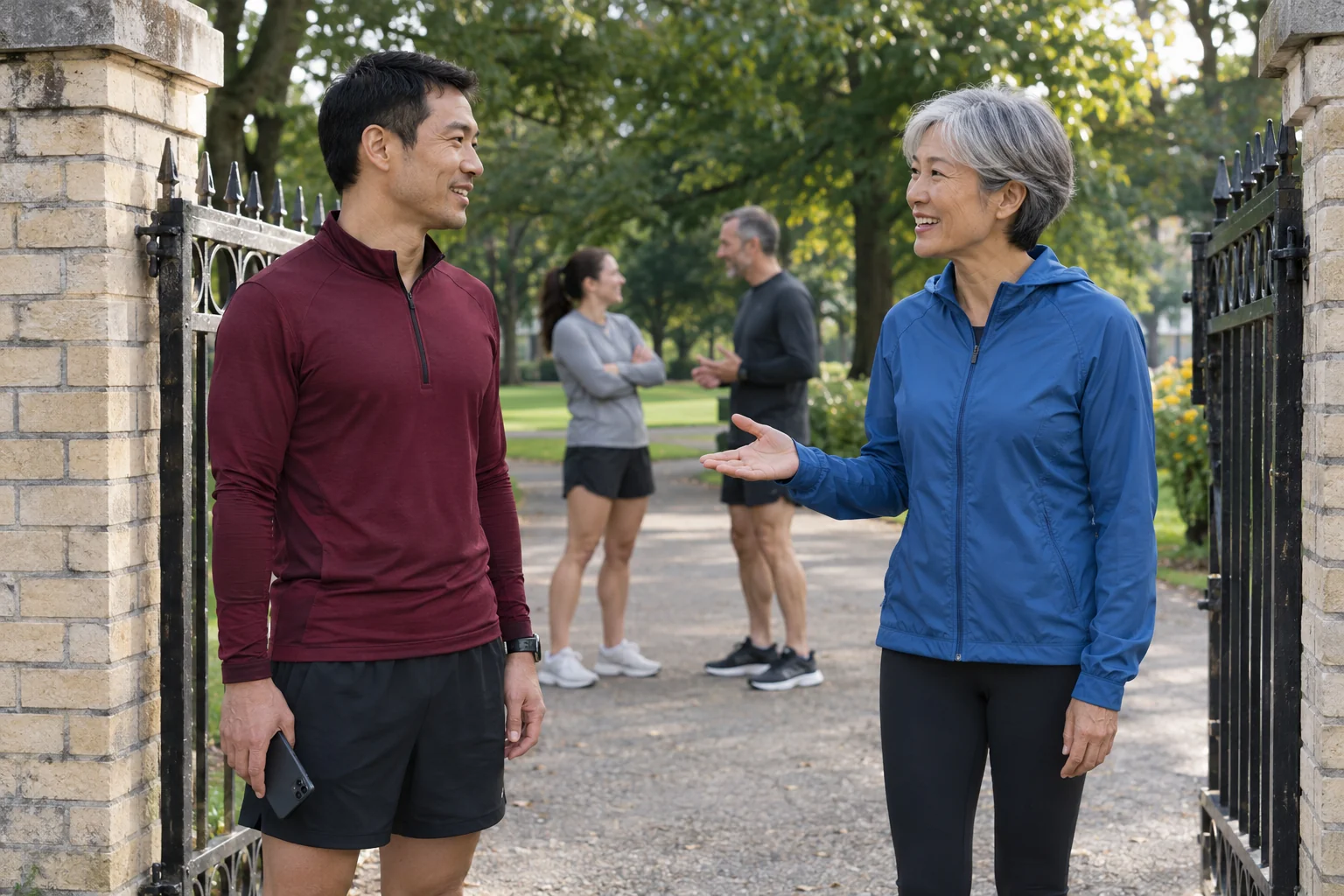
Some enjoy talking in a larger group; a few familiar greetings give others a sense of belonging. From outside, a quieter participant’s attachment to a shared place may be unclear. Belonging need not equal talking volume, group-photo counts or constant enthusiasm. Personal meaning often appears more quietly.
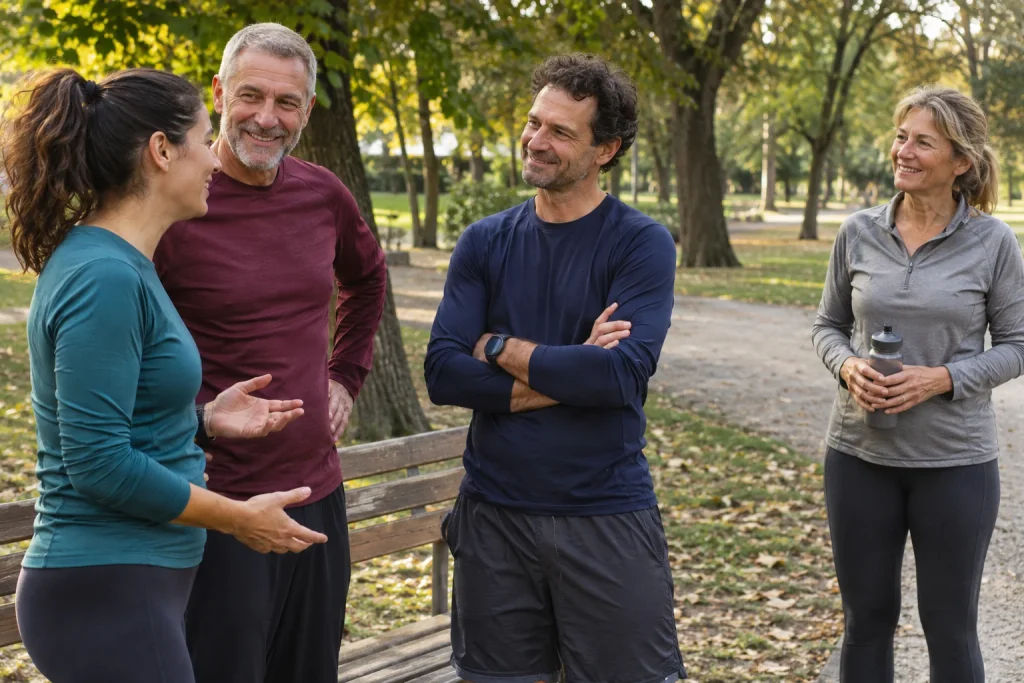
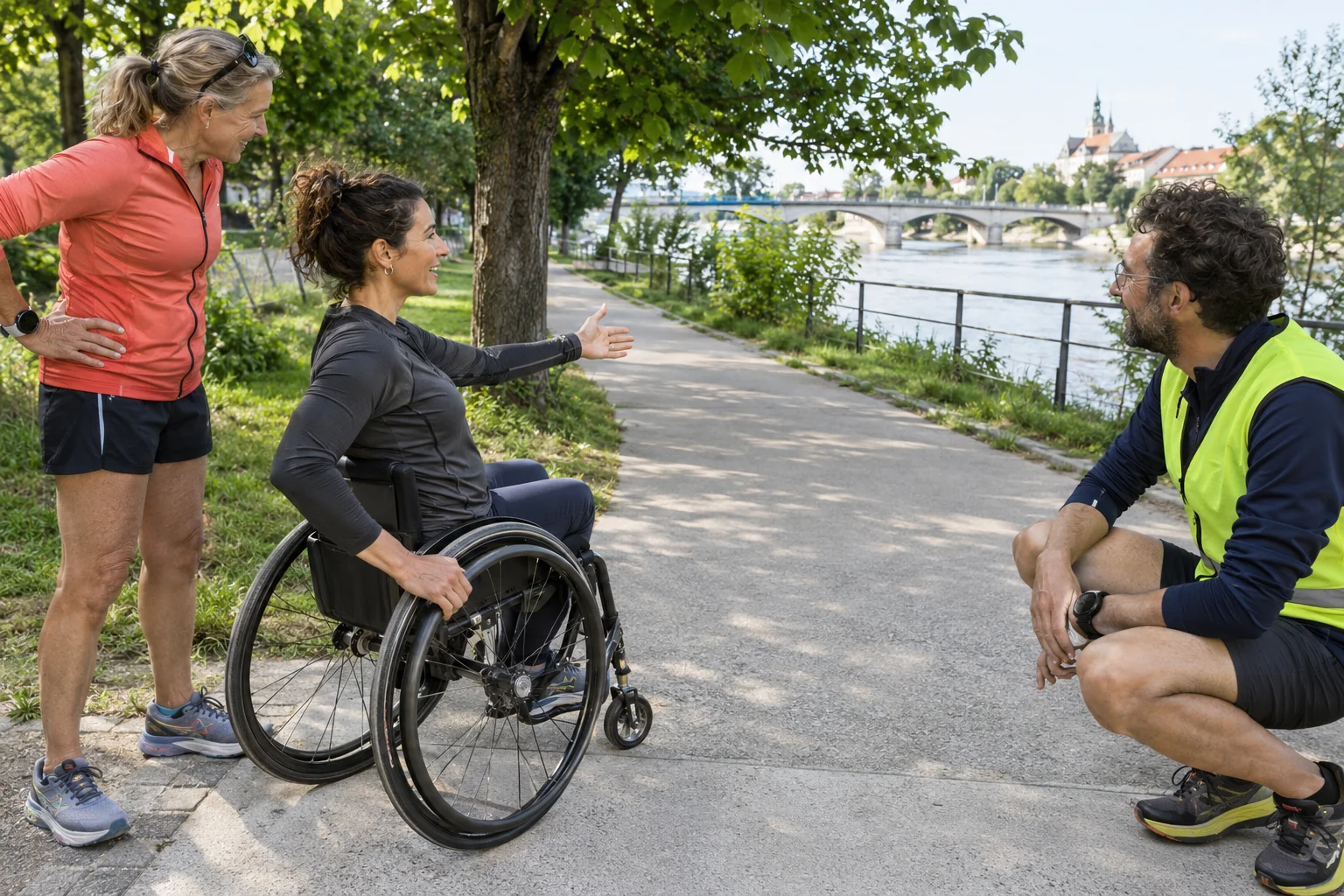
In an imagined park scene of our own, four people talk after the session. One stands slightly farther away, mainly listening and occasionally contributing. This may be precisely what feels comfortable. Acceptance does not require pulling them into the centre. The example does not establish every quiet person’s feelings; it reminds us to ask their preference rather than draw ready-made conclusions from behaviour.
Less frequent attendance is not automatic distancing either. Someone can connect with a community while attending occasionally because of other obligations. A relationship’s value need not become an attendance competition. Research data have their meaning, while personal relationships have their own history. They can be examined together without turning either into a moral judgement of the other.
 Enlarge image
What can you ask about your community experience?
First, what makes the place familiar and attractive: a person, shared arrangements, surroundings or freedom of choice? Second, what makes the occasion genuinely accessible: proximity, convenient timing, compatibility with other tasks? Third, which participation form would you currently choose? These are open questions, rather than a ready-made community scale.
Answers can separate pleasant connection from organisational obstacles. You may like the company but find timing unworkable. An event may be accessible while you want another setting. Not every difficulty is a fault in your openness. Place, framework and how freely you choose attendance can all form part of community experience.
The studies do not imply everyone should run in groups. Independent and shared activities can offer different values without requiring a permanent choice between them. Familiar company may appeal during one period and time alone during another. Your preference does not contradict recurring community events being important to others.
A community’s value can be described precisely
Parkrun research offers an interesting meeting point between actual participation and personal community experience. Records show attendance; questionnaires approach from another side. Examining separate wellbeing domains widens the perspective further. Together, these reveal more than compressing everything into one happiness promise.
You can describe your own activity similarly: you like familiar faces, value meeting and also find timing or the social setting fits differently each week. The relationship’s value does not depend on matching a group average. It can simply mean a place where you enjoy being present by your own choice.
Sources
- Stevens, Rees and Polman: Social identification, exercise participation, and positive exercise experiences, online 2018, journal issue 2019.
- Grunseit, Richards and Merom: Running on a high: parkrun and personal well-being, published in 2017.
- The correction to the Grunseit study’s sample age-group composition, 2019.
- Publisher’s bibliographic correction concerning the actual 2017 publication.
How Futószív articles are prepared: our editorial guidelines.