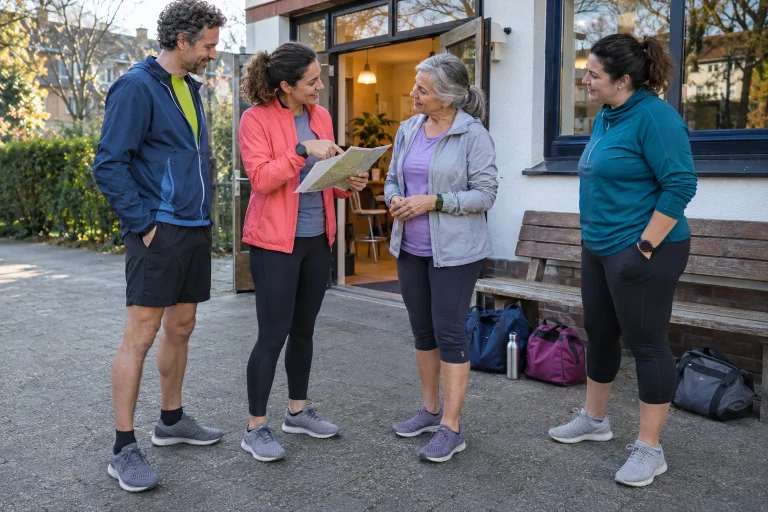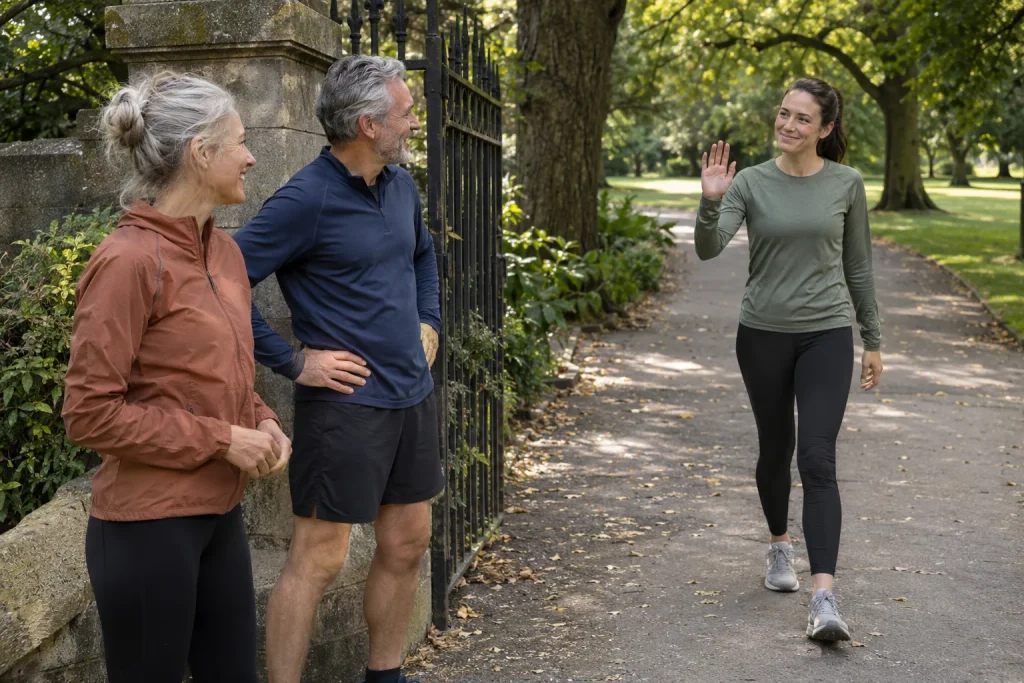
For some, a shared run initially means three strangers at a park entrance. A few meetings later, they recognise a jacket, know who tends to arrive first and have someone to wave to. Friendship has not necessarily formed, yet the situation has changed: a running location has become a meeting point. The social meaning of repetition often appears in small details like these, long before someone calls themselves part of a community.
What does research tell us, and what cannot be read from an attendance list? Questionnaire and interview studies in parkrun settings approach the question from different sides. They help distinguish attendance, familiarity and identity linked to a group. The following considerations support understanding experience; they do not offer a recipe promising belonging after a fixed number of meetings.
Being present and belonging are different information
Participation can be observed from outside: someone attended, completed a route or helped with a task. Belonging has personal meaning. The same event may offer one person social comfort and another a convenient opportunity to move. Neither person’s participation is less valid. The difference matters when we try to infer people’s experiences automatically from attendance counts.
A runner may attend regularly because the venue is close, the time convenient and the course familiar, while barely speaking to others. Someone else attends less often but feels strongly connected to a few acquaintances. These imagined situations show why a trace of activity and a relationship’s meaning are not interchangeable. A record is useful data, but does not tell the personal experience alone.
Group identity adds another layer: the community partly belongs to how someone thinks about themselves. The everyday word ‘we’ may signal this connection, but not every use means deep identification. A label is unnecessary for enjoying a meeting. Leave room for people who are simply glad to move among familiar faces for now.
What did the questionnaire study connect?
Stevens, Rees and Polman analysed 289 parkrun participants. They examined group identification and several aspects of experience through questionnaires, alongside objective attendance data. Stronger identification was associated with more participation, greater exercise-specific satisfaction, group cohesion and life satisfaction. The study presents relationships in a real physical-activity setting.
Association does not establish the direction clearly, however. Connection may support returning, while repeated participation may shape connection; circumstances may influence several variables together. A statistical model does not replace an experiment establishing a cause by changing one component. The finding indicates an interesting relationship, rather than a compulsory path to satisfaction.
For a runner, this can encourage describing experience through several questions. What was being there like? How comfortable was connecting? Why would you like to return? These allow separate answers rather than reducing the experience to occasions recorded in a system. No improvised research scale is needed: a few precise words can say more than one overall rating.
Interviews also show what repetition can mean
In 2022–2023, Dunne and colleagues conducted online semistructured interviews with 39 men aged 45–64 who ran, walked or volunteered at parkrun in Ireland. Participants had differing experience and came from urban and rural settings. The analysis identified an inclusive environment, social ties of differing strength and social engagement changing with participation.
This was not a survey representative of the whole population, and does not prove every running group offers everyone a similar experience. Interviews are strong at showing the meaning of developing connections through participants’ perspectives. Stories alongside numbers can reveal details that attendance data cannot capture.
The two research approaches can therefore complement one another without answering the same question identically. Quantitative associations ask how defined variables occur together. Interviews explore how people experience and interpret connections. Neither must substitute for the other: each shows part of the same social world at a different resolution.
 Enlarge image
A familiar face is not necessarily a close friend
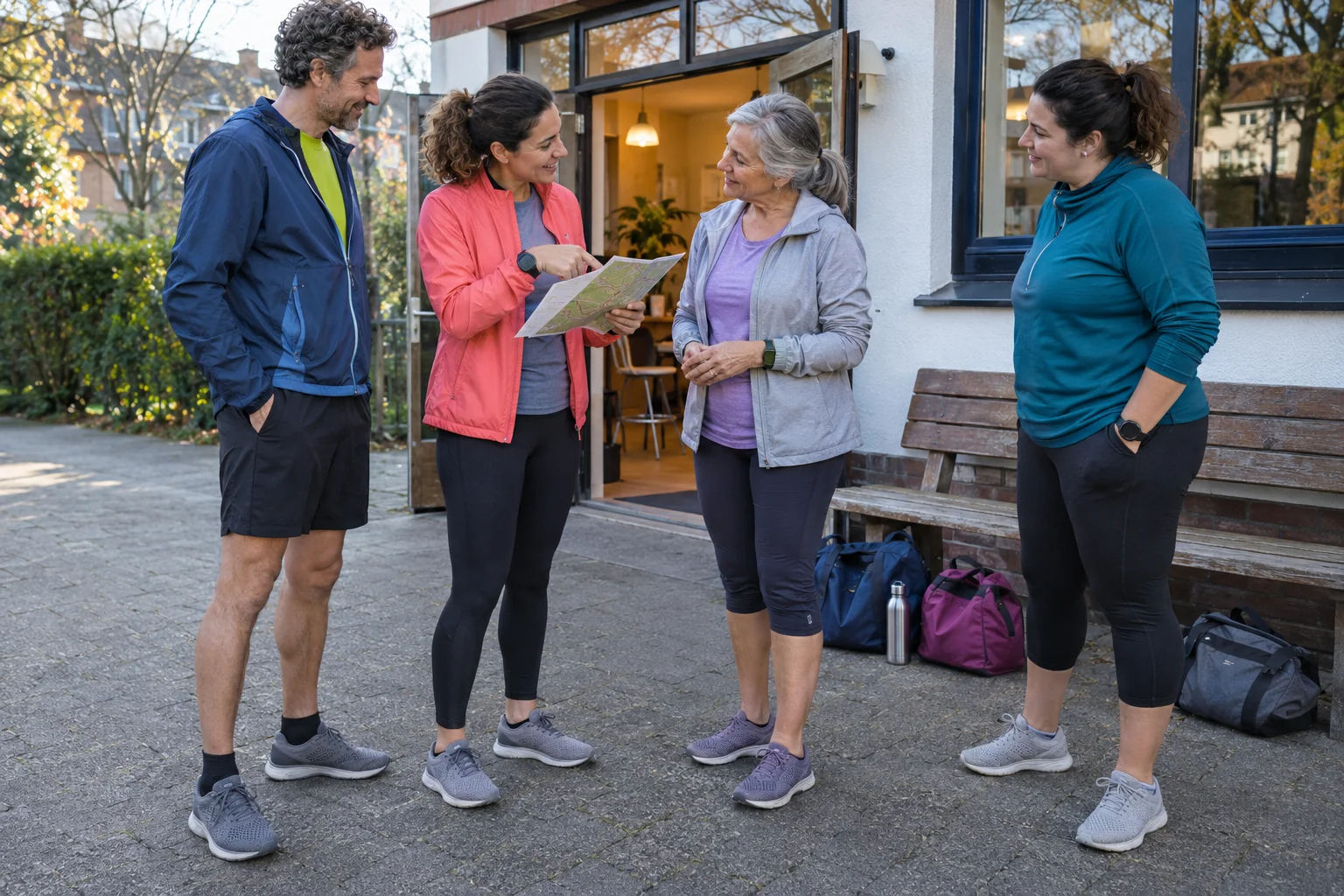
Someone returning your greeting may be enough, so every start is not a completely unfamiliar situation. This is not a less valuable relationship because it lacks long conversations or private-life closeness. Loose familiarity in a park can be pleasant in its own right. Not every connection needs to become a close friendship for shared space to feel more human.
Different levels of closeness carry different responsibilities too. The support requested from an old friend is not automatically expected from a regularly seen runner. If the boundary is unclear, a kind but limited connection can easily disappoint. Accepting a greeting and respecting personal space can coexist in a supportive running setting.
Mutual familiarity is not always symmetrical either. You may recognise others before they know your name. That is not necessarily rejection. Attention, timing of encounters and memory differ. Simply introducing yourself again may be more practical than immediately treating uncertainty as proof of your social worth.
Repetition offers opportunities, not a compulsory schedule
Repeated meetings provide more chances for recognition and conversation. There is still no universal threshold beyond which belonging certainly develops. Some feel comfortable among strangers quickly, others take time and some seek no stronger social connection. Respecting your own rhythm matters more than completing an imagined community-development plan.
Regular attendance is not only willpower either. Work, travel, caring responsibilities, health and finances shape who can attend and when. Frequent presence does not imply greater commitment or better character. A group recognising members only by attendance counts may marginalise precisely those who find participation harder to organise.
Distinguish repetition you look forward to from compelled compliance. Setting off because seeing someone will be pleasant differs from expecting your absence to be challenged. The latter may involve social pressure rather than mere familiarity. A connection does not automatically gain value when you regularly surrender rest or time boundaries for it.
An absence does not erase previous connection
A relationship with a community need not end because several weeks pass without a shared run. Shared experience, knowing someone by name or the possibility of meeting later can remain. Every absence need not be explained in detail. Flexibility can appear in how simply someone can return without proving loyalty.
The group may have changed when you return. New faces arrived, old acquaintances now exercise at another time or the usual route differs. This can create temporary unfamiliarity even if the place once felt comfortable. The old connection and present situation can both be true; neither needs to invalidate the other.
During injury or illness, social presence not being tied exclusively to running performance can be especially useful. But this is an option, not another task alongside time away. Someone need not volunteer, organise or exchange messages constantly to remain connected. Connection can coexist with recovery and private life taking priority.
Who feels part of ‘we’?
Internal habits can become natural to longstanding members. A newcomer may not understand jokes, know where to wait or whom to ask. This knowledge gap is not a lack of ability. Recognising that our own comfort partly comes from learned local knowledge makes it easier to receive others’ uncertainty patiently.
A shared identity can become narrow if only one runner type counts as a real member: fast runners, regular racers or those who are always loudly enthusiastic. Different paces, ages and communication styles can coexist. Belonging need not require everyone to run or behave identically.
Personal boundaries remain valid here too. Recognition does not permit photography, public tagging or probing health questions. You can connect kindly while letting the other person decide what information may be shared about them. Everyday conditions for trust often appear in such small, concrete gestures rather than grand praise of the community.
 Enlarge image
How can you understand your own experience?
After the next meeting, ask what felt familiar and what remained uncomfortable. Did the location, one person or movement itself offer security? Was there a real choice between conversation and silence? These are personal observation questions, not a diagnostic test or a shortened research questionnaire. Answers need not become scores.
Wanting something and feeling it is expected are another useful distinction. A greeting before running may suffice for you while others enjoy staying to chat. That does not mean you connect incorrectly. Clearer needs can help you state boundaries kindly and compare your experience less with other people’s social rhythm.
If a setting repeatedly feels excluding or humiliating, you need not accumulate further visits hoping repetition alone will solve everything. Another meeting format, one trusted companion or running alone can also be appropriate. Community is a valuable possibility, but not a compulsory condition for movement to have personal meaning.
Familiarity’s value lies in the relationship experienced
Familiar faces can give a running place continuity not captured by a route or finish time. Notice this without projecting the same experience onto everyone. Loose acquaintance, a shared identity or one friendship may matter to different people. These can coexist with different attendance frequencies.
The studies highlight that movement’s social world can be investigated in its own right. Personal decisions also require asking what the situation means to us. An attendance streak’s length does not decide whether connection is real. Often, a simple greeting welcomed by both people says most about how a strange location became a little more familiar.
Sources and interpretation
Stevens, Rees and Polman: Social identification, exercise participation, and positive exercise experiences – relationships between questionnaire variables and objectively recorded participation. Dunne and colleagues: My parkrun friends – middle-aged men’s social experiences in Irish parkrun settings. Everyday examples are editorial interpretations, not stories taken from the interviews or proven club programmes.
How Futószív articles are prepared: our editorial guidelines.