You may like the idea of meeting people, yet feel that a first visit to a running club is too big a step. Distance or pace may not be the main question. Perhaps you want to know whether someone will be waiting at the meeting point, whether there will be time to talk and whether you can leave without immediately committing to the whole programme.
Exercising with others can offer a chance to connect, but ‘go running with other people’ leaves many details unanswered. A community does not become right for you simply because many people stand at the same start point. In a workable opportunity, movement, relationships and the conditions of participation all matter together. You can find out about these before completing your first lap.
Being alone, social isolation and loneliness are not the same
The CDC discusses social isolation and loneliness as separate concepts. The former relates to a lack of relationships, contact and support; the latter may be the feeling of a gap between the connection you want and the connection you experience. Someone can feel lonely despite knowing many people. Time spent alone does not mean the same experience for everyone either.
You therefore do not have to choose a community based on other people’s assumptions. You may want a few calm encounters, while someone else wants to belong to a regular group. For some, renewing an old relationship matters more than making many new acquaintances. Naming more precisely what you miss can help you avoid expecting an overly general programme to provide every answer.
Age alone does not reveal what you want. Retirement, moving home or loss can alter familiar connections, but people do not experience these changes identically. You do not need to introduce yourself as a ‘lonely older person’ to join a shared walk. It may be enough to say that you would like to find out what the session is like.
What can exercising together offer?
A shared route can provide an obvious topic and repeated opportunities to meet. You do not have to begin with a personal story: you can talk about the park, the time or a local event. Movement can provide a common framework, but opportunities for conversation do not arise automatically. If everyone is occupied with their own pace, there may be little attention left for a new participant.
The National Institute on Aging information on connecting with others mentions activities suited to your interests and exercising with others as possible routes. This is not a promise of a personal result. A shared walk is one opportunity to nurture relationships, not a general treatment for every emotional difficulty.
One practical value of regular sessions is knowing where and when you can meet the same people. That still does not make attendance compulsory every time. Connection depends on more than a streak of appearances. It can help to find a setting where you can rejoin after a temporary absence without a lengthy explanation.
Participation in a community can involve several roles. One person walks, another comes for the meeting beforehand, while someone else joins through an agreed organisational task. Volunteering should nevertheless remain a choice. You do not have to prove your usefulness or take on continuous work to earn the right to belong.
 Enlarge image
A study can find different experiences and measured outcomes
A six-month randomised study published in 2026 compared two types of group walking programme for older community-dwelling people with a passive control group. One programme included cognitive tasks. Psychosocial well-being was a secondary area of investigation; researchers collected both questionnaire outcomes and participants’ perceived changes.
The standardised questionnaires showed no significant intervention effect on outcomes including loneliness and social support. At the same time, participants reported favourable personal changes and developing relationships. Both findings deserve to be retained together. A pleasant experience is not the same as an established between-group effect, but a different measurement result does not invalidate an individual’s reported experience either.
The practical lesson is neither that every group works nor that none does. Programme type, participants and measurement all matter. When choosing a session for yourself, find out about its specific conditions. You do not have to produce a scientific result for a conversation to feel good, and you do not have to claim improvement simply because you attended.
A first visit may need concrete points of reference
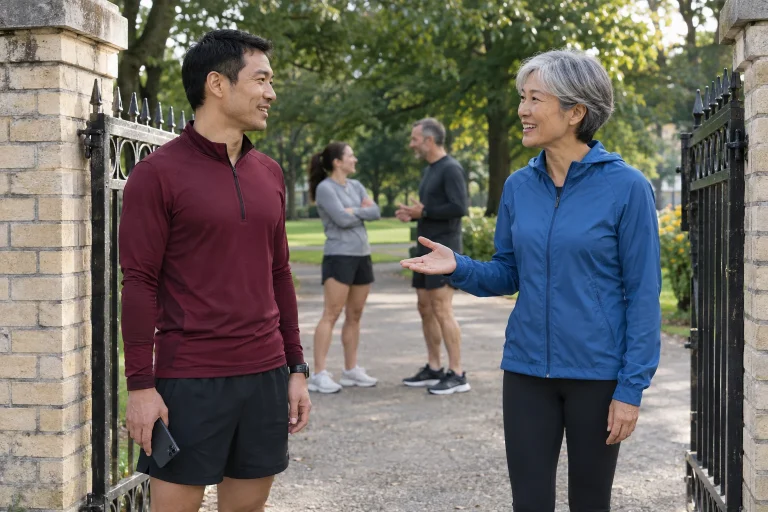
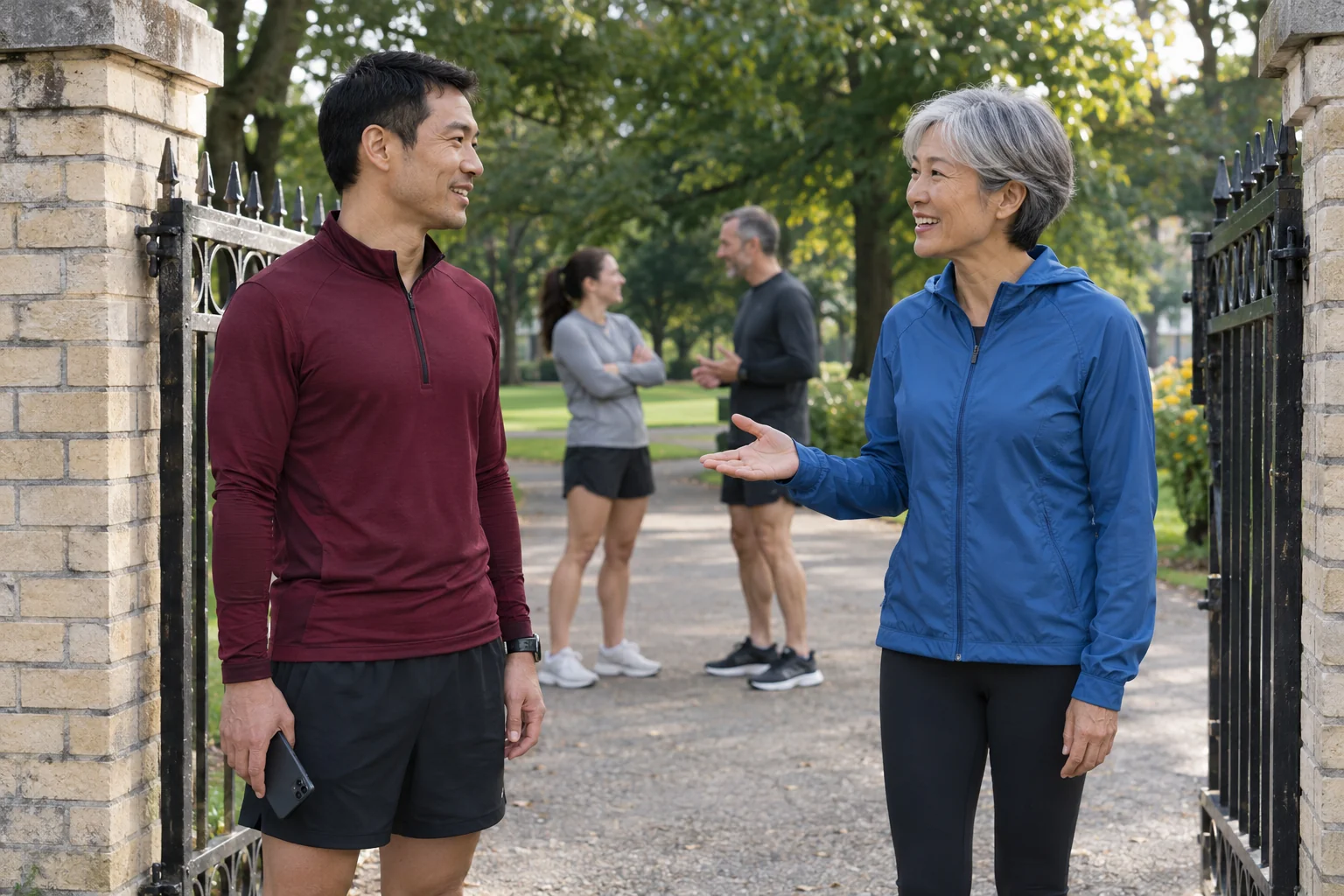
‘Feel free to come along’ is kind, but offers little to someone who does not yet know the place or people. Arriving may be easier if you know the exact meeting point, who will welcome you and the likely programme. A large park with several entrances or an unfamiliar clubroom can create uncertainty before you even set off.
You can ask the organiser how new participants are welcomed, whether there is a walking or shorter option, and when there is time to talk. You need not treat the answer as an immediate membership decision. A single visit to observe or get acquainted can be a worthwhile beginning if the organisers make it possible.
Check the outward journey and getting home too. An enjoyable programme may involve a difficult-to-reach venue or a long wait. This is a real condition of participation, not a lack of motivation. If everyone leaves by car afterwards and you travel another way, it helps to know in advance how the meeting fits into your day.
| Question before attending | What does it clarify? |
|---|---|
| Who can I approach when I arrive? | You do not have to work out how to join an unfamiliar group on your own. |
| What participation options are available? | Company should not depend on a single distance or pace. |
| Where and when do you talk? | Is there genuinely room for connection alongside movement? |
| How will I get home? | Does the whole occasion fit your time and circumstances? |
The welcome continues during the activity
How the group organises itself still matters after the first introduction. If the faster members set off and a slower newcomer is left alone, calling it a shared programme may mean little. Ask whether there is an agreed pace, companion or meeting point. Choose an option suited to your circumstances rather than pushing yourself for everyone else’s sake.
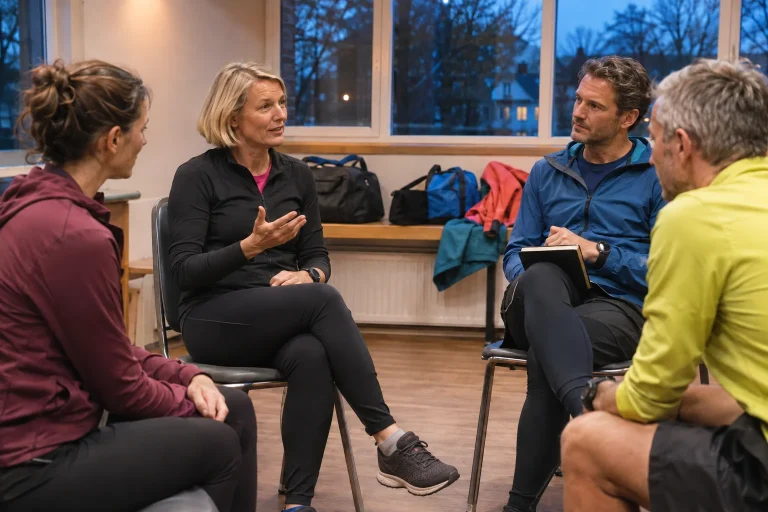
It can matter just as much whether you can hear the conversation and organisational information. A noisy location or a large group talking at once can make participation harder. You can explain this without disclosing your entire personal history. A calmer place or smaller conversation circle can offer a different experience from the same people in a crowded setting.
Well-intentioned interest does not confer an unlimited right to ask questions. You do not have to discuss your health, a family loss or finances to be accepted. You can express your boundaries simply: you would rather not say more about that now, but would enjoy talking about today’s programme. Relationships can develop at their own pace.
Respect should have a place among jokes and stories too. Repeated mockery based on age, body or pace is not a compulsory part of a sporting environment. If such a situation makes you uncomfortable, you do not need to look for every cause within yourself. Choosing another group or another way of connecting is a valid option.
Sometimes conversation needs time set aside
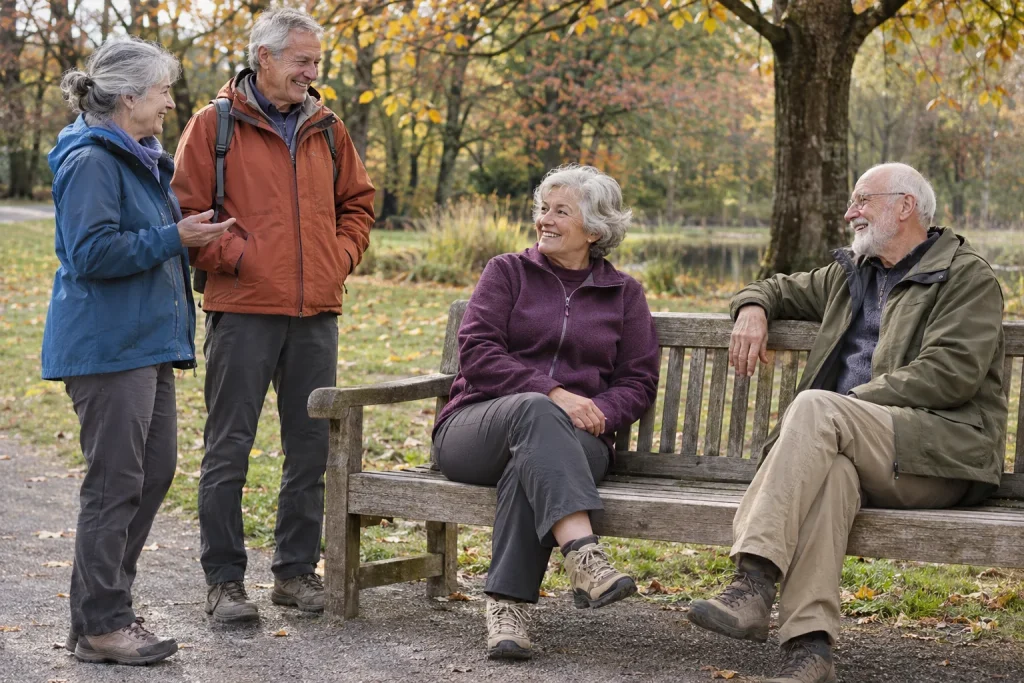
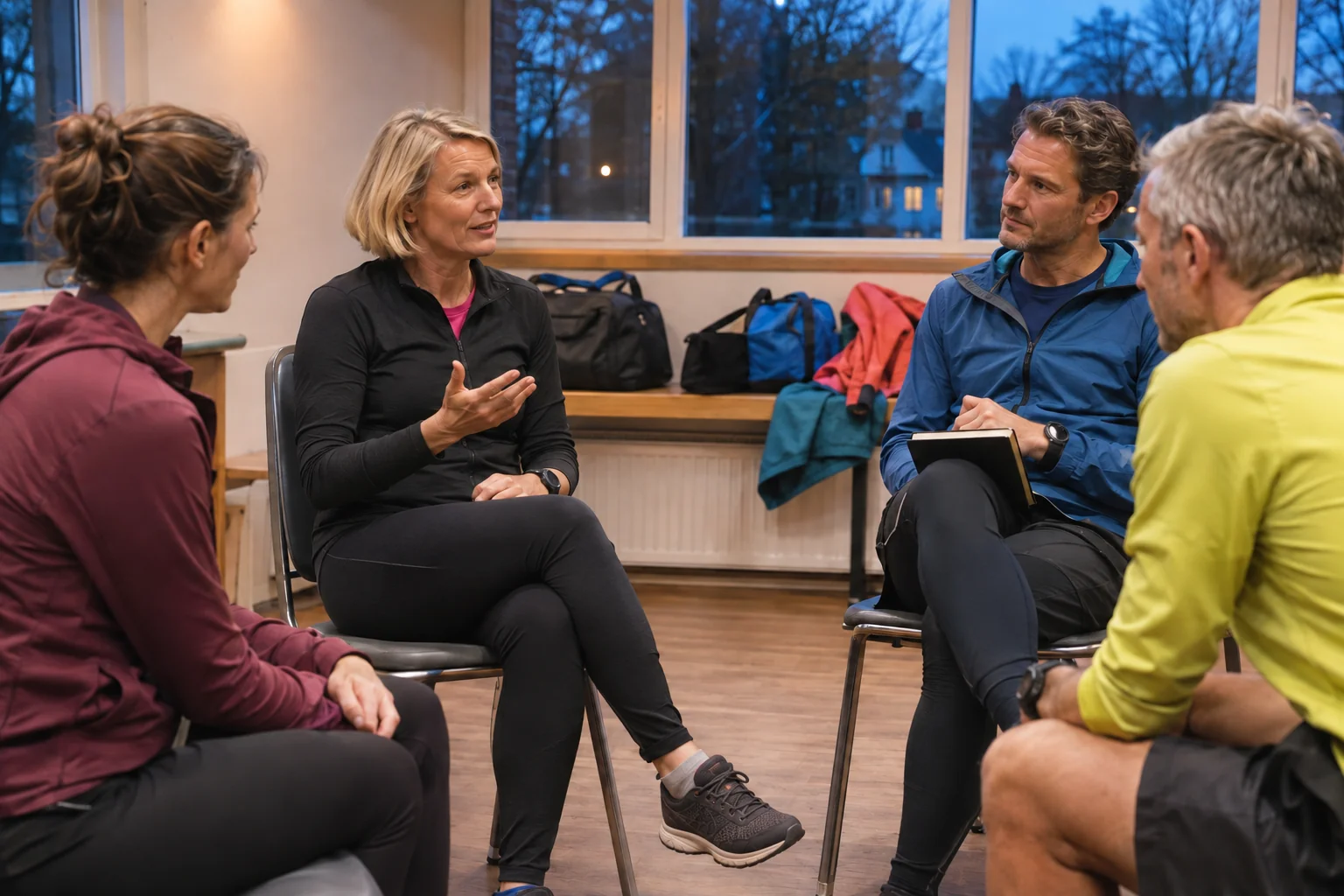
In the five minutes after a run, many people are already leaving for home. If meeting others is your main wish, ask about an occasion that includes a relaxed shared part. This could be a conversation by a bench or another programme arranged in advance. The format is workable when both the location and cost fit participants’ circumstances.
Sports results do not have to be the topic of every conversation. A book, local event or everyday interest can also provide common ground. Belonging to a running community is possible through more than the length of a race list. Getting acquainted may be easier if the organiser gives space to stories beyond those of the fastest people or those who travel most.
If you enjoyed talking to someone, you can discuss the next contact as a small step. For example, ask whether they usually attend the same session. There is no need to exchange phone numbers or personal details immediately. Mutual interest and consent matter more than creating an instant friendship from one meeting.
 Enlarge image
Keep participation voluntary and flexible
The NIA guidance on maintaining activity also emphasises enjoyable movement options adaptable to real life, along with a supportive social environment. Your own routine can nevertheless include both company and time alone. You do not have to turn every activity into a social occasion.
If you only have room to meet people on a particular day, agreed participation without exercising may also be appropriate. Injury or another obstacle need not automatically end every connection. The group may, of course, have practical limits, so clarify the options beforehand. Company and completing a particular workout can remain separate questions.
You do not need to justify an absence to the entire community. You can agree a simple notification for organisational purposes without anyone demanding an account of your personal circumstances. Returning should not become another entrance exam. Small organisational habits like these can help prevent the programme from becoming another pressure in your day.
An online group can be useful for staying in touch too, but it is not comfortable for everyone. You can ask for basic information available another way. Constantly reading messages, sharing photos or sending location data is not a necessary condition of belonging. Exercising together does not remove your own choice about sharing.
If things did not improve, that does not prove personal failure
A first meeting may be pleasant, neutral or tiring. You do not have to draw a final conclusion about your social possibilities from it. Naming what did not fit may help: the pace, travel, lack of conversation or welcome. Looking for a different format may be a more precise response than forcing yourself back into the same situation.
If loneliness or emotional difficulties persist, intensify or make everyday functioning harder, seek appropriate professional help. You do not first need to prove that you have tried every club and programme. A community occasion can support your life, but it has neither an obligation nor a guaranteed ability to resolve every problem.
A fictional older woman finds little connection on a running club’s long loop because the group splits apart. Later, she looks for a shared walk where she knows in advance who will welcome her and what opportunity there will be to talk afterwards. She does not claim that this removes every difficulty. Her next choice simply fits more closely with what she needs now.
This keeps exercising with others in perspective: an opportunity to meet, share experiences and nurture relationships in a way that suits your needs. Numbers attending or distance completed are insufficient on their own. Accessible participation, a respectful welcome and room for your own decisions can together make the occasion truly workable.
Sources
CDC: social isolation and loneliness; NIA: opportunities to nurture relationships; Hotterbeex and colleagues, 2026: group walking, questionnaire results and personal experiences; NIA: activity habits and support. Checked: 21 November 2026. The welcome questions and story are original illustrations, not a loneliness-treatment protocol or clinical scale.
How Futószív articles are prepared: our editorial guidelines.