An adjusted pace does not automatically account for every condition
You run more slowly up the same hill today than last week, yet Effort Pace gives a similar value. That may be a useful comparison, but it does not mean the watch has removed the weather and every challenge of the surface from the number. The metric adjusts according to a defined model. Understanding that model’s scope prevents you from expecting proof of performance entirely independent of weather and terrain.
The COROS Activities support page describes Effort Pace as a personalised metric that considers gradient and running efficiency interpreted from historical data. The same page explicitly states that it currently adjusts for slope, without accounting for weather or altitude above sea level. This is an important boundary of the public manufacturer description checked in November 2026. Source: COROS Activities, Effort Pace.
The word “adjusted” therefore applies only to the specified adjustment. It does not mean every run in every set of conditions has been converted to a common laboratory standard. A useful question is: which environmental difference does the model try to address, and which remains outside it? Making this distinction lets the metric help on hilly routes without leaving the other characteristics of your training out of the interpretation.
Gradient and personal history are two components
On an uphill section, measured pace describes your speed of progress. A terrain-adjusted metric asks a different question: how might the effect associated with the slope be interpreted within a particular model? This is not a new stopwatch result in itself. Keep the actual time, distance and pace alongside the Effort Pace value. Adjusted data and directly recorded data have different roles and can complement each other.
The COROS explanation of personalisation highlights the inclusion of the user’s historical data, compared with the earlier approach based on gradient and pace. The aim is to account for individual uphill and downhill running efficiency. This does not mean two runners receive the same adjustment on the same hill, or that every new user immediately has a perfect personal model. Interpret the specific conditions using the manufacturer’s current description. Source: personalised Effort Pace.
As an illustration of our own, imagine two people who run similarly on the flat but show different patterns uphill. A one-size-fits-all table and a model using personal history may treat them differently. This example does not reverse-engineer the COROS formula. It shows why knowing the percentage gradient alone is insufficient to understand the algorithm’s entire operation. Personalisation adds information; it is not unlimited environmental adjustment.
 Enlarge image
The same slope, a different surface
In our simple example, a rise of three metres over a horizontal distance of one hundred metres gives a three per cent gradient. That geometry does not change when the path is dry, rocky or slippery. Yet the running task may differ. Placing your feet, moving securely and negotiating bends may require different attention. Gradient alone does not describe every surface characteristic, so interpreting a slope-based metric also requires a description of the ground.
A 2025 original study compared short runs by ten active adults on standardised smooth and uneven laboratory tracks. Several cardiorespiratory and perceived-exertion measures were higher in the uneven condition. This illustrates that the surface is a separate factor; percentages from that particular experiment cannot be applied to every woodland trail. Source: Bettega and colleagues, even and uneven surfaces.
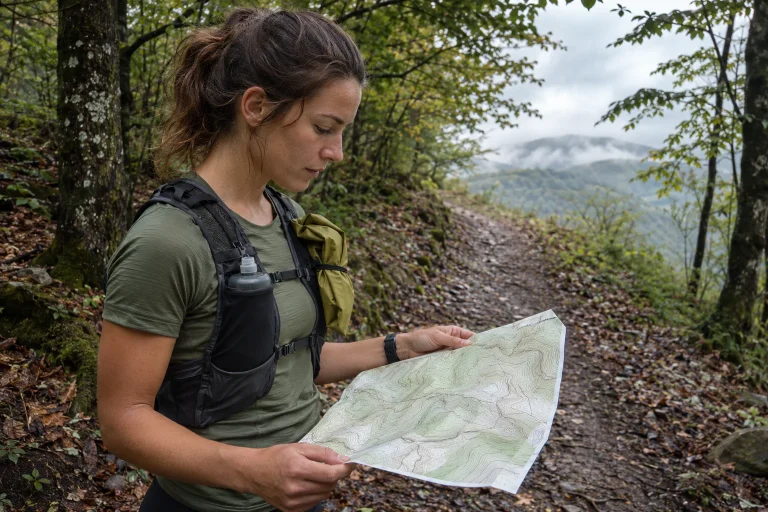
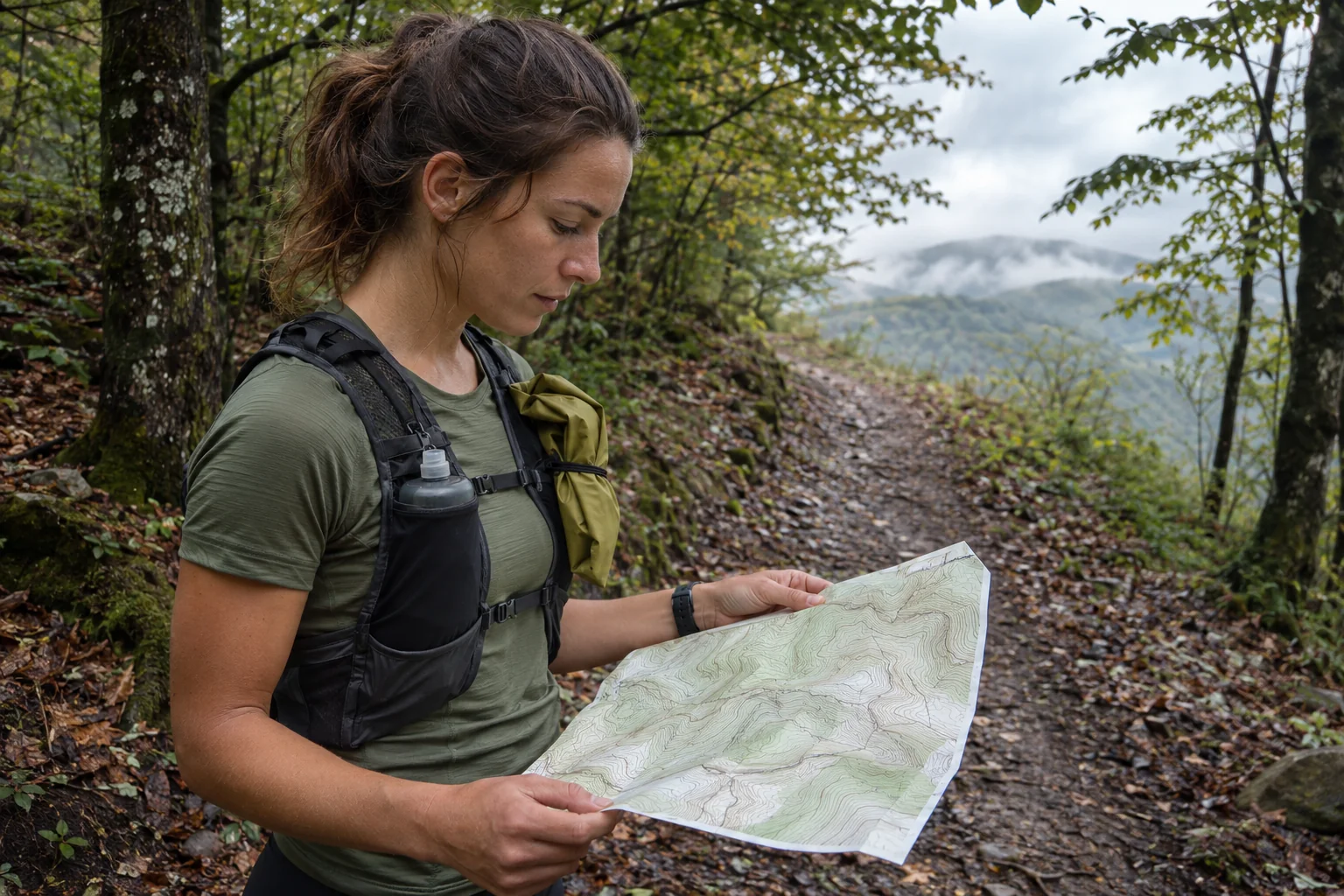
Your own log could therefore say “same route, but wet leaves and more cautious cornering”. That is a real condition rather than an algorithmic adjustment. If your measured pace is slower, do not automatically read a decline in fitness into the adjusted metric. First consider whether you were performing the same movement task. A slower section chosen for safe progress is neither faulty data nor a performance failure. The watch’s number cannot know every detail of the ground for you.
What excluding weather means in practice
If the manufacturer does not adjust for weather, do not call the displayed Effort Pace a wind-free or heat-free pace. Keep the actual weather conditions separately. Wind direction, sunshine, moisture or clothing may differ between two outings on the same mountain loop. You do not need to create your own correction formula for each. It is enough to establish that other conditions changed alongside the adjusted number, so a difference cannot be traced to one fitness-related cause.
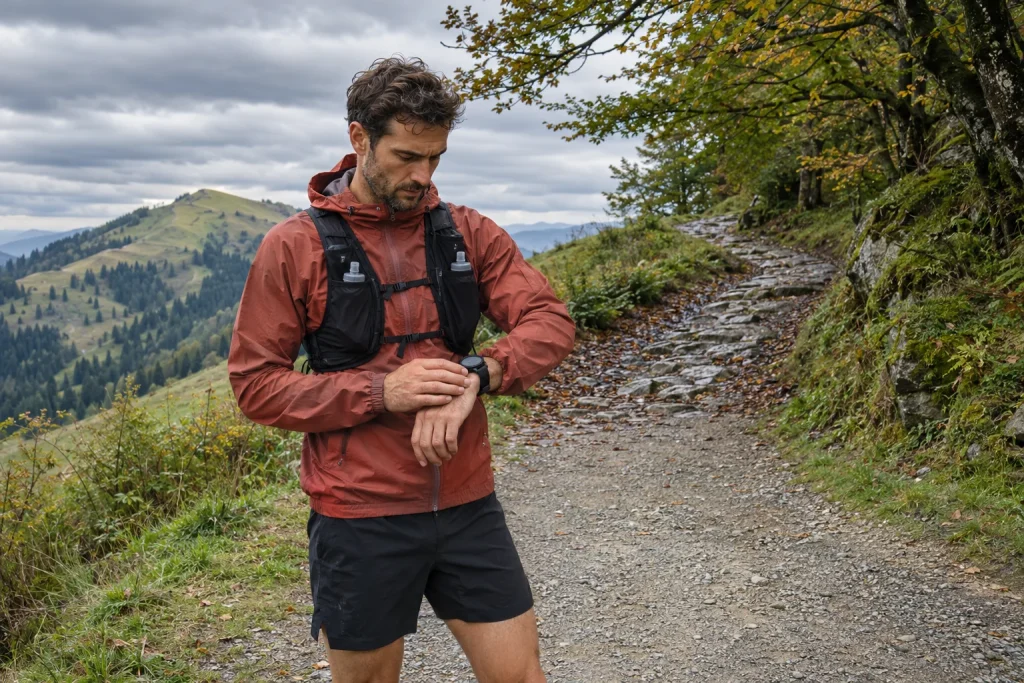
In an illustrative situation of our own, an exposed ridge has a headwind one day and a tailwind another. The gradient and route are identical, but the experience of progressing may not be. You cannot infer an excluded factor from the metric’s name. If Effort Pace stays unchanged, that does not establish equal total effort. If it changes, you cannot reliably work backwards to the strength of the wind or the extent of your improvement.
Adjustment for altitude above sea level is also separate from accounting for the local slope. A hill’s gradient describes the nearby change in elevation, whereas absolute altitude provides different environmental information. Do not let the similarity of the words blur the distinction. The Activities description lists altitude as an excluded factor. When comparing mountain routes, therefore, do not describe a value as fully adjusted for the altitude environment if the manufacturer does not claim that. Source: scope of the adjustment.
Walking and steep descents: the model can change over time
The COROS October 2026 update description reports another change to the Effort Pace algorithm. It specifically mentions distinguishing walking from running, as well as changes to how steep downhill running is handled. This is a reminder that the metric is not a timeless natural constant. After an algorithm update, an apparently identical task may produce a different estimate. The device and software version also matter when making comparisons. Source: COROS October 2026 update.
Do not treat every walking section as a failed attempt at running. On trails, the form of travel may be part of the task and conditions. Technical analysis should retain where and why you switched, and how this appears in the data. Manufacturer detection may help, but it does not flawlessly establish the movement type of every step. If you see an odd transition in the record, compare it with what actually happened rather than rewriting your actions retrospectively from the number.
Several factors can change even when you run the same loop before and after an update. The algorithm is one possible cause, not automatically the sole explanation for every difference. Note the version change, conditions and sport mode used. If the change is consistent, several similar outings can help you formulate a precise support question. Old and new adjusted values need not be silently treated as perfectly unchanged elements of the same scale.
A pace-like unit is not a direct energy cost
Effort Pace is an estimate expressed as pace, not a direct laboratory measurement of total metabolic energy cost. Minutes per kilometre on the display are neither joules nor oxygen uptake. This does not diminish the metric’s practical purpose: it was designed for a different task. The distinction matters when you try to judge the total energy demands of two runners or two terrains from a single adjusted pace.
In a hypothetical example of our own, the actual pace on an uphill section is 6:00, while the model reports an Effort Pace of 5:00 minutes per kilometre. The difference is one minute, but this does not imply twenty per cent more calories or any particular energy ratio. The mathematical relationship between pace values is not the same as physiological cost. Without knowing the algorithm’s complete internal model, there is no justification for creating your own conversion formula from it either.
Research into energy demands specifies the instruments and protocols used. The uneven-surface study, for example, included cardiometabolic measurements alongside controlled running. That is a different setup from working backwards to total exertion from pace displayed on a sports watch. Precise claims about the relationship between a watch model and laboratory measurement require a specific investigation. Source: methods of the surface study.
 Enlarge image
Keep comparisons brief while retaining the important conditions
A useful personal table has separate columns for measured pace, Effort Pace, route section, surface and relevant environmental conditions. Add a few words about your subjective experience, such as easy to maintain or cautious because of slippery ground. The aim is not a new composite score. The comparison helps you see when the model provides meaningful additional information and when too many other conditions have changed.
Where possible, examine identical or clearly separated sections. Do not inadvertently compare the average of a long climb with a short technical descent merely because both have an Effort Pace value. A shared name does not create a shared task. If a section involved several stops, route-finding or changes of surface, flag that before considering the numbers. An adjusted metric does not erase real events from the recording.
Keep your conclusion narrow and checkable. For example, on an uphill section run in dry, similar conditions, the adjusted data moved in a similar direction to the change in measured pace. That is interpretable as a personal observation. It does not establish that “I have subtracted every environmental effect”. If the series is uncertain, retain that uncertainty too. A good running log does not require the same single certain explanation every week.
Using a model well means recognising the reality it leaves out
Effort Pace can be useful if, during a hilly run, you want additional feedback with a defined purpose beyond simple pace of progress. It belongs within a set of data: measured time and distance, environment, personal experience and the manufacturer-documented estimate can be interpreted together. You do not need to watch every screen on every run. Choose a view that helps with your task while remembering the model’s limits.
On wet, technical terrain, safe progress should be the real task. Do not speed up for a more attractive adjusted number where the surface or visibility calls for caution. The algorithm works from documented inputs, but you can also see where your next step will land. The device’s value does not replace a decision on the trail. A good note about a cautious section remains useful in later analysis too.
Terrain-adjusted pace is therefore neither a weather-free time result nor a direct energy measurement. It is a personalised model that can evolve, alongside which the surface, absolute altitude and daily conditions still matter. Using it with these factors means you need not expect perfect knowledge of everything. It is enough for it to give an additional answer to a clear question while you retain the actual conditions of your run beside the number.
Sources
- COROS Activities: Effort Pace
- COROS: personalised Effort Pace
- COROS: October 2026 update
- Bettega and colleagues: running on uneven surfaces
How Futószív articles are prepared: our editorial guidelines.