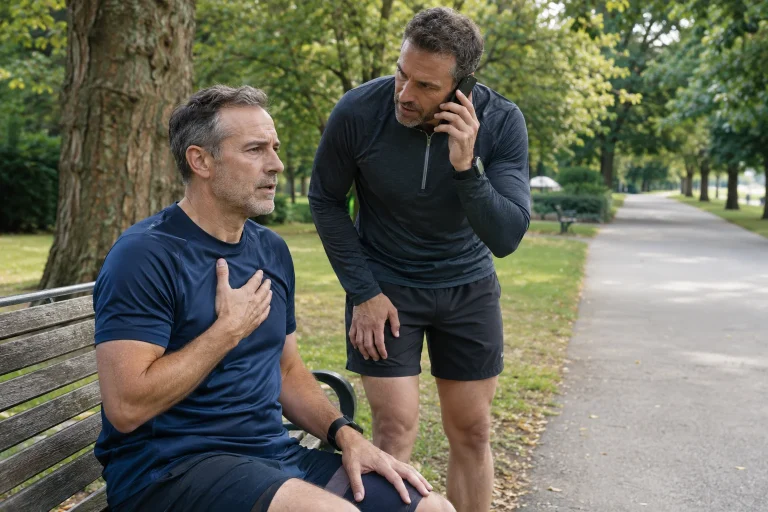
Running can bring enjoyment, community and freedom. It is a different situation when missing training causes intense guilt, you make eating conditional on completing exercise, or you feel obliged to cover the kilometres despite pain or feeling unwell. These difficulties should not simply be called discipline. Your relationship with eating and movement may need healthcare attention even when your performance still appears strong.
If an eating disorder is suspected, you do not have to wait for a particular body size or a dramatic collapse. Early help aims to assess physical and mental health, not judge the athlete. This article offers support for seeking help and for the supportive role of people around you. It is not a self-diagnostic test, nutritional treatment or a programme granting clearance to return to running.
You cannot reliably identify an eating disorder from someone’s body
The NICE guideline states that a single measure, such as body mass index or the duration of illness, should not determine whether someone receives treatment. Physical and mental health need assessment alongside concerns and behaviour. Appearance is not a reliable examination of fitness to participate in sport.
In running settings, it can be particularly easy to mistake a concerning change for something deserving recognition. Praise for weight loss, always completing training or a strict eating routine can conceal different situations. Fellow runners are not there to diagnose from appearances, but should avoid automatically rewarding worrying symptoms and behaviour.
If this affects you, you do not have to prove that you are ill enough. It is already a valid reason to talk if thoughts about eating, weight or training take up increasing space and make your day difficult. You do not need to choose an exact category before seeking help.
What is worth putting into words?
You can explain if you often postpone eating, feel anxious about departing from your usual routine or feel compelled to exercise after eating. Also say if it is difficult to stop training, you conceal your activity or the idea of a rest day causes intense distress. These are not diagnoses, but experiences that matter for assessment.
The NIMH information discusses several eating disorders with different symptoms. Not every problem involves the same eating pattern, and not all centre on the same body-image concerns. Explain your own experience rather than making it fit a familiar story.
Physical signs also belong in the consultation: dizziness, persistent fatigue, recurring injuries, menstrual changes or another concern. None alone proves an eating disorder, but they can be considered together. Do not use running data to argue that a symptom does not count yet.
Eating disorders and REDs: related, but not the same
The IOC consensus on REDs discusses the health and performance consequences of problematic low energy availability in sport. An eating disorder can lead to this situation, but an energy shortfall does not always result from deliberate restriction or a diagnosable eating disorder. These terms should not be used interchangeably.
The distinction matters because the background and help needed may differ. General advice to eat more will not necessarily resolve intense fear or compulsion connected with eating and movement. Conversely, unintentionally inadequate intake does not always mean a psychiatric diagnosis.
Risk-assessment tools used in sport are intended for professional assessment. Do not assign yourself a colour from a community graphic or use it to grant yourself permission to run. Diagnosis and decisions about participation in sport may require an appropriate healthcare team.
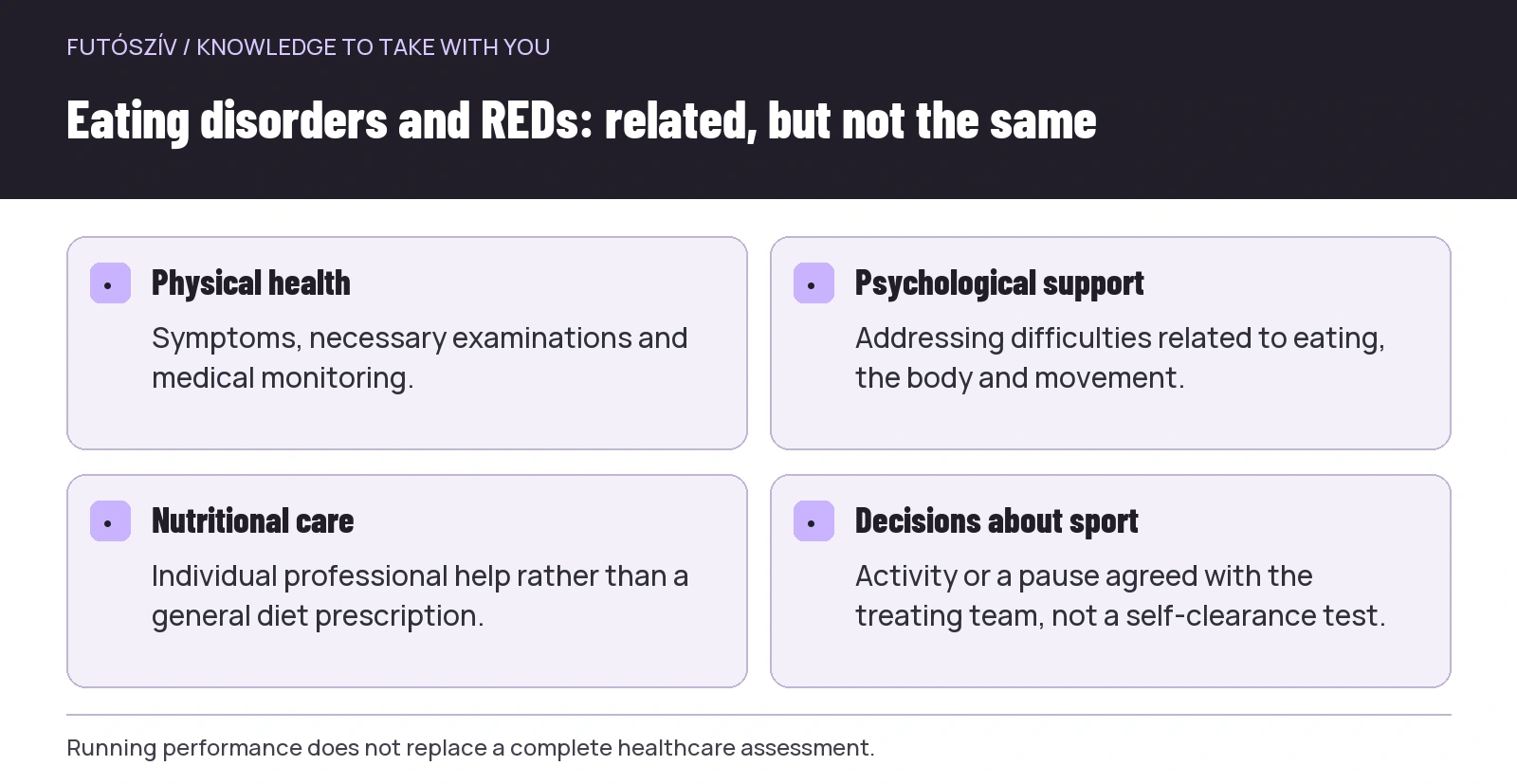 Enlarge diagram
Text version of the illustration
- Physical health
- Symptoms, necessary examinations and medical monitoring.
- Psychological support
- Addressing difficulties related to eating, the body and movement.
- Nutritional care
- Individual professional help rather than a general diet prescription.
- Decisions about sport
- Activity or a pause agreed with the treating team, not a self-clearance test.
Good performance does not make the situation safe
Results may remain stable or improve for a while even as serious difficulties develop around eating and training. Sporting results are not a complete measure of health. Pain, feeling unwell or an increasingly restricted daily life may be more important signals than a new personal best.
Do not automatically confuse an inability to rest with strong motivation either. If training overrides every other need or feels compulsory even during illness and injury, it is worth discussing with a professional. The function of the behaviour may matter at least as much as the amount.
People around the runner should therefore look beyond slowing down. Avoiding shared meals, constant conflicts about exercise or secrecy may also be changes worth asking about sensitively. The aim is not surveillance, but support in reaching help.
How can you seek help without solving everything first?
You can start with a GP, a mental health professional experienced in eating disorder care or an appropriate sports medicine contact. Explain that your relationship with eating and movement worries you and that you would also like a physical assessment. Ask how to access any further care needed.
The NIMH discusses psychotherapy, medical monitoring and nutritional support within treatment plans, depending on individual circumstances. Help may require several professionals working together. A general training or diet plan does not replace eating disorder treatment.
If getting started is difficult, ask someone you trust to help make a call or accompany you. You can write a few sentences for the appointment. You do not have to change the behaviour before asking for help; that may be exactly what you need support with.
A temporary pause from running can be part of treatment
The NICE guideline recommends advising people with an eating disorder who exercise excessively to stop excessive exercise. What movement is possible in a particular situation, and whether a complete pause is needed, should be judged from physical and mental health. Do not independently establish an amount of training you assume must still be allowed.
Reducing exercise can bring strong feelings. Tell your clinician about these too, because the plan needs not only to change the calendar but also to help you manage the difficulty. Fear of losing sport is a real experience, not a reason to conceal symptoms.
If rest has been prescribed, do not secretly switch to another activity for the same purpose. Walking, cycling or home workouts can continue excessive activity if you merely rename its function. Clarify uncertainty within the treatment plan.
Returning is not a single performance test
The IOC consensus links participation decisions to considering health status together with several sporting circumstances. A good laboratory result, a symptom-free day or a successful run does not alone mean the whole situation is resolved. Returning may require a clear professional plan.
Clarify with the treating team who decides about activity, what you will monitor and when you will review it. Returning to movement may have a different purpose from chasing previous results. How you relate to eating, rest and a missed session matters too.
Recovery should not have a race deadline. If an entry or external expectation makes you feel rushed, say so. Decisions about sporting participation and long-term health must not be squeezed into a single result target.
What can a running friend say?
Start with a specific, non-judgemental observation: I am worried that you keep training when unwell, or I notice that taking a rest seems very difficult for you. Do not analyse their body or request detailed food numbers. Ask whether they would discuss it with an appropriate professional and what practical help they would accept.
Avoid praise that rewards weight loss, skipping food or persisting through pain. ‘Just eat more’ or ‘Then do not run’ rarely resolves the whole situation. Support can mean arranging an appointment, accompanying someone or simply being calmly present.
If your friend is resistant, you can still explain that you are concerned and would like to find help. Do not become a secret training monitor, but do not take on the clinician’s role alone either. If they are seriously unwell, immediate medical help matters more than agreeing on everything first.
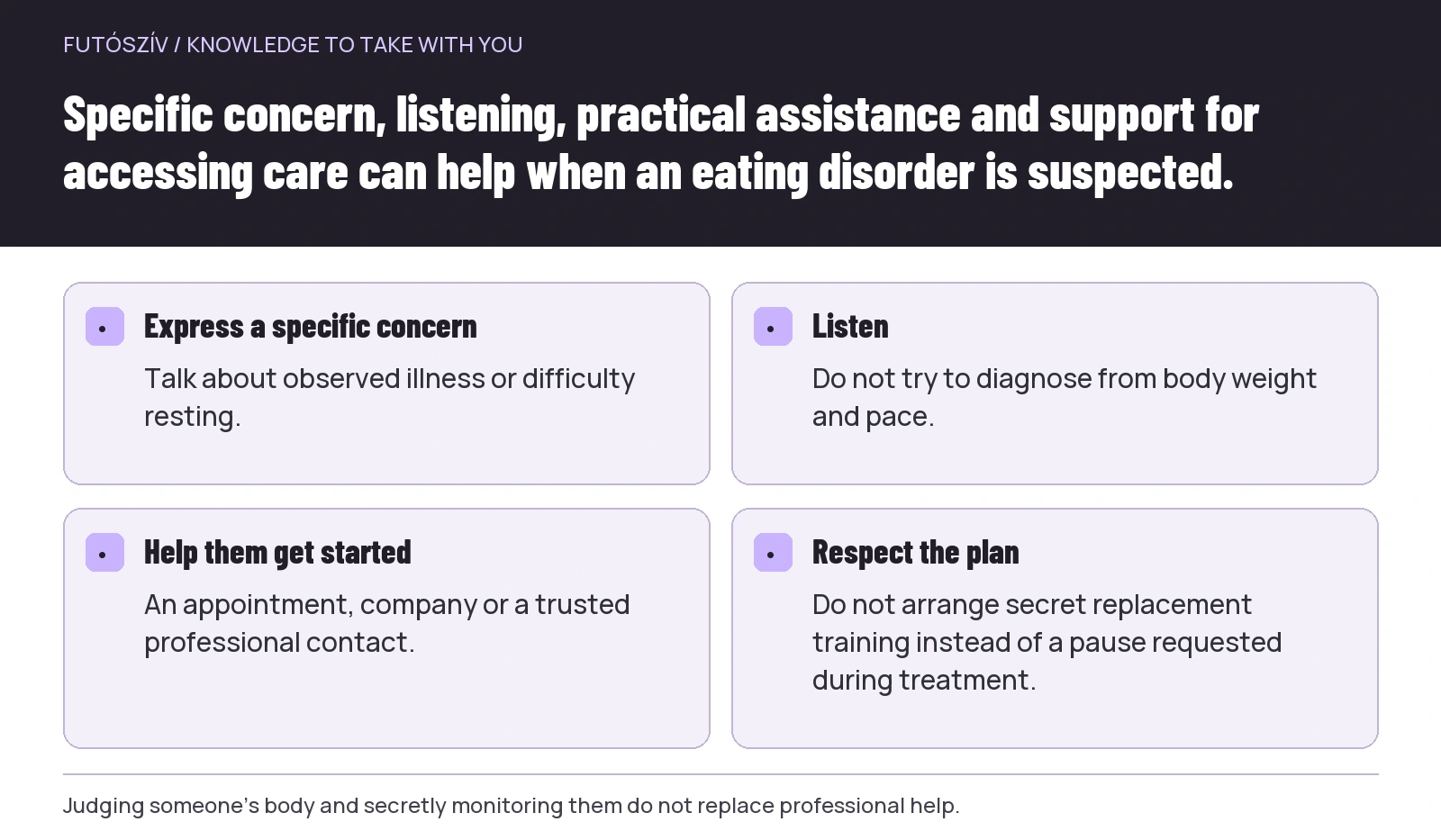 Enlarge diagram
Text version of the illustration
- Express a specific concern
- Talk about observed illness or difficulty resting.
- Listen
- Do not try to diagnose from body weight and pace.
- Help them get started
- An appointment, company or a trusted professional contact.
- Respect the plan
- Do not arrange secret replacement training instead of a pause requested during treatment.
Community culture can change too
The Australian Institute of Sport also treats prevention and an appropriate care environment as responsibilities of sporting institutions. The document was developed within an elite sport system, so not every organisational element can be copied into a recreational group. Its underlying question can still be asked locally: what behaviour does the community reward?
A running group can drop constant talk of ‘working off’ food, ranking bodies and public weigh-ins. Training and shared meals should not revolve around guilt. An organiser or coach can make clear that seeking healthcare help is not weakness.
Alongside celebrating results, make room for rest, rehabilitation and someone temporarily remaining in the community in another role. Participation should not depend solely on current performance. This way, a connection with sport need not necessarily be lost during treatment.
Data sometimes occupy too much space
Tracking calories, body weight and training data can reinforce an existing compulsion in some circumstances. If you feel numbers are controlling your day, discuss this with your clinician. An appropriate change may be individual; you do not need to independently build another, stricter measurement system for recovery.
Monitoring a return involves more than numbers too. Flexibility, feeling secure around eating, accepting rest and daily functioning may be important areas in the professional plan. Progress does not necessarily look like a constantly rising curve in a sports app.
You can also choose less social media content that reinforces comparison or compulsion. This can be a supportive environmental step, but does not replace treatment. The aim is not to follow perfect rules in this area as well, but to make necessary help easier to reach.
If you are seriously unwell, do not wait until the next training session
The NICE guideline also considers urgent medical care necessary when physical health is seriously compromised. If you faint or have chest symptoms, severe weakness, confusion or rapid deterioration, do not use exercise to judge the situation. In immediate danger, call 112 for urgent help.
You do not have to meet home-measured heart-rate, body-weight or laboratory thresholds for feeling unwell to be taken seriously. A reading considered unusually low because of a sporting background is not automatically reassuring when an eating disorder is suspected. Clinical assessment needs the whole situation.
Tell the care provider relevant information about eating, movement and any other behaviours. The aim is appropriate help, not blame. If speaking alone is difficult, ask a supportive person to help you make contact.
The first step can be a single honest sentence
‘I have lost flexibility around eating and running, and I would like help.’ You do not need a more detailed, perfectly worded story for assessment to begin. Your sporting goal may change temporarily while the longer-term value of running remains.
Recovery is not another performance competition. Physical safety, appropriate nutritional and mental healthcare, and a supportive environment all matter together. Find running’s place again within that plan, rather than using it instead of treatment.
Sources
- NICE NG69: Eating disorders – recognition and treatment
- NIMH: Eating Disorders – What You Need to Know
- IOC: Consensus statement on Relative Energy Deficiency in Sport, 2023
- Australian Institute of Sport: Disordered Eating Prevention and Management Policy and Best Practice Principles
How Futószív articles are prepared: our editorial guidelines.