You have run for decades, know your favourite loops and are accustomed to longer periods of activity. Even so, strength and balance may need separate attention in your week. This does not call your running history into question. A regularly repeated sport and the varied movement tasks of daily life do not ask exactly the same things of you.
The aim is not to add another compulsory checklist on top of every run. First understand which movement ability matters in which situation, what is already part of your programme and where appropriate individual help may be needed. Running can retain its own value while you deliberately make room for other kinds of activity too.
Endurance and force production are different questions
The NIA information on types of exercise presents aerobic activity, muscle strengthening and balance separately. Aerobic movement relates to sustained activity and the functioning of breathing and circulation. Strength also appears in other tasks, such as moving an object or rising from a seat.
The everyday difference is easy to see: a comfortable walk and opening a difficult door are not the same task. Your running experience is valuable, but your own functioning provides separate information about difficulty with that door or another daily activity. Such tasks do not all need to be converted into running pace to matter.
Force production is not a single attribute for which a general statement of “I am strong” answers every situation either. Different positions, equipment or tasks may present different demands. An individual plan should therefore connect to the specific goal. Running volume alone should not lead you to assume that every muscle group or movement is adequately supported.
Balance during movement also draws on several sources of information
Balance does not mean only standing still on one leg. Maintaining bodily stability while moving, turning or changing position is also a task. The NIDCD explanation of balance describes the cooperation of vision, the inner ear, muscles and sensory information about body position. This shows why the question is broader than one sporting movement.
You may navigate a familiar flat loop well, while turning in a narrow entrance or setting off carrying a bag presents different conditions. You can name that difference without putting together a balance test at home. Describing a current difficulty may be more useful than trying the hardest possible task to prove your ability.
New dizziness, unsteadiness or a fall must not be dealt with simply by “doing more balance training”. Investigation is a different question from an individually chosen activity programme. A familiar running route and a long sporting history do not automatically explain a new change. Seek the help needed for the symptom on the basis of its own circumstances.
Different activities can overlap without becoming fully interchangeable
The CDC guide for older adults emphasises the combined role of several types of movement and mentions activities that may contain more than one component. The categories are therefore not hermetically sealed boxes. This does not mean, however, that one favourite sport fulfils every targeted task equally.
As a runner, for example, you may attend to rhythm, ground and body position, but this does not automatically make a complete individual strength or balance programme. “I run on trails, so that covers everything” puts too much into one sport label. The particular route and your overall functioning remain separate questions. Nor does a varied environment need to become a deliberate test of risk.
| Named goal | What deserves separate attention? | What is insufficient on its own? |
|---|---|---|
| Sustained activity | The chosen activity and your current individual framework. | A single strength result achieved in a different task. |
| Daily force production | The specific movement, position and help needed. | Weekly running distance. |
| Stability | Individual sensory function, environment and changes of position. | A timed test invented at home. |
The table is not an exercise physiology test and does not rank the goals. It helps prevent you from expecting one successful area to answer every other question. The complexity of movement does not reduce the value of running. It offers more meaningful questions for your next individual plan.
 Enlarge image
An everyday goal points to the help you should look for
You can place a daily activity behind the goal “I want to be stronger”. Which task matters to you, and what is difficult about it? It might involve rising from a seat, handling equipment for an outdoor outing or another personally important movement. Making this specific does not require provoking a symptom or giving up assistance.
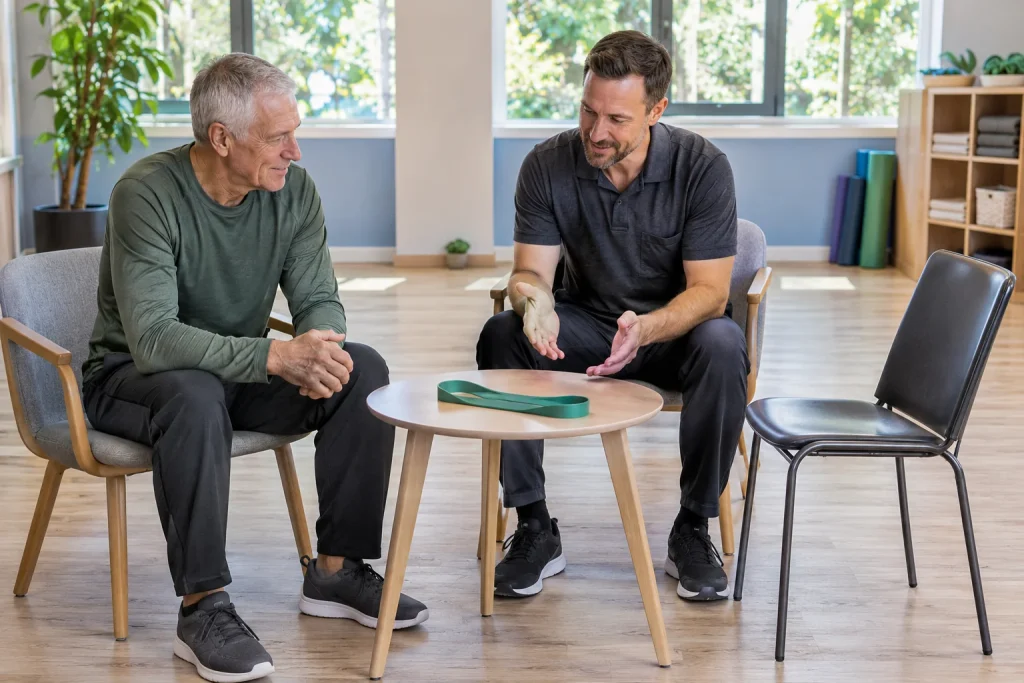
If you plan with a professional, describing the real task helps give the programme an understandable purpose. Not everyone is given the same movement, weight or resistance. Current condition, history and environment all matter. This article therefore contains no identical strengthening dose or number of sets for everyone.
Access to equipment is part of the programme’s usability too. Is there a suitable space, how will the equipment be brought out, and does someone need to be present? A home task does not become practical simply because its name sounds easy. Its conditions must be understood too. If these are missing, the individual plan can be clarified with your clinician or an appropriate exercise professional.
A first appointment can be about learning rather than demonstrating performance
Someone who has run for a long time may still be a beginner in another form of movement. This is a natural situation: there is new equipment, different instruction and a different task for attention. Learning does not require immediately demonstrating difficulty worthy of your former sporting results. An appropriately chosen first session can aim to help you understand the task and its own conditions.
Naming a strengthening or balance task provides little guidance if you do not know how to carry it out in your situation. You can ask for a demonstration, a simple explanation and feedback. Using support need not be considered beneath your sporting past. Appropriate execution of the task matters more than the appearance of managing without help.
A new task should not become a competition to overcome pain or dangerous unsteadiness. Report anything that is unclear or causes symptoms. The general NHS balance information also uses gradual progression and an appropriate environment. An example shown online still does not assign an individual task to every reader.
At home, a short reminder in your own words may help you retain what you learned, if this was provided or agreed. The text should not consist of inventing missing details yourself. Equipment, necessary help and the changes that mean asking for an adjustment should be clear. Being able to follow an individual plan is part of learning.
You can rearrange space in the calendar too
When considering a new activity, the first thought is often that something must be added to existing runs. A week can be arranged in several ways, however. Consider which session serves which purpose, where travel is involved and what fits alongside daily tasks. Finding a place for the programme is about more than the amount of load.
In an individual plan, a different type of activity session can have a task of its own. Its preparation, learning and finishing time must also be included. Travelling to new equipment or attending at the group’s scheduled time are real commitments. You do not need to call the whole day free just because the task looks short in its description.
The relationship between running and other activity programmes can be reviewed with an appropriate professional when necessary. A universal sequence set out in a general article does not determine what suits your week. The aim is to understand each session’s role and keep the plan adaptable alongside your individual condition.
- What is the specific purpose of the new task?
- Under which individual conditions and with what equipment can it be performed?
- Where does it fit in the real week?
- What will you review, and when, before continuing?
Measured ability and number of falls are separate outcomes
An original study involving several kinds of task examined a programme in women aged seventy to ninety who had previously fallen. Several strength and functional measures improved, but no between-group difference in the number of falls was found during the one-year study. The participants in that particular research are not equivalent to every reader who has been running for a long time.
The lesson is to name the outcome precisely. When strength or balance performance improves in a study, there is no need to add a guaranteed improvement in every other outcome. Equally, not detecting a difference in falls in one sample does not make every appropriate programme pointless. The question measured defines the limits of the claim.
In your own plan, it is therefore useful to clarify what is being followed. Has an important daily task become easier, can the programme you learned be carried out appropriately, and has a new difficulty appeared? Personal experience and any professional measurements can be interpreted together. One result does not have to become a comprehensive certificate of fitness to run.
 Enlarge image
How can this connect to an established running routine?
In a fictional example, someone still enjoys familiar park runs but recognises that they provide little information about other daily tasks. They seek individual help to learn about another appropriate form of activity. The meeting aims to review current functioning and options, rather than determine whether earlier runs “were all for nothing”.
The new plan names which task serves which goal and how its execution can be followed. Experience gained while running remains useful, but learning to use new equipment is not skipped. The weekly arrangements are reviewed too, so activities are not simply piled on top of one another. The change receives a task of its own.
A different step may be appropriate for another reader, particularly with a new symptom or previous fall. The example is not a training plan or a sequence that applies to everyone. It shows that curiosity and learning can sit alongside a long running history. Every new question need not be interpreted as criticism of a sporting identity.
A fuller picture of movement can provide more useful answers
It is worth reviewing from time to time what your current programme serves. If running provides the aerobic activity you enjoy, separately named strength and stability goals can remain alongside it. Every session need not develop every ability at once. The relationship between the parts and their individual suitability matter more than finding one activity that does everything.
If daily functioning changes, you can discuss it specifically. A sporting past and a current need for help can both be true. Alongside assessment of a new symptom, this information can help select an appropriate programme. Learning takes nothing away from what you have previously gained as a runner.
Strength and balance can thus remain separate, understandable tasks even in an experienced runner’s life. The aim is not to reduce the place of running, but to understand more aspects of daily movement. Individually chosen options, learned execution and a weekly arrangement you can follow can together provide a more useful basis for continuing.
Sources
NIA: three types of activity; CDC: combined activity for older adults; NIDCD: how balance works; NHS: general background to balance tasks; Original study of a programme involving several types of task in older women. Checked: 21 November 2026. This article is not an individual programme of strength or balance exercises.
How Futószív articles are prepared: our editorial guidelines.