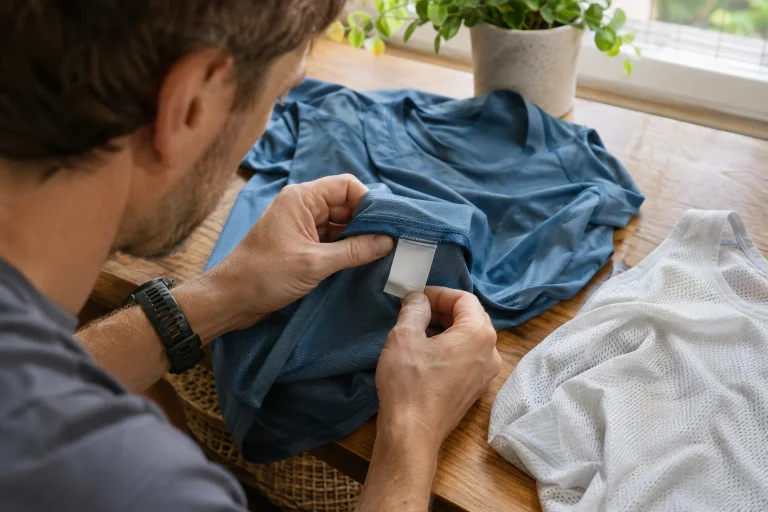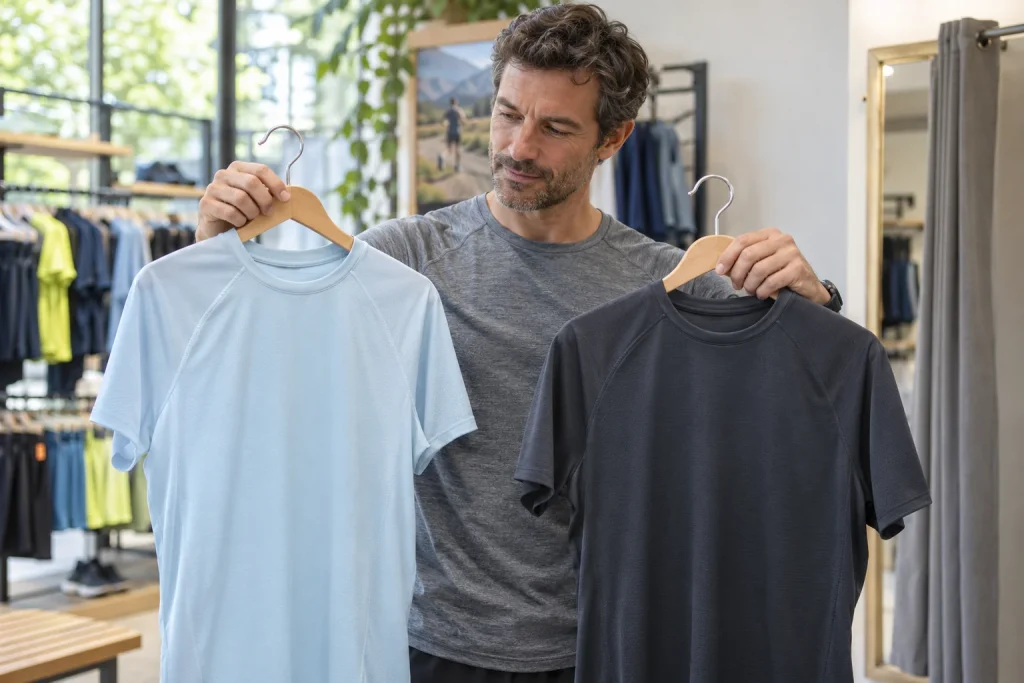
When choosing between a dark and a light running shirt, two questions are easy to confuse. One is how the garment behaves in sunlight in terms of heat load. The other is how much UV radiation the material lets through towards covered skin. Visible colour may arise around both, but does not amount to a single shared protection score. A light top can be properly rated sun-protective clothing, while a dark material’s colour alone does not establish a specific UPF rating.
For a useful choice, put the material’s documented properties, actual coverage, a comfortable cut and your planned running environment alongside colour. Two separate research tasks help explain the distinction in this article: UV testing of technical shirts and assessment of radiative heat exchange on a thermal manikin. Our shopping examples are editorial explanations based on these, not new product tests or predictions of personal heat strain.
Visible colour is one piece of information; UV protection is a separate property
ARPANSA’s clothing guidance lists several factors related to a textile’s UV protection. Alongside structure, density, thickness, stretching and condition, it includes colour and dyeing. In general, darker colours and higher dye concentrations may absorb more UV. However, this is an observation concerning one of several factors. It does not mean any dark shirt receives a defined protective rating purely from the colour you see.
The same dark blue shade can appear on garments with different structures and thicknesses. Similar colours seen in a shop therefore do not establish identical UV transmission through the two materials. The useful question is which specific data belongs to the garment concerned. If one top has a named UPF label and you rely only on colour for the other, you are not comparing information of equal detail. Keep that difference in evidence within the decision.
It is worth describing colour’s role this way: it can help explain a material’s behaviour, but does not replace testing reported for a particular product. This does not narrow the choice exclusively to dark clothing. A light top with documented properties and appropriate coverage can equally form part of your outfit. The aim is to find clothing whose claims you understand the basis for and which you can use comfortably.
What did the study of different-coloured technical shirts find?
Aguilera and colleagues examined 34 technical shirts made entirely from polyester. Alongside colour, they considered fabric structure and cover factor together with several UV-related protective characteristics. In the sample examined, cover factor showed an important relationship with the result, while they did not find the same protective-factor relationship for colour. This illustrates why judging a particular sports textile solely by whether it looks dark or light may be inadequate.
The study does not mean colour never matters in any textile. It concerns a defined sample of polyester shirts and a particular testing arrangement. We do not extend the finding to every cotton garment, dye or fabric structure. The important distinction for readers is between a general material consideration and the finding in a particular sample. Both can be valid information without either having to describe every possible garment.
When comparing products yourself, therefore, first check whether you are discussing the same material and design. Several things may differ between two brands’ light shirts or two different cuts within a range. If the structure is not identical, do not call the comparison purely a colour experiment. The question is then a choice between two whole garments. Documented rating, coverage and comfortable use together may offer more help than a simple ranking of colours.
 Enlarge image
Radiative heat gain is a different measurement question
A primary study published in October 2026 used the thermal manikin called ANDI to examine clothing outdoors in direct sunlight. The method sought to isolate net radiative heat flux in warm conditions with little air movement. In this arrangement, white and light clothing produced more favourable radiative heat gain than darker versions. The research offers a meaningful reference on the relationship between sunlight and clothing colour, but is not a personal core-temperature finding measured in runners.
The thermal manikin does not measure the same task as textile testing for UV transmission. Lower radiative heat gain does not automatically reveal a UPF number, and a high UPF value does not establish your overall running comfort either. This distinction matters even when you consider both questions before a sunny run. You are looking for two separate pieces of documented information about two separate properties.
The practical advantage is that you need not expect everything from one descriptor. You can look for lighter clothing for sunny use while separately checking its UV protection and trying it for your own movements. The three considerations are not mutually exclusive. The product’s particular design determines which properties are available together. The research distinction therefore helps refine your choice; it does not force you to sacrifice either thermal comfort or coverage without thinking.
Reading specifications in two columns: sun protection and use
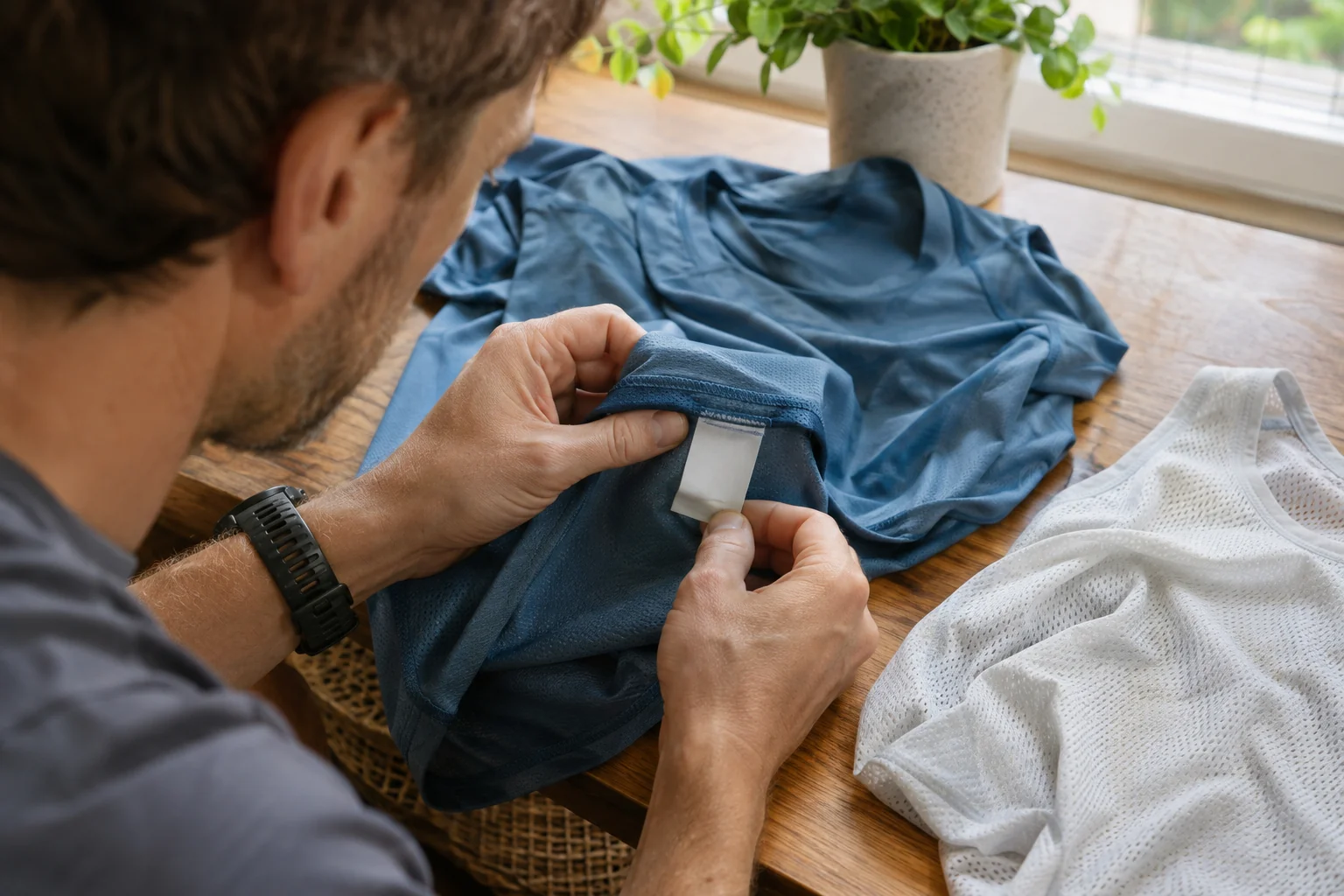
Let the first column of your comparison contain the documented UV property. This can include the particular model, UPF label, specified standard and warnings about use. In the second column, write your practical considerations: colour, cut, sleeve coverage, how seams feel and how it works with a vest. Do not put an equals sign between the columns. The first organises product data; the second describes how you can wear the garment for your own activity.
If data is missing, note the absence too. ‘No UPF is stated’ differs from saying the garment certainly provides no protection; equally, you must not assign it an arbitrary specific value. You can ask the manufacturer for more information or choose an item for which the data important to you is available. The decision becomes clear when documented claims, your own impressions and unknowns are not merged.
One possible question is: ‘Which UV protection rating is stated for this exact colour and material version?’ Another is: ‘To which fabric condition and version does the stated value apply?’ Identifying the model matters more in the question than a long list of technical abbreviations. If you saw several similar products in the shop, your own note of the label can help ensure the answer concerns the garment you chose.
Check coverage in motion; shade is sufficient
The fabric’s protective property relates to the area actually covered. Look at where the sleeve ends, the size of the neckline and where the hem stays when you move your arms naturally. You can learn this through a calm fitting in the shade. You do not need to expose skin to sunlight to see whether it appears during a movement. The check provides information about the garment’s geometry, not a measurement of the fabric’s UPF.
A tightly stretched state may differ from a comfortable resting one. A manufacturer’s warning about stretching may therefore feature among your questions when choosing the right size. The aim is not the largest possible garment, but comfortable fit as intended together with appropriate coverage. If the top regularly shifts or bothers you during an important movement, take this into account as a separate practical experience alongside colour and labelling.
You can also try your own combination with a running vest if you regularly wear one. The clothing may settle differently beneath and beside the straps than when worn alone. You want to understand the whole outfit: what covers you, what can you access and what stays comfortable? Do not call the result of a vest fitting a new UV rating for the shirt. The two pieces of information stay separate: the documented fabric characteristic and your own wearing situation.
Three everyday choices, three more precise questions
In the first situation, you own a familiar dark top but cannot find UPF data for it. The question is then the particular product’s documentation and your full sun protection routine, rather than a rating invented from its colour. The manufacturer may provide further information; in other cases, you may look for an item whose information is easier to interpret for your purpose. Do not automatically classify existing clothing as dangerous or entirely sufficient on the basis of one visible property.
In the second situation, you try a light shirt with a specific UV label, but its sleeve or hem does not stay in the right place. Colour does not supply the next question here; cut and coverage do. It is worth comfortably trying another size or design and checking the documented property for the new version too. Good material data does not remove the skin area that the garment actually fails to cover during your movement.
In the third situation, you have two comfortable garments with appropriate documentation in different colours and are choosing for a sunny run. The environment and your own practical task can then take the foreground alongside other sun protection measures. Research on radiative heat gain may provide a reference, but does not calculate a personal cooling effect for you. You have more real information for your choice without needing to turn any of it into an excessive promise.
 Enlarge image
Colour choice needs a complete plan suited to the day alongside it
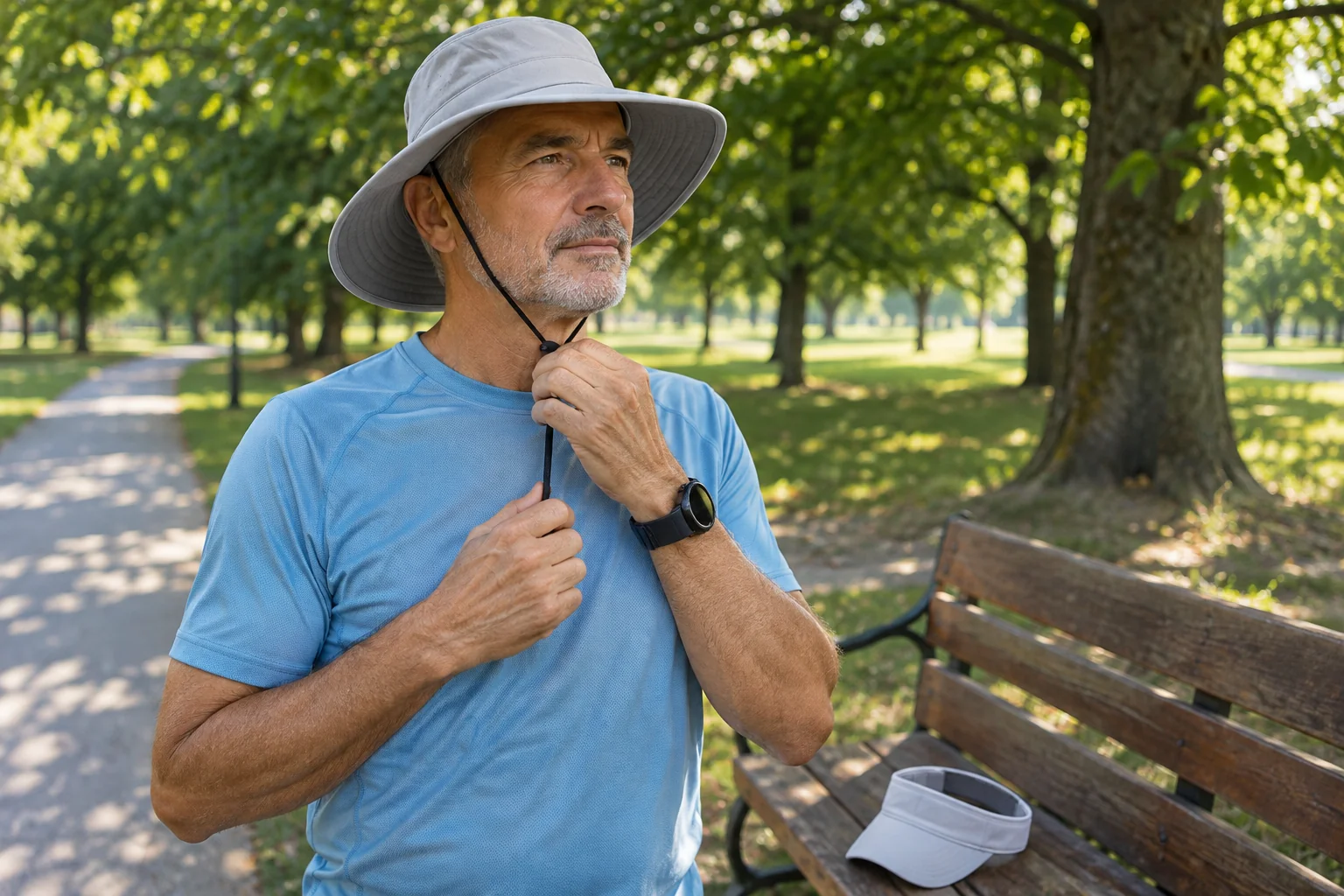
ARPANSA recommends using clothing together with other protective elements under the relevant UV conditions. Exposed skin, your head and eyes need separate attention: headwear, sunglasses, sunscreen used according to instructions and seeking shade can all form part of the full plan. The shirt’s colour does not settle these tasks. Check current local UV information for your route and time separately from choosing the top too.
For practical planning, ask whether you can choose another time or a shadier route and how you will organise the rest of your time outdoors. Warming up, waiting and the journey home may also be time outside, not only the run started on your watch. Think through your whole day, but do not calculate a homemade sunburn deadline from it. Clothing and sunscreen labels are not personal timers accounting for every circumstance.
If you plan to run with individual photosensitivity, a skin condition or a medication-related question, do not replace personal healthcare advice with a choice of clothing colour. You can gather the particular circumstances and chosen protective elements to make the discussion factual. For most everyday shopping questions, however, being able to name colour, verified material properties and actual coverage separately is already a great help.
Primary sources and keeping the findings separate
Factors in UV protection are summarised by ARPANSA’s clothing guidance and the guide to the labelling system. The particular shirt study is Aguilera and colleagues’ study of technical polyester textiles. The separate heat-exchange investigation is the 2026 primary study entitled Dear ANDI; we interpreted the publisher’s available, indexed abstract. Checked: 21 November 2026. The shopping situations are our own examples, not our own clothing tests or personal healthcare findings applying to every runner.
How Futószív articles are prepared: our editorial guidelines.