The coach sees the plan; the runner lives their day. Data and conversations connect the two. If the only report is that everything was fine while an easy run felt hard, the next plan begins from an incomplete picture.
Good feedback needs neither a long account nor a perfect sports watch. It needs the completed task, your experience and important circumstances to reach the coach clearly. Collaboration works when both know which information is needed, when and why.
Make the first agreement about the goal
Do you want a faster race time, consistency, a return after a long break or a sustainable place for running in life? This determines coaching direction. Success differs between runners, and a results list is not the main priority in every period.
Alongside the goal, explain constraints: available days, travel, other sports and known health circumstances affecting movement. A coach cannot read all these from an uploaded run.
Revisit the shared goal occasionally. If life changes, adjusting the plan is not a failure of collaboration. Its purpose is precisely to create a useful next step from reality.
“Easy” does not always mean the same to both people
In a study following university cross-country runners and their coaches, intended and perceived training loads could differ, particularly for sessions meant to be easy. Findings from this specific athlete group cannot generalise to every coaching relationship, but illustrate shared terminology’s importance.
Clarify how easy, moderate and hard tasks are judged. If using a scale, answer the same whole-session question rather than scoring the fastest section one day and the entire day’s fatigue another.
Alongside prescribed pace, make intended execution understandable. What is the goal in wind, on hills or with unusual well-being? Discussing this beforehand reduces guessing between the watch and your sensations.
Four details can make a good brief report
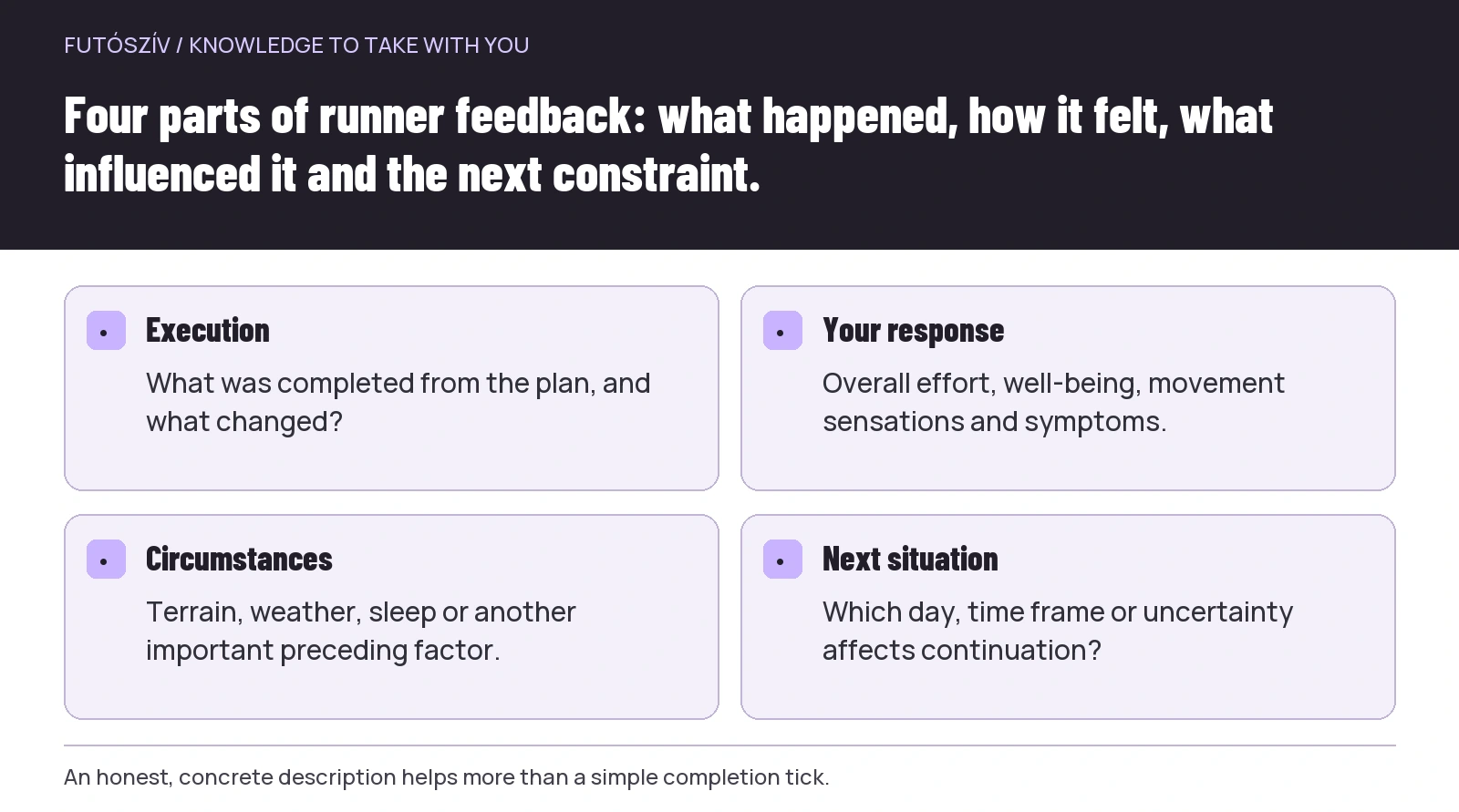
First describe what actually happened. Mark a shorter run, longer recovery or different route. An uploaded average pace may not reveal these differences.
Second, summarise your response: whole-session difficulty, movement sensations and any symptoms. Third, add important circumstances, such as unusual weather, little sleep or another sport the previous day.
Fourth, explain what comes next. Advance notice of travel, a late shift or a family task makes planning easier than retrospective explanation. You need not share every detail, just the framework relevant to the task.
A useful message is not an excuse
A fictional example: “I ran three sections of the main set instead of the planned four. After the second, the whole task became harder than usual, so I shortened it. I slept little last night; I have no symptoms today. I travel tomorrow and will have only a short time window.”
This describes the change, reason and next situation. It is more useful than “I ruined the workout, sorry”. An emotional judgement alone makes identifying necessary plan changes difficult.
You need not present a run more favourably for the coach. Longer recovery, extra acceleration and omitted sections are all important information. An honest report is the material for shared work, not a judgement on yourself.
 Enlarge diagram
Text version of the illustration
- Execution
- What was completed from the plan, and what changed?
- Your response
- Overall effort, well-being, movement sensations and symptoms.
- Circumstances
- Terrain, weather, sleep or another important preceding factor.
- Next situation
- Which day, time frame or uncertainty affects continuation?
Report symptoms separately and precisely
Instead of “my leg felt odd”, describe where discomfort appeared, when it began, how it changed and whether movement was affected. You need not provide your own diagnosis. The coach also needs to distinguish actual observation from assumption.
A coaching relationship cannot replace healthcare. New, worsening or concerning symptoms may need an appropriate professional; an urgent illness should not wait for a message reply. Make this boundary clear in communication arrangements.
Where necessary, adapt the subsequent plan to healthcare advice. Give your coach information needed for load planning and which you wish to share. The extent of data sharing can be agreed beforehand too.
Agree the scope for independent adjustments
What happens if a task feels disproportionately hard, weather deteriorates or time becomes shorter? When can you ease, shorten or omit it? A shared principle beforehand is better than uncertain execution every time.
The agreement does not grant unconditional permission to run through every difficulty. Health questions require separate assessment. Independent decision boundaries support a responsible programme adapted to circumstances.
Briefly report adjustments afterwards. Do not secretly make up omitted work elsewhere to match weekly numbers. The coach needs actual load for future planning.
The relationship’s supportive quality matters too
A study of questionnaire data from more than five hundred athletes described associations between the coach–athlete relationship, support, confidence and well-being. It was cross-sectional and does not prove that one communication method causes a specified result for everyone.
The practical question still matters: can you report honestly, ask and express uncertainty? Fear of humiliation over a bad day can remove information needed for planning. Disciplined work and a respectful relationship can coexist.
Coaching feedback should clarify the next decision. Beyond praise or dissatisfaction, it helps to explain what worked and what will change. The runner then understands the programme better rather than merely executing it.
Do not let channels become an information maze
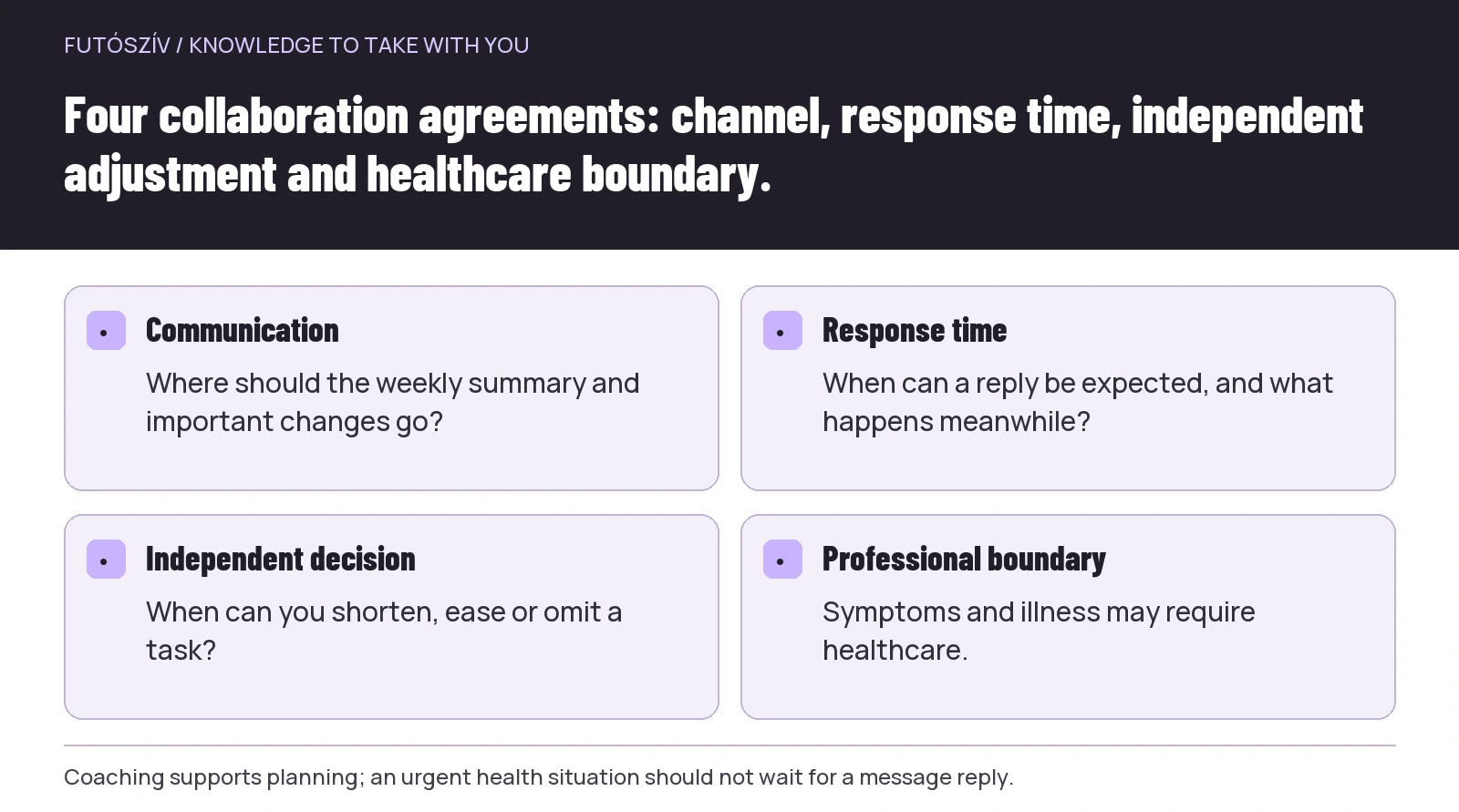
Agree where the plan lives, where brief post-session comments go and how important changes are reported. If data sits in an app, symptoms in an old message thread and next week’s availability is spoken, information is easily lost.
You do not necessarily need one tool for everything, but a clear system. Know which platform each person checks and when, and what needs a separate signal. Match channels to the scale of collaboration.
Clarify response time too. A remote coach may not be available every minute of every run. If the plan needs constant immediate answers, establish more decision boundaries beforehand.
Look for patterns in the weekly summary
Alongside short daily comments, occasionally review repetitions. Which day was regularly hard, where did time fail to fit and which task worked well? A recurring pattern may tell more than one unusual run.
Include more than mileage. Execution, effort and life circumstances shape next week too. If late training regularly shortens sleep, for example, reflect this in task order.
End the joint review with a clear next decision: what stays, what changes and what you will observe afterwards. Every review need not rewrite the entire programme. One well-chosen adjustment can teach a great deal.
 Enlarge diagram
Text version of the illustration
- Communication
- Where should the weekly summary and important changes go?
- Response time
- When can a reply be expected, and what happens meanwhile?
- Independent decision
- When can you shorten, ease or omit a task?
- Professional boundary
- Symptoms and illness may require healthcare.
Discuss the race goal before starting
Clarify the target time’s basis and conditions that change it. The coach’s estimate, runner’s dream result and daily reality are not always identical. Unspoken differences can produce different assessments after the race too.
Agree pacing, practical tasks and what happens if environment or condition differs from expectations. An alternative goal need not weaken commitment. It can help the runner regard more than one outcome as meaningful.
After finishing, allow both a factual and experience-based account. What happened, and how did you experience it? Together these inform the next period’s task.
Communication depends on the situation
A qualitative study involving eight Olympic archers explored communication considered important in differing training and competition situations. Another sport and distinctive environment cannot supply a ready-made running-coach method. It does remind us that the appropriate message depends on situation and person.
During training, a short concrete instruction may help. Weekly review allows more explanation. After a difficult race, listening may come before detailed split analysis.
Explain which feedback you understand easily and ask about unclear terms. Building shared language is part of the relationship, not a one-off introduction. Neither person needs to read minds.
If you disagree
State the concrete difference: an overcrowded week, unclear task purpose or a different assessment of current condition. Observation and questions help more than personal judgements. Give the coach an opportunity to explain their reasoning too.
If disagreement concerns symptoms, appropriate healthcare assessment has a separate role. Exercise tolerance is not determined by who argues more convincingly. Respect professional boundaries and the runner’s own reports.
The collaboration’s format or goals may not fit. Review this factually too. A relationship’s value depends not on remaining unchanged in every circumstance, but on supporting appropriate, respectful work for the runner.
The coach cannot solve every life situation
A good coach supports and helps organise sporting tasks, but cannot replace every other professional. Nutritional, health or mental difficulties may require additional help. Appropriate referral can be part of collaboration.
Equally, the runner is more than a data supplier. Goals, experience and available time come from your life. Express these even when they do not fit a predefined app field.
A productive relationship is shared orientation: the coach provides a professional framework, the runner honest experience and the plan develops from both. Precise feedback aims not at a perfect completion list, but a next task suited to a real person and real week.
Primary research
- A season-long comparison of runners’ and coaches’ perceptions of training load – a university cross-country setting.
- Coach–athlete relationship, support, confidence and well-being – questionnaire associations, not causal proof.
- Communication situations among Olympic archers – small-sample qualitative research in another sport.
How Futószív articles are prepared: our editorial guidelines.