
The finish clock, your watch and the results list can show different times without any necessarily being wrong. Often, they start and stop at different moments. To understand net and gross time, first name the endpoints: from which starting event to which finish does the measurement run?
At a mass-participation road race, the field may take time to cross the start line. At the official starting moment, a runner at the back may not yet be moving on the course. The two time concepts make this difference visible. Rules for placing, awards, cut-offs or qualification must still be checked separately in the event’s current information.
Two starting points, the same finish
Gross time runs from the official start to finishing within the race’s system. English information often calls this gun time. Net time runs from a runner’s own start-line crossing to finishing, and may be called chip time or net time. Identify the exact field using the results list’s key.
The road-race organising manual from World Athletics’ predecessor separately presents these two starting points in transponder timing. We use its conceptual explanation here; an older publication does not establish award rules for every current event. Your race’s current information remains necessary.
In a simple example assuming one shared start and identical finish detection, gun time includes waiting to reach the start line. Chip time excludes that wait. Wave starts or separate race categories may make the official starting reference more complex, so do not infer from the label alone. Check which start the system uses.
An illustrative timeline
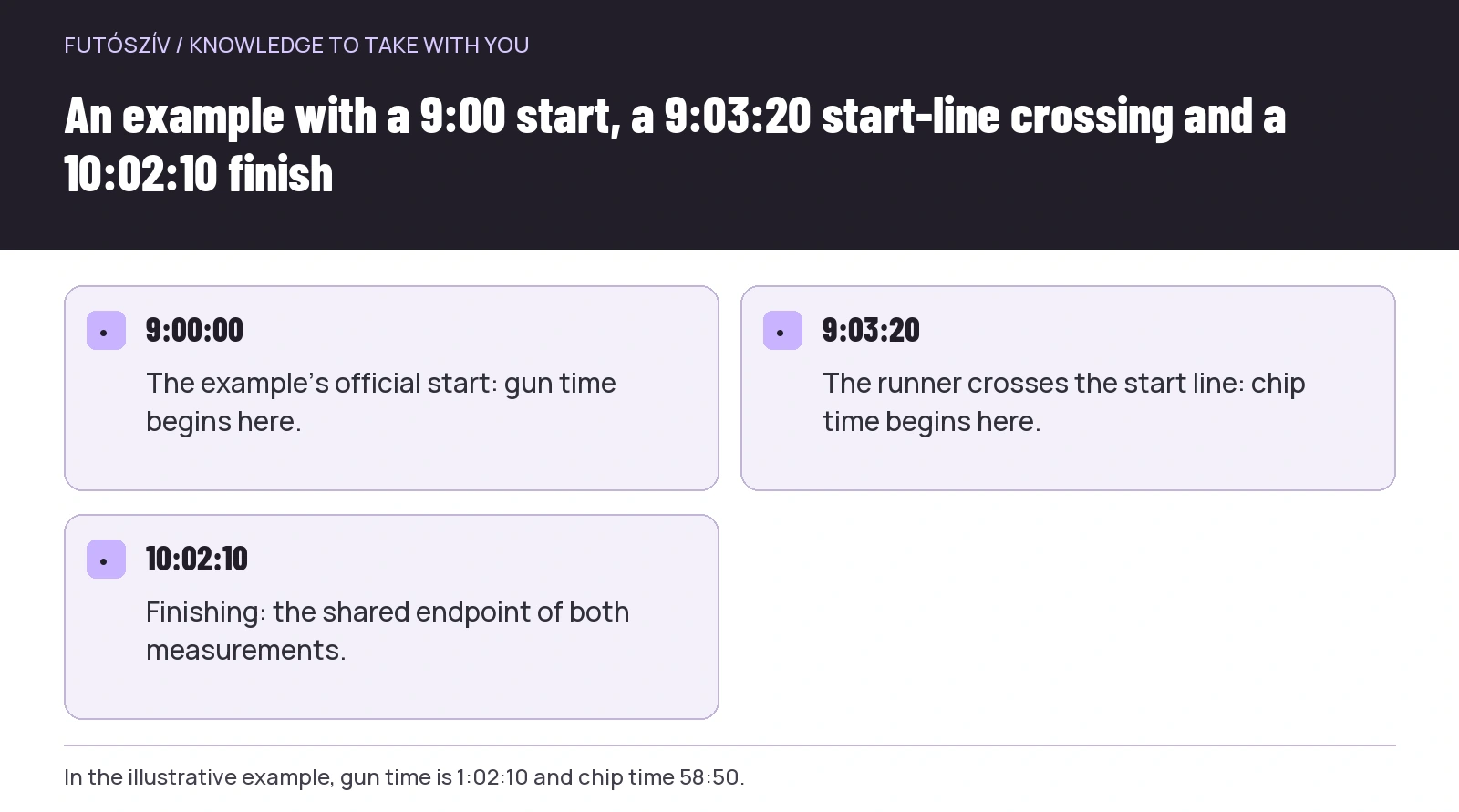
Suppose an imaginary race officially starts at 9:00:00. A runner crosses the start at 9:03:20 and finishes at 10:02:10. In this example, gun time from the official start is 1:02:10. Chip time from the runner’s own start-line crossing is 58:50. The difference is 3:20, the time from the official start to reaching the line.
| Event | Imaginary time | What is it needed for? |
|---|---|---|
| Official start | 9:00:00 | The gun-time starting point in the example |
| The runner crosses the start | 9:03:20 | The chip-time starting point in the example |
| The runner finishes | 10:02:10 | The endpoint of both measurements |
| Gun-time result | 1:02:10 | From official start to finish |
| Chip-time result | 58:50 | From the runner’s own start crossing to finish |
The table is a calculation example, not a real result. It separates three events. Seeing around 1:02 on the finish clock does not prevent your own chip time being under an hour. The starting point gives the data meaning, not just the size of the displayed number.
 Enlarge diagram
Text version of the diagram
- 9:00:00
- The example’s official start: gun time begins here.
- 9:03:20
- The runner crosses the start line: chip time begins here.
- 10:02:10
- Finishing: the shared endpoint of both measurements.
Do not automatically treat the finish clock as your own time
With several waves, multiple distances finishing together or a complex event, the clock may need a separate explanation. Its display does not necessarily count from your own start-line crossing. Review event information beforehand and look for the official result in the correct category.
Finish photographs can be particularly misleading. A runner and the clock appear together, but the image does not establish that runner’s start. When sharing a result, name the data used. “My chip time was…” is more precise than an unexplained screenshot.
Understanding waiting time can help pre-start calm too. If the event’s system provides chip timing, time to reach the start line has a different role in your personal chip result. Zone rules and starting procedures still apply. Timing operation does not authorise joining another zone or delaying your start improperly.
Your own watch may provide a third kind of data
You choose when to start and stop the device. Pressing at the start signal may put your recording closer to gun time. Starting at the line may place it closer to chip time. Buttons and automatic functions can record different moments, however, so identical results to the second are not necessary.
Check whether your app displays elapsed time or moving time. Automatic pausing or manual stopping serves a different task from start-to-finish race timing. Time at an aid station, toilet or course stop may continue in the race while one watch summary counts differently. Clarify the data field’s name before comparison.
Use your watch to follow the programme, but it does not automatically determine the results list. With a discrepancy, first inspect the measurements’ starting and finishing points. A device recording may help clarify a question, but does not independently replace the official result. Follow the organiser’s process.
Placing and personal time may need different rules
Two runners’ finish-line order and chip-time order can differ if they crossed the start at different moments. This is not a mathematical contradiction. Someone reaching the start later may have a shorter chip time while finishing behind another person. You therefore need the organiser’s rule to establish placing.
The official detailed SPAR Half Marathon page separately addresses possible differences between award order and a net-time-based list in its timing and results information. Check current conditions for the particular edition there. The example shows that a results list may serve several purposes; learn the ordering basis alongside the field name.
Do not create a general rule from which time determined your placing at a previous race. Event, category and award type can matter. If competing for a prize or official qualification, read the relevant conditions separately. Tracking a recreational runner’s personal target time may be a different question.
A second calculation: the order of two runners
An imaginary shared start happens at 10:00. Anna crosses the start at 10:01 and finishes at 10:56, giving chip time of 55 minutes and gun time of 56 minutes. Bence crosses at 10:04 and finishes at 10:58, giving chip time of 54 minutes and gun time of 58 minutes. Anna finishes first; Bence spends less time between his own start and finish.
This does not establish which receives the higher official placing. The race rules would be needed. The example deliberately names no winner; it only shows why order and time type need separate treatment.
When comparing results with a friend, look at the same column first. Your gun time and their chip time use different starting points. The comparison can mislead even if both numbers are correct. Precise terminology can resolve the apparent contradiction simply.
 Enlarge diagram
Text version of the diagram
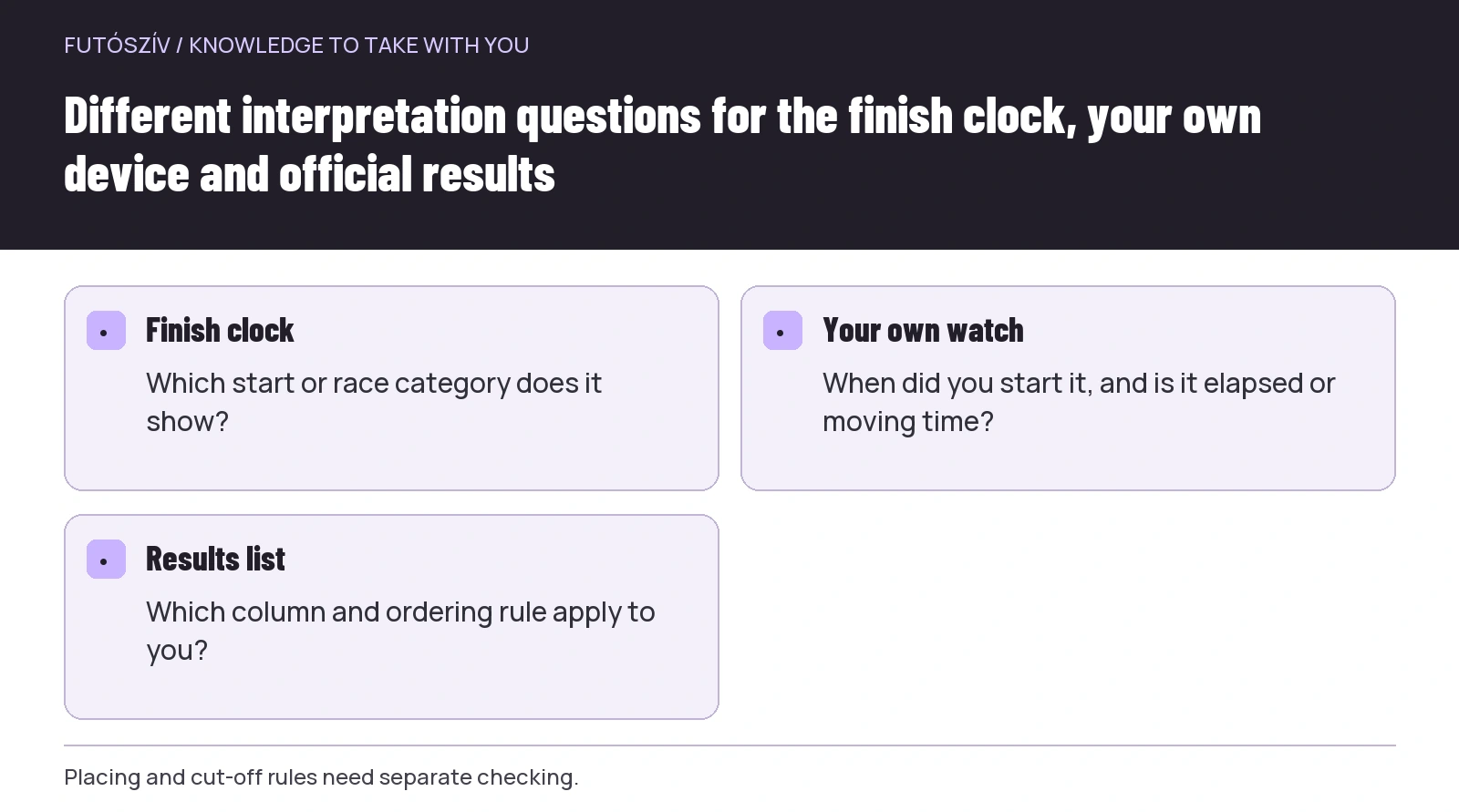
- Finish clock
- Which start or race category does it show?
- Your own watch
- When did you start it, and is it elapsed or moving time?
- Results list
- Which column and ordering rule apply to you?
Read the cut-off’s starting point separately
The existence of chip timing does not automatically establish every cut-off detail. An event may define overall and intermediate limits tied to a start or specified time. Find the precise wording. With wave starts, the reference applying to your situation matters particularly.
Do not try to reconstruct the whole system from the finish clock while running. Record beforehand where the particular limit starts. Split and checkpoint conditions may get separate lines. A cut-off is an organiser’s framework to account for while planning.
If the wording is unclear, ask precisely: “In my wave, from which time is the intermediate checkpoint limit counted?” This is more useful than the general question “is there chip timing?”. The answer then concerns the decision you actually need. Keep the organiser’s official information.
Correct chip use may be a prerequisite for timing
Read where the device is, how to wear it and whether it must be returned. A chip built into a bib’s back and a separate relay device to hand over are different use situations. General running experience does not replace the particular device’s instructions. If uncertain, ask before the start.
The Budapest Half Marathon pairs information , for example, distinguishes the roles of individual and relay-related bibs. Everyone in a team therefore needs to know which object moves on with the next member. Check exact wearing and handover procedures for your edition rather than relying on general memory.
At timing points, follow the route and organiser instructions. There is no need to make a conspicuous movement bringing the device close to a mat unless instructed. Your task is correct wearing and following the designated route. The organiser or timing team can clarify operational questions at an appropriate time.
If a result is missing or different
First check the category, edition and name you are searching. Inspect field labels, results-list status and the stated contact channel. A fresh list may still be processing, but do not automatically use this to explain every omission. Organiser information guides the next step.
Gather the number, category, discrepancy seen and available personal data for your enquiry. Be factual: which field shows what, and why do you request a check? Do not construct a certain technical explanation from another participant’s data or a finish photo. The responsible people know the system’s details.
Keep any deadline for results enquiries in mind. A social comment is not always an official report. Using the correct channel helps the question reach the right place. Meanwhile, keep your own recording if relevant to clarification.
Which time belongs in your log?
Add type and source beside the number. For example, “official chip time”, “gun time” or “my watch’s elapsed time”. If following chip results for a personal aim, keep the label consistent later too. Consistent data naming simplifies many future comparisons.
For qualification or submitting a time to another event, check that event’s conditions separately. A number saved as a personal best is not automatically accepted everywhere. Required time type, evidence and event conditions matter together. Accurate documentation is more useful than keeping one unexplained number.
Chip and gun time ultimately answer two different questions about the same finish. Knowing their starting points makes results-list differences easier to interpret. You can add meaning to your watch and finish-clock numbers, then find the appropriate race rules for placing and time limits.
How Futószív articles are prepared: our editorial guidelines.