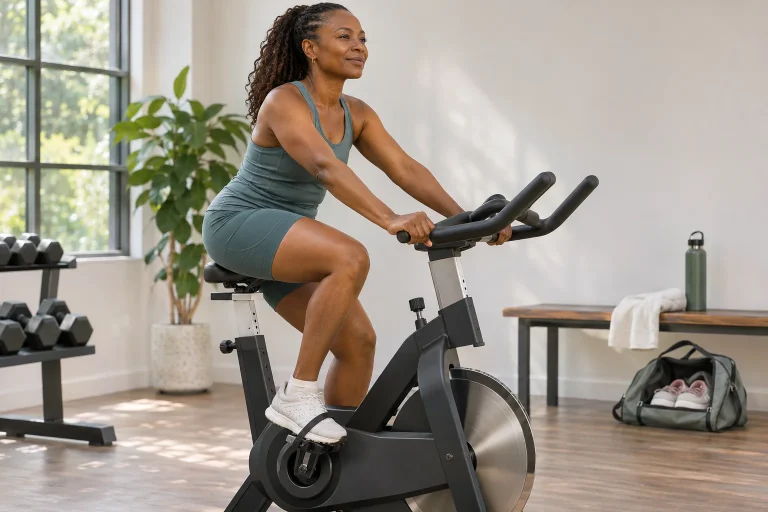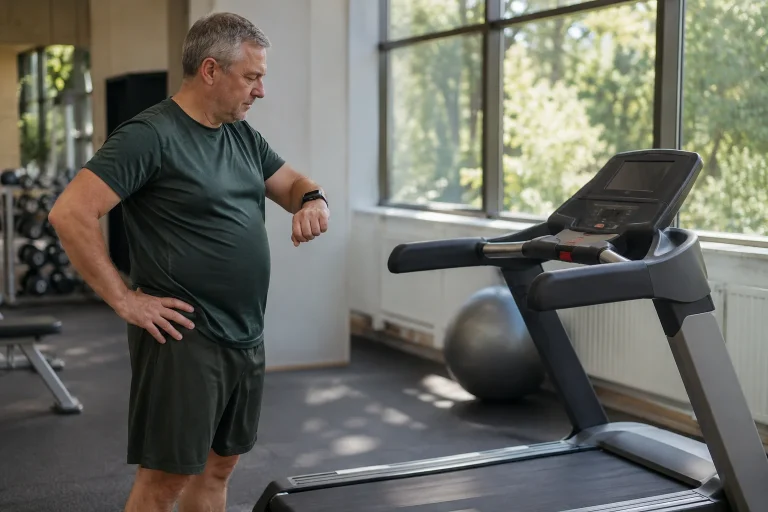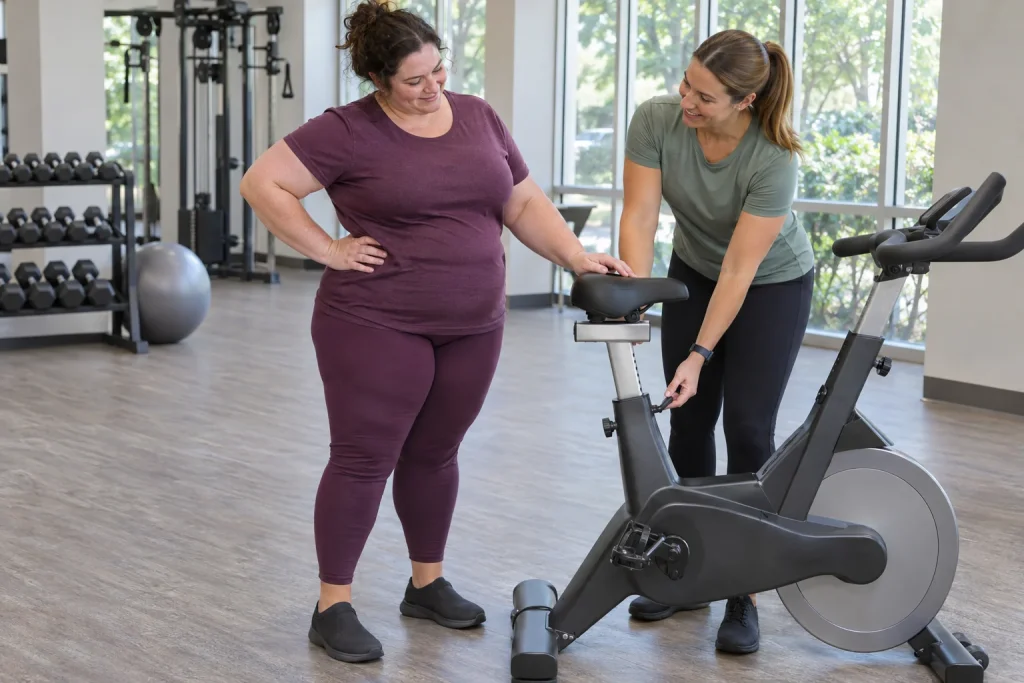
Three exercise bikes stand next to one another in the gym. They all look substantial, but one seat cannot be adjusted comfortably, another requires a high step-over, and the third has no maximum user weight you can find. You do not need to summon the courage for a risky trial. You need a few precise technical details and appropriate help. This is as much a part of choosing equipment as opening hours or access to changing rooms.
At a higher body weight, raising capacity limits can feel particularly uncomfortable. You may worry everyone will look at you or the question will become an unsolicited dieting conversation. Factual preparation can preserve the discussion’s purpose: finding equipment you can use comfortably according to its instructions. A machine’s limit is a property of the machine. It does not describe your efforts so far, your character or which movement may become appropriate for you.
Three separate questions: can it support you, do you fit, and is it usable?
The manufacturer’s maximum user weight is a condition of use for a particular product. Seat width, step-over height, handle placement and adjustable pedal distance are separate information. A machine may meet the technical capacity requirement yet fail to provide a suitable seated position. A wider seat alone does not establish sufficient capacity, and a heavy frame does not replace the manufacturer’s description.
The third question is actual usability. Can you reach a control without stretching uncertainly forwards? Can you stop the moving equipment as demonstrated? Is there room to get on and off even when someone uses the neighbouring machine? These practical details cannot be read from a single kilogram figure. The importance of appropriate size and operation is also highlighted by the NIDDK information on becoming active.
Write the three considerations on separate lines. For example: the maximum user weight has been confirmed; seat adjustment still needs clarification; you want to try getting off only with a professional present. A favourable figure then cannot conceal the other two open questions. You need not immediately judge the whole gym yes or no: first establish which specific equipment might be an option.
Identify the exact machine before looking for a number
A brand name is usually insufficient. One manufacturer may make several treadmills, bikes or strength machines, with different instructions for different versions. Ask for the model and, if needed, the variant and information identifying the actual unit at the gym. A photograph of the rating plate taken at reception may be more useful than a product name recalled from memory; do not include other guests without permission.
Check what the capacity table actually names. The machine’s own weight, shipping weight and maximum user weight are different concepts. In an English description, “maximum user weight” is one phrase to look for; “weight” alone is insufficient. Confusing pounds with kilograms is another possible source of error. Ask for unambiguous units, rather than choosing by the larger number.
The official Concept2 BikeErg product page, for example, lists user-weight capacity, machine weight and the seat-to-pedal range separately. This illustrates a specification sheet’s structure, rather than recommending the model generally to everyone living in a larger body. One model’s figures must not be transferred to another bike, every product from that manufacturer or an unidentified unit in the gym.
If older information and a new product page give different figures, do not decide by appearance which applies to the local machine. Send identifying details to the operator or manufacturer’s customer support. General internet searches can easily mix versions or old descriptions. Until clarified, technical suitability remains unresolved, rather than implicitly established.
 Enlarge image
How can you ask beforehand without a public weigh-in?
A phone call or email may be the easiest way to begin. For example: “I would like the exact model of your exercise bike and the manufacturer’s maximum user weight. Could you help with its manual and a short adjustment trial?” This is a technical request. It does not require your complete weight history or a commitment to lose weight before receiving an answer.
If choosing suitable equipment requires discussing personal information too, you can ask to speak privately. Identify what you want clarified and ask how the information you provide will be used. Learn the gym’s own procedure beforehand; this article does not claim identical administrative requirements everywhere. You need not volunteer to be weighed at an open reception in front of other guests to obtain the equipment specification.
“It will definitely be fine; it is a very strong machine” may be kindly intended but is incomplete. You can respond: “Thank you; I would like to check the specific manufacturer figure.” If the manual is unavailable, agree who will find it and by when. Several other guests having used the machine does not resolve uncertainty. Someone else’s size and previously problem-free session are not documentation for your choice.
The on-site trial should be setup, rather than a performance test
You do not need to complete an entire workout on your first visit. First learn the machine’s operation and use situation with a staff member equipped to help. Ask them to demonstrate adjustment, checking fastenings and stopping. Afterwards, describe the sequence in your own words: which lever releases what, and what must be secured again before use.
Stop the machine as instructed before making any adjustment for which the manufacturer requires this. Do not assume every seat lever or pedal fastening works like the one at your previous gym. If adjustment requires holding a heavy component or adopting a position that feels uncertain, ask for help. Learning setup is not a dexterity contest, and staff assistance is more than pointing out the machine’s name.
During the trial, notice what limits you. Pressure from a seat edge, inability to reach an adjustment lever and pain during movement are different problems. The first two require clarifying design and access; pain must not automatically be attributed to a faulty seat. Do not try to prove yourself with increasing resistance because someone says the equipment should be comfortable.
Condition and surroundings matter even when the specification is suitable
Technical documentation applies to equipment used and maintained as instructed. A loose seat, damaged part or adjustment mechanism that does not secure reliably is not acceptable because the nominal weight limit is suitable. Report the fault to staff and do not continue on the assumption that it will probably survive another session. Judging repairs and technical usability is not the guest’s responsibility.
The manufacturer’s manuals and drawings matter because they contain operation and maintenance requirements alongside dimensions. They establish the placement, clearance or checks required by the product. Do not improvise an extra seat riser, independently replace a load-bearing component or prop up a wobbling machine with a random object. A comfort modification can affect operation too.
Examine the surroundings under everyday conditions too. Can you approach with your bag, put belongings somewhere and avoid stepping over a weight plate left beside the pedal? After a demonstration in a quiet, empty gym, ask about busier periods too. You should not have to squeeze your body smaller to pass along an obstructed route; another layout or time may be possible.
Weight capacity is not a medical fitness certificate
Even if a machine satisfies every technical and size requirement, this does not mean using any resistance or duration is advisable. Current activity levels, symptoms, known conditions and the selected task are separate questions. The NICE recommendations on activity emphasise considering individual physical abilities. This is not an identical exercise dose assigned to everyone of one body size.
The reverse is also true: a machine with insufficient capacity does not prove all movement is impossible for you. Another device, another gym or an appropriately selected activity needing no equipment may be an option. The choice need not be treated as a compulsory waiting room for running. If comfortable cycling or walking currently suits your condition and goal, its value is not determined by when you replace it with jogging.
If chest pain, severe breathlessness or feeling unwell occurs during use, stop and ask for help; severe or sudden symptoms need urgent care. Recurring joint pain, dizziness or unusual exertional symptoms deserve separate assessment. These cannot be explained by the kilograms in a specification sheet. Clarifying technical questions and investigating health symptoms complement one another.
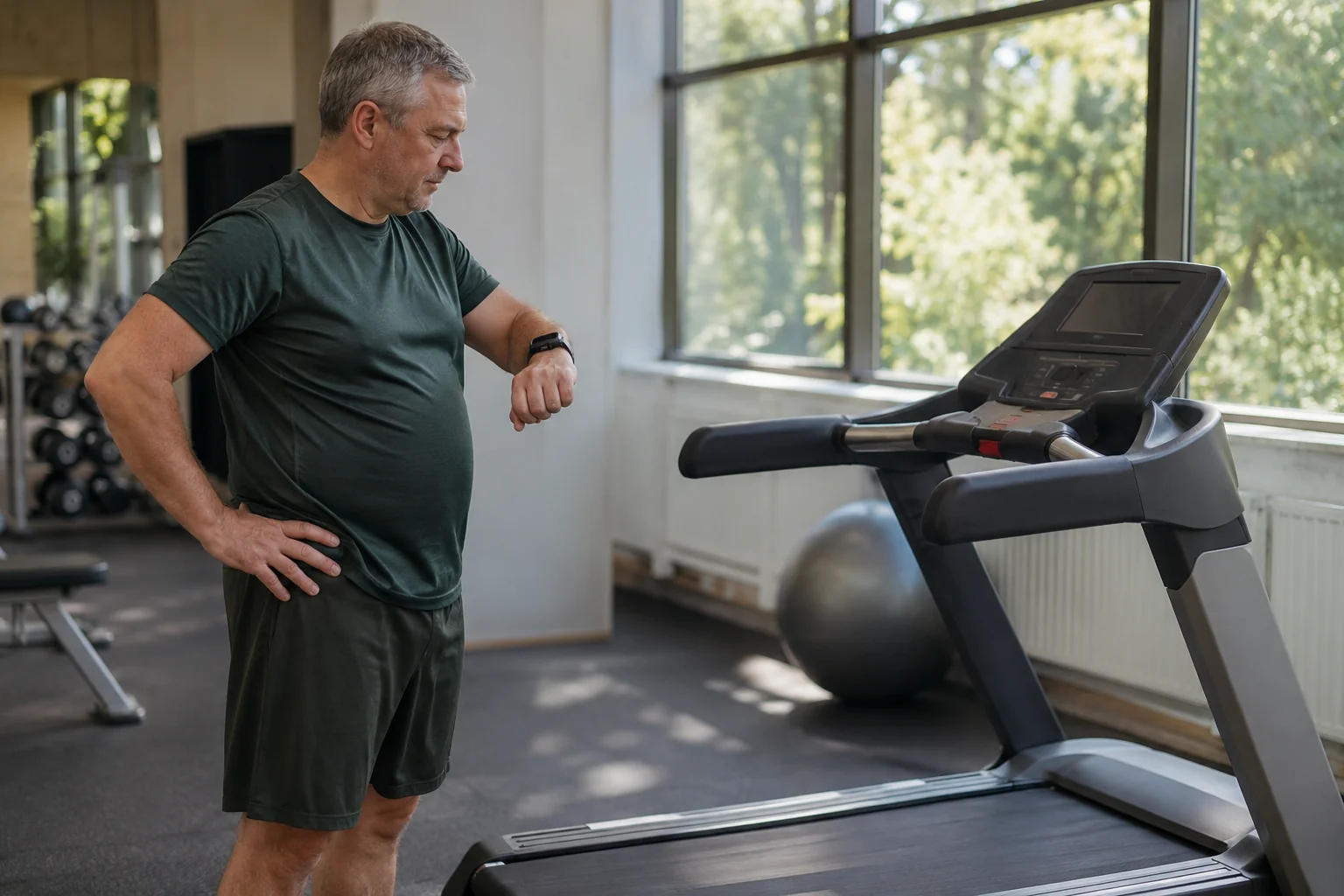 Enlarge image
Before buying equipment or a membership, consider the whole use situation
For home equipment, package size, delivery and assembly matter too. Fitting the machine into a room does not necessarily leave the required operating space around it. Plan where you will get on, in which direction you will adjust the seat and how a helper can reach it. Do not substitute the narrow passage you are used to at home for clearance specified in the technical manual.
For a used product, ask for the exact model, an available manual and condition information. A seller calling it “professional equipment” does not replace a missing rating plate. If the model or compliance with use conditions cannot be clarified, leave the purchase undecided. You are not obliged to pay on the spot to avoid disappointing the seller.
For a gym membership, agree trial and contract details before paying. Ask which machine is usable for you, what happens if it is being repaired and whether a meaningful alternative exists. A single suitable machine being constantly occupied also affects everyday usability. Check prices and cancellation conditions in that particular facility’s current information; general activity recommendations do not guarantee access at a specific gym.
A short question sheet that keeps the discussion on topic
Make your own five-line note: exact model; manufacturer’s user-weight limit; size and adjustability; getting on and off reviewed with assistance; unresolved question and contact person. The note is not a health test and needs no score. It helps identify missing information even after a polite but vague answer.
If someone makes an uncomfortable remark, redirect the topic: “Right now, I would like to understand the equipment’s documented conditions of use.” If staff cannot help factually, seeking another employee or facility may be reasonable. You need not put safe use aside to avoid seeming a demanding guest. Good cooperation provides data, a clear demonstration and a respectful answer to your question.
Your first success may therefore be not getting onto a still-unconfirmed machine, while finding the person who can locate the right manual. That is real progress towards a usable exercise environment. Next time, you can arrive with identified equipment, learned adjustments and a plan respecting your own limits, rather than a general promise.
Sources
- NIDDK: Staying Active at Any Size
- NICE NG246: Physical activity and diet
- Concept2: BikeErg product specifications
- Concept2: BikeErg manuals
How Futószív articles are prepared: our editorial guidelines.