When breastfeeding, running often starts with something other than planning the workout. First you need a window between feeds, a comfortable bra, someone to take care of the baby and, ideally, a proper meal too. These are not minor inconveniences that interfere with sport: they are the conditions that make running possible at this stage of life. A well-organised short session may offer more than an ambitious plan that repeatedly leaves out eating or rest.
Breastfeeding in itself does not mean that exercise harms breast milk. However, readiness to run after childbirth is a separate question. If you still have wound-healing issues, pelvic-floor symptoms or other concerns, follow the appropriate care and activity plan. The practical suggestions below are for someone whose individual condition already allows the activity concerned.
What do we know about milk, and what does the research not answer?
In an early randomised study aerobic exercise improved breastfeeding participants’ fitness without showing adverse changes in breast-milk volume or composition, or in infant weight gain, during the period studied. This is an important counterpoint to fears that moderate exercise necessarily spoils breast milk.
However, a study like this does not establish the safety of every running workload, every nutritional situation or every postpartum condition. It cannot show that prolonged, exhausting exercise or a substantial energy deficit does not matter. Use the finding to answer the question it actually addresses: breastfeeding and appropriately chosen aerobic activity can be compatible.
There is no need to fear for milk quality after every run or to introduce complicated feeding rules on your own because of this concern. If there is a genuine concern about your child’s feeding or growth, discuss it with the child’s healthcare provider and a professional experienced in breastfeeding. A training diary does not replace that assessment.
A running day in practice: start with the time window
Choose a time that does not require a long delay to a usual feed. According to ACOG, breastfeeding or expressing before a run may reduce the discomfort of full breasts. This is an option for comfort, rather than compulsory extra expressing before every session. Keep your own feeding situation and your baby’s needs at the centre of planning.
In practice, this may mean a short session, staying close to home and allowing the departure time to shift slightly. Agree with the person caring for the baby when you expect to return, how to contact you and what will happen if leaving turns out not to be practical. Agreeing changes in advance can be less stressful than negotiating at the last moment.
If a feed or a difficult morning means missing a run, you do not have to squeeze it in that evening at any cost. Build real alternatives into the weekly rhythm: a shorter activity the next day, an easy walk or simply rest. Treat these as options rather than debts.
Do not make a long run the first test of your bra
Look for support that allows comfortable movement and breathing without painful pressure. Do not estimate the right size solely from your pre-pregnancy clothing. How full your breasts are that day, strap adjustment and fabric seams also matter. Try the bra while walking and moving briefly before planning a longer session.
Good support should not be equated with the tightest possible compression. The NHS information on mastitis recommends a comfortable, supportive bra and also mentions avoiding tight clothing. If an elastic band or fastening presses on one spot, do not try to get used to it while running. Another style or adjustment may work better.
A sports bra that opens for feeding may be convenient, but it is not essential equipment. What matters is how it works for you: can you move comfortably, access your breast when needed and avoid chafing from the fastening? The most technical labels do not necessarily indicate the best solution.
 Enlarge diagram
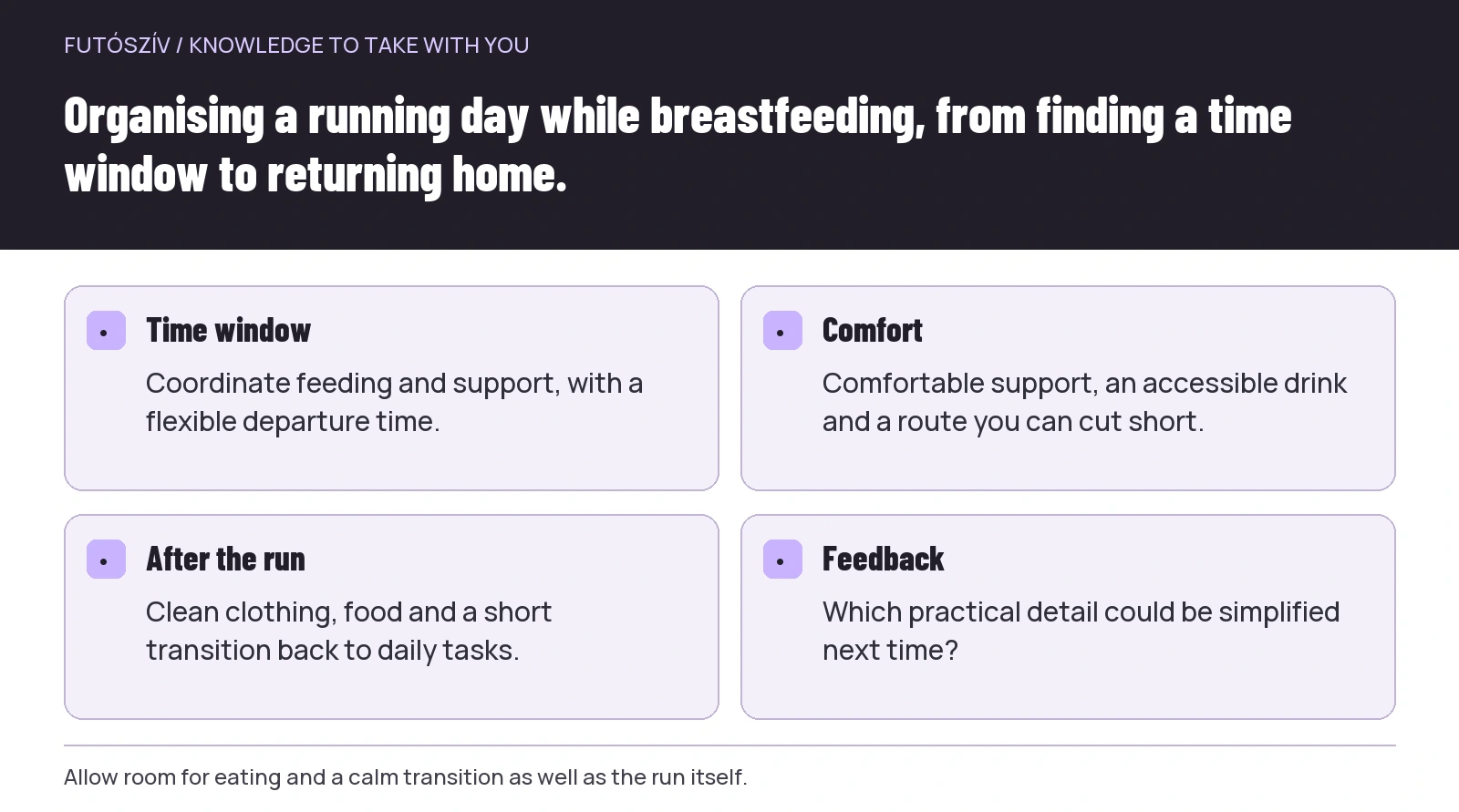
Text version of the illustration
- Time window
- Coordinate feeding and support, with a flexible departure time.
- Comfort
- Comfortable support, an accessible drink and a route you can cut short.
- After the run
- Clean clothing, food and a short transition back to daily tasks.
- Feedback
- Which practical detail could be simplified next time?
Do not leave eating as a task to postpone until after exercise
The CDC explains that energy needs during breastfeeding are affected by factors including activity and whether feeding is exclusive or mixed. A single figure supplied by an app will therefore not necessarily describe your daily needs. Running adds to the demands of this life stage; it does not make regular meals unnecessary.
Look at your actual day rather than an ideal version. Is breakfast available after a disrupted night? Can you eat at lunchtime, or do you start housework as soon as the baby falls asleep? Preparing food for after a run can mean a simple sandwich, a leftover main meal or another food you tolerate well. It does not require a specialist recovery product.
Arranging regular meals is often a family task. The person helping with the baby may also help ensure that food is prepared and there is time to eat it. If you rush straight back into the day hungry after every run, address that situation before making the pace plan stricter.
Weight loss should not be a condition for returning to running
It is easy to treat breastfeeding, training and weight change as one project. Yet this can quietly create a daily pattern in which you complete the exercise while repeatedly cutting down your food. The value of your return is not measured by how quickly you fit into an old pair of trousers.
If you want to exercise and change your eating at the same time, tell your professional adviser that you are breastfeeding, how much activity you do and what symptoms you have. Persistent fatigue, poor recovery or declining performance does not establish any single deficiency, but it can be a good reason to review the whole situation. Do not try to diagnose yourself from a self-selected calorie target.
Your aim may simply be to have enough energy after running to eat, care for yourself and take part in the rest of the day. This is no less serious a sporting goal. It provides a foundation for more predictable training later.
Fluids: make them accessible, not compulsory
Preparing a bottle may seem a small thing, but it is easily missed when every minute before departure is busy. Have a drink available before and after the run, and adapt the route to the weather. A short loop in cool conditions and a longer session in the heat are different situations.
Do not force yourself to drink as much as possible as a supposed guarantee of milk supply. If you are unsure of your fluid needs, have unusual symptoms or follow medically prescribed fluid guidance, seek individual advice. A sports drink is not essential for every jog while breastfeeding either; the session’s duration and circumstances matter.
A practical arrangement may be to keep a drink by the place where you feed at home and prepare a separate running bottle. This makes drinking less likely to become another item on the task list that you remember only in the evening. Convenient access helps more than a rigid litre target designed for someone else.
If you are concerned about milk supply, do not diagnose running as the cause
The HSE recommends contacting a healthcare professional experienced in breastfeeding if you are worried about milk supply. The current fullness of your breasts or the result of one expressing session is not enough to determine on your own that running has caused a problem. The baby’s feeding and growth, the feeding circumstances and the mother’s condition need to be assessed together.
Prepare a brief, factual account: when the concern started, whether feeding or expressing routines changed, whether there was an illness and what activity you did. This can help a professional, but it should not become a home experiment with your baby’s feeding. Necessary feeding support must not be delayed while trying to prove a theory about exercise.
A temporary change to training may be practical while the situation is clarified. Continuing, supplementing or ending breastfeeding, however, involves personal and healthcare decisions. Nobody has to follow one supposedly correct feeding story for the sake of running performance.
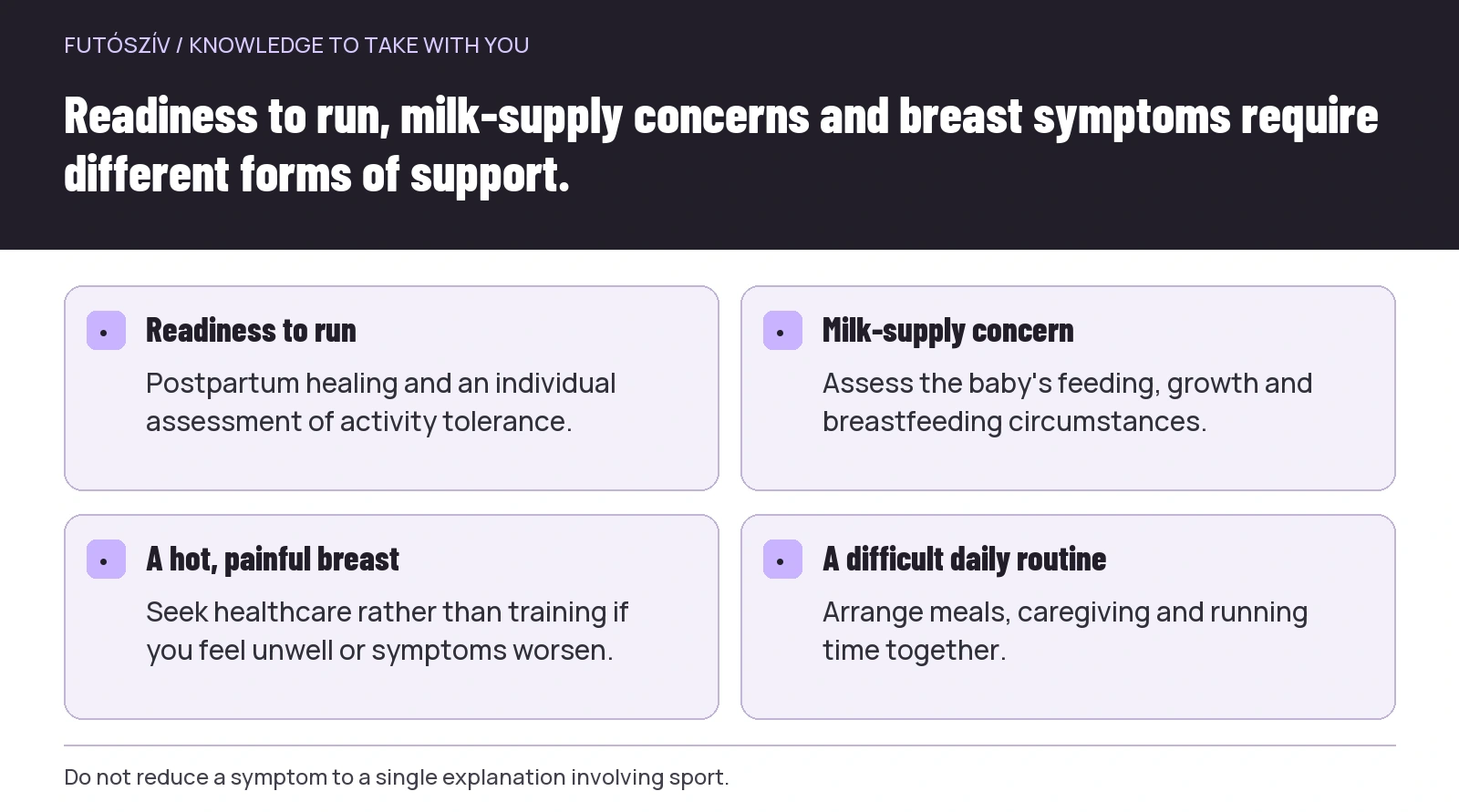 Enlarge diagram
Text version of the illustration
- Readiness to run
- Postpartum healing and an individual assessment of activity tolerance.
- Milk-supply concern
- Assess the baby’s feeding, growth and breastfeeding circumstances.
- A hot, painful breast
- Seek healthcare rather than training if you feel unwell or symptoms worsen.
- A difficult daily routine
- Arrange meals, caregiving and running time together.
A hot, painful breast and feeling unwell: do not run through it
The NHS notes that mastitis symptoms can develop quickly: a painful, hot, swollen area may be accompanied by redness and flu-like illness. This is not a situation in which a run should be used to test whether it is only mild tightness. Prioritise rest and arranging appropriate healthcare.
The Academy of Breastfeeding Medicine protocol warns against forceful, deep massage of the breast. Do not try to resolve symptoms yourself with pressure resembling foam rolling or with forced extra expressing. Seek advice based on your symptoms and feeding situation; rapid deterioration or severe illness requires urgent care.
If symptoms do not improve, recur or have an uncertain cause, contact a doctor and breastfeeding support. Time your return to running according to how your condition settles. Missing a session does not justify trying to make it up with double training over the next few days.
Make the return home predictable
A few calm minutes between finishing the run and the next feed can help. Set out a clean top, comfortable clothes, a drink and food. If your skin is sweaty or uncomfortable, freshening up may improve comfort; avoid turning it into a compulsory ritual that requires another long stretch of time every session.
Make sure the person staying with the baby understands that you may need a short transition after returning from exercise. You do not have to take back every task as soon as you walk through the door. Sharing care makes it realistic for running to provide a break or some enjoyment.
Try one simple session before arranging several runs a week. Which part was difficult: leaving, timing the feed, clothing or returning home? Use that experience to improve the next plan. A good system is not one that looks tightly scheduled on paper, but one that stays flexible as days change.
Build the logistics before a longer session too
If a longer run or race becomes your goal, do more than increase the kilometres. Think through time away, travel, opportunities to feed or express, private space and managing equipment. If you need to express milk, plan its storage and transport according to the relevant health guidance; do not leave the issue to the temperature inside a race bag.
A shorter trial close to home can show what you actually need. There is no need to test every detail for the first time at an all-day event. A companion’s support should be an agreed task, rather than an uncertain possibility.
Your own experience matters in the planning too. If a run creates nothing but stress because the arrangements are so complicated, you can change the goal or the timing. Sport while breastfeeding has no compulsory performance level. A workable solution can be short, local and variable in length.
Five questions to check before the next session
- Is this activity appropriate for my individual postpartum condition?
- Do I have comfortable clothing, an accessible drink and a real opportunity to eat?
- Are feeding and the baby’s care arranged around my departure and return?
- Are there breast symptoms or illness that require support instead of training?
- Will the planned run leave room for recovery and the rest of the day?
Combining breastfeeding and running is not an exercise in perfect timing. It means finding good-enough, comfortable and sustainable opportunities within a changing life situation. Eating, support and taking symptoms seriously belong in that process just as much as running shoes do.
Sources
- Dewey and colleagues: A randomized study of the effects of aerobic exercise by lactating women on breast-milk volume and composition, 1994
- ACOG: Exercise After Pregnancy
- CDC: Maternal Diet and Breastfeeding
- HSE: Concern about your breast milk supply
- NHS: Mastitis
- Academy of Breastfeeding Medicine: Clinical Protocol #36, The Mastitis Spectrum, Revised 2022
How Futószív articles are prepared: our editorial guidelines.