
You run regularly, yet your lipid results show an unfavourable value. This does not make activity worthless or prove you must now train harder. A laboratory result reflects several factors together, and running fitness is not the same as overall cardiovascular risk.
The useful question is what each finding means in your circumstances, what realistic role activity may have and whether other lifestyle or healthcare steps are needed. This article provides a framework for interpretation and consultation; it does not determine a personal diagnosis, target or treatment.
A lipid panel contains several separate pieces of information
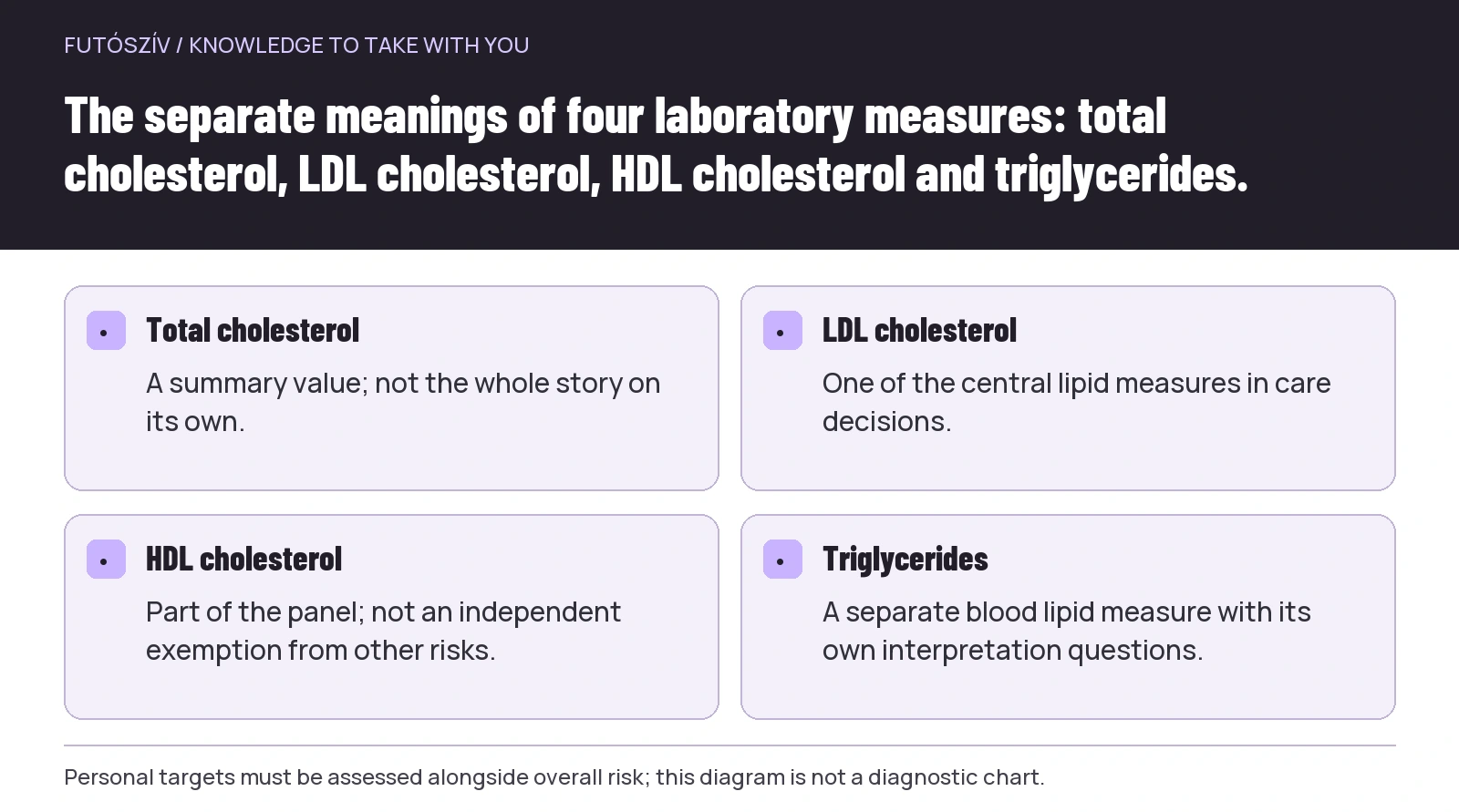
According to the NHLBI information , a lipid panel assesses LDL and HDL cholesterol and triglycerides, among other things. The single total-cholesterol number does not explain every detail. Discussing the result as a whole is therefore useful.
LDL cholesterol plays an important role in risk and treatment decisions. HDL is another part of the panel, while triglycerides are a separate blood lipid measure. Do not try to cancel out every other abnormality with one favourable value or produce your own certificate of safety.
The reference range on a laboratory report and a personal treatment target are not necessarily the same question. Which target is justified may differ according to history and overall risk. Clarify this with your care provider rather than deciding by comparison with other runners’ results.
A running result is not a laboratory test
Completing a distance quickly or managing many kilometres is important sporting information. It does not, however, replace assessment of blood pressure, lipids, known conditions and family history. Performance and health risk are separate areas that may be related but are not identical.
Being in good shape does not remove the value of following necessary check-ups. Equally, do not regard an unfavourable result as a personal or sporting failure. The appropriate question is which next step is justified in the particular situation.
The benefit of running need not be proved through a short-term shift in one laboratory value. Regularity, how you feel and endurance are experiences in their own right, while assessment of clinical goals remains part of care.
What does a controlled exercise study show?
A randomised study involving 111 initially less active adults with overweight and mild-to-moderate lipid abnormalities compared differing exercise amounts and intensities. Several lipid and lipoprotein measures changed favourably even without a substantial change in body weight.
In the detailed analysis, not every measure responded alike; changes in standard LDL cholesterol did not describe all the measured details. The main analysis relied on participants adhering to the protocol, and the programme took place in a defined group. This is not a result promising identical improvement to every runner.
The lesson is proportionate: regular activity may play a favourable role, but does not reduce every value by one certain percentage. The study does not imply you should independently copy the highest-load group’s task for better laboratory results.
Why does response differ between people?
The NHLBI risk information discusses inherited and other health factors alongside lifestyle. Lipid values do not arise solely from running kilometres. Family history therefore matters even if you are regularly active.
If high cholesterol or early cardiovascular events have occurred in the family, mention this at the consultation. Give precise known information where possible and indicate uncertainty. You do not need to make your own genetic diagnosis.
Understanding personal background helps you avoid trying to change training volume alone. Activity may be an important element while care also examines other questions. Both ideas can be valid together.
 Enlarge diagram
Text version of the diagram
- Total cholesterol
- A summary value; not the whole story on its own.
- LDL cholesterol
- One of the central lipid measures in care decisions.
- HDL cholesterol
- Part of the panel; not an independent exemption from other risks.
- Triglycerides
- A separate blood lipid measure with its own interpretation questions.
Personal targets are linked to risk
The 2025 ESC/EAS update discusses LDL cholesterol management together with cardiovascular risk categories. There is therefore no single online threshold that has an identical meaning for every runner.
At review, ask which result needs the main attention, what your own target is and which factors determined it. The answer may include previous disease, other risks or family history. This overall picture shapes the personal plan.
Do not try to replace risk assessment with one health score on your running watch. An app may provide informative data without necessarily knowing the complete history. Clinical decisions need to be made within an appropriate professional framework.
Ask about preparation for the test rather than guessing
Before testing, follow the laboratory’s or care provider’s instructions. Clarify whether fasting is necessary, how to handle regular medicines and whether other preparation is required. Do not change treatment yourself to produce a more favourable reading.
Mention circumstances substantially different from usual: illness, an especially unusual training period or another important change. The doctor decides whether these affect interpretation or the next step. The date and preceding circumstances provide information alongside the result.
Do not schedule punitive exercise or extreme dietary experiments in the days before blood sampling. The aim is to understand the actual condition, not polish the result of a one-off examination day. An honest picture of lasting habits is more usable.
What running programme might be sustainable?
Start from current activity and your personal healthcare framework. If returning to activity, repeatable, manageable sessions may matter more than a high workout count. As an experienced runner, look at the existing system as a whole rather than automatically adding another intense day.
Choose activity whose full time requirement fits your life. Running, walking, cycling or another appropriate form may all have a role. A programme’s value does not come solely from the fastest pace or exhaustion felt at the end of a session.
If you have another condition, current symptoms or plans for a substantial increase in training, consult the appropriate professional. A lipid report alone is not a full assessment of fitness to exercise. The specific task must fit the whole situation.
Running does not remove other lifestyle questions
Alongside running, food, smoking, blood pressure and other health factors also have a place in care. It is unhelpful to treat activity as a trade-off automatically balancing every other question. A personal plan can have several elements.
If you want dietary changes, discussing them with an appropriate dietitian may be worthwhile. Do not build everything around one forbidden food or an extreme dietary approach. A sustainable system suited to your own needs generally requires more attention than a quick rule.
Activity and eating should not become a mutual punishment system. Running can have its own enjoyment and purpose, while eating fulfils nutritional needs. Clinical questions do not need to be solved through self-blame.
Medication and exercise are not mutually exclusive alternatives
The 2025 European update links lifestyle measures and, where necessary, medication to individual risk. This does not mean a regular runner can always avoid medication or that activity has no role once treatment begins.
If receiving treatment, do not decide on stopping or changing it independently because of good training fitness or one improved result. Ask what follow-up is needed and when effects can be assessed. The decision belongs within care.
If new symptoms or medication-related uncertainty arise, report them precisely: when they started, under what exertion and how they change. Do not diagnose every muscle sensation yourself, but do not conceal persistent or concerning symptoms either.
 Enlarge diagram
Text version of the diagram
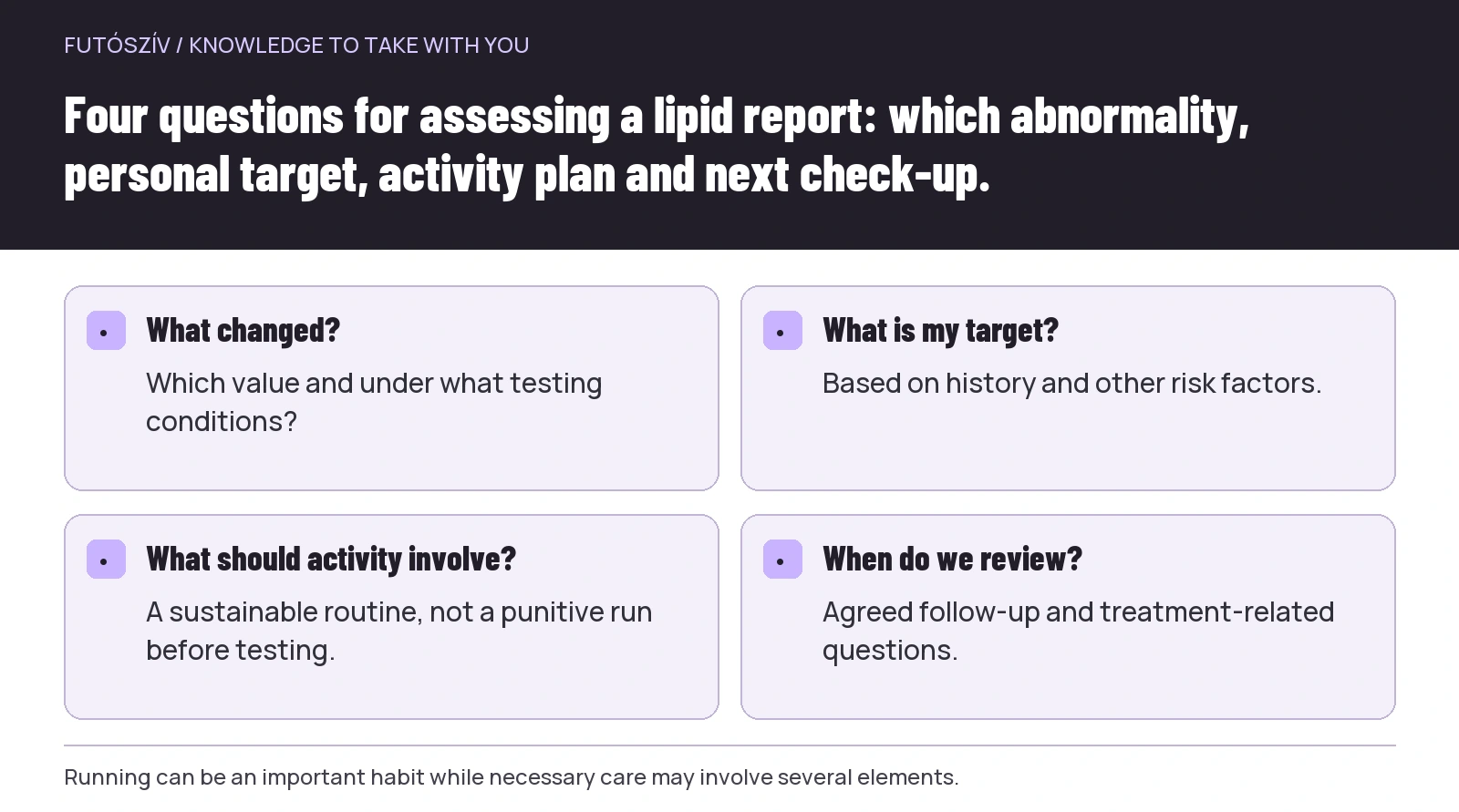
- What changed?
- Which value and under what testing conditions?
- What is my target?
- Based on history and other risk factors.
- What should activity involve?
- A sustainable routine, not a punitive run before testing.
- When do we review?
- Agreed follow-up and treatment-related questions.
Assess supplement promises against the actual goal too
A “heart-friendly” or “for cholesterol” claim in a product advertisement is not the same as demonstrated clinical benefit in your own circumstances. Choosing appropriate care is not a comparison of advertising claims. The 2025 ESC/EAS update puts evidence and clinical outcomes at the centre of decisions.
If you use something regularly or plan to, tell your clinician. Ingredients and how it is used matter more than sporty-looking packaging. Do not independently replace recommended care with a new supplement.
Nor do you need to buy confidence for exercise through products. A manageable activity routine, agreed check-ups and an understandable goal may offer more useful support than another solution promising a quick fix.
How should you assess the next result?
First check whether you are comparing the same measure and unit. Testing conditions and the interval also matter. Do not draw major conclusions from an online conversion error or two different rows.
At review, discuss which change matters relative to your own target and what should follow. If treatment, eating and activity all changed meanwhile, the effect of a single factor cannot be separated with certainty. The practical plan can still be assessed.
Keep the completion and experience of activity separate in your running log. The laboratory result then does not become a retrospective grade for every workout. Together, the two kinds of information support the next decision.
Three common misunderstandings
“I run, so everything must be fine.” Sporting performance does not replace clinical assessment. Necessary follow-up matches personal health and history.
“If LDL has not improved enough, running is useless.” Activity can have several kinds of value, and lipid measures do not respond identically either. Other elements of necessary care need examining too.
“Because of the result, every workout must now be harder.” Increasing training load is not automatic treatment. The programme should match the current starting point and healthcare framework, aiming for lasting regularity.
Bring four questions to the review
Which abnormality matters most in my circumstances? What is my personal target and why? Which activity and other lifestyle changes are justified? When and how will we reassess? These questions seek a usable plan, not merely a reassuring label.
The AHA guide to LDL cholesterol also supports interpretation together with a healthcare professional. Expressing your own history and goals is an important part of the conversation.
Regular running is not magic on a laboratory report but a valuable habit within overall lifestyle. It serves you well when, retaining its own enjoyment and sporting purpose, it fits appropriate healthcare follow-up and management of personal risk.
Official and primary sources
- ESC/EAS 2025 lipid guideline update.
- Effects of the amount and intensity of exercise on plasma lipoproteins – a specific controlled exercise programme, not a personalised promise of results.
- NHLBI: cholesterol testing; causes and risk factors.
- AHA: LDL cholesterol guide.
How Futószív articles are prepared: our editorial guidelines.