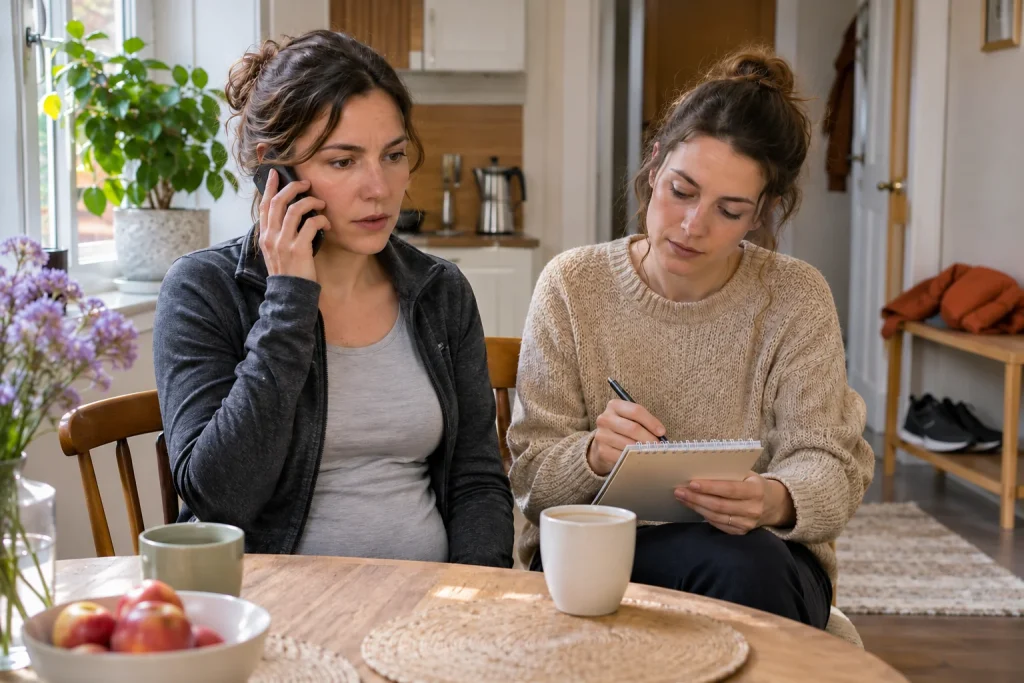
If you notice vaginal bleeding during pregnancy, stop activity and seek healthcare advice promptly. Do not wait until the loop ends so you can call more calmly afterwards. Heavy bleeding, severe abdominal or shoulder pain, fainting, significant dizziness or feeling unwell requires immediate help; in Hungary, call 112. Distance covered and the running watch do not determine symptom severity.
Bleeding can have several causes and does not establish on its own what is happening with the pregnancy. Individual assessment is needed for the appropriate next step. This guide helps you briefly describe what you noticed, request help from someone at the location, and understand why a change of pace or yesterday’s run cannot explain the cause.
Bleeding is a symptom, not a ready-made conclusion
The NHS explains that vaginal bleeding in pregnancy is not always serious, but can signal a condition needing urgent care, so healthcare advice is necessary. Its information describes appearances from spotting to heavier bleeding. The NHS bleeding page does not make less conspicuous symptoms a way to rule out every problem yourself.
Two separate statements can be made about bleeding noticed while running. One is that this was when you noticed it. The other would be that running caused it. The first is part of the account; the second is an explanation requiring evidence. You need not provide a causal answer to seek help. Activity timing may be useful context for the care provider, but cannot replace assessment of the symptom and your condition.
Equally, do not immediately assume the worst outcome is certain. RCOG emphasises that early-pregnancy bleeding or pain does not always mean a problem, but still warrants seeking medical advice. The RCOG information on early bleeding and pain builds on assessment and follow-up as needed, not predicting outcomes at home from symptoms.
Do not make another trial section your first action
“I will walk a little more and see whether it stops” may seem understandable, particularly without much pain. Nevertheless, stop organising the outing. You need not test bleeding through another run, stairs or a slower pace. Continuing movement is not a diagnostic tool; symptoms remaining unchanged over a section do not mean the situation has received individual assessment.
With a companion, state clearly that you are ending the outing and asking for help. You need not describe an intimate symptom in detail before the group. You can share what happened privately with one trusted person. Others may only need to know that the plan is changing for health reasons and you need calm space or assistance.
Do not spend the first minutes properly recording the run. Stopping the app, saving the route or notifying the coach comes after establishing contact. Someone helping can take over bags, group communication or arrangements for getting home. You do not need to handle every practical detail simultaneously.
What should you say first on the phone?
Begin with being pregnant, noticing bleeding and your location. Give the known stage of pregnancy if you know it, and whether you have pain, dizziness, a feeling of faintness or other illness. When requesting urgent help, precise location and contact details are particularly important. Give these basics before a long running history.
A general communication example is: “I am pregnant and have just noticed vaginal bleeding. I am at this location. I have these accompanying symptoms, or have not experienced these. I would like to know what care I need and where to turn.” This is not compulsory wording and does not replace emergency questions. Answer further questions from the healthcare professional or emergency operator.
If you are unsure where the blood comes from, say so directly. Do not repeatedly examine yourself to create a more precise account or invent a definite answer. What you observed, uncertainty and accompanying symptoms together provide important information. The professional determines an appropriate examination.
 Enlarge image
Describing amount, colour and timing
You need not estimate blood volume in millilitres. Use ordinary, factual language: a few spots, a larger area, or a pad soaked in a short time. Mention recurrence or increasing bleeding. Report clots if noticed, but do not independently diagnose from appearance.
Colour can be one observation, but must not become a safety rule. “It is brown, so definitely unimportant” and “It is red, so definitely means this” are both overly settled conclusions. The NHS discusses spotting and bleeding of different colours; a colour chart does not determine the need for individual care.
| Observation | How to describe it | What not to infer |
|---|---|---|
| Timing | “I noticed it in the park; this is what I have experienced since.” | Do not automatically infer that running caused it. |
| Amount | “I saw this many spots; later there were more, or it stayed unchanged.” | Do not create your own severity classification. |
| Accompanying symptoms | “I also feel pain or dizziness, or have not noticed these.” | Absence of pain must not become a rule-out criterion. |
| Previous assessment | “My follow-up was on this date, and this was the guidance.” | Do not give an old report authority to override every new symptom. |
Keep the chronology brief. You need not reconstruct minute-by-minute memories of every earlier movement. If part of the symptom became clear only later, say so. Actual observations and changes matter more to the professional than making every detail of the account appear orderly.
When is immediate help needed?
Both the NHS and RCOG identify heavy bleeding, severe abdominal pain, shoulder pain, dizziness or fainting as urgent signs. Urgent assessment comes first with these. You need not wait for every sign simultaneously. In immediate danger in Hungary, call 112 and follow instructions; do not copy a foreign information sheet’s healthcare telephone numbers.
The CDC also discusses bleeding and fluid leaking during pregnancy among warning signs. The CDC symptom list reminds us that taking symptoms seriously does not depend on sporting performance. Still being able to speak or walk is no reason to postpone contact.
If alone, notifying someone you know may help practical arrangements, but they should not be your only source of healthcare assessment. You need not send a picture to a running group first or poll the internet about others’ similar experiences. In urgency, shorten the route to professional help rather than increasing the number of opinions.
How can a companion help at the location?
A companion should first help you contact care. Establish the precise location, keep the phone accessible and stay if you request it. They should not persuade you using their own or acquaintances’ experience. “Surely nothing is wrong” is no more a usable professional opinion than an immediate serious diagnosis.
Useful tasks include taking bags, finding a nearby gate or meeting point and informing other participants without sharing intimate details. If professional help is called, describe the accessible location precisely and follow guidance. A companion should not give treatment instructions based on online reading.
Consent matters in everyday communication too. They can ask whom to notify and what they may share. If you are speaking on the phone, they need not take over unnecessarily, but may remind you of a previously mentioned symptom. If your condition prevents meaningful communication, they should arrange immediate help and report facts rather than guessed causes.
What might assessment involve, and what can remain open?
RCOG explains that evaluating early-pregnancy bleeding may involve reviewing symptoms, previous pregnancies and general health history, plus ultrasound or blood tests. The care provider chooses what is needed. You need not decide beforehand which report will answer the question, and this article gives no laboratory-value interpretation thresholds.
Everything may not be clarified in one conversation. The main questions then concern the next step: recommended follow-up, when and where it happens, which new symptoms require earlier contact and whom you can reach. Do not “test” uncertainty through sport. Request individual guidance about activity between assessments too.
If information is unclear, ask in your own words: “Have I understood that this is my next action, and with this change I should not wait for follow-up?” This separates actual advice from what you might add afterwards. With consent, someone supporting you can also note contact details and practical follow-up arrangements.
 Enlarge image
Why not immediately blame yourself?
Symptom timing can easily become a story explained backwards: it must have been the hill, stairs or yesterday’s run. One event preceding another does not prove causation. Self-blame does not improve assessment. If an activity concerns you, describe it factually to the professional and ask about its significance.
RCOG’s early-miscarriage information also links further care to assessment findings rather than your own conclusion from a symptom. The RCOG patient information can be applied to your individual story only if the provider has actually established that condition. Noticing bleeding alone does not entitle you or those around you to declare a certain outcome.
Name the support you need: “Right now I need you to come with me, not help search for a cause.” Your companion does not need a perfect sentence to be present. Calm attention, practical help and respect for personal boundaries may matter more than rushed reassurance. You can discuss the feeling of uncertainty with your care provider too.
Returning to running is another decision
Bleeding stopping is not independent certification of readiness to run. Discuss subsequent activity boundaries based on assessment, diagnosis or follow-up plan and your own condition. Do not assume previous permission automatically remains valid after every new symptom. We give no universal restart timetable calculated from symptom-free days.
You may simply tell the coach there is no new running programme yet and that you will discuss it later with individual guidance. A missed outing is not a debt. Rest or follow-up need not be offset with extra strength work, longer walks or next week’s kilometres. The sporting plan can adapt to an assessed situation; care need not be justified to the sporting plan.
If arranging one thing beforehand, make help accessible: know whom to contact for healthcare questions, and ensure your companion knows how to describe the location precisely if needed. Once symptoms actually occur, do not make another plan or compare articles. Describe what you noticed and seek guidance for your own situation.
Sources
- NHS: vaginal bleeding in pregnancy
- RCOG: bleeding and pain in early pregnancy
- CDC: urgent maternal warning signs
- RCOG: patient information on early miscarriage
How Futószív articles are prepared: our editorial guidelines.